Sanding Belt Length Calculator
Calculate open belt length from pulley diameters and center distance, then include tracking, tension, belt width, and splice overlap allowances.
Choose a common belt sander layout, then fine tune pulley sizes, center distance, and allowances to match your machine.
Calculated Belt Results
Calculation Breakdown
| Preset | Typical Belt | Drive / Idler | Center Distance | Typical Use |
|---|---|---|---|---|
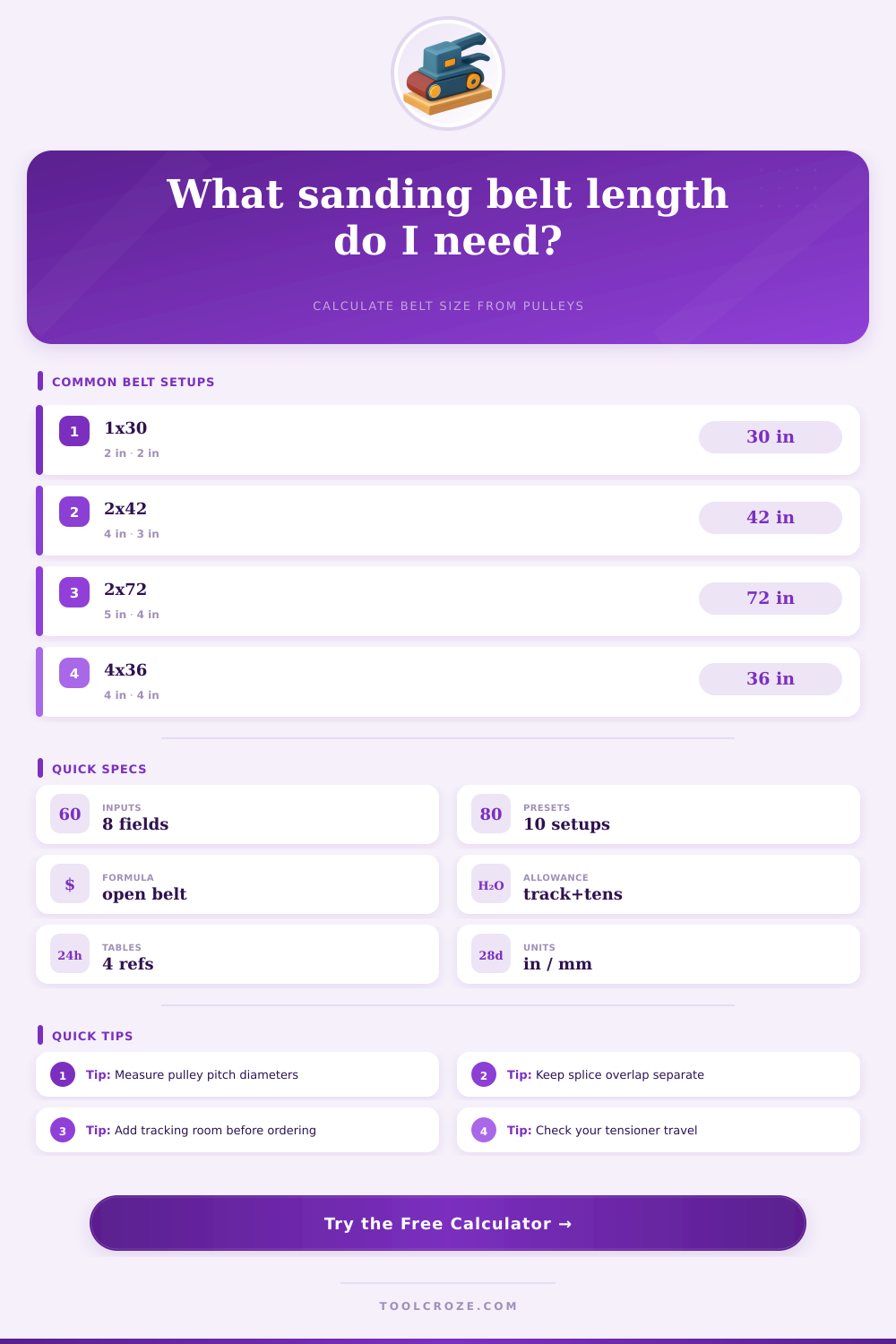
| 1x30 Bench Sander | 1 in × 30 in | 2 in / 2 in | 11.4 in | Sharpening, small parts |
| 1x42 Knife Detail | 1 in × 42 in | 3 in / 2 in | 17.1 in | Detail grinding |
| 2x42 Shop Sander | 2 in × 42 in | 4 in / 3 in | 15.4 in | General shaping |
| 2x72 Grinder | 2 in × 72 in | 5 in / 4 in | 28.5 in | Knife and metal work |
| 6x48 Edge Sander | 6 in × 48 in | 5 in / 5 in | 16.1 in | Wood edge flattening |
| Nominal Size | Length | Width Range | Common Machine | Notes |
|---|---|---|---|---|
| 1x30 | 30 in / 762 mm | 1 in | Small bench belt sander | Short platen, light tension |
| 3x21 | 21 in / 533 mm | 3 in | Portable hand belt sander | Compact dual roller path |
| 4x36 | 36 in / 914 mm | 4 in | Belt and disc combo | Common hobby format |
| 2x72 | 72 in / 1829 mm | 2 in | Knife grinder | Long arm and contact wheels |
| 6x48 | 48 in / 1219 mm | 6 in | Edge or bench sander | Wide woodworking surface |
| Abrasive | Backing | Best Materials | Typical Grits | Belt Fit Note |
|---|---|---|---|---|
| Aluminum oxide | X-weight cloth | Wood, paint, mild steel | 40 to 220 | Good general flex |
| Zirconia alumina | Y-weight cloth | Steel, stainless, hardwood | 24 to 120 | Likes firm tension |
| Ceramic alumina | Polyester cloth | Tool steel, alloys | 36 to 120 | Stable on long belts |
| Silicon carbide | Waterproof cloth | Glass, stone, rubber | 80 to 400 | Avoid sharp tracking crown |
| Non-woven surface | Nylon web | Deburring, blending | Coarse to fine | Check thickness clearance |
| Adjustment | Typical Range | Use When | Calculator Effect |
|---|---|---|---|
| Tracking allowance | 0.10 to 0.50 in | Small crowned pulley or tracking arm | Adds to finished length |
| Tension allowance | -0.25 to 0.50 in | Spring arm needs more or less travel | Adjusts ordered length |
| Lap splice | 0.38 to 0.75 in | Shop-made cloth-backed belt | Adds to cut strip only |
| Skived overlap | 0.50 to 1.00 in | Smoother joint on wider belt | Adds to cut strip only |
| Butt/tape joint | 0 to 0.10 in | Thin film or specialty backing | Little strip addition |
The length of the sanding belts is an important factor that must be consider when setting up a sanding machine. The length of the sanding belt affect the way that the sanding machine operates. If the sanding belt is too short, the belt will create excessive tension against a tensioner that hold the belt in place.
Additionally, if the sanding belt is too long, it will slip on the pulleys that turn the sanding belt, and the belt will track poorly on the machine. Poor tracking will result in uneven sanding of the workpiece. Therefore, it is important to ensure that the length of the sanding belt are correct.
How to Choose the Right Sanding Belt
In order to determine the correct length of the sanding belt, there is a few specific measurements that will need to be obtained. The diameters of the drive pulley and the idler pulley will be important in calculating the length of the sanding belt loop. Additionally, the center distance between the two shaft will also be important.
With each of these measurement obtained, the open belt formula can be use to calculate the length of the sanding belt loop. A calculator can make these calculations for you, which help you to create an order without making a mistake. In addition to calculating the length of the sanding belt with the formula, it is also important to make allowances for certain features of the sanding belt.
For example, an allowance must be made for the sanding belt to track proper on the crowned pulley or adjustment arm. Additionally, an allowance must be made for the sanding belt to accommodate stretching of the belt. Finally, if the sanding belt manufacturer is making the sanding belt, an allowance must be made for the splice overlap of the sanding belt.
Otherwise, the sanding belt will be too tight or the sanding belt will not remain on the pulleys. In addition to length, the width of the sanding belt is another important measurement for the sanding machine. The sanding belt width will determine the amount of area that can be sanded in one pass of the belt, as well as the amount of flex that the belt can experience around the small contact wheel.
It is not recommended to use a sanding belt that is too wide for a contact wheel that is too narrow. Therefore, it is important to ensure that the sanding belt width match the sanding machine, as is true for the length of the sanding belt. Many sanding machines use common sanding belt size for sanding belts.
For instance, 2×72 grinders will use a sanding belt that is long enough to allow for clearance of the contact wheel. However, 4×36 sanders will use a shorter sanding belt, as the belt must fit both the belt arm and the disc attachment. These sizes are standard for sanding belts for these machines because they allow the sanding belt to allow for the pulleys to travel to their limits while still remaining within the limit of the sanding belt.
Several factor will change the operation of the sanding belt while it is in operation. For instance, the temperature of the sanding belt will change the length of the sanding belt, as will the temperature of the machine frame. Additionally, sanding belt pulleys may become coated in dust, which will change the effective diameter of the pulley.
Finally, the spring tensioners that hold the sanding belt may lose there spring force over time. To account for these changes, many people will make their measurement of the center distance at the midtravel of the belt and add a buffer to that measurement. This buffer will allow for the sanding belt length to remain functional despite these changing condition.
The type of splice that is used to join the ends of a sanding belt can also impact the sanding process. For instance, a lap splice create a change in the thickness of the sanding belt, which can lead to an even sanding of the workpiece. A butt joint with tape is a smoother splice than a lap joint, but is a weaker joint for sanding belts on high-speed sanding machines.
Finally, a skived overlap is another type of joint between sanding belt sections, but requires more skill to form the joint correct. Therefore, the type of sanding belt joint must be appropriate for the sanding task, and the joint type must match the sanding machine. In order to determine the correct sanding belt, it is important to ensure that the length of the sanding belt is correctly matched to the sanding machine.
Additionally, the sanding belt should be matched to the type of material that are to be sanded. By carefully measuring the sanding machine and accounting for all allowances, the sanding belt that is manufactured will remain stable while in operation, and the operator will be able to spend more time working.