Sandbox Sand Calculator
Estimate loose volume, compacted volume, sand weight, bag count, ordered depth, and top-up reserve for rectangular, round, oval, hex, and L-shaped play areas.
▣Play Area Presets
Load a real sandbox or playground size, then adjust the shape, fill depth, compaction, density, bag size, and waste allowance.
⚙Sandbox Inputs
Sandbox Sand Estimate
▦Sand Spec Comparison Grid
📋Sandbox Depth Reference
| Use case | Typical depth | Planning note | Best fit |
|---|---|---|---|
| Toddler scoop box | 4 to 6 in | Easy to rake and keep below a shallow frame | Small covered boxes |
| General backyard play | 6 to 8 in | Enough for buckets, trucks, molds, and normal settling | Home sandboxes |
| Digging and construction play | 8 to 10 in | Supports deeper digging without quickly exposing the liner | Family play pits |
| Preschool or daycare zone | 10 to 12 in | Plan more reserve for raking, leveling, and high traffic | Shared play areas |
| Large play court | 12 in plus | Confirm containment, drainage, inspection, and maintenance needs | Institutional sites |
📦Bag Size And Yield Table
| Package | Nominal weight | Approx volume at 100 lb/ft³ | Good planning use |
|---|---|---|---|
| Small craft bag | 20 lb | 0.20 ft³ | Indoor sensory tubs and tiny boxes |
| Common play sand bag | 50 lb | 0.50 ft³ | Most retail sandbox fills |
| Large landscape bag | 80 lb | 0.80 ft³ | Medium boxes with fewer bag opens |
| Heavy contractor bag | 100 lb | 1.00 ft³ | Big play areas where lifting is manageable |
| Bulk yard delivery | 2700 lb | 1 yd³ | Large school or community sand areas |
📏Shape Formula Reference
| Shape | Area formula used | Input meaning | Planning note |
|---|---|---|---|
| Rectangle or square | L x W | Inside frame dimensions | Measure inside the boards, not outside trim |
| Circle | Pi x D² / 4 | Length is diameter | Round plastic shells rarely fill to the rim |
| Oval | Pi x L x W / 4 | Major and minor axes | Useful for curved timber or molded zones |
| Hexagon | 0.866 x L x W | Point-to-point by flat-to-flat box | Good estimate for regular timber rings |
| Octagon | 0.828 x L x W | Overall bounding box | Accounts for clipped frame corners |
| L-shape | 0.75 x L x W | Overall bounding rectangle | Edit factor by changing dimensions if one leg is much smaller |
🏗Common Sandbox Size Table
| Play area | Typical dimensions | Suggested depth | Planning comment |
|---|---|---|---|
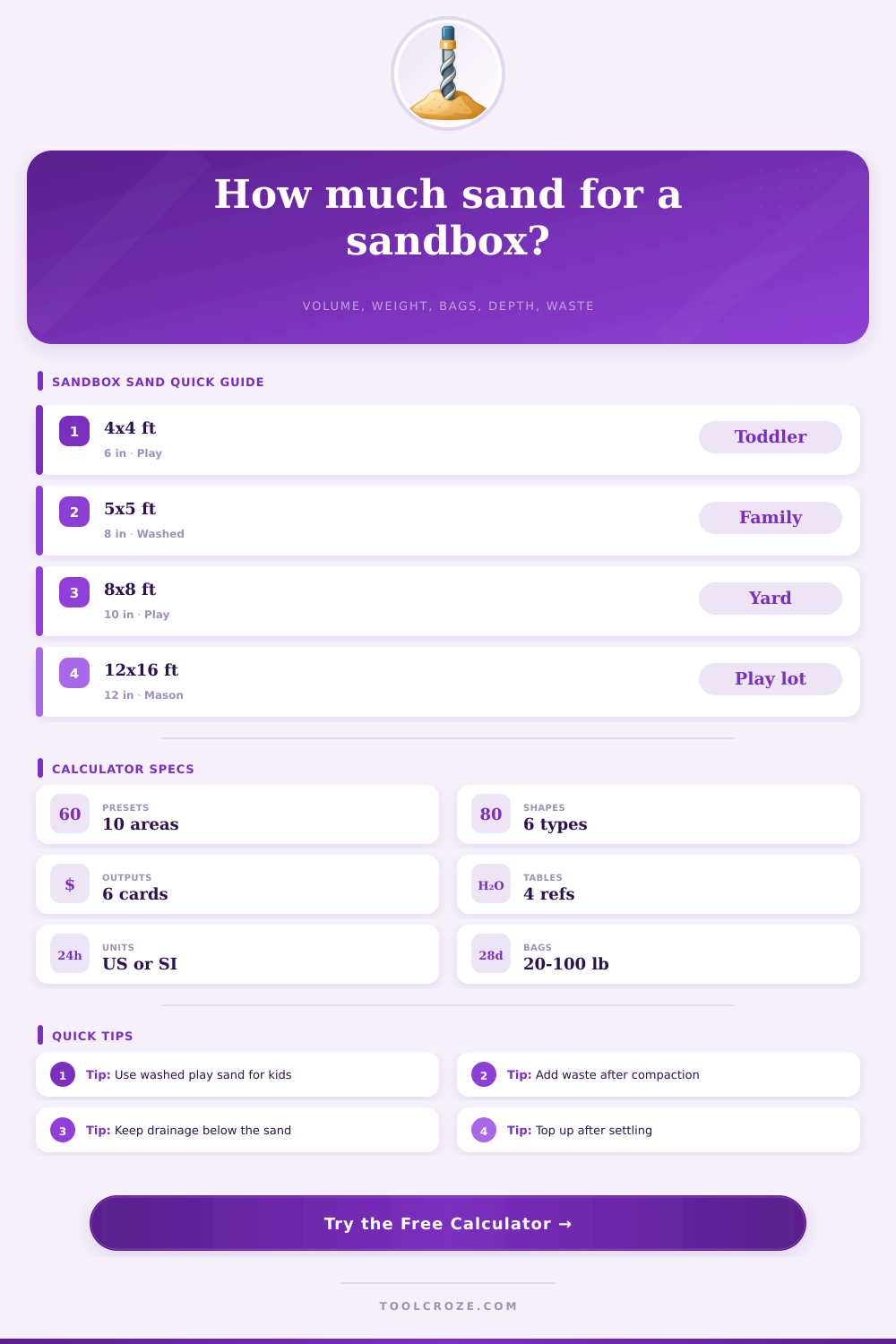
| Covered toddler box | 4 x 4 ft | 5 to 6 in | Easy to cover, clean, and refresh |
| Backyard family box | 5 x 5 to 8 x 8 ft | 6 to 9 in | Most homes use bagged play sand |
| Sand table trench | 3 x 8 to 6 x 10 ft | 6 to 8 in | Good for preschool scoop and pour play |
| Timber play ring | 8 to 12 ft across | 8 to 10 in | Round and hex shapes need inside measurements |
| School play court | 12 x 16 ft plus | 10 to 12 in | Bulk delivery is often easier than retail bags |
✓Practical Sand Planning Tips
When you determine how much sand you need for your sandbox, you must calculate the amount of sand based off how sand can change positions within the sandbox over time. Sand naturaly settle into a compacted state within the sandbox due to the effect of gravity and rainfall. Additionally, sand naturaly moves towards the edges of the sandbox when children plays within it.
Each of these actions reduce the amount of sand that remains within the sandbox. Therefore, in order to account for these changes in the position of sand within a sandbox, it is necessary to employ a compaction percentage in your calculation of the amount of sand that you need to purchase for the sandbox. A compaction percentage accounts for how much sand will naturally compress within the sandbox.
How Much Sand Do You Need for a Sandbox
By using a compaction percentage, you can ensure that the sand remains deep enough within the sandbox after it settles. Furthermore, you must also select the target depth for the sandbox. The depth that you desire the sand to reach within the sandbox.
The shape of the sandbox will also have an impact upon the amount of sand that you need to purchase. If the sandbox is to be in the shape of a rectangle, it is easy to calculate the area of sand that you will need. However, if the sandbox is of a circular or oval shape, different mathematical formulas is required to calculate the amount of sand that will be needed to fill the sandbox to its target depth.
Each of these formulas can be entered into the sandbox calculator to determine the total amount of sand that will be required based on the dimensions of the sandbox. If you only measure the outside dimensions of the sandbox, there may be insufficient sand to fill the sandbox. Thus, you should use the dimensions of the interior of the sandbox in the calculations to ensure that there is enough sand to fill the sandbox.
Sand of one type is not the same as sand of another type. For instance, play sand tends to contain some washed material and tends to remain in a loose state within the sandbox. In contrast, mason sand is a different type of sand that typically sets together more tight than play sand.
Thus, when you select the density setting within the calculator, you must ensure that you are selecting the correct setting for the type of sand that will be used within the sandbox. The density of sand will impact the total weight of sand that is required for the sandbox. Furthermore, the density setting will also impact the number of bags of sand or how much bulk sand that is purchased for the sandbox.
If you dont select the correct density setting, both the total weight and number of bags of sand will be incorrect. Another factor that you should consider in calculating the amount of sand that is required for your sandbox is the provision of a waste allowance. A waste allowance accounts for the amount of sand that may be spilled in the filling of the sandbox, the amount of sand that may be lost during the leveling of the sandbox, and the amount of sand that may be lost over time as it is moved within the sandbox.
By providing for a waste allowance for sand within the sandbox, you will ensure that you dont find yourself with a sandbox that is not fully fill with sand prior to the children beginning to play within it. Without providing for a waste allowance, you may have to make an additional trip to the store to purchase sand to fill the sandbox. Another factor that will influence the amount of sand that you must purchase for your sandbox is the depth of the sandbox.
Sandboxes that are used by young children only require a shallow depth for the sand within the sandbox. However, sandboxes that are used by children of older ages may require a depth to the sandbox that allows those children to dig tunnels within the sandbox. If the sandbox is too shallow, the children may reach the bottom of the sandbox when digging in it.
Therefore, it is up to the caregivers to determine the depth that will permit the children to play in the sandbox in the way in which they intends for them to play. Sand can be purchased in small bags or in bulk. An individual can easily transport bags, but bulk sand is typically less expensive per pound than sand that are bagged for purchase.
In the sandbox calculator, the calculator will display the total weight and the number of bags of sand that are required for the sandbox for you. These measurements will allow you to determine the cost of purchasing sand in either bags or bulk. For sandboxes of significant size, this cost comparison will be significant.
Finally, another consideration of the cost of setting up and maintaining your sandbox is that which relates to its future needs. For instance, if the sandbox is established under a tree, it may become a common location for leaves to fall. Additionally, if the children use the sandbox each day, the sand within it will need to be replenished each time.
Therefore, it is another consideration to provide for a reserve of sand in which to maintain the level of sand within the sandbox. Through calculating the amount of sand that is required for your sandbox, you will be able to plan for each of these factors, including the target depth for the sand within the sandbox, the compaction percentage of the sand, and the amount of sand that is required according to the shape of the sandbox.