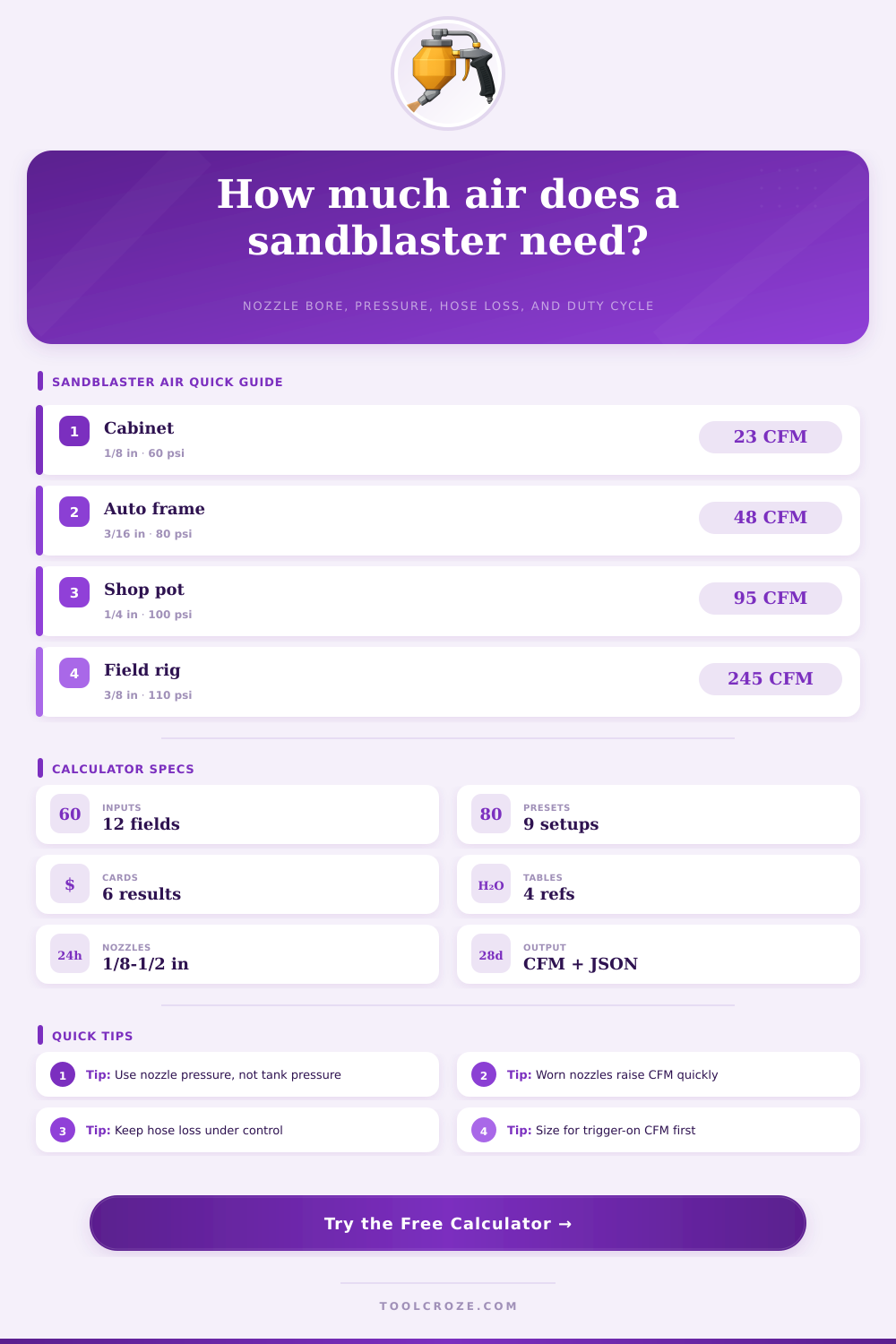
Sandblaster Air Consumption Calculator
Estimate required compressor CFM from nozzle bore, blast pressure, duty cycle, media valve setting, hose loss, pot size, and work duration.
1 Sandblaster presets
Choose a common setup, then adjust the nozzle, pressure, compressor, hose, and pot details for your rig.
2 Air demand inputs
3 Results
4 Nozzle and compressor grid
5 Nozzle air reference table
| Nozzle bore | Typical label | Approx. CFM at 80 psi | Approx. CFM at 100 psi | Approx. CFM at 120 psi |
|---|---|---|---|---|
| 1/8 in | #2 | 18 | 22 | 26 |
| 3/16 in | #3 | 39 | 45 | 53 |
| 1/4 in | #4 | 70 | 81 | 95 |
| 5/16 in | #5 | 117 | 137 | 160 |
| 3/8 in | #6 | 167 | 196 | 229 |
| 7/16 in | #7 | 233 | 272 | 318 |
| 1/2 in | #8 | 302 | 354 | 414 |
6 Compressor matching table
| Compressor delivery | Best nozzle range | Normal use | Watch point |
|---|---|---|---|
| 20 to 35 CFM | 1/8 in | Small cabinets, short spot work | Pressure drops fast above 70 psi |
| 45 to 70 CFM | 3/16 in | Auto parts, small pressure pots | Use short hose and lean media |
| 90 to 125 CFM | 1/4 in | General shop blasting | Need real FAD, not pump displacement |
| 160 to 220 CFM | 5/16 to 3/8 in | Contractor pots and field work | Hose ID and dryer loss matter |
| 275 to 375 CFM | 7/16 to 1/2 in | High production blasting | Nozzle wear can overrun capacity |
7 Hose loss reference table
| Hose setup | Typical added demand | Good match | Comment |
|---|---|---|---|
| 1/2 in, 25 to 50 ft | 8% to 20% | 1/8 to 3/16 in nozzle | Too restrictive for production nozzles |
| 3/4 in, 50 to 75 ft | 6% to 15% | 3/16 to 1/4 in nozzle | Common light pot setup |
| 1 in, 75 to 150 ft | 5% to 12% | 1/4 to 5/16 in nozzle | Balanced shop and field hose |
| 1-1/4 in, 100 to 200 ft | 4% to 10% | 5/16 to 3/8 in nozzle | Better for long runs |
| 1-1/2 in, 150 ft plus | 3% to 8% | 3/8 to 1/2 in nozzle | Used on high CFM rigs |
8 Pot size and media valve table
| Pot size | Usable media at 100 lb/cu ft | Lean valve runtime | Normal valve runtime | Rich valve runtime |
|---|---|---|---|---|
| 0.8 cu ft | 68 lb | 45 to 70 min | 28 to 45 min | 18 to 30 min |
| 2.0 cu ft | 170 lb | 55 to 90 min | 35 to 60 min | 24 to 40 min |
| 3.5 cu ft | 298 lb | 65 to 110 min | 42 to 75 min | 28 to 52 min |
| 6.5 cu ft | 553 lb | 80 to 140 min | 55 to 95 min | 35 to 68 min |
| 10.0 cu ft | 850 lb | 95 to 170 min | 65 to 120 min | 42 to 85 min |
9 Tips and safety note
To choose a compressor for your sandblaster, you first must determine how much air your nozzle consume while in operation. Many people will select a compressor based off the compressor plate or the compressor that someone else use who is also sandblasting, but both of these options are inaccurate because they dont take into account the air demand of the nozzle that you are using. The demand for air from your nozzle are based upon the bore of the nozzle and the pressure at which the nozzle is operating.
For instance, a quarter-inch nozzle that operates at one hundred psi will draw at around eighty cubic feet of air per minute, but the same nozzle at eighty psi will draw around seventy cubic feet of air per minute. The calculator can help you to determine the difference between the air that your compressor is delivering and the air that your nozzle demand by simply entering the size of your nozzle, the working pressure of the nozzle, and the length of the hose that you are using to supply the air to your nozzle. Another critical factor to consider that is just as important as the peak air flow that the compressor must deliver is the duty cycle.
How to choose a compressor for your sandblaster
The duty cycle is a factor that determines how long your nozzle will be in operation during a set period of time. For instance, a seventy percent duty cycle mean that your nozzle will be in operation for seventy minutes out of every hundred minutes. If your compressor cannot deliver air to satisfy the air demands of your nozzle during peak use, your pressure will drop, which will make your sandblasting operation slower, waste more media, and require you to cease your operation until the compressor can regain the necessary air pressure in it’s tank.
The diameter of your hose and its length will also impact the amount of air that is supplied to your nozzle. If your hose is long or narrow, it will create a loss of pressure to the nozzle. For instance, a three-quarter inch hose that is fifty feet in length will reduce the pressure at the nozzle by six to fifteen percent.
Using smaller diameter hoses will starve a large nozzle of air, but using oversized hoses will increase the weight and cost of your equipment without necessarily improving the pressure that is supplied to the nozzle. Any number of fittings, dryers, or whip hoses will create a loss of air and pressure at your nozzle. The setting of the media valve will also impact the air demand of your system.
If you set the valve to a lean position, your nozzle will use less media, but if you set the valve to a rich position your nozzle will cut faster, but will empty your media pot more quick. For these two variables, you will have to determine the balance between air demand and the need to refill the media pot during your sandblasting operation. The calculator accounts for these variables so that you can see how the media valve will alter both air demand and media pot runtime.
The wear of your nozzle will also impact the demand for air from your compressor. If your nozzle wears down over time, the bore of the nozzle will increase and the air demand will increase with that increase in bore size. For instance, increasing the size of the bore of the nozzle by five percent will increase the demand for air from your compressor by ten percent.
Many sandblasters will believe that their compressor is failing when in reality the issue is the wear of there nozzle. To avoid this common mistake, use a gauge to measure the size of the bore of your nozzle so that you can account for this in the wear field of the calculator. Other factors in your sandblasting operation will also impact the air that your compressor can output.
Factors like the environmental factors and the general condition of your compressor will change the amount of air that is output from your sandblaster. Tables can be referenced to determine the impact of these variables, but the only way to know for sure is to gauge the pressure at your nozzle. Using this gauge to determine your pressure will allow you to make adjustments to your compressor settings in the calculator until the calculator match the measurement of your gauge.
By matching your nozzle, hose, pressure, and duty cycle, you will find that your sandblasting operation will remain consistent with a stable output of air to your nozzle. By balancing these four variables, you will find that both your sandblasting operation will remain efficient and that your compressor will not work against the limitations of your sandblasting system.