
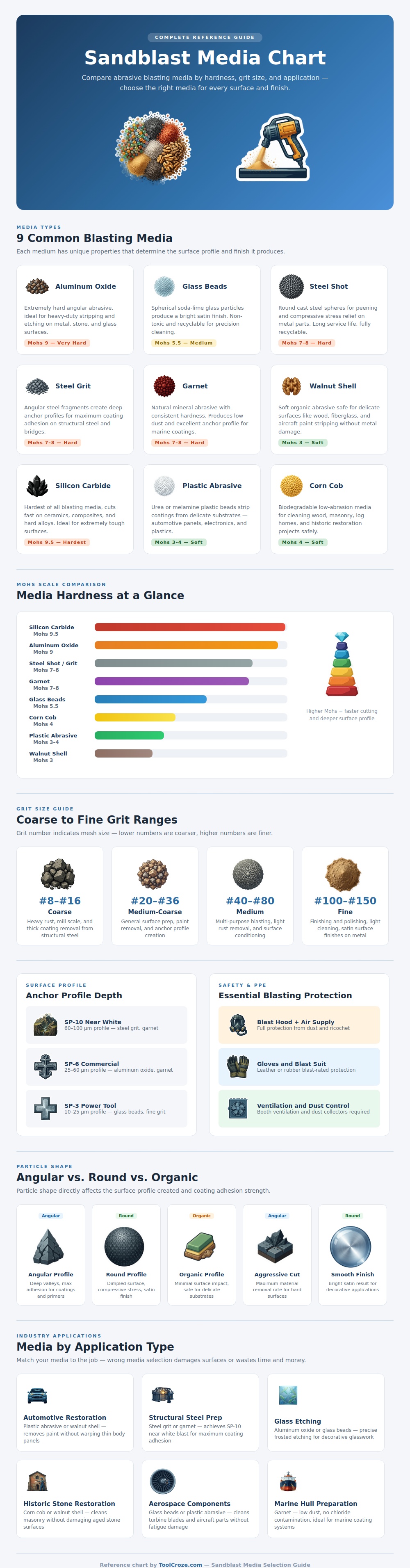
Abrasive media selection in sandblasting isn’t always about maximum aggression; it’s about matching correct abrasive to the application. Diamond-bladed abrasives might remove rust from a steel beam, yet destroy profile necessary for paint adhesion. Applying the incorrect medium will result in either insufficient coating retention or over-aggressive treatment of fine substrates.
So it becomes a question of grit size, shape, and hardness; will your project work out or not? We’ve broken down the most popular blasting media into nine types (see graphic above) along with their respective Mohs ratings and best uses. As you might expect, steel shot and grit ranks in the 7 to 8 range, delivering great cleaning power with recyclability as an added plus.
How to Pick the Right Sandblasting Material
At the other extreme, we have corn cob, plastic abrasive, and walnut shell, all within the 3-4 range on Mohs scale. Ideal for delicate surfaces such as thin automotive panels, historic wood and stone, and even glass and metal, these eco-friendly organics don’t cut too deeply whereas glass beads is used to produce a bright satin finish. Moving up the toughness chain, aluminum oxide ranks right behind at 9, perfect for glass and metal etching. And at the top, we find silicon carbide; hardy stuff for really hard surfaces like hard alloys and ceramics… With a hardness of 9.5.
It’s not as simple as hardness. Just as important to consider is particle shape, which affects finished surface texture. For example, angular media like garnet or steel grit cut deep into the surface. This creates a rough profile that are ideal for heavy-duty coatings that need strong mechanical adhesion. Conversely, round media (e.g., steel shot, glass beads) produce a dimpled surface by “peening” the base without gouging deep valleys; such a relief texture removes compressive stresses while still offering some degree of cleaning action. In-between are organic media which can cleans yet have little effect on the base substrate. Knowing the difference helps determine whether your goal is a high-adhesive coating or simply an aesthetically pleasing finish.
The size of the grit refines your result even more by controlling how deep it cuts and what kind of surface profile it creates. On the coarse end are numbers 8 through 16 that will quickly clean off thick coatings and remove heavy mill scale but leave the surface very rough. That’s ok if you’re preparing structural steel and want part to be durable instead of smooth. Moving towards the finer grits (like number 100 to 150) slows the material removal way down. You’ll have a really smooth surface good for light cleaning or polishing. Medium grits in the middle, around number 40 to 80, offers a balance between speed and an acceptable finish. Most general purpose jobs fits here.
Abrasive blasting jobs are inherently dangerous. Massive amounts of dust and flying debris fly around at high speed, exposing operators to severe health hazards. To protect workers, proper gear such as full body suits, gloves, and a pressurized blast hood must be worn. There should of also be effective dust collection systems and enough ventilation for an operator to safely conduct their job. Skipping out on safety measures puts operators at risk while also putting you at odds with regulations.
Depending on the type of media selected for the application, there is several industries and specific uses within those industries: In automotive restoration, walnut shell or plastic media is used to strip paint off vehicle parts without warping delicate, thin metal body panels. Garnet is a popular marine hull cleaner because it has low dust levels and no chloride, so it won’t corrode steel over time. Restoring historic buildings requires special care. Because of this, workers may use walnut shells or even corn cobs to clean masonry but must avoid any products that will erode aged stone surfaces. In aerospace applications, cleaning components must be precise. Glass bead cleaning is used to get rid of contaminants without creating fatigue cracks in turbine blade material.
To conclude. Good sandblasting is all about matching the media properties to what your surface needs. If you’re doing an aggressive surface like a heavy industrial job, you want a hard angular grit to promote adhesion of coatings. For something more delicate like a decorative item you want a softer round bead that won’t damage surface but will still provide a nice smooth finish. Matching these up right will save you money on reworking, will keep you on task faster, and give you a result that lasts longer.
Next time you are doing a blasting project, consider not only what that machine can throw at it, but what the surface needs.
