Sand and Gravel Calculator
Estimate layered sand and gravel volume, compacted depth, tons, bags, truckloads, and waste for patios, paths, drainage trenches, slabs, and landscape bases.
📌Project Presets
📐Dimensions and Materials
Material Estimate
Full Calculation Breakdown
🧱Material Spec Grid
📊Depth Reference Table
| Project Use | Sand Layer | Gravel Layer | Compaction Note |
|---|---|---|---|
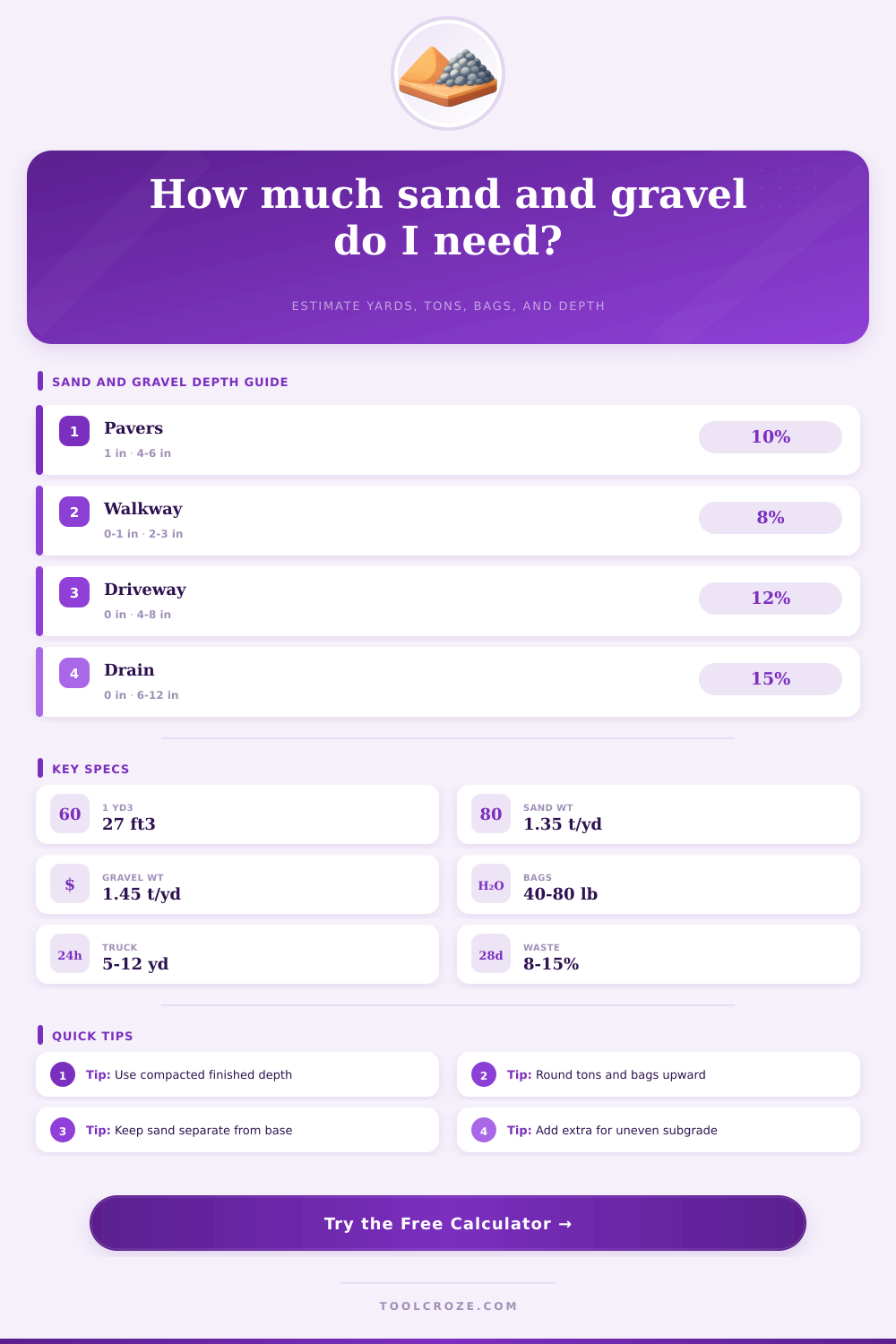
| Paver patio or walkway | 1 in screeded bedding sand | 4-6 in compacted crushed stone | Compact gravel in lifts before sand |
| Garden path with pea gravel | 0-1 in leveling sand | 2-3 in decorative gravel | Use edging to hold rounded gravel |
| Residential driveway base | 0 in unless leveling is needed | 4-8 in dense graded aggregate | Increase depth for weak soil |
| French drain trench | 0 in bedding or 1 in coarse sand | 6-12 in clean drain stone | Use washed stone with void space |
| Sandbox or play area | 6-12 in play sand | 0-2 in drainage gravel below | Separate layers with fabric if needed |
⚖Density and Yield Table
| Material | Typical Density | Tons per yd³ | Best Use |
|---|---|---|---|
| Concrete or bedding sand | 95-105 lb/ft³ | 1.28-1.42 | Pavers, leveling, bedding |
| Mason sand | 90-100 lb/ft³ | 1.22-1.35 | Joints, fine leveling, play areas |
| Pea gravel | 95-105 lb/ft³ | 1.28-1.42 | Paths, decorative surfaces |
| 3/4 in crushed gravel | 105-115 lb/ft³ | 1.42-1.55 | Compacted base and slab subbase |
| Clean drain stone | 100-110 lb/ft³ | 1.35-1.49 | Drainage trenches and pipe bedding |
🚚Bag and Delivery Reference
| Package or Load | Approx Volume | Best Scale | Planning Note |
|---|---|---|---|
| 40 lb bag | 0.35-0.45 ft³ | Small repairs | Easy to carry, many bags for yards |
| 60 lb bag | 0.50-0.65 ft³ | Short paths, patching | Common home center size |
| 80 lb bag | 0.65-0.85 ft³ | Heavier small jobs | Check lifting limits before ordering |
| Pickup bed load | 0.5-1.5 yd³ | Landscape refresh | Payload is usually the limit |
| Dump truck delivery | 5-12 yd³ | Patios, drives, drains | Confirm access and dumping spot |
🔧Compaction and Overage Table
| Field Condition | Compaction Add | Waste Add | Use When |
|---|---|---|---|
| Level formed pad | 5% | 5-8% | Simple slab or bordered patio |
| Normal paver base | 10% | 8-10% | Plate compacted aggregate base |
| Drainage trench | 10-15% | 12-15% | Irregular trench walls or spoil loss |
| Soft subgrade | 15-20% | 12-20% | Low spots, ruts, or wet soil |
💡Calculation Tips
Patio projects gets most weekend warriors excited; until they realize how large it all need to be. Sure, they imagine look of stone at night under an even sky, but not its weight below the surface. A cubic yard of crushed stone weigh about as much as a small sedan, and sand is no featherweight either. Gravel and sand are deceptively heavy.
Get too many yards for your patio and you’ll have a mountain of material you can’t move before dark, but not enough and you’re stuck with a half-empty truck bed. Rather than guess coefficients and conversions, use the calculator above; enter your dimensions and let it do the math for you.
How to Calculate Patio Materials
So how does it work? The core task is knowing what you’re measuring. For example, volume are not just width times length; it is depth times width times length. And then there’s waste plus compaction. When you put in a 4″ paver base with gravel, you’re not talking about four inches of free-flowing gravel that fell out of the back of truck. You want four inches of compacted gravel, and because the thickness settle over time, you must add extra to account for it.
So if you specify four inches of depth as finished material (without adding for compaction), you’ll get a shallow, weak base. This tool automaticly accounts for it. It tells you how much raw material to order so you have desired thickness after it is beaten down into place.
When planning out the delivery, another key consideration are the density of the material. For instance, although sand weighs less than gravel, it’s close. Three-quarter inch crushed stone will be pushing one-hundred-ten-plus pounds per cubic foot, and concrete sand may be around ninety-five pounds per cubic foot. This become important when you’re figuring out truckloads, as a typical dump truck has perhaps eight to twelve cubic yards of capacity (depending on gate width and site access).
Unless you know exactly how much of each type of material you’ll need for an order, you risk being left with too much sand or too much base if you attempt to mix materials and split the truckload. It is best to keep them separate in your mind before calling the supplier.
There’s something about waste: It’s a silent budget killer. When things go right, you imagine livig in a perfect rectangular world where everything lines up. But we live in a world of cuts, and trenches, and irregularly shaped patio that require extra material (a.k.a., 10-15%) for irregular jobs. The soil underneath isn’t always even, and you can’t rake stone back out from underneath a border block effectively, so there’s spillage onto the wheelbarrow and in flowerbeds. Plan for this loss and avoid the frustrating return trip to the hardware store to grab a couple more bags of finishing product.
But don’t overlook the fact that there’s some structural sense in layering, too. Sand atop as a bedding layer (typically only an inch thick) offers a nice flat surface for pavers to lock down onto, and lets you make small adjustments to level things out. The main base is beneath, and made of gravel, which holds weight; if you put gravel on sand, it shift around each time you walk on it, since the finer particles is sinking into the coarser ones. Maintaining the separation between these layers keeps everything stable from side to side and drains properly downhill.
If you have an area of soft subgrade, you will need more than standard digging depth. Add extra thickness to clay soils that swell and shrink to level out bumps and divots. The calculation factors this in by giving you the option to add more compaction allowance (so it effectively raises the overall yardage recommended). It’s just a tweak on the input side, but protects against future cracking due to settlement. You should of accounted for it.
The whole thing is realy less complicated than geometry; it’s more like “how do I respect the mass,” because we’re moving tons of rock. Plan for that, account for its settling, bring in excess material for the mess that building makes. If you get the base down right, the surface will remain level long after your initial excitement has worn off.
You’ll appreciate it when the patio holds up to a summer party because you weren’t working with magic. You were just using math done correctly before ever putting a shovel into ground.