Running Rigging Calculator
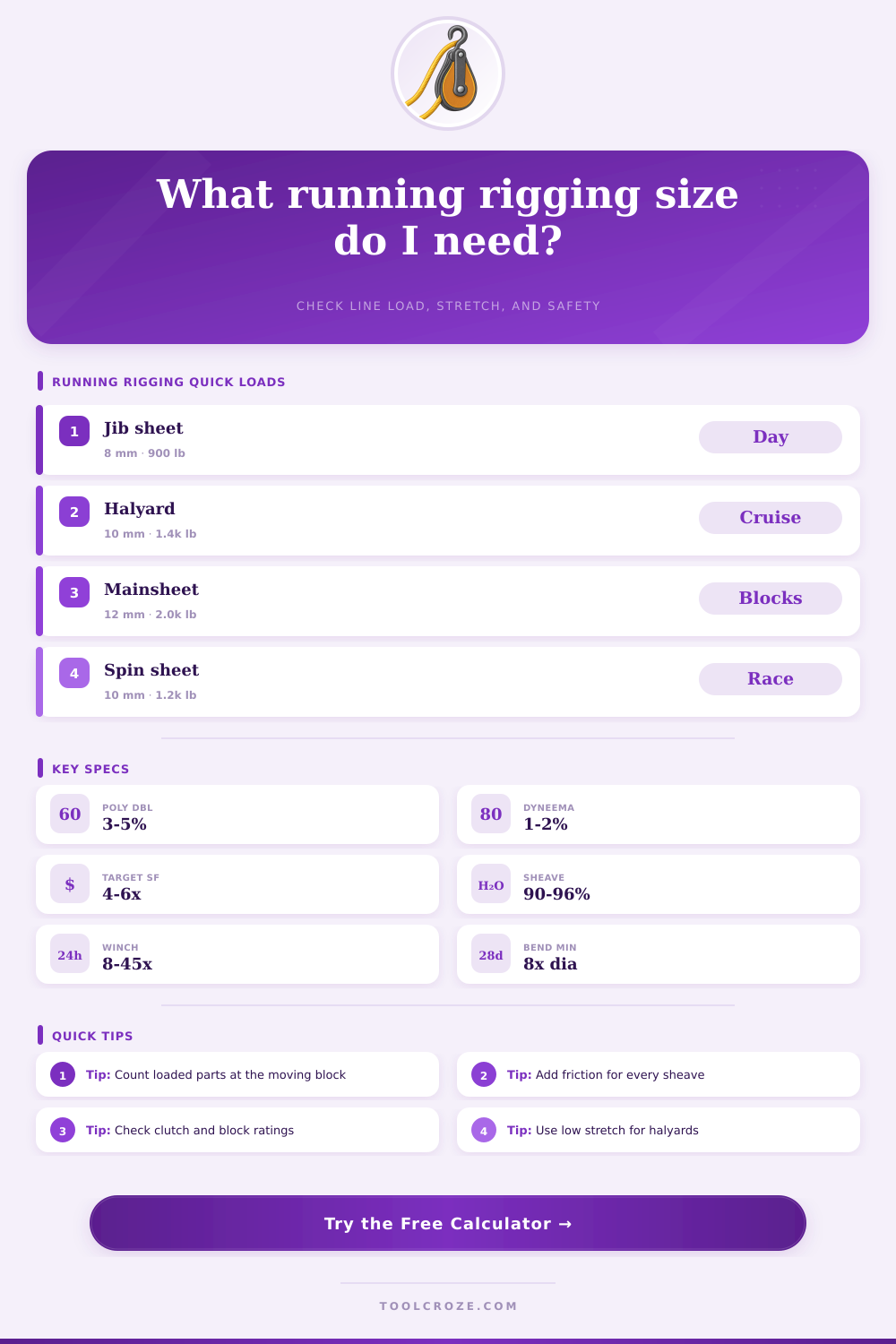
Size sailboat sheets, halyards, reefing lines, vangs, travelers, and tackles by estimating sail load, purchase efficiency, sheave friction, line stretch, winch assist, working load, and safety factor.
1 Running rigging presets
2 Line and load inputs
Running rigging calculation results
Formula breakdown
3 Selected line spec comparison
4 Reference tables
| Line material | Typical stretch | Strength behavior | Common running rigging use |
|---|---|---|---|
| Polyester double braid | 3-5% at 20% MBL | Moderate strength with good handling and UV resistance | Sheets, control lines, cruising halyards where some stretch is acceptable. |
| Polyester cover with HM core | 1.8-2.8% at 20% MBL | Higher strength with better clutch holding than bare HM line | Performance halyards, reefing lines, loaded travelers. |
| UHMWPE single braid | 0.8-1.5% at 20% MBL | Very high strength but slippery in clutches and hands | Cascades, soft shackles, lashings, stripped sections, high-load purchases. |
| Covered Dyneema or Spectra | 1-2% at 20% MBL | Very high strength with a grippy protective cover | Low-stretch halyards, genoa sheets, offshore reefing lines. |
| Nylon double braid | 7-10% at 20% MBL | Elastic and shock absorbing, not ideal for precise trim | Temporary tackles, preventers, snubbers, and shock-loaded utility lines. |
| Aramid performance line | 1-1.8% at 20% MBL | Low stretch but sensitive to tight bends and UV exposure | Specialized race controls with generous sheaves and inspection intervals. |
| Diameter | Polyester double braid MBL | Covered HM MBL | Typical deck hardware note |
|---|---|---|---|
| 6 mm / 1/4 in | 1,500-2,100 lbf | 3,500-5,500 lbf | Small controls, dinghy sheets, light vang tackles. |
| 8 mm / 5/16 in | 2,600-3,600 lbf | 5,500-8,500 lbf | Small-boat sheets, reef lines, light halyards. |
| 10 mm / 3/8 in | 4,500-6,000 lbf | 8,500-13,000 lbf | Common cruising sheets and halyards; check clutch diameter range. |
| 12 mm / 1/2 in | 6,500-9,500 lbf | 12,000-18,000 lbf | Large mainsheets, genoa sheets, and loaded offshore halyards. |
| 14 mm / 9/16 in | 9,000-13,000 lbf | 16,000-24,000 lbf | Heavy cruising sheets; confirm self-tailer and turning block fit. |
| Purchase layout | Ideal ratio | Typical sheave loss | Practical tail load cue |
|---|---|---|---|
| Direct sheet | 1:1 | 0-1 turning sheave | Winch or hand load is close to the sail-control load. |
| Simple 2:1 | 2:1 | 1-2 sheaves | Tail load often lands near 55-65% of direct load. |
| Mainsheet 4:1 | 4:1 | 3-5 sheaves | Ball-bearing blocks matter once loads climb. |
| Cascade vang 8:1 | 8:1 | 4-8 sheaves or rings | Line load falls, but hardware anchor load can be high. |
| Reefing line | 2:1 to 4:1 | Many deck turns | Friction often dominates; oversize blocks and fair leads. |
| Control | Typical coefficient | Stretch priority | Line sizing reminder |
|---|---|---|---|
| Jib or genoa sheet | 0.55-0.80 | Medium | Use sheet lead angle and winch load; diameter also needs hand comfort. |
| Mainsheet tackle | 0.40-0.70 | Medium | Purchase reduces tail load, but boom load and block rating stay high. |
| Halyard | 0.25-0.45 | High | Low stretch keeps luff tension stable and sail draft forward. |
| Reefing line | 0.35-0.60 | High | Check tack, clew, boom sheaves, organizers, clutches, and winch angle. |
| Vang or traveler | 0.45-0.90 | Medium | High purchase systems can hide very large attachment loads. |
| Spinnaker sheet | 0.30-0.55 | Low to medium | Low weight and handling often matter as much as ultimate strength. |
5 Running rigging tips and safety note
A running rigging calculator are a tool that will help you to calculate the load that will stretch the control line. A control line is a line that is used to control a sail. The calculator will help a person to understanding the load on that control line.
The calculator is important in that if a control line can stretch to much, then the sail can change shape. Additionally, if the control line is too weak, it will fail when a gust of wind is encountered by the boat and sail. To calculate the load on a control line, the calculator will first calculate the base force of the wind.
How to Calculate the Load on a Control Line
The calculator calculates the force of the wind based off area of the sail and the speed of the wind. In addition to these variable, the angle of the control line must be entered into the calculator. The angle of the line is important in calculating the load on the control line.
For instance, a control line that has a shallow angle will experience a different load then a control line that has a steep angle. An alteration of the angle will alter the load on the control line. In addition to calculating the base force of the line, the calculator will first calculate the purchase of the line.
Purchase is the advantage that is created by the use of blocks and pulleys to reduce the force that is placed onto the person controlling the winch. However, each block and each organizer within the system will reduce the efficiency of purchase. Each turning point in the system can be provided for