Round Plate Weight Calculator
Calculate solid disk or annular round plate weight from diameter, thickness, material density, center hole size, quantity, and cut allowance.
⚙Unit System
🎯Round Plate Presets
📏Plate Inputs
Round Plate Results
Calculation Breakdown
🧱Material Density Grid
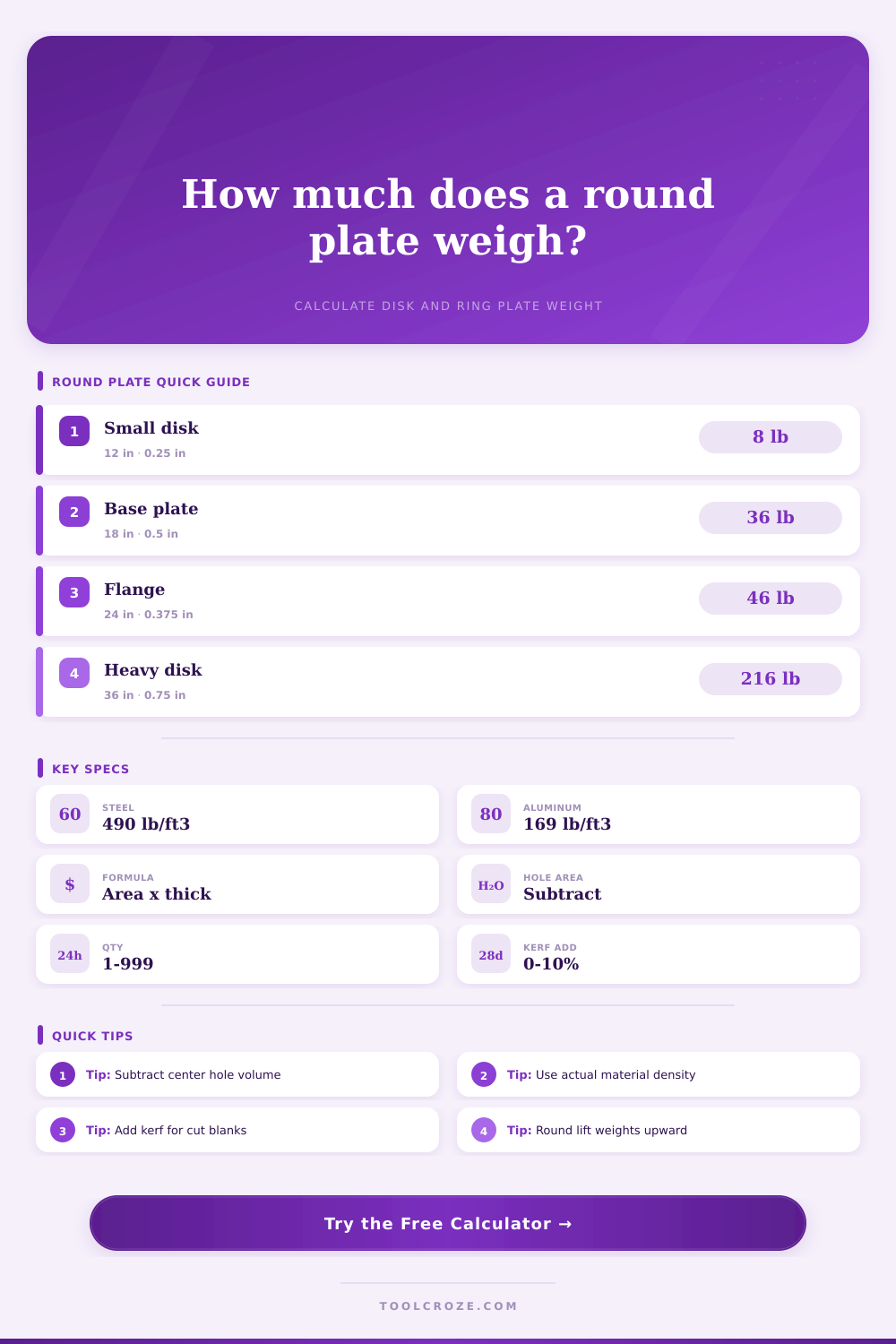
📐Common Round Plate Weights
| Plate Type | Diameter | Thickness | Carbon Steel Weight |
|---|---|---|---|
| Small cover disk | 8 in | 1/4 in | 2.8 lb |
| General disk | 12 in | 1/4 in | 6.3 lb |
| Pipe base plate | 18 in | 1/2 in | 28.4 lb |
| Large cover plate | 24 in | 3/8 in | 50.1 lb |
| Heavy machinery disk | 36 in | 3/4 in | 338.0 lb |
🛠Material Density Reference
| Material | Density lb/ft³ | Density kg/m³ | Use Case |
|---|---|---|---|
| Carbon steel | 490 | 7850 | Base plates and covers |
| Stainless steel 304 | 500 | 8000 | Food, washdown, corrosion areas |
| Aluminum 6061 | 169 | 2700 | Lightweight covers and fixtures |
| Brass | 532 | 8520 | Decorative and bearing plates |
| Copper | 559 | 8960 | Conductive blanks and disks |
| Cast iron | 450 | 7200 | Machine bases and weights |
| Titanium | 281 | 4500 | High strength lightweight parts |
◎Area And Perimeter Formulas
| Shape | Area Formula | Perimeter Formula | Weight Formula |
|---|---|---|---|
| Solid disk | π x D² / 4 | π x D | Area x thickness x density |
| Annular plate | π x (OD² - ID²) / 4 | π x (OD + ID) | Net area x thickness x density |
| Batch total | Area x quantity | Perimeter x quantity | Each weight x quantity |
| Allowance total | Net result x factor | Usually unchanged | Total x allowance factor |
📋Round Plate Planning Sizes
| Scenario | Typical Geometry | Check First | Suggested Allowance |
|---|---|---|---|
| Pipe cap cover | Solid 8-16 in disk | Outer diameter clearance | 2-5% |
| Column base | Solid 14-24 in disk | Anchor layout and load | 5% |
| Flange blank | Annular 10-36 in ring | Inner diameter tolerance | 5-8% |
| Decorative insert | Thin 4-18 in disk | Finish thickness | 2% |
| Counterweight | Thick 12-48 in disk | Handling weight | 0-2% |
💡Calculation Tips
Too many times you pick up steel plate that looks light on paper, only to find it weighs about as much as a lead anchor in your hand. It happens more frequent than you might imagine. More often than not, it’s simply a matter of volume and density, which are things our brains aren’t very good at visualizing until we’re already drenched with sweat underneath the load. Carbon steel weigh more per square foot than aluminum does, sure, but its weight also build up fast as you increase the diameter. We learn this after we grab for the lifting strap.
This lets you concentrate on the nuts and bolts of the task (pun intended) without getting bogged down in complex math. As you see above, this will determine your weight for material thickness, outside diameter, and material density. Including center holes if you’re using annular rings instead of solid disc. That’s important, because a big center hole reduces the weight of something that appears to be a pretty hefty chunk of steel by quite a bit.
How to Calculate the Weight of Steel Plates
If you choose the annular setting, the system will consider the difference between the inner and outer circles and provide a net weight value representing the true metal you’ll have to move around. It’s just a little tweak to geometry, but it help keep you from making big mistakes in your estimates.
In most situations, dimension isn’t the deciding factor so much as material choice is. Regardless of whether you’re manufacturing a huge base for some piece of machinery or a tiny washer, steel will weigh about three times more than an equal volume of aluminum. And when you jump from one type of metal to another. Perhaps seeking conductivity versus corrosion resistance with different types of alloys. Knowing their relative weights can help.
For example, stainless steel may be your material of choice for a piece of equipment used in a food processing setting, but be aware that this adds approximately two percent additional weight over regular carbon steel. This may not seem like very much on one unit, but if you’re placing an order for 50 pieces as part of a production run, those few ounces add up quickly.
Another variable that’s frequently overlooked is thickness. A quarter inch may seem thin until you double it; suddenly, it has twice as much weight without being twice as large, a change that is easy to forget because it isn’t linear. To close this gap between theory and reality, the calculator allows you to enter both an amount and a percentage of cut allowance. This addresses both small fluctuations in mill stock dimensions as well as kerf loss when things gets cut out. It is not precise to the gram, but it maintains your crane capacity safely within bounds and keeps your shipping quotes on target.
While it may not feel like critical information, perimeter and area measurements can be incredibly important when preparing to weld or finish edges. Knowing how much length your weld will cover allows you to estimate how long it will take and what amount of material you’ll use to weld the circumference of a round plate, for example. The results section also breaks out all of these components to show exactly where in the part the weight comes from. This includes the raw total before any allowance as well as the safety margin you specified. This helps you compare your results against a strict weight budget.
The biggest error people make with plate estimating is to forget that they have multiple plates. If one plate is manageable, then 10 plates on a pallet or even just 10 stacked together is not the same deal. You can type the number into it and it will calculate out total load for your project and take into account what you’ll actualy encounter. Even if you apply an allowance it rounds up just a little so you’re always at least covered for your lift capacity.
That said, it’s really only the beginning of properly dealing with the material. You also have to consider the surface finish, as it’s delicate. You must also consider the proper angle of the slings on a lifting device and where the center of mass lie. Knowing how much something weighs eliminates all that guesswork though, which allows you to plan your lift well before ever setting foot in the shop.
It doesn’t matter what the numbers show or hide; gravity is what matters, and the numbers never lie. You should of get ’em right and save yourself more than just time, save your back too.