Roofing Waste Calculator
Estimate roof area, cut waste, total squares, bundles, starter, ridge cap, and underlayment from footprint, pitch, roof shape, and material specs.
Roofing Waste Results
Full Breakdown
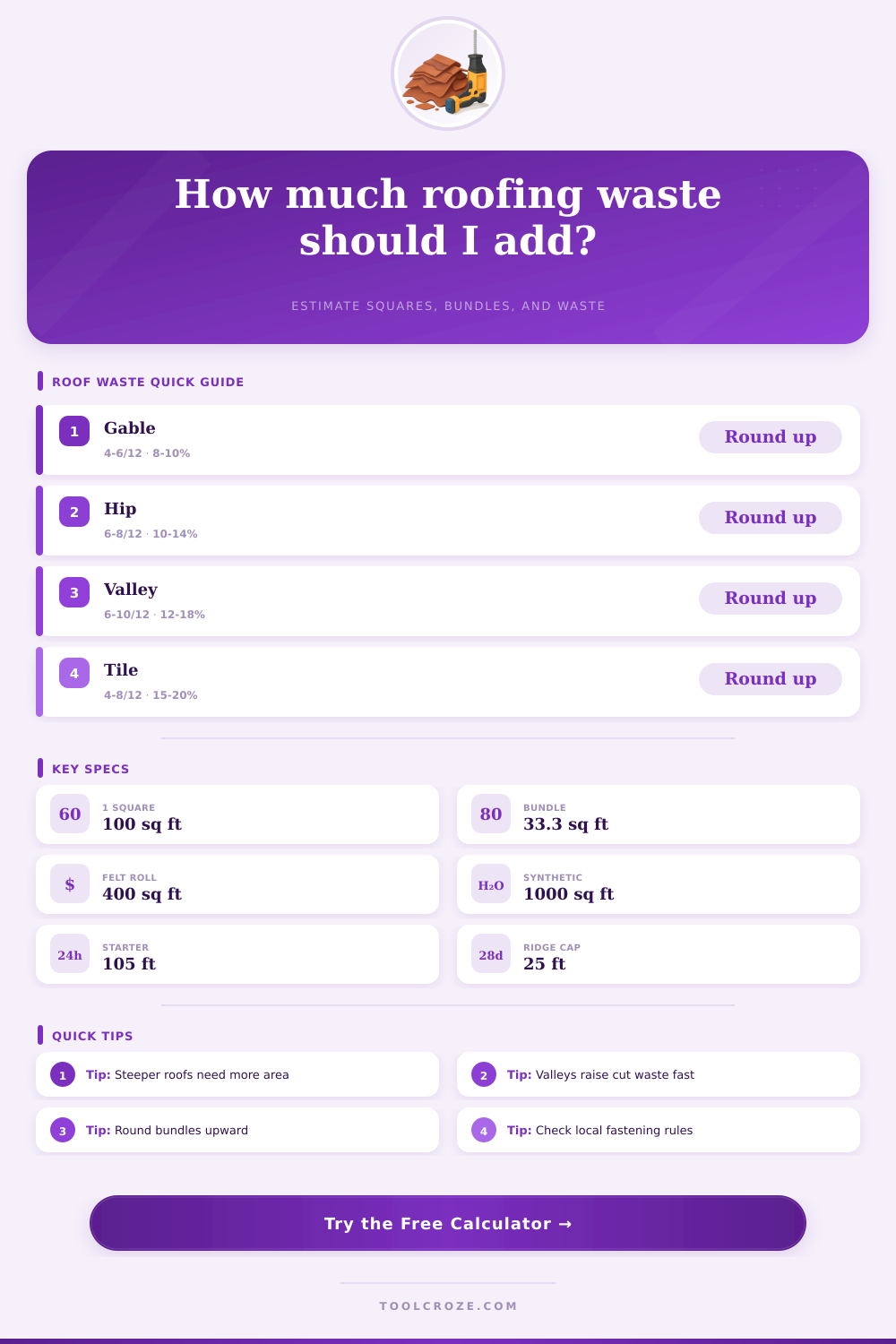
| Material | Base Waste | Typical Coverage | Use When |
|---|---|---|---|
| Architectural asphalt shingles | 10% | 33.3 sq ft per bundle | Most residential re-roofs |
| 3-tab asphalt shingles | 8% | 33.3 sq ft per bundle | Simple roofs with straight courses |
| Standing seam or panel metal | 12% | Panel layout dependent | Long runs and custom panel lengths |
| Clay or concrete tile | 15% | Usually ordered by square | Fragile units and trim pieces |
| Slate roofing | 18% | Usually ordered by square | Sorting, breakage, and coursing |
| Pitch | Slope Factor | Area Effect | Waste Note |
|---|---|---|---|
| 3/12 | 1.031 | +3.1% over plan | Low pitch, check material rating |
| 6/12 | 1.118 | +11.8% over plan | Common gable and hip roofs |
| 9/12 | 1.250 | +25.0% over plan | More staging and cut handling |
| 12/12 | 1.414 | +41.4% over plan | Steep roof safety planning needed |
| Roof Shape | Added Waste | Why It Changes | Starter/Ridge Impact |
|---|---|---|---|
| Simple gable | 0% | Few rake cuts and no hips | Moderate starter, short ridge |
| Hip roof | 2% | Hip cap and angled field cuts | Longer ridge and hip cap order |
| Cross gable | 4% | Valleys and intersecting planes | More rake starter and flashing edges |
| Complex cut-up | 8% | Many short courses and offsets | Verify each ridge and hip run |
| Accessory | Common Coverage | Calculation | Rounding Rule |
|---|---|---|---|
| Field shingles | 33.3 sq ft per bundle | Total roof area divided by bundle coverage | Always round up to full bundles |
| Starter strips | 105 ft per bundle | Eaves plus rake length if used on rakes | Round up, keep a short spare length |
| Ridge cap | 25 ft per bundle | Ridge plus hip cap length | Round up before ridge vent deductions |
| Underlayment | 400 to 1000 sq ft per roll | Base roof area plus lap allowance | Round up by roll coverage |
The standard approach to re-roofing goes like this: Homeowners buy only enough roofing to cover their home’s floor area. They calculate the footprint of house times some slope factor they look up on the internet. When materials arrive, first shipment doesn’t quite match second because the batch number has changed; or when crew shows up, it lacks enough material to finish the hips.
Don’t blame bad luck; blame geometry, geometry that you cannot see from the driveway. Roofing waste is less about material loss and more about complexity tolerance. It is also about dealing with complex shapes. When you install it in straight rows on a simple gable, every cut makes a piece that can be reused on the next row. Add an offset wall, a dormer, a valley; any such remaining pieces are now too small to be useful.
Why You Need More Roofing Material Than You Think
Once you enter your pitch and shape of your roof into the calculator, it do the math on the number of additional bundles that will remain after the cuts. Increasing the pitch increase the area. Most folks don’t give it much thought, but pitch does matter. Six over twelve will add about twelve percent to your plan area, since the surface is longer than its footprint would indicate. With a nine over twelve pitch, you’re up to twenty-five percent! What you’ve done is buy more shingles (and pay for vertical rise).
The tables of references breakdown the math, material by material, explaining why a slate or tile roof needs a higher buffer than an asphalt one. Slate and tile aren’t exactly robust stuff (they break easily when handled), and eat through your count quickly. Asphalt is forgiving; tile isn’t. Waste increases as pitch goes up, and shape increases it even more. On a basic hip roof, every corner requires a diagonal cut that leaves long triangular offcuts. Those triangles won’t fit back onto a different hip unless you rotate them, which never seems practical in real life. More complex roofs with several plane that meet and form valleys will push waste as high as 18% or more. That’s not your penalty fee; that’s how much waste it takes to make everything connect.
The tool asks for details about these elements, such as valley length, dormers, or any other penetrations. It uses those details to add to the amount and raise grand total before ordering. It’s worth mentioning here because it happens enough that I have to warn people about it: Underlayment is frequently overlooked. Many owners calculate shingles but buy felt rolls based off the flat footprint. That means less coverage per roll and therefore more rolls needed. To get a correct number of rolls needed, better yet plug into the calculator which accounts for this lap factor. The calculator includes an underlayment estimator to account for the lap allowance. This ensures you won’t be caught with your pants down after roof is exposed to the elements prior to shingle installation.
Jobs can go wrong in quiet places like starter strips and ridge caps. For starters (so to speak), starter bundles are sold by the linear foot of eave, with double that length if your house has rake starters as well. Ridge caps depend on how many hips you have, which means a complex roof with multiple valleys needs significantly more cap material then a simple box shape. The tool divides those extras, making it easy to round each up separately. You’ll fall into the trap of combining left-over bits from various categories; you won’t be able to patch gaps between eaves with spare ridge cap, for example.
Now, there’s one factor I haven’t mentioned yet: safety. While you won’t see this as a bundle count, it is part of the planning process. A steeper roof takes more time for staging and more time in air. It also requires extra caution when handling materials. You will probably use something like synthetic underlayment that sticks better than felt, but it go on slower and thus has higher indirect labor costs. You plan for waste, but actualy you’re planning for a safer, slower job.
A better strategy is to use the initial calculation as a starting point but not a goal. Round up on bundles; carry an additional roll of underlayment in the pickup; stock just enough cap to cover the math. The price for having excess material is far lower than the cost of returning to the supply house with a waiting crew in the rain (or heat). Measure twice, cut once. Let the extra material give you some peace of mind.
Now that you know what’s behind all those other bundles, you see roof differently. No longer is it just a flat square space, but rather a series of planes coming together and requiring skillful fitting. And now that the math has been done for you by the calculator, you can get to work thinking about strategy. Order more than you think you’ll need to account for cuts, and then you won’t make single biggest error people make in doing their own roofs, running out of shingles half-way up the second story.