Roof Casting Calculator
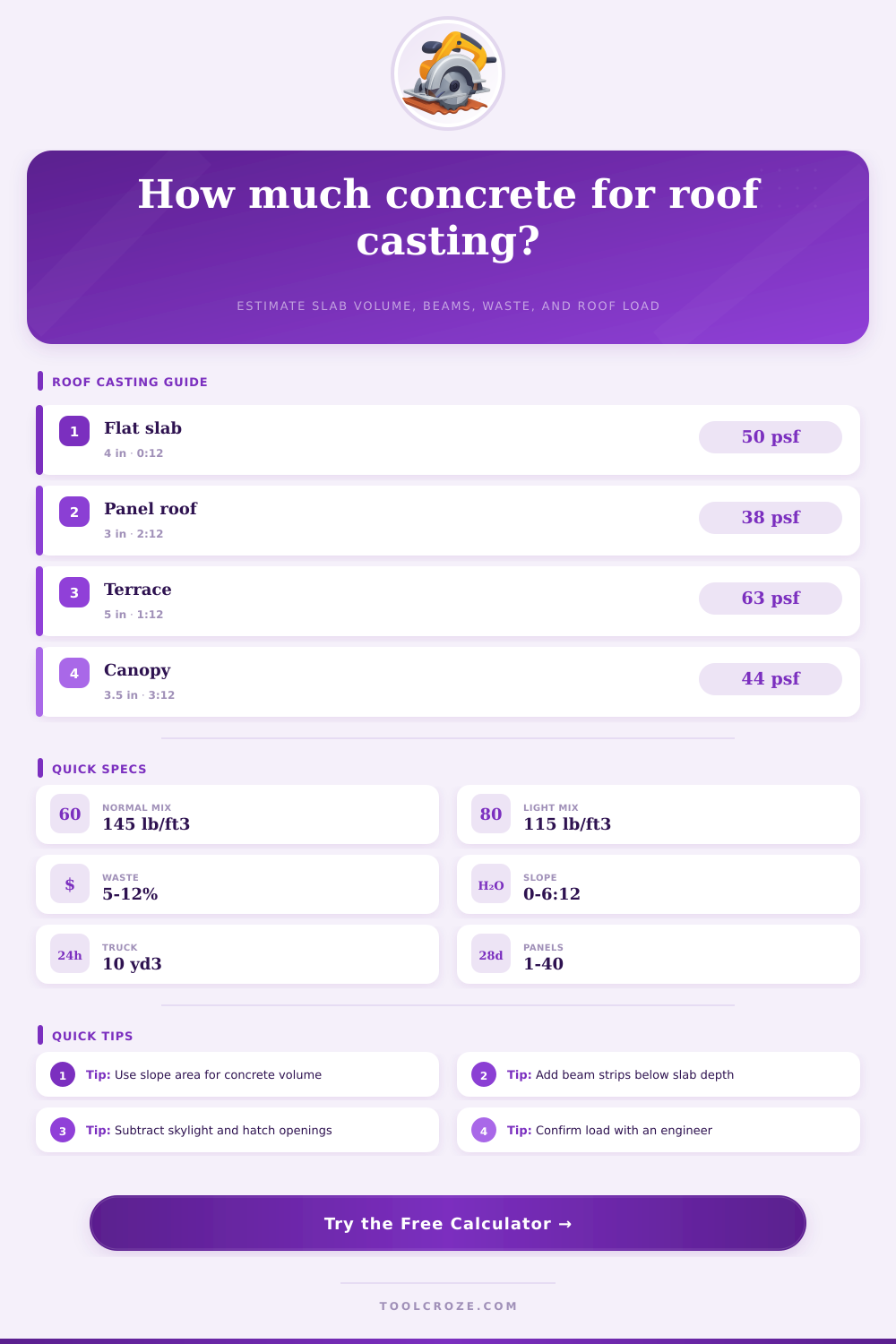
Estimate cast roof slab or precast panel concrete volume, slope area, overhang volume, beam strip concrete, waste allowance, mix weight, and roof dead load.
Calculation Breakdown
| Concrete / roof casting | Typical density | 4 in slab load | Common use |
|---|---|---|---|
| Normal-weight structural concrete | 140-150 lb/ft³ / 2240-2400 kg/m³ | 47-50 psf / 2.25-2.40 kPa | Cast-in-place roof slabs, terraces, garage roofs |
| Reinforced planning mix | 148-155 lb/ft³ / 2370-2480 kg/m³ | 49-52 psf / 2.35-2.49 kPa | Conservative dead-load estimate including steel |
| Lightweight aggregate concrete | 105-125 lb/ft³ / 1680-2000 kg/m³ | 35-42 psf / 1.68-2.01 kPa | Roof decks where dead-load control matters |
| Foam concrete roof screed | 35-75 lb/ft³ / 560-1200 kg/m³ | 12-25 psf / 0.57-1.20 kPa | Insulating fills and non-structural slope layers |
| Dense precast panel concrete | 150-155 lb/ft³ / 2400-2480 kg/m³ | 50-52 psf / 2.40-2.49 kPa | Factory roof planks, coping panels, canopy units |
| Detail | Measure in calculator | Volume effect | Field check |
|---|---|---|---|
| Main cast roof slab | Length, width, overhang, thickness, slope | Plan area x slope factor x thickness | Measure inside form edges, not wall centerlines |
| Downstand beams or ribs | Total beam strip length, width, extra depth | Beam strip volume adds below slab | Do not double-count slab thickness inside the beam |
| Openings and blockouts | Opening area | Opening area x thickness is subtracted | Subtract only openings left unfilled by concrete |
| Gable or shed slope | Pitch rise per 12 run | Increases actual cast surface area | Use pitch perpendicular to ridge direction |
| Overhangs and canopies | Eave and rake overhang fields | Adds width and length before slope factor | Include drip edge thickening as beam length if cast |
Calculating the volume of concrete for a roof slab is a task that require care, as using the incorrect volume will create structural or financial problems. If the volume of concrete ordered is too little, it will create a cold joint in the poured slab. On the other hand, if the volume of concrete ordered is too much, the extra concrete will become rubble on the construction sites.
Therefore, calculating the volume of concrete that is required for the roof slab ensure that the construction site doesnt waste resource or face supply issues. Building contractors sometimes make mistakes when calculating the required volume of concrete for roof slab. They often calculate the volume based off the footprint of the buildings on site, but the size of the roof slab will be larger than the footprint due to the presence of eaves and rakes.
How to Calculate Concrete Volume for a Roof Slab
The eaves and the rakes defines the overhang of the roof slab, and you must account for the volume of the overhang when calculating the volume of the roof slab. Another mistake that many contractors make is not accounting for the slope of the roof. Roof slab have a pitch to allow water to run off the roof.
A slope will have a more greater surface area than a flat surface. The volume of concrete for a slope is greater due to the stretching of the surface of the slab. The slope of the roof must be accounted for when calculating the volume of the roof slab.
Another mistake is not accounting for the volume of beam strips. A lot of contractors dont account for this because they think that the beam strips is part of the thickness of the roof slab. Most structural roofs will use downstand beams.
These beams will take up part of the volume of the roof slab and you must account for them when calculating the total volume of the roof slab. A third mistake is not using the correct type of concrete for the roof slab. The weight of the roof will be the normal weight of the concrete, but in the case of large spans in a roof, lightweight aggregate concrete will reduce the load on the walls if it is used for the roof slab.
Therefore, calculating the load of the roof will require determining the density of the concrete mix. The next mistake that many contractors make is not allowing for waste in the calculation of the total volume of the roof slab. Due to the concreting process, some of the concrete will remain in the pump line for the roof slab, some of the concrete will leak through the formwork, and some of the concrete will be lost when leveling the poured concrete.
Therefore, 10 to 12 percent more concrete should of been ordered than the theoretical volume of the roof slab. Another mistake is not accounting for openings in the roof. The volume of concrete for small openings like skylights is negligible.
Therefore, it isnt necessary to account for the volume of such openings. However, for large openings like stairwells, you must deduct the volume of the concrete for the openings from the total volume of the roof slab to avoid buying concrete that wont be used in constructing the roof slab. Finally, calculating the dead load of the roof slab.
The dead load of the roof slab is the weight of the roof slab, the beams, and the roofing membrane. The dead load must be calculated and compare with the live load of the structure to ensure the roof can support the load of the concrete. The structure must be able to support the weight of the concrete before the roof can support the live load in the form of people and furnitures.