Rolling Offset Pipe Calculator
Calculate horizontal offset, vertical rise, roll offset, travel distance, fitting angle, cut length, takeout allowance, and pipe size details for field layout.
Calculation Breakdown
| Fitting angle | Travel multiplier | Setback multiplier | Typical use |
|---|---|---|---|
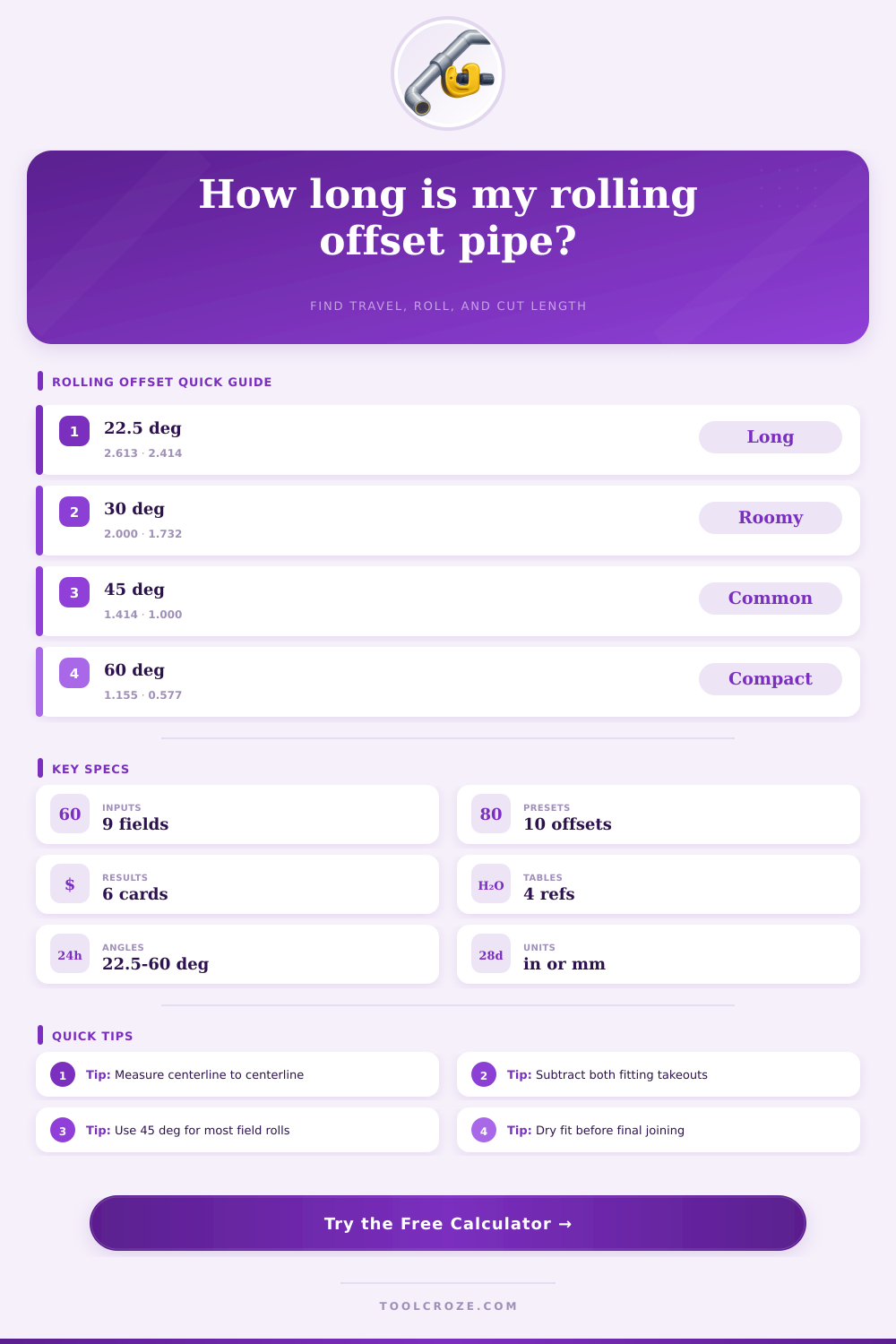
| 22.5 degrees | 2.613 x roll | 2.414 x roll | Long, gentle offset where space allows |
| 30 degrees | 2.000 x roll | 1.732 x roll | Moderate offset with smoother flow |
| 45 degrees | 1.414 x roll | 1.000 x roll | Common plumbing and pipefitting layout |
| 60 degrees | 1.155 x roll | 0.577 x roll | Compact offset with steeper fitting angle |
| Nominal pipe size | Common OD | Typical takeout range | Layout note |
|---|---|---|---|
| 1/2 in | 0.840 in | 0.50 to 0.75 in | Small water or gas offsets |
| 3/4 in | 1.050 in | 0.63 to 1.00 in | Copper, steel, and PEX branches |
| 1 in | 1.315 in | 0.75 to 1.25 in | Hydronic and small process runs |
| 1-1/2 in | 1.900 in | 1.00 to 1.75 in | Drain and vent offsets |
| 2 in | 2.375 in | 1.25 to 2.25 in | Drain, sprinkler, and light process pipe |
| 3 in | 3.500 in | 2.00 to 3.50 in | Waste and larger mechanical piping |
| 4 in | 4.500 in | 3.00 to 5.00 in | Main waste, chilled water, and headers |
| Fitting type | What to measure | Use in calculator | Field caution |
|---|---|---|---|
| Threaded elbow | Center to thread engagement | Takeout per fitting | Confirm make-up depth by material |
| Solder or braze elbow | Center to tube stop | Socket allowance | Clean and seat tube fully |
| PVC DWV fitting | Center to hub stop | Hub takeout | Dry fit can stop short of solvent fit |
| Grooved fitting | Centerline to pipe end mark | Coupling allowance | Use manufacturer groove dimensions |
| Weld elbow | Center to weld end | Center-to-end dimension | Account for bevel and root gap |
| Preset | Horizontal | Vertical rise | Angle and size |
|---|---|---|---|
| 1-1/2 in Sink Drain | 8 in | 4 in | 45 deg, 1-1/2 in PVC |
| 2 in Lavatory Vent | 10 in | 6 in | 45 deg, 2 in PVC |
| 3/4 in Copper Water | 5 in | 3 in | 45 deg, 3/4 in copper |
| 1 in Hydronic Loop | 14 in | 9 in | 30 deg, 1 in copper |
| 2 in Sprinkler Main | 18 in | 12 in | 45 deg, 2 in steel |
| 1-1/4 in Steel Gas | 7 in | 5 in | 45 deg, threaded steel |
| 3 in Waste Line | 24 in | 10 in | 22.5 deg, 3 in PVC |
| 4 in Chilled Water | 36 in | 18 in | 45 deg, 4 in steel |
| 50 mm PVC Roll | 260 mm | 160 mm | 45 deg, 50 mm PVC |
| 100 mm Steel Roll | 900 mm | 450 mm | 30 deg, 100 mm steel |
Okay, so you’ve measured both offsets with a tape measure. You now know by how much the pipe has to climb and how far it have to move horizontally. But here’s what you don’t know: How long should you make straight piece of pipe connecting these two? That’s when geometry kicks in, because there’s no way the pipe will go directly from Point A to Point B. No, it’ll need to turn twice; first away from its original run and then back into line. And length between turns is greater then one or the other offset, and depends entirely on fitting angles you select.
That’s where the calculator above comes in; it does all the math for you. But if you understand why the numbers change, you won’t make any expensive blunders out on the job. What it all comes down to is the roll offset, the actual diagonal distance across space. That’s your vertical and horizontal measurements combined into a single vector. Say you climb six inches upward and slide over six inches to the right, then your offset is approximately eight point five inches. That’s simple geometry: Your two measurements makes a triangle with its hypotenuse, or the roll offset.
How to Measure Pipe Offsets
For pipe-cutting purposes, it’s all about travel distance. To determine how much straight run you’ll need before adding fittings, divide that roll offset by sine of your elbow angle. With a forty-five degree elbow, for instance, the multiplier is one point four one four. In other words, for each inch of roll, you’d should of allow about an inch and seven sixteenths of travel. The steeper your angle, the less room you’ll need… But the longer your pipe will have to become in order to compensate for that same offset. Conversely, shallow angles such as twenty-two and a half degrees produce gentle runs with lots of extra length, making them a great space-saving choice, though they’ll cause more turbulence in the drain line.
Nobody remembers the takeouts: pipe fittings uses up some of the measured length. Cut the pipe on centerline to centerline, and your joints are guaranteed to fall an inch or two short. Subtracting the manufacturer’s takeout allowance for every elbow, defined as distance from the face of the socket (or the end of its threads) to the center of the bend. Will get you there. That figure varies widely among different copper solder bends, threaded steel nipples and even PVC hub fittings. Cutting with a generic number almost always results in pressure points that leak or sloppy-looking gaps between fitting. By allowing you to enter the actual takeout for your hardware, the tool ensures that cut piece of pipe fits neatly between the fittings without forcing the joints.
People trip up over the word setback. This is where you must place first elbow some distance back from imaginary offset point. Think of a plumb-bob hanging vertically downward from the middle of your target centerline. That’s not where the elbow goes. It goes where line of the drop-down plumb bob meets another line. This second line is at a right angle to the roll offset and intersects at the elbow itself. Setback is equal to the ratio of the roll offset divided by tangent of the angle. Without it, you’ll end up putting the elbow down in exactly the wrong place, either ahead of time or after.
Dry fitting is non-negotiable here to make sure everything aligns correctly. You have got to dry fit this thing. Before you glue or thread anything together, assemble everything loosely first. This tells you if your numbers match your house and if any obstacles such as ducts or joists lies in wait along the way.
The math doesn’t depend on material selection, but the feel does. For instance, steel is accurate as long as it’s engaged correctly into the threads, but how well it removes material depends. Copper tends to be tight and hold a bend well. PVC will go hard but is brittle when pushed beyond its limits.
The interface has preset buttons that makes getting up and running fast. They load common setups like sprinkler main lines or sink drain pipes, so there is no guessing required for average sizes. However, always check against what is actualy going on at your job site. Older pipe can warp a bit over time and wall thickness vary by pressure rating.
A layout isn’t merely a calculation. It’s a plan that fits on the first try. Learning about angle multipliers and their effect on travel distance, or knowing where takeouts will shrink cut length, eliminates guess work and replaces it with planning. Subtracting those inches right before cutting means making a clean installation instead of hacking together a fix. Preventing extra work later on not only saves money and time but also requires less material.