
Drill the hole and then insert fastener. Squeeze the tool. It sounds easy enough but you end up with a loose bolt. Why? Because the nut doesn’t grip material. In fact, it will spin in the sheet metal. When this happen on thin sheet metals such as aircraft racks or car panels, it’s common.
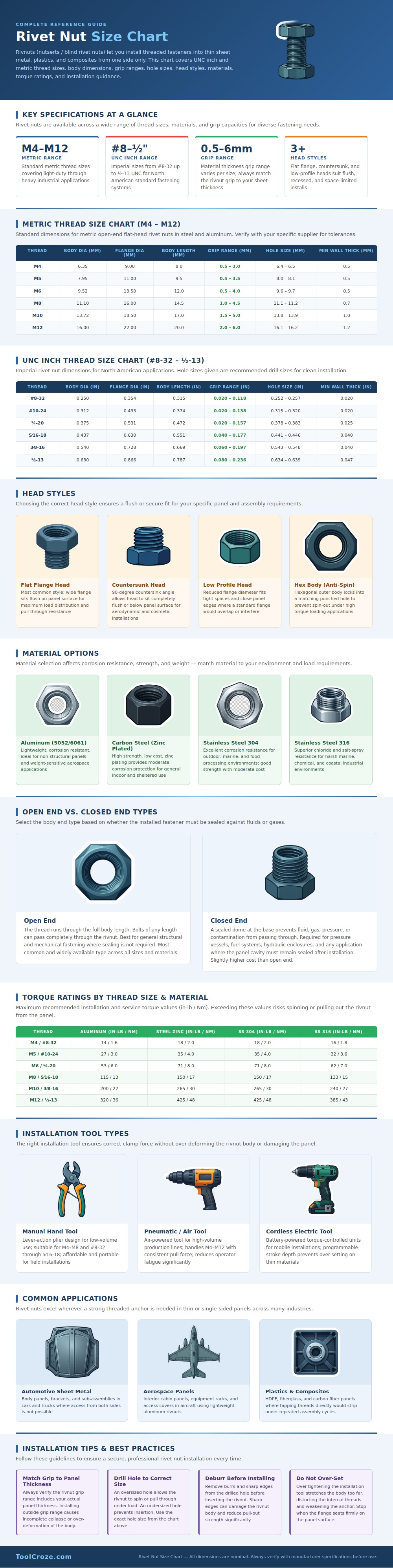
Often times the cause of failure is a mismatch of material to hardware. Failure typicaly results in enlarged holes or stripped threads. Panel thicknesses is matched to grip ranges in chart. It sounds like a medium rivet nut would fit everywhere, right? Nope. Wrong answer. A rivet nut that’s too large will expand until it is too thin and pull through the material, or worse yet crack composite. If it is too small, the body won’t compress, so it won’t have enough surface area on a two-millimeter aluminum sheet. Use what fills out the same thickness as the sheet you’re using it on. The chart helps you see those limits without having to guess.
How to Stop Loose Bolts
There are other factors: Material selection make things complicated. Cheap and strong, zinc plated steel. Good for sheltered car components indoors. Salt sprays peel off the zinc coating. Stainless steel is good for harsh conditions (boats) or outdoors. Type 304 is good for general weathering. Type 316 do better with marine conditions where it’s exposed to a lot of chloride. Cheap steel today = higher repair bills tomorrow.
The head style determines the engagement between fastener and part. A flat flange distribute force over surface area. The countersink version tucks flush with panel. This is vital for aerodynamics and in areas where cables might snag. It is also low profile for those close to edges. Hex body locks into punched holes and won’t spin out at higher torques. All shapes solves unique spatial issues.
Installation technique often determines success more different than the hardware selection does. Drill hole exactly to the given diameter. If the hole is too big, the screw will rotate in place when you tighten it. Too small, you’ll never get it started. It’s essential to deburr the edge of drilled holes. When pushing a soft aluminum bodied tool on there is nothing worse than having sharp metal cutting away at your body. That immediately reduce the grip strength.
As soon as the flange seats firmly against the panel, stop pulling the tool. You’ll stretch threads inside which ruins the anchoring strength. The torque ratings of a guide are not a suggestion, they are a hard limit. Torqued beyond them, you’ll pull the thing out or shear off threads. Just follow the suggested torque for your material type.
Joint mechanics matter. Match the grip, measure twice, and get correct corrosion grade. And respect the torque limits. It’s not about brute force; it’s all about precise alignment between substrate and hardware. If you understand those relationships, you won’t have any spin-outs. You’ll be left with joints that hold secureley.
