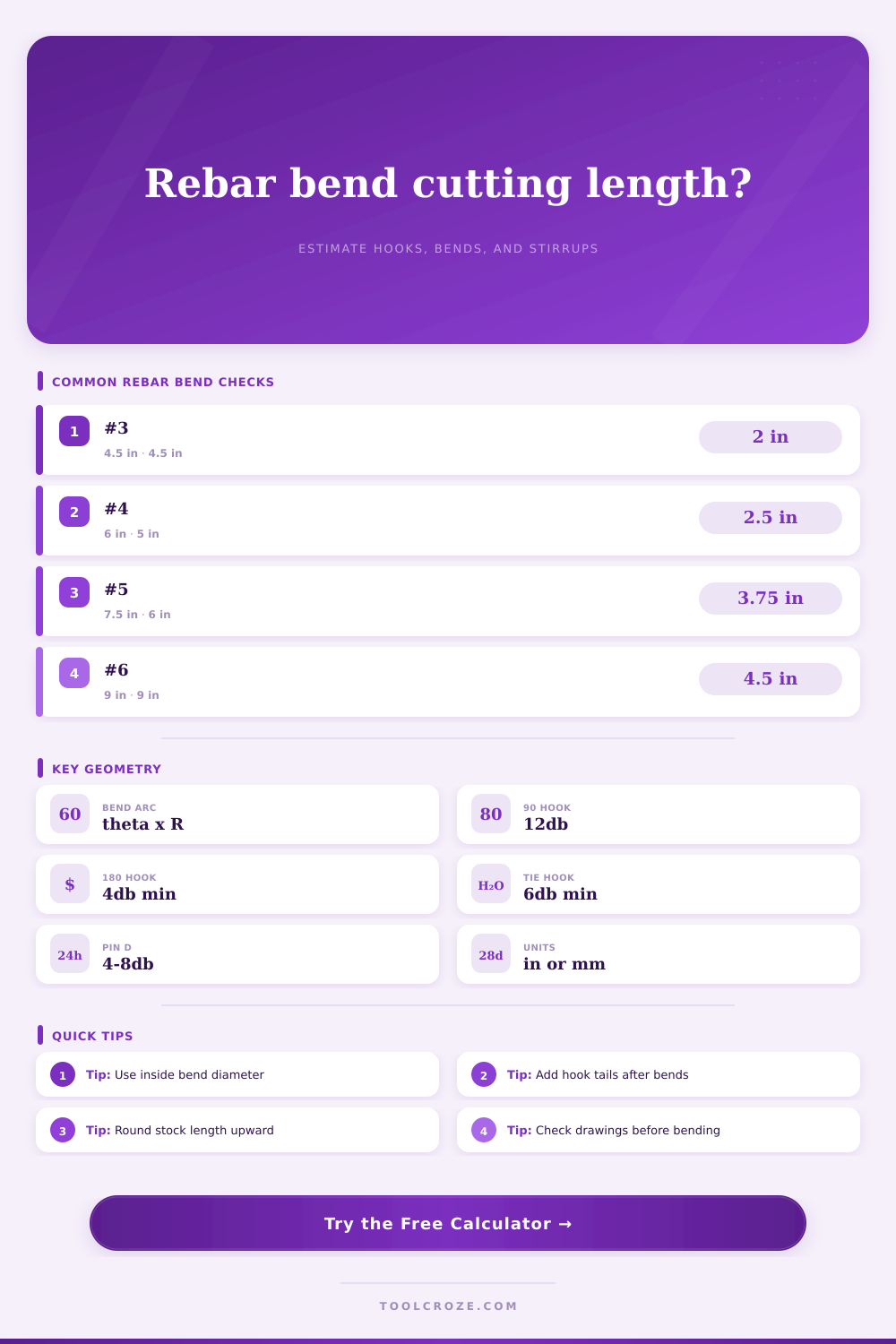
Rebar Bend Calculator
Calculate rebar bend allowance, hook extension, stirrup cutting length, manual deduction or add length, minimum inside pin diameter, total stock length, and bend weight.
⚙Unit System
📌Real Hook And Stirrup Presets
📐Bend Geometry Inputs
Rebar Bend Results
📊Current Bend Spec Grid
📘Minimum Bend Diameter Reference
| Use Case | Bar Sizes | Typical Minimum Inside Bend Diameter | Calculator Rule |
|---|---|---|---|
| Stirrups and ties | #3 through #5 | 4db, not less than 2.5 in is commonly used for shop hooks | max(4db, 2.5 in) |
| Stirrups and ties | #6 through #8 | 6db for larger tie bars | 6db |
| Standard main bar hooks | #3 through #8 | 6db finished inside bend diameter | 6db |
| Standard main bar hooks | #9 through #11 | 8db finished inside bend diameter | 8db |
| Field bending note | All sizes | Use the project schedule when it calls for a larger pin | entered value governs |
📏Hook Extension Reference
| Hook Type | Typical Tail Rule | Common Use | Calculator Treatment |
|---|---|---|---|
| 90 degree standard hook | 12db extension | Footing dowels, wall bars, beam bars | Add 12db per hook |
| 135 degree stirrup hook | 6db, 3 in min for #3-#5; 12db for #6-#8 | Closed ties and beam stirrups | Add selected tail per hook |
| 180 degree standard hook | 4db, 2.5 in min extension | Anchorage returns and footing hooks | Add max(4db, 2.5 in) |
| Seismic 135 degree hook | Usually same tail rule, often shown by schedule | Hoops, special ties, boundary steel | Add 135 degree tie tail |
| Crosstie pair | One 135 degree tail plus one 90 degree tail | Column crossties and hoop legs | Add one pair per hook set |
🧱Stirrup And Tie Preset Dimensions
| Preset | Bar | Inside Straight Dimensions | Hook Setup |
|---|---|---|---|
| Beam 135 stirrup | #4 | 10 in x 16 in | Two 135 degree hooks |
| Column closed tie | #3 | 8 in x 8 in | Two 135 degree hooks |
| Metric stirrup | #4 / 13M | 200 mm x 300 mm | Two 135 degree hooks |
| Crosstie | #4 | 30 in straight leg | 135 degree plus 90 degree |
| Footing U-bar | #4 | 18 in base, 12 in legs | No extra hook tails |
| Heavy 90 hook | #8 | 48 in main leg | One 90 degree hook |
⚒Bend Allowance And Deduction Formulas
| Item | Formula | Input Needed | Use In Cutting Length |
|---|---|---|---|
| Centerline bend radius | (inside diameter + bar diameter) / 2 | Pin diameter and bar size | Find arc length |
| Bend allowance | angle radians x centerline radius | Bend angle and bend count | Add for every bend |
| Outside setback | tan(angle / 2) x centerline radius | Outside-to-outside dimensions | Compare against BA |
| Suggested bend deduction | 2 x setback - bend allowance | One bend at a time | Use if schedule dimensions include virtual sharp corners |
| Final cut length | straight + bend allowance + hooks + add - deduction | All selected inputs | Primary calculator result |
💡Rebar Bending Tips
When you cut reinforcing bar, you has to think about what’s actualy happening to the steel. In other words, steel bends both ways: It compresses and stretches one way on the inside face of the bend and another way on the outside face. So how do you cut rebar? To be more exact, how do you calculate the arc that results from forcing metal around a pin?
Cutting rebar is more of an exercise in calculating arcs than it is in measuring straight lines. Cut it as if it were cardboard and you’re going to get bars that are either too short to fit or too long to use without trimming. Plug your geometry into the calculator above, and let it handle the math for you. No need to wrestle with trigonometry when things gets complicated.
How to Cut Rebar Correctly
The principle behind all of this math is called the radius of centerline. You input the inside bend diameter, which is the distance from bending machine pin to the bar. The tool then adds half the diameter of the bar to determine the actual path of the steel. Why does it matter? It matters because as the steel bends around the bar, the material on the inside actualy goes further than the material on the outside. The end result is a calculated arc length that needs to be added to the total cut length.
Here is the catch 22. If you measure by outside to outside, then you has forgotten about the corners gobbling up more material. Not only do you lose length but you gain arc. There’s also the issue of hook extensions, another wrinkle that stumps even seasoned estimators.
For instance, a common ninety-degree hook with a straight tail should of have at least twelve times the bar diameter. A stirrup hook with an angle of one-thirty-five degrees frequently demand only six diameters, plus at least a straight section of three inches. This is not an arbitrary rule: the purpose is for the steel anchor to be embedded properly into the concrete so the structure hold together when it carries loads. It’s all laid out neatly in the reference table on the page which explains how long your hook needs to be depending on what size bar you choose.
For example, use a number eight bar? That has a smaller tail length compared to a number four bar. But the proportions of their relationship stay constant. Failure to follow these rules can mean structural failure. So make sure to re-check the hook lengths before slicing away.
Another part of the geometry problem involve ties and other parts with multiple bends within one item. Stirrups have four corners on a rectangular stirrup that introduce a bend allowance and turn the stirrup in a new direction. With the calculator, you enter dimensions of the straight portion and it automatically includes the four arcs along with the hook extensions at each end.
Another consideration is the minimum pin diameter. There’s a certain ratio (as specified by code) between bend diameter and bar size so the steel doesn’t weaken or crack when bent. If the bar is too big for the bend and then wrapped around a tiny pin, it can fracture inside and leave a hidden weak spot. The tool does that check automatically as well and flags if you’ve selected a pin that is too tight for the bar size.
The last useful result is a weight estimate. Steel weighs a lot. Excess is expensive, so is deficit. In money and logistics. The calculator takes the unit weight of each size of bar, multiplies it by the cut length and adds a waste factor.
There’s a messiness to field conditions. Bars are cut short. Hooks are bent back into shape and straightened. Errors are made. For jobs with controlled results, it’s common practice to add a five to ten percent waste allowance. It recognize that perfect isn’t very common on the job site.
The beauty of getting rebar bending right is respect for the material. Don’t try to fool yourself that steel isn’t strong because it’s strong, but also knows its limits. It’s not simply a matter of arithmetic; it’s the waste, the hook tails, and the arc you’re accounting for. And all this is in preparation to give the skeleton of a building the chance to do its job. Feed your geometry to the numbers on the screen, and they’ll be only as good as what you feed them. Bend with care, measure carefully, and let the steel find it shape.