🏎 RC Motor Torque Calculator
Calculate torque, thrust, speed, and power for RC motors based on KV rating, voltage, and load specs.
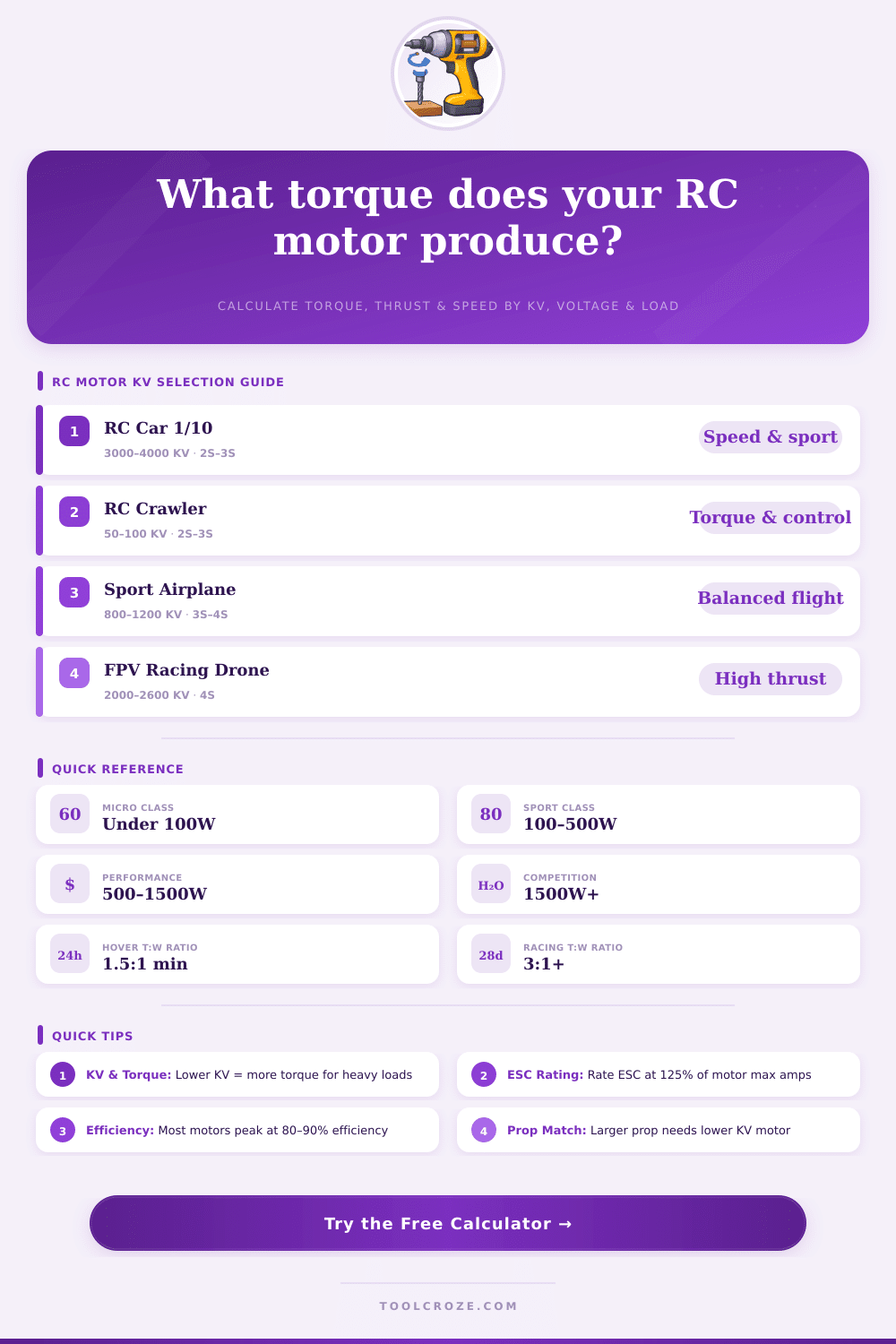
| RC Type | Recommended KV | Voltage | Typical Use |
|---|---|---|---|
| RC Car 1/10 Sport | 2700–4000 KV | 2S–3S | Speed runs, bashing |
| RC Crawler / Trail | 45–100 KV | 2S–3S | Torque & low-speed control |
| Monster Truck | 1800–2400 KV | 3S–4S | Power bashing |
| Sport Airplane | 800–1500 KV | 3S–4S | Balanced flight |
| Scale Airplane / Glider | 600–900 KV | 4S–6S | Efficiency & long flights |
| FPV Racing Drone | 2000–2600 KV | 4S | High speed & agility |
| Photography Drone | 400–900 KV | 4S–6S | Stability & payload |
| RC Boat Speed Run | 3500–5000 KV | 4S–6S | Max speed |
| RC Helicopter | 600–900 KV | 4S–6S | Collective pitch control |
| Cell Count | Nominal Voltage | Fully Charged | Cutoff Voltage |
|---|---|---|---|
| 1S | 3.7V | 4.2V | 3.0V |
| 2S | 7.4V | 8.4V | 6.0V |
| 3S | 11.1V | 12.6V | 9.0V |
| 4S | 14.8V | 16.8V | 12.0V |
| 5S | 18.5V | 21.0V | 15.0V |
| 6S | 22.2V | 25.2V | 18.0V |
| T:W Ratio | Performance Rating | Best For | Notes |
|---|---|---|---|
| 1.0–1.3 : 1 | Hover / Float | Photography drones, gliders | Minimum for stable hover |
| 1.5–2.0 : 1 | Sport | Sport planes, FPV freestyle | Good climb & maneuverability |
| 2.0–3.0 : 1 | Aerobatic | 3D planes, race quads | Vertical climbs possible |
| 3.0+ : 1 | Racing | FPV racing, speed runs | Extreme agility, short flights |
The Torque of an rc motor ranks between those themes that easily becomes confused, especially for beginners in the hobby. Even so it not necessarily must be like this. The main idea itself stays fairly easy.
It binds directly with the amount of flow through the motor revolutions. When the voltage grows without change of the load or adaptation, also the flow mounts.
What Controls Torque in an RC Motor
A formula binds the Torque with other traits of the rc motor. The Torque match matches to Kt multiplied by the flow. And that Kt one can count from the Kv of the rc motor.
Specifically, the term Kt for Torque in Nm each amp are 9.549 divided by Kv in RPM each volt. So an rc motor with higher Kv owns lower Kt, what results in less Torque each amp.
This explains the cause about revolutions and Kv. If you wrap more copper wires around every arm of the stator, that gives lower Kv and higher Kt. Therefore an rc motor with more revolutions delivers more Torque each amp, although it spins more slowly.
On the contrary, an rc motor with few revolutions spins more quickly, but generates less Torque each amp. Revolutions and Kv both tell you about the speed or the Torque of the rc motor, even so there is no simple way to compare them directly one with the other.
Also the size of the rc motor has weight. A bigger rc motor simply produces more Torque. An rc motor of type 3660, that has the same Kv as 3650, can spin at same speed, but the bigger has more Torque.
That extra fource allows it to run more cool, so that you can load it strongly and end with a fast car.
Here something notable about the function of Torque at various speeds. At zero RPM the back EMF matches zero volts. During the rc motor boost, the back EMF grows and moves toward the voltage of the supply.
Because Torque bases on flow, that depends on the voltage gap divided by resistance, when the back EMF reaches almost the supply voltage, the rc motor loses Torque for more boost. That marks its limit of speed.
In practice, the real limit for Torque in high-power brushless rc motor systems commonly is not the rc motor itself. More commonly it comes from the skill of the battery to provide enough flow. And honestly, too much Torque can create real troubles.
When some switch to brushless systems, the sudden Torque can break the drivetrain. So better ask, is the drivetrain strong enough to lastit.
The Torque that the rc motor makes depends also on the amount of wire coils, their size and form, the thickness of the wire and the strength of the used permanent magnets. The number of poles plays a role; it affects the Torque, not only the amount of magnets fixed here. Outrunner rc motor types deserve attention for high Torque.
And bigger propellers require more Torque for boost, so choosing the right rc motor wants to balance all those elements.