Ratchet Strap Calculator
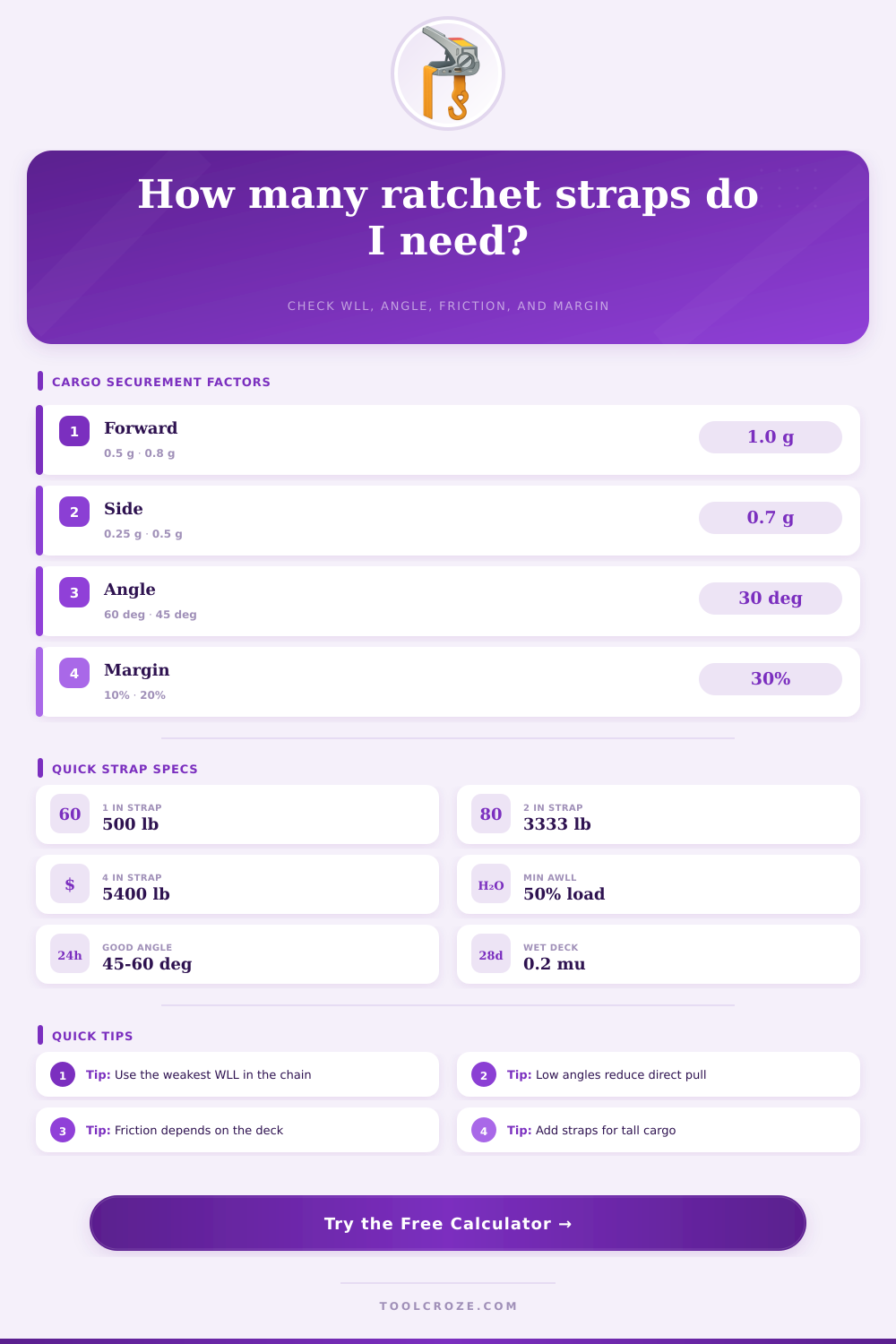
Estimate the number of tie-downs needed from cargo weight, strap WLL, tie-down angle, direct or indirect securement method, deck friction, pretension, braking and side-force factors, hardware limits, and a chosen safety margin.
1Cargo presets
2Securement inputs
3Results
4Formula breakdown
5Strap, hardware, and spec grid
6Reference tables
| Cargo surface pair | Dry friction estimate | Wet or dusty estimate | Use note |
|---|---|---|---|
| Wood crate on wood deck | 0.35 to 0.45 | 0.20 to 0.30 | Good for common trailer floors; inspect for loose debris. |
| Steel on wood deck | 0.25 to 0.35 | 0.15 to 0.25 | Add blocking or mats when steel can slide easily. |
| Rubber tire on wood deck | 0.55 to 0.70 | 0.35 to 0.50 | Tires help friction, but machines still need direct restraint. |
| Plastic pallet on metal | 0.20 to 0.30 | 0.10 to 0.20 | Low friction; use edge protection, blocking, or more straps. |
| Rubber friction mat | 0.60 to 0.80 | 0.40 to 0.60 | Only count mat benefit when the mat is clean and positioned well. |
| Securement method | Main restraint source | Angle effect used here | Best suited for |
|---|---|---|---|
| Indirect over-the-top | Friction from clamp force | Clamp = 2 x pretension x sin(angle) | Boxes, pallets, lumber, and stable rectangular cargo. |
| Direct to cargo anchor | Horizontal strap component | Pull = WLL x cos(angle) x layout factor | Vehicles, machines, equipment, and cargo with rated tie points. |
| Blocked plus strapped | Blocking plus strap backup | Calculator shows strap portion only | Dense cargo that can be immobilized against fixed stops. |
| Contained load | Vehicle structure and restraints | Use calculator for added tie-down planning | Loads inside vans, boxes, bins, or sided trailers. |
| Strap or hardware item | Typical WLL | Common use | Important limitation |
|---|---|---|---|
| 1 in cam or ratchet strap | 300 to 1100 lb | Light cargo, totes, small appliances | Often limited by hook and sewn eye rating. |
| 1.5 in utility ratchet strap | 1000 to 1800 lb | Motorcycles, ATVs, light equipment | Check soft loops, axle straps, and trailer anchors. |
| 2 in ratchet strap | 2500 to 3333 lb | Pallets, lumber, utility trailer cargo | Edge protection is critical on sharp cargo corners. |
| 4 in flatbed winch strap | 4000 to 5400 lb | Commercial flatbed loads | Do not exceed webbing, winch, hook, or anchor WLL. |
| D-ring or stake pocket anchor | Varies by mount | Tie point on trailer or truck | The installation can be weaker than the ring itself. |
| Planning check | Common factor | Why it matters | Calculator input |
|---|---|---|---|
| Forward braking | 0.8 g severe check | Hard braking tries to shift cargo forward. | Braking force factor |
| Rearward acceleration | 0.5 g common check | Acceleration or rollback can pull cargo backward. | Use braking field if rearward is your focus. |
| Lateral cornering | 0.5 g common check | Turns, lane changes, and bumps push cargo sideways. | Side force factor |
| Vertical movement | 20% load check | Uncontained cargo needs downward control. | Shown in breakdown |
7Tips and safety note
The ratchet strap calculator is a tool that you can use to determine whether your cargo is secure. To use the calculator, you must enter certain data points into the calculator. These data points include the weights of the cargo, the rating of the straps, the angles of the straps, the friction coefficient between the cargo and the trailer, the pretension of the straps, and the force factors of the cargo.
This calculator allow you to compare the force that is required to hold your cargo to the strength of the straps and the friction of the trailer. By using the ratchet strap calculator, you can determine if the straps will be sufficient to secure your cargo during transport. When a moving vehicle changes the direction in which it is moving, the cargo move in different directions.
How to Use the Ratchet Strap Calculator
Additionally, if you secures the cargo with straps to the trailer, the cargo will move forward when the driver applies the brakes to the vehicle. Similarly, the cargo will move sideways when the vehicle takes a sharp turn. For these reasons, the ratchet strap calculator requires the input of two factors: the braking factor and the side factor.
The braking factor take into account the forces created by the cargo moving forward when the brakes are applied to the trailer. The side factor account for the forces created by the cargo moving sideways. If your hauling cargo that is tall and narrow, the side factor will be the most important in securing the cargo.
The ratchet strap calculator includes a field for the margin of safety in the calculation.