Random Width Hardwood Flooring Calculator
Estimate mixed-width area, waste, linear feet, board counts, and bundle totals for balanced hardwood installs.
| Metric | Value | What it means |
|---|---|---|
| Room size | 0.00 x 0.00 | Clear inside dimensions. |
| Cutout area | 0.00 | Closets and recesses removed. |
| Base area | 0.00 | Raw floor area before waste. |
| Layout factor | 10% | Pattern waste added to base takeoff. |
| Species factor | 0.5% | Movement allowance by wood type. |
| Final area | 0.00 | Area to order against. |
| Weighted width | 0.00 | Blend of the three board widths. |
| Lineal feet | 0 | Total board length by width share. |
| Boards by width | 0 / 0 / 0 | Rounded up per width type. |
| Rows | 0 | Courses across the room. |
| Perimeter | 0.00 | Expansion-gap line. |
| Set | Widths | Avg | Use |
|---|---|---|---|
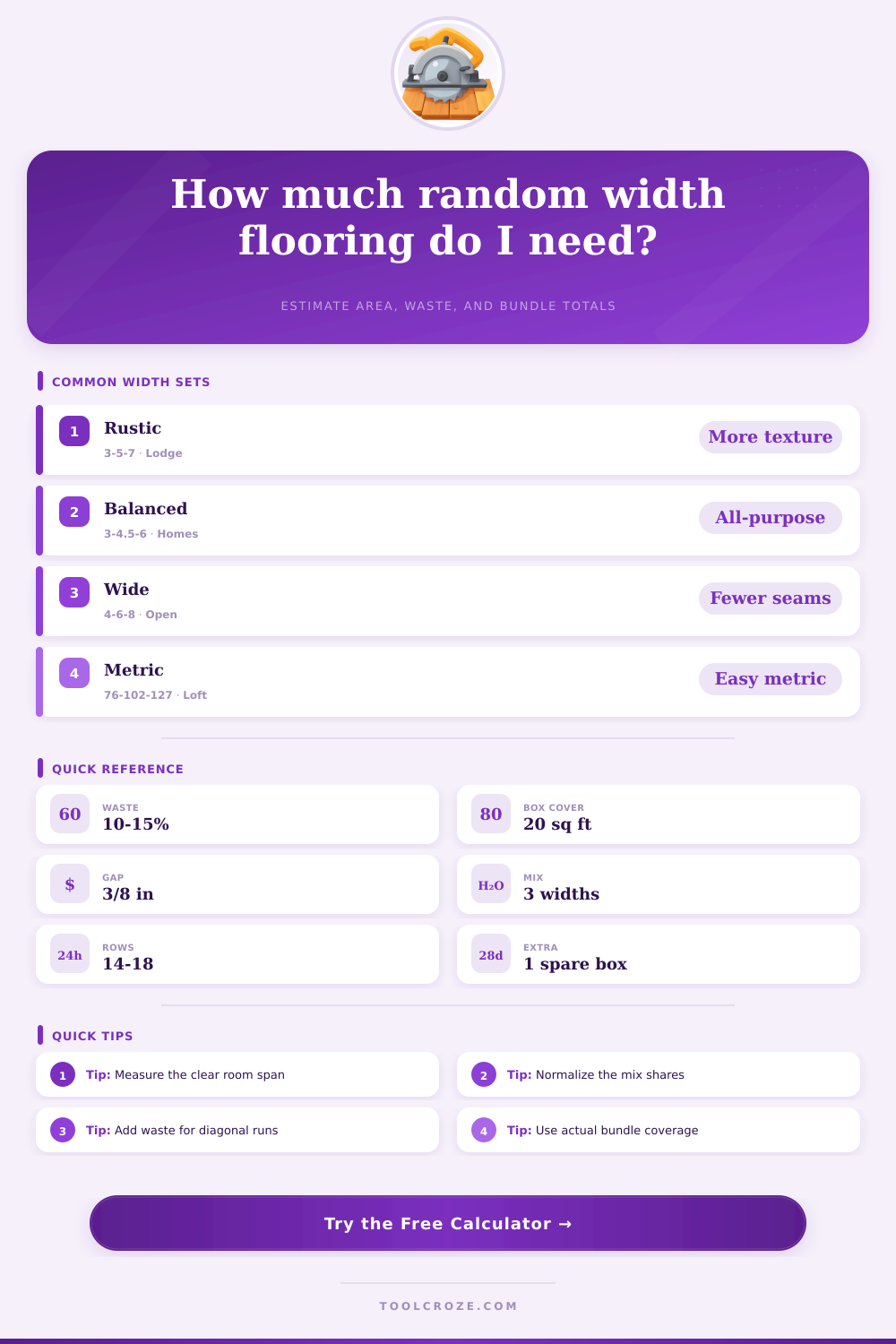
| Rustic | 3/5/7 | 5.0 in | Lodge |
| Balanced | 3.25/4.5/6 | 4.6 in | Homes |
| Wide | 4/6/8 | 6.0 in | Open |
| Metric | 76/102/127 | 102 mm | Loft |
| Layout | Add | Row f | Best |
|---|---|---|---|
| Straight | 8% | 1.00 | Most rooms |
| Diagonal | 12% | 1.03 | Feature floors |
| Herringbone | 15% | 1.08 | Formal spaces |
| Parquet | 18% | 1.12 | Custom work |
| Species | Density | Janka | Note |
|---|---|---|---|
| White oak | 47 | 1360 | Stable |
| Red oak | 44 | 1290 | Classic grain |
| Maple | 44 | 1450 | Bright finish |
| Hickory | 50 | 1820 | High wear |
| Room | Area | Bundles | Comment |
|---|---|---|---|
| 10 x 12 | 120 sq ft | 6 | Bedroom |
| 12 x 14 | 168 sq ft | 8 | Family room |
| 14 x 18 | 252 sq ft | 11 | Open space |
| 15 x 20 | 300 sq ft | 13 | Large room |
- The room is treated as a rectangle unless you enter a cutout area.
- Installed area includes waste, pattern add-on, and species allowance.
- Width shares are normalized before linear-foot calculations.
- Board counts round up for each width so you can plan by carton.
- Metric mode uses meters, millimeters, and square meters for inputs.
Random width flooring consist of planks of varying width, and random width flooring typicaly includes a mix of narrow, medium, and wide plank. To order the correct amount of random width flooring for a project, you must calculate how much flooring you need for that project; if you calculate the amount of flooring incorrect, you could end up with either too little flooring for your project or too much flooring that you will end up throwing away. Random width flooring is typicaly sold in bundles that contain a percentage of planks of each different width; these percentages are referred to as the shares of each width of flooring.
The shares of the different widths are important to know because the shares determine the average width of the planks in the flooring, and the average width of the planks will determine how many rows of flooring you will need to install in the area that you are to install the flooring. To calculate the amount of random width flooring that you will need for your project, you first must measure the clear span of the area in which you plan to install the flooring. To measure the clear span of the area, measure from wall to wall in the area, but exclude any area that will not be covered by the flooring (such as kitchen islands).
How to Order Random Width Flooring
Additionally, you must also decide on the direction in which you would like to lay the floorboards in the area. If you decide to lay the floorboards along the length of the area in which you are installing the flooring, then the width of the area will determine the number of rows of flooring that you will need to purchase. However, if you choose to lay the floorboards across the width of the area that you are to floor, the length of the area will determine the number of rows of flooring of random width that you will need.
In calculating the amount of random width flooring that you will need for your project, you must also account for the amount of flooring that will be wasted during the installation process; this flooring that will be wasted is referred to as waste. To account for flooring waste, you must add some percentage of flooring to the total square footage that you calculate for your project. For instance, if you plan to lay the flooring in a straight pattern, you should plan for a waste factor of 8 to 10 percent of the total square footage that you calculate.
However, if you plan to install the flooring in a diagonal pattern in your project, you will need to account for more waste; in this case, you will need to use a waste factor of 12 percent or more of the total square footage of the area that you wish to floor. Additionally, different species of wood has different waste factors due to the fact that some woods exhibit more movement than others with changes in humidity around the wood. For instance, acacia wood may require more “breathing” room than white oak wood due to humidity changes.
In addition to calculating the amount of flooring based on the area that you plan to floor, you must also account for the expansion gap that the flooring planks will require. Expansion gaps are created around the perimeter of the area that is to be floored, and an expansion gap of 3/8 of an inch is typicaly used. The purpose of creating these expansion gaps is to allow the wooden flooring to expand or contract based off changes in the humidity within the area in which the flooring will be installed.
To calculate how many box of flooring you will need, you will use the coverage rate for the flooring as listed on the carton label of the flooring boxes. Based upon the size of the area that is to be floored and the coverage of one box of flooring, you can calculate the total amount of boxes that you will need to purchase. Random width flooring comes in different set of flooring.
For instance, one type of flooring set includes planks of widths of 3 inches, 5 inches, and 7 inches; this type of flooring is sometimes referred to as a rustic set. A rustic set typicaly includes planks that exhibit some knots in the flooring. Another type of random width flooring set includes planks of widths 3 inches, 4.5 inches, and 6 inches; this set is sometimes referred to as a balanced set.
Another type of flooring includes planks of widths of 4 inches, 6 inches, and 8 inches; this set is referred to as a wide set and is typicaly used in large areas so that fewer seams are created between the planks of flooring. Random width flooring is useful in that it allows floorboards of different widths to be used simultaneously to create a specific rhythm within the room that gets floored. There are some common mistakes in flooring calculations that you should avoid when purchasing random width flooring.
For instance, one mistake that you should avoid is to forget to acclimate the flooring for at least one week prior to installing it into your area. Additionally, you should also avoid ignoring the fact that the humidity within the area will impact the movement of the wood within the flooring. Furthermore, you should also avoid installing the flooring tight against the walls of the area that is to be floored; expansion gaps must be left between the flooring and the walls.
Another mistake is to avoid eyeballing the amount of flooring that you need for the area; instead, calculate the linear feet of the flooring that will be needed for the project. Additionally, avoid installing a herringbone flooring pattern; if you do decide to use a herringbone pattern, you will need to plan for a very highly waste factor for the flooring (because there will be many cuts in the flooring to create such a pattern). Finally, there are some species of flooring that can be used for random width flooring.
For instance, white oak flooring comes in both dark and light species and is a popular flooring option for those who desire to use random width flooring with neutral colors. Additionally, those who desire darker colors in their homes often choose walnut flooring. Maple flooring is another species of flooring that is often chosen for kitchens.
Additionally, engineered flooring is an option for areas like basements or other rooms that may contain radiant heat. Finally, each species of flooring has different Janka hardness ratings; the Janka hardness rating for each type of wood indicates the density of the wood and how much the flooring boards may move within the installed area. Once you have measured the area that will be floored, calculated the amount of waste that will be created during installation, and decided on the type of shares of flooring planks of random width that will be used, you can complete your order for the flooring.
You should of checked the room size first.