🏗 Rafter Angle Calculator
Turn roof rise, span, ridge thickness, and overhang into a clean angle, pitch, and cut-length layout for common, shed, and custom roofs.
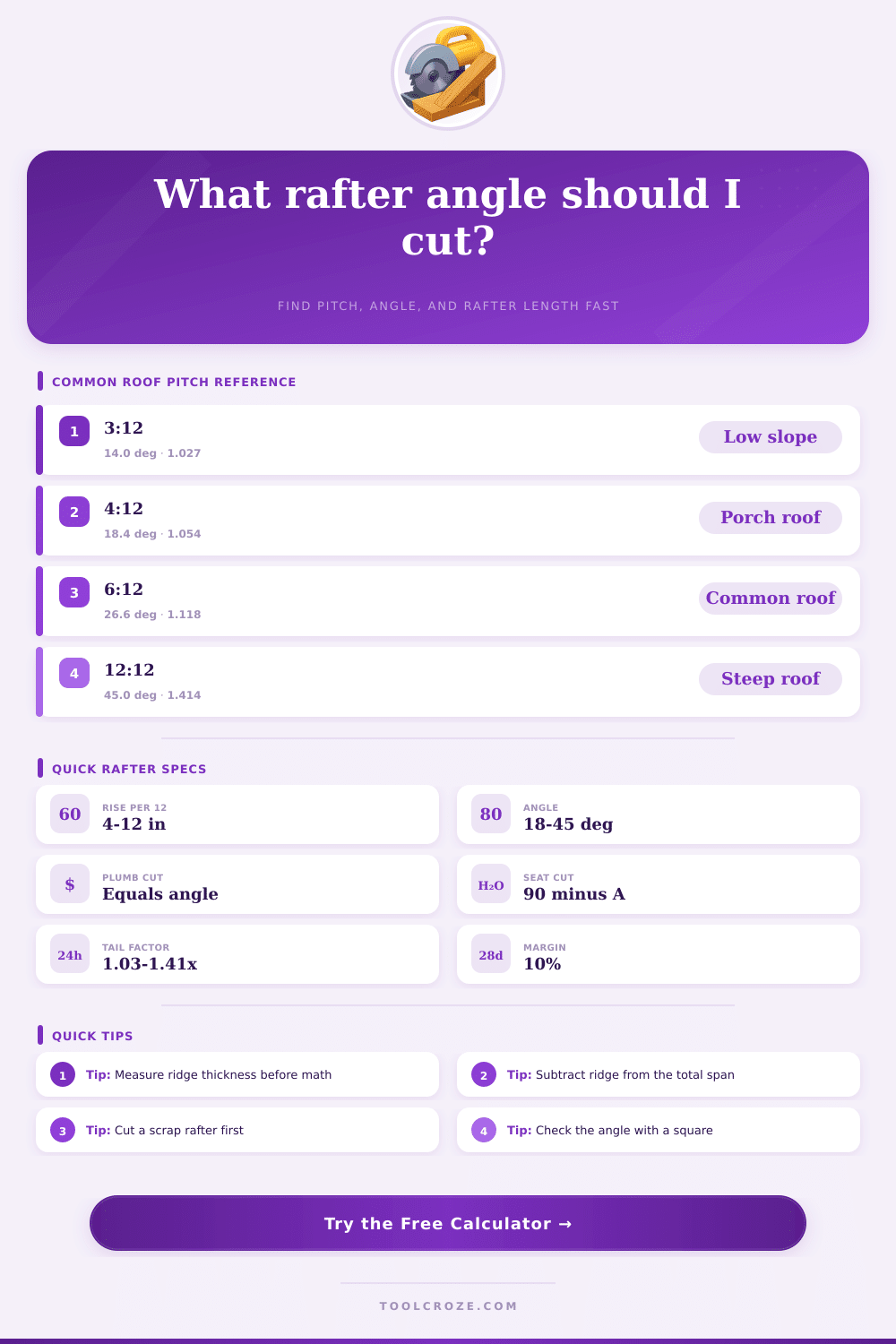
| Roof pitch | Angle | Length factor | Typical use |
|---|---|---|---|
| 3:12 | 14.0 deg | 1.027 | Low slope roofs |
| 4:12 | 18.4 deg | 1.054 | Porches and sheds |
| 6:12 | 26.6 deg | 1.118 | Common gable roofs |
| 12:12 | 45.0 deg | 1.414 | Steep roof lines |
| Item | Formula note | Practical use | Check |
|---|---|---|---|
| Plumb cut | Equals roof angle | Top of rafter | Set on square |
| Seat cut | 90 minus angle | Birdsmouth seat | Keep support safe |
| Common length | sqrt(run^2 + rise^2) | Main rafter body | Use effective run |
| Tail length | Overhang / cos(A) | Fascia projection | Measure projection |
Rafter angle squares are a practical tool for quickly installing rafters or marking angles in carpentry. A speed square, sometimes called an angle finder, is one of the most popular tools for this job. That versatile tool works as a protractor, rafter square, and combination square.
Thanks to its solid base it stays flat in place, so the angle square measures depth adjustment on table saws too.
How to Measure and Cut Rafter Angles
The slope of roof is shown as X in 12, where X shows the inches of vertical rise for every 12 inches of horizontal run. The scales for roof slope on speed square help to quickly mark the cut angles for the top and bottom ends of rafters. You can also use a framing square to lay out rafters, if the slope is known.
For example, a 7-in-12 slope for a garage is marked by means of a framing square for the angles of the birds mouth cut, after the rafter length is determined.
A 12-in-12 slope equals 45 degrees, while 6-in-12 is 26.5 degrees. A 4-in-12 roof is about 18.4 degrees. Traditionally you take the rise inches above 12 run inches.
So if the roof has a 45-degree angle, because every 12 inches along the horizontal run it climbs 12 inches, that makes it a 12-in-12 slope.
A rafter is structural support that stands at an angle and carries the roof load from the ridge to the eaves. Common rafters run from ridge to eave. Jack rafters run from a ridge or eave to another rafter.
Cripple rafters run between a hip and a valley. The hip rafter creates the hip at the outside corner of the roof and is placed between two common rafters at the ridge. The valley rafter forms the valley at an inside corner.
Both hip and valley rafters have a 45-degree angle. Because the hip or valley runs at 45 degrees to common rafters, it needs a longer run for the same rise.
Cutting rafter angles needs attention. Ninety degrees minus the roof pitch angle gives the plumb cut angle. You can turn the rafter on its end and cut at the opposite angle.
At steep angles the cut does not go all the way through the wood, so finishing by means of a hand saw is needed. A helper or a clamp jig helps to keep the rafter still. A construction calculator is practical, enter rise and run, get the diagonal for the lenght, then enter pitch for the angle.
A T-bevel with a tight line gives a precise cut angle when direct measurements are hard to take. Cut one rafter end and use it as a template for the rest, simple method.