Rack Weight Capacity Calculator
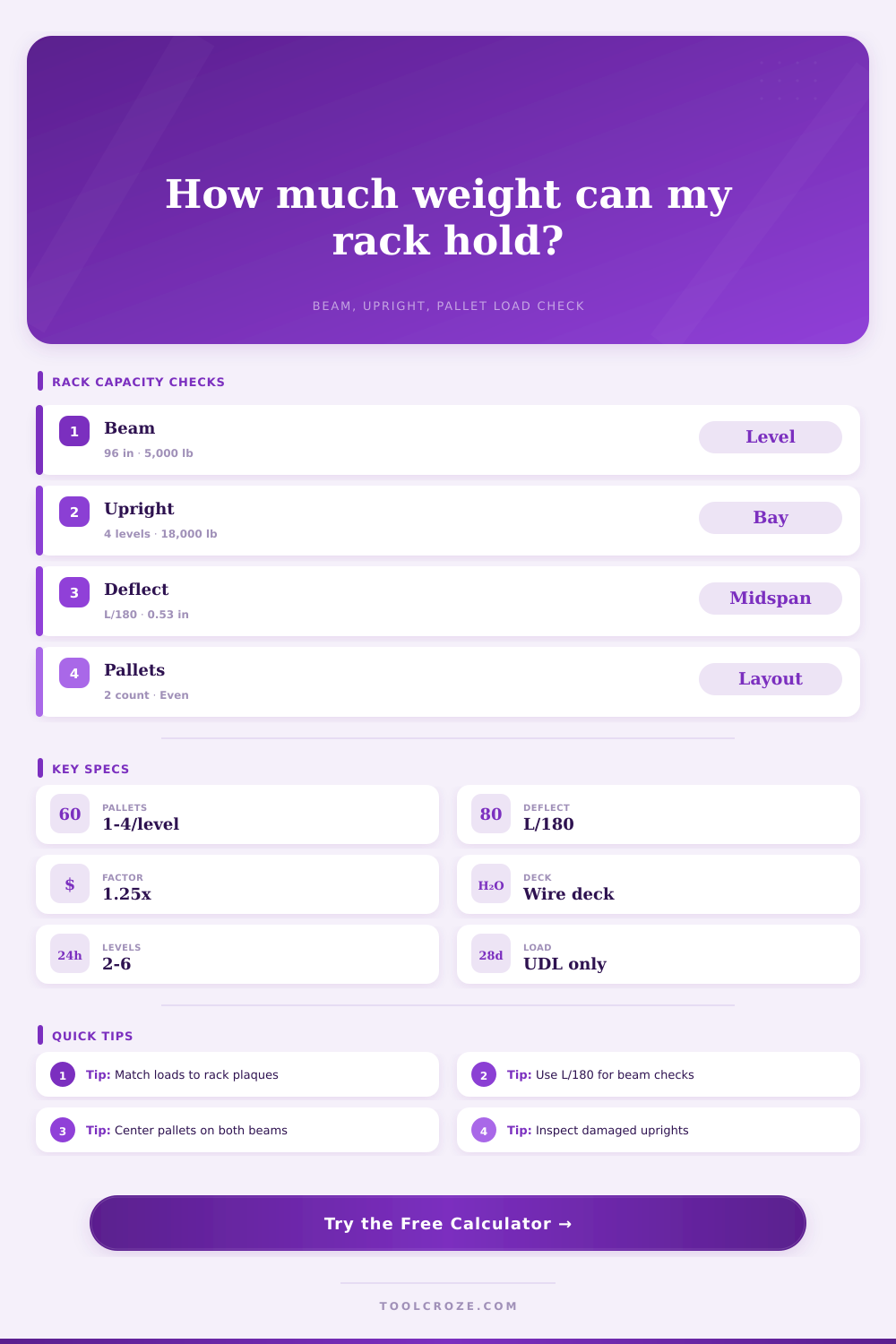
Estimate storage rack capacity by checking beam span, beam section, upright frame rating, shelf levels, deck type, load distribution, deflection limit, safety factor, and pallet count.
Rack Capacity Results
| Beam section | Typical pair capacity at 96 in | Best use | Capacity note |
|---|---|---|---|
| 3 x 1.5 in step beam | About 3,000 lb | Light cartons, hand stack, small bins | Deflection often controls long spans |
| 4 x 1.75 in step beam | About 5,000 lb | Two standard pallets on a 96 in bay | Common selective rack section |
| 5 x 2 in box beam | About 8,000 lb | Dense product, freezer, or bulk storage | Check connector and frame ratings too |
| 6 x 2.5 in box beam | About 12,000 lb | Heavy pallets or wider beam spans | May require crossbars for decking |
| 6 x 3 in structural channel | About 16,000 lb | Structural rack or rugged warehouse bays | Use engineered rack drawings |
| Upright bay rating | Loaded levels | Approx usable per level at 1.25x | Planning comment |
|---|---|---|---|
| 12,000 lb | 3 | 3,200 lb | Works for cartons or light pallets |
| 18,000 lb | 4 | 3,600 lb | Often upright-limited with heavy pallets |
| 24,000 lb | 4 | 4,800 lb | Good match for standard 96 in beams |
| 36,000 lb | 5 | 5,760 lb | Check base plates and anchoring |
| Condition | Calculator factor | What it represents | Watch point |
|---|---|---|---|
| Centered pallets on beams | 1.00 | Uniformly distributed load assumption | Keep pallets seated on both beams |
| Uneven pallet weights | 0.90 | Heavier pallet may control one side | Do not mix unknown weights at height |
| Front or rear offset | 0.85 | Load is not centered on the beam pair | Inspect stops and pallet overhang |
| Point loads or skid feet | 0.75 | Concentrated contact instead of UDL | Use engineering review for machine skids |
| Wire deck | 0.95 | Deck rating and waterfall fit reduce margin | Never exceed deck label rating |
| Pallet supports | 1.05 | Better front-to-back support for pallets | They do not raise beam plaque ratings |
| Beam length | Common pallet count | Typical pallet width | Layout note |
|---|---|---|---|
| 84 in | 2 narrow pallets | 36 to 40 in | Keep clearance at both uprights |
| 96 in | 2 standard pallets | 40 in | Most common selective rack layout |
| 108 in | 2 wider pallets | 42 to 48 in | Check beam depth for deflection |
| 120 in | 3 small pallets | 32 to 36 in | Load balance matters more |
| 144 in | 3 or 4 pallets | 32 to 40 in | Long spans are often deflection limited |
At first, the warehouse floor are still. Then a forklift driver sees a slight bowing of a steel beam. It’s not severe enough to cave in immediately. However, it is noticeable enough to alert a safety officer, who then checks the load plaque and realizes the math no longer add up. That’s when inventory planning encounters real-world structure.
Rack capacity is most often treated like a fixed value found on a metal tag. In reality, it’s a flexible equation that change whenever you add or remove a pallet or otherwise change layout. Recognizing its flexibility avoids silent failures. Which tend to be more costly than their obvious counterparts. That’s what the calculator up top filters out.
Why Rack Capacity Is Not Fixed
First there are key variables: Section and span of beam itself; those drive selectivity in most rack systems. That means a particular load profile is assumed when designing a 96 inch step beam. Adding in heavy machinery skid or fitting an extra third pallet won’t work because the uniform load assumption doesn’t hold. That’s where the tool add the reduction factor for offset or uneven loading.
And no, it’s not telling you whether the beam will snap (that’s really rare). It’ll be telling you whether deflection will exceed the safe level; typically L/180. At that point, the shelf isn’t quite level enough for pallets to remain stable while being handled. But it doesn’t result in immediate catastrophe. Rather it speed up metal fatigue and makes the operator uncomfortabley using it.
The other side of the equation people forget about is upright frame capacity. They look at the rating of the beam but forget the upright frame that holds all those level. As you add more levels, total capacity of the upright is divided further. For example, if your frame has a rating of 18,000 pounds with four level then each level will bear less weight. It may seem like it makes sense to put one level fully loaded and leave another empty but that could of place extra stress on certain beam to column connections. The idea isn’t for them to be individual shelves. It’s meant to be an overall system. When you spread out the weight over entire bay it lowers the center of gravity and balances structural load.
There are trade-offs to different decking options. Decking options include wire mesh decks which offer air flow/visibility but may carry less load then the beam itself. Steel or plywood decking can distribute point loads like machine feet, but the weight of the decking itself reduce the overall capacity. A little thing, yes…but it’s important if you’re running at the ragged edge. The calculator takes all this into account and reminds us the lowest common denominator is safe working load.
But the design manual paints a perfect picture that doesn’t always hold true with real world conditions. Over time, the integrity can be compromised by forklift impacts, some amount of corrosion, or even how pallets are stacked. A dented upright may appear okay to naked eye, yet has probably sustained a large loss of load bearing strength. Inspections are not just a box to check off a compliance checklist. It’s a must-do maintenance step to ensure your numbers on the plaque still correspond to reality. Guesswork isn’t good, ask an engineer when you’re unsure.
This isn’t about squeezing every last cubic inch out of the space at any cost, but creating a dependable storage solution that stands the test of time. Remember that little bow we saw in the beam above? Being able to catch something like that before it turns into an issue is what separates a well-running operation from a very expensive mishap.