PU Aggregate Calculator
Estimate polyurethane-bound and resin-bound surfacing quantities by area, finished depth, aggregate grading, binder ratio, kit coverage, compaction, edge loss, batch size, and working time.
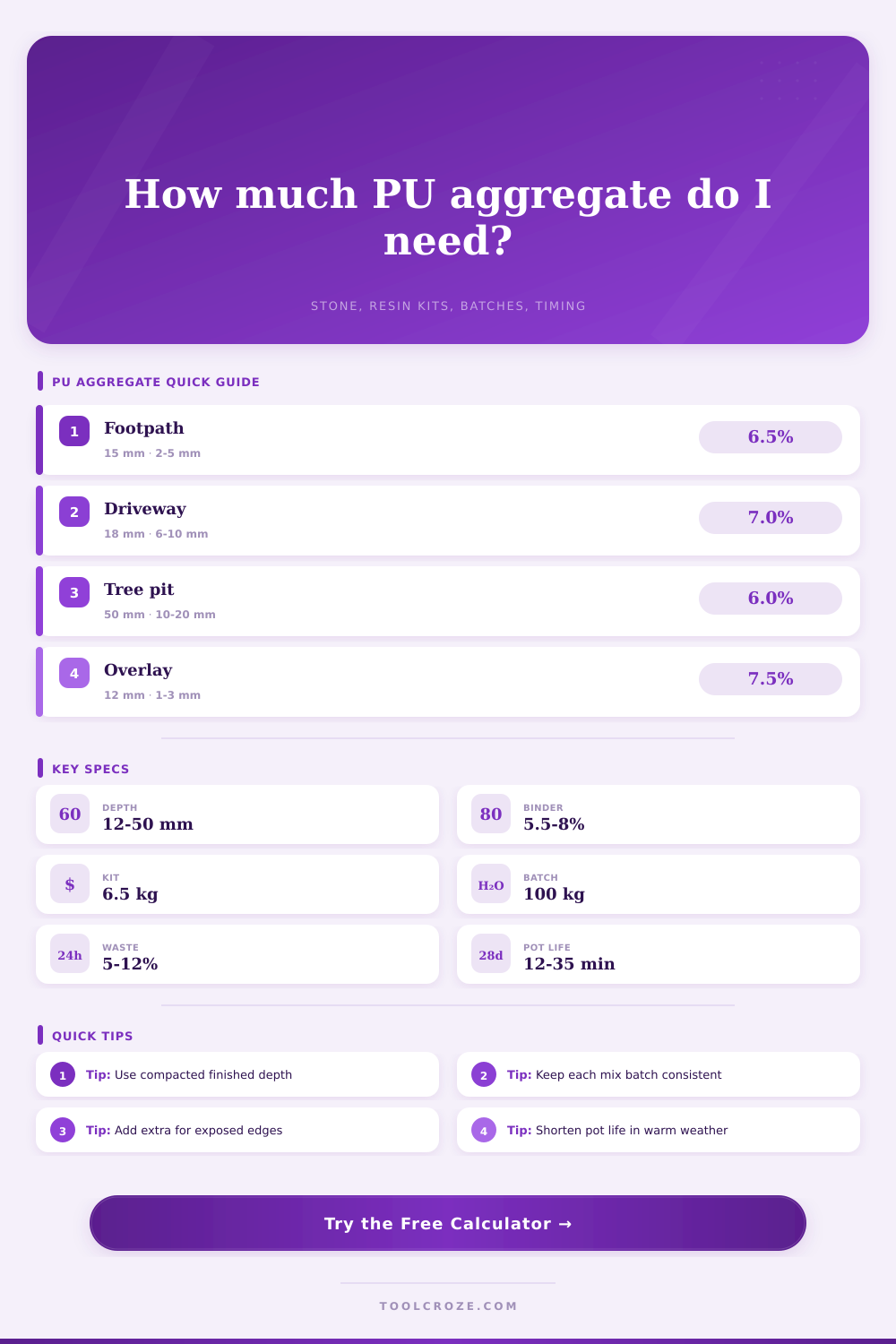
📌Real PU Aggregate Presets
⚙Surfacing Inputs
PU Aggregate Estimate
Calculation Breakdown
🧪Aggregate and Resin Spec Grid
🪨Aggregate Grading Reference
| Aggregate Type | Typical Density | Best Surfacing Use | Binder Planning Note |
|---|---|---|---|
| 1-3 mm kiln dried quartz | About 1,600 kg/m³ | Fine overlays, balconies, and decorative edging | Higher surface area often uses 7.0% to 8.0% binder |
| 2-5 mm dried decorative gravel | About 1,650 kg/m³ | Paths, patios, courtyards, and pedestrian areas | Common all-round grade with 6.5% binder |
| 6-10 mm washed angular gravel | About 1,700 kg/m³ | Driveways, ramps, and firmer wearing courses | Use 6.5% to 7.5% depending on voids and grading |
| 10-20 mm open tree-pit stone | About 1,520 kg/m³ | Deep porous tree pits and drainage surrounds | Lower binder ratio can keep open texture |
| 3-6 mm EPDM rubber-stone blend | About 950 kg/m³ | Play areas and softer pedestrian surfacing | Check blend design because rubber changes binder demand |
⚖Binder Ratio and Kit Coverage
| Binder Ratio | Aggregate per 6.5 kg Kit | Approx. Coverage at 15 mm | Typical Use |
|---|---|---|---|
| 5.5% by aggregate weight | 118 kg aggregate | About 4.8 m² | Open tree-pit or coarse porous mixes |
| 6.0% by aggregate weight | 108 kg aggregate | About 4.4 m² | Coarse grades with lower surface area |
| 6.5% by aggregate weight | 100 kg aggregate | About 4.0 m² | Common resin-bound footpath kit format |
| 7.0% by aggregate weight | 93 kg aggregate | About 3.8 m² | Driveway wearing course and angular stone |
| 7.5% by aggregate weight | 87 kg aggregate | About 3.5 m² | Fine aggregate and exposed edges |
⏱Working Time and Batch Reference
| Site Condition | Suggested Batch | Working Time | Planning Note |
|---|---|---|---|
| Cool 10°C to 15°C day | 100 kg to 125 kg aggregate | 25 to 40 minutes | Set is slower but moisture risk may rise |
| Normal 16°C to 23°C day | 75 kg to 100 kg aggregate | 18 to 30 minutes | Keep a steady mix, rake, and trowel rhythm |
| Warm 24°C to 30°C day | 50 kg to 75 kg aggregate | 12 to 22 minutes | Reduce batch size and shade materials |
| Small patch or detailed edge | 25 kg to 50 kg aggregate | Use the shortest pot life | Detailing consumes more open time than flat laying |
📐Common PU Aggregate Surface Specs
| Surface Scenario | Finished Depth | Aggregate Grade | Allowance to Add |
|---|---|---|---|
| Footpath over prepared asphalt or concrete | 12 mm to 15 mm | 1-3 mm or 2-5 mm dried stone | 5% to 8% edge and trowel loss |
| Domestic driveway wearing course | 18 mm to 20 mm | 6-10 mm washed angular gravel | 8% to 12% for edges and traffic areas |
| Porous tree pit or landscape inset | 35 mm to 50 mm | 10-20 mm open graded stone | 6% to 10% for overbreak and voids |
| Balcony or terrace fine aggregate overlay | 10 mm to 12 mm | 1-3 mm kiln dried aggregate | 8% to 12% for thresholds and drains |
| Ramp, cycle path, or narrow strip | 15 mm to 18 mm | 2-5 mm or 6-10 mm stone | 10% to 15% for long exposed edges |
💡PU Aggregate Quantity Tips
For driveways, many people like polyurethane aggregate surfacing: It’s stable like concrete, but drains like gravel. But this stuff has to be mixed just right. If batch heats up, or if wrong proportions of chemicals is used, the aggregate will separate from binder. This isn’t a structural problem; it’s a chemistry problem.
When you’re estimating how much material to buy, that means keeping track of time are at least as important as making sure you’ve got sufficient amounts. After entering in depth and area, calculator calculates what is needed. Gone are the days of guessing on coefficients and conversions. But the user need a bit of physical intuition to input into the calculator.
How to Plan Your Polyurethane Driveway
The biggest problem is depth. Don’t confuse the depth with amount of stone you need (loose volume). When the stone settles and you walk on it and rake it, it take up less space than when you just dumped it on your lawn. Order based off the final compacted depth plus a small percentage for compaction. That way, there’s no shortage of rock. Five percent is adequate; that’s the space between rocks, so it’s mostly air. It sounds like a lot, but on a big patio, that percentage represent an entire extra bag of aggregate.
A second source of frustration is the binder ratio. Resin costs money and it’s goopy. Too little resin, and you end up with a weak dusting that won’t hold stone in place; your drive gets loose from tire treads. Too much resin, and things gets slippy and shiny. For residential drives, seven percent by weight is typically the right balance between the two.
This figure also depend on surface area. The smaller the stone, the more surface area there is to hold, meaning it absorbs more resin. Chunky stones (six to ten millimeters) require less resin than fine ones (one to three millimeters). The chart below indicates how resin requirements varies with particle size. One recipe does not fit all.
These projects are also very sensitive to temperature. The polyurethane reaction releases heat. As it cures it generates heat. This means that if it’s a cool morning you may get 30 minutes per batch to work. If it’s a hot afternoon you may only get twelve minutes per batch before it gels up. You’re literally racing against a chemical reaction that won’t stop. That’s why batch size does matter. You don’t want to mix the whole driveway all at one time. Unless you would of had a big crew!
The tool figures out how many batches you need, and gives you a working window based off temperature. As the temperature go up, it will decrease its estimate of the pot life. Remember to leave the stone in the shade till it’s time to mix.
Finally, there is edge loss. No matter how perfectly rectangular your driveway may be, there’s no such thing as no-waste. There will be spilled stone from mixing it. Troweling it onto the curb mean lost material at the edges. Curved driveways and awkward corner need more coverage. Professional care adds in a percentage for waste.
Out-of-material halts progress. That requires waiting for delivery. Waiting creates a visible seam. A seam is bad because it is a trip hazard. The planning is unseen, but key to a successful project.
Order sufficient resin for complete coverage of the stone. Mix small enough quantities to remain workable. Respect the chemistry as much as the looks. The binder holds the stone. The binder holds the stone because the ratio was correct. The ratio was correct because you did the math before starting.