Pressure Treated Wood Shrinkage Calculator
Estimate board movement, final size, and dry-gap change before the lumber settles.
⚒ Calculation controls
🧱 Species and spec comparison
Southern yellow pine
Douglas fir
Spruce-pine-fir
Hem-fir
📊 Shrinkage reference tables
| Species | Density | Tangential | Radial | Longitudinal | Movement class |
|---|---|---|---|---|---|
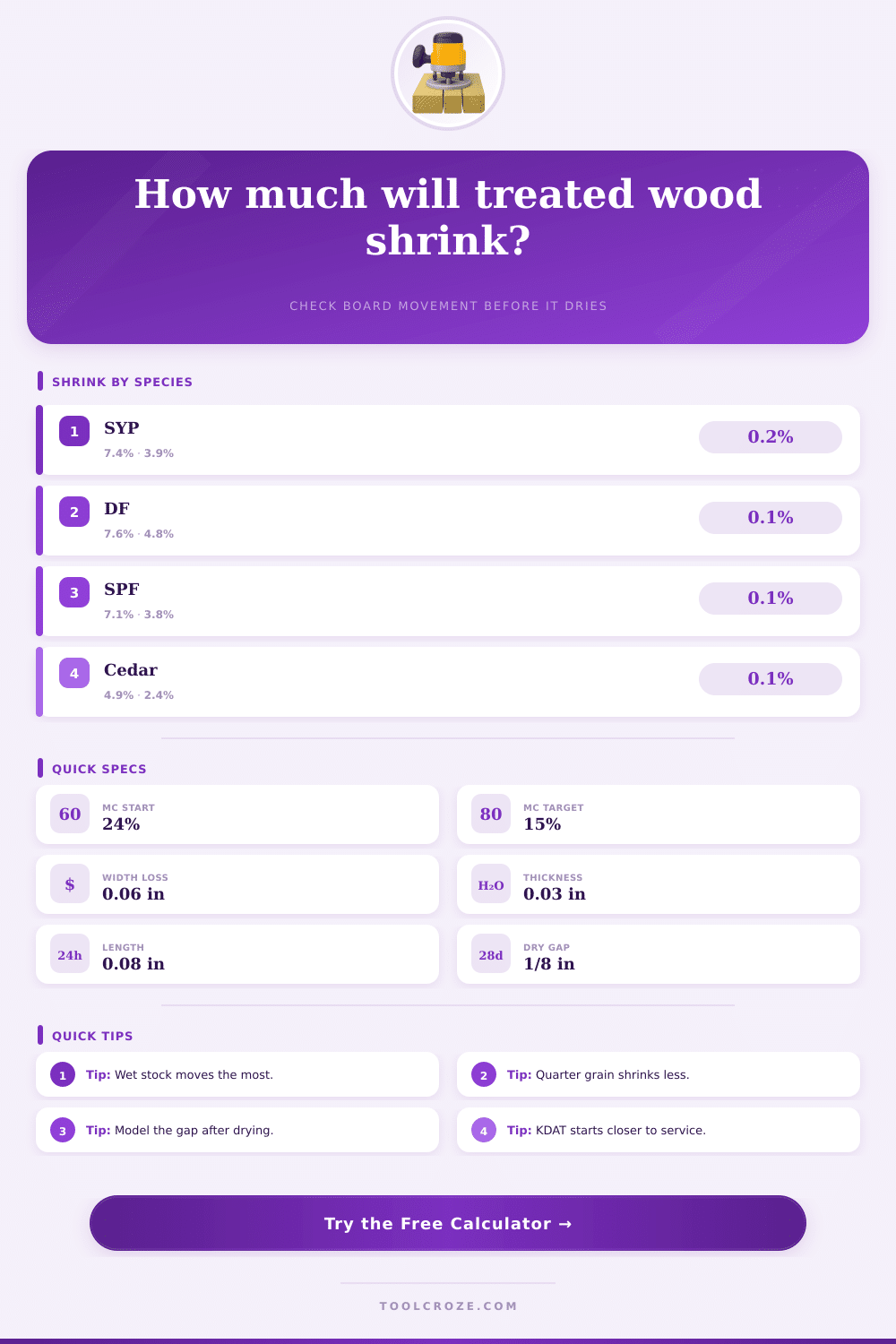
| Southern yellow pine | 36 lb/ft3 | 7.4% | 3.9% | 0.2% | High |
| Douglas fir | 33 lb/ft3 | 7.6% | 4.8% | 0.1% | High |
| Spruce-pine-fir | 28 lb/ft3 | 7.1% | 3.8% | 0.1% | Moderate |
| Hem-fir | 31 lb/ft3 | 7.4% | 4.4% | 0.1% | Moderate |
| Western red cedar | 23 lb/ft3 | 4.9% | 2.4% | 0.1% | Low |
| Redwood | 28 lb/ft3 | 6.8% | 3.8% | 0.1% | Moderate |
| Nominal | Actual in | Actual mm | Common use |
|---|---|---|---|
| 2 x 4 | 1.5 x 3.5 | 38 x 89 | Plates |
| 2 x 6 | 1.5 x 5.5 | 38 x 140 | Joists |
| 2 x 8 | 1.5 x 7.25 | 38 x 184 | Rim boards |
| 2 x 10 | 1.5 x 9.25 | 38 x 235 | Stair blanks |
| 2 x 12 | 1.5 x 11.25 | 38 x 286 | Wide spans |
| 4 x 4 | 3.5 x 3.5 | 89 x 89 | Posts |
| 6 x 6 | 5.5 x 5.5 | 140 x 140 | Posts |
| 5/4 x 6 | 1.0 x 5.5 | 25 x 140 | Deck boards |
| Condition | Typical MC | Movement risk | Calculator use |
|---|---|---|---|
| Freshly treated | 22-30% | Very high | Set start MC here |
| Wet yard stock | 18-24% | High | Most deck stock |
| KDAT | 12-16% | Lower | Closer to service |
| In service | 10-15% | Steady | Use as target MC |
| Use case | Start gap | Dry gap | Why it matters |
|---|---|---|---|
| Deck boards | 1/8-1/4 in | 1/4-3/8 in | Board edges open up |
| Fence pickets | 1/8 in | 3/16-1/4 in | Air flow and reveal |
| Post sleeves | 1/16-1/8 in | 1/8 in | Clearance for wrap |
| Trim or slats | 1/16 in | 1/8 in | Keep lines straight |
Pressure treated wood dry out and shrink after a bit of time This is one of the biggest frustrations working with it. You can build a deck with wet wood, with boards perfectly butted without gaps. After some months gaps appear everywhere.
Pressure treated lumber can shrink almost 9 %, when it moves from wet to dry state. The moisture of new boards ranges between 30 and 50 %, usually around 35 %. It commonly happens that you treat boards and install them while they are wet.
Pressure treated wood will dry and shrink
During the wood dry, it loses that moisture and shrin ks. Up to 1/4 inch of shrink is normal. For 2×12 it reaches 1/2 inch.
Work with wet treated wood is a bad idea, unless you accept shrink, splits, gaps, squeaks and warp. Cut treated lumber as soon as it arrives so wet can destroy saws. It helps to open pallets of treated wood and leave them dry before using the material.
Leave the wood dry for around two days in the sun, that is a good way.
Wood shrinks by width and thickness, but not really by length. Length shrink is only around 0,05 %, while wood dries from saturation. For 8-foot post it is 1/16 inch out of 96 inches.
Cutting boards for 5-9 % of long shrink would be a nightmare, but well, that mostly concerns width.
Mills usually undercut lumber that will be treated, because of the swelling during the process. So engineers and programs for load calculations alter values for pressure treated beams. Some boards have different widths already at the store.
For instance, 2×8 can measure 7-1/4 inches, while another has 7-1/2 inches.
Over time pressure treated lumber slightly shrinks by width, while it entirely dries. It matters to consider that little shrink, laying a deck or fence. Many builders do not leave spaces between the tops of boards on pressure treated decks because of that.
For cut miters, choose drier bits to avoid big gaps after they dry. The cut ends of sloping deck boards shrink more on the heel than on the toe.
Pressure treated lumber kiln-dried after treatment you find for a higher price, although not at big stores. All wooden lumber has a bit of shrink and cracks that you must expect. Wear gloves always handling pressure treated wood.
Safety goggles and dust masks are advised during sanding, boring or cutting of treated wood.