Press Fit Pin Calculator
Estimate pin-to-bore interference, contact pressure, insertion force, thermal assembly relief, and practical fit risk for dowel pins, bushings, sleeves, and hub joints.
Press Fit Estimate
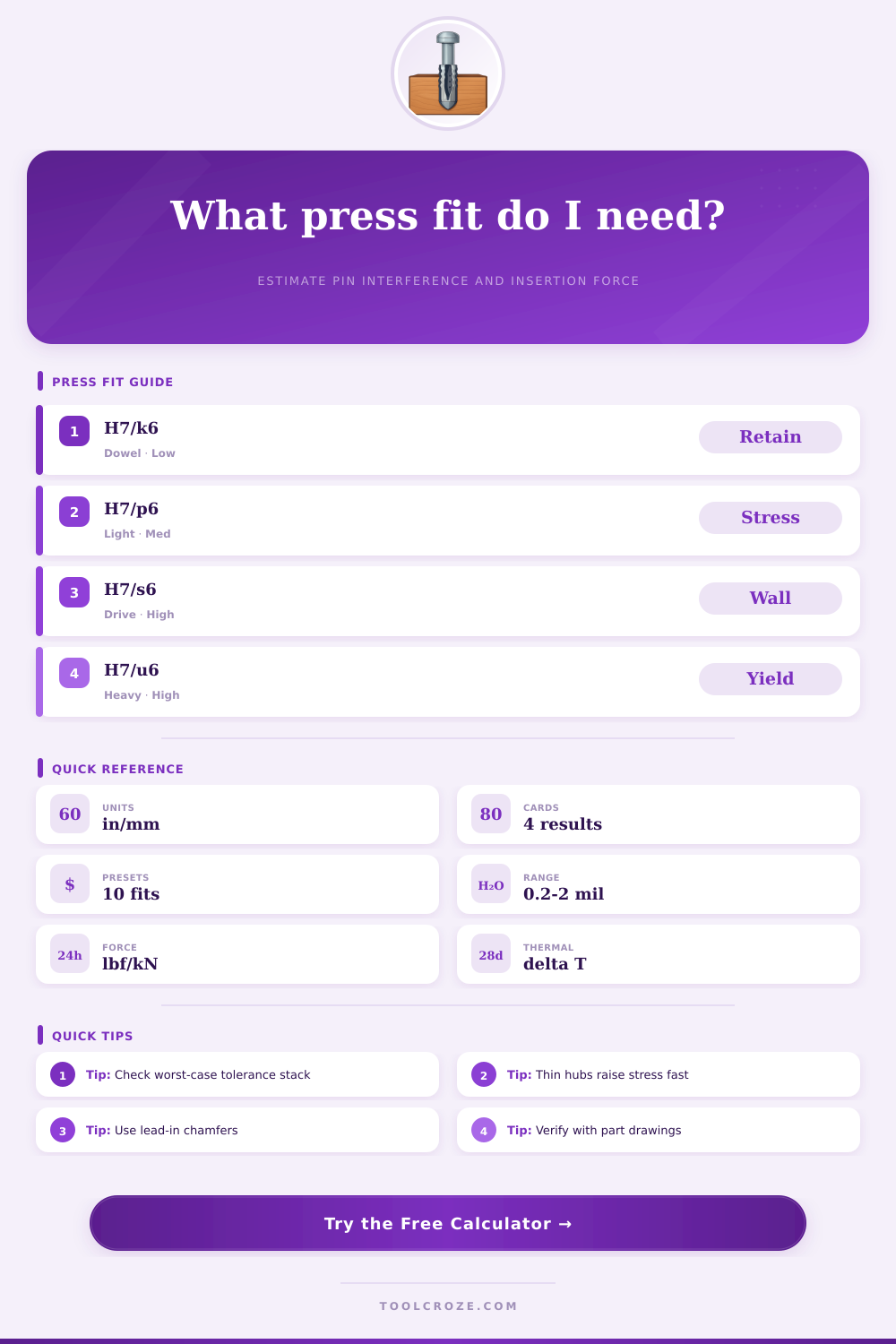
| Fit class | Typical use | Interference per inch | Design watchpoint |
|---|---|---|---|
| H7/g6 slip or location | Removable dowel, fixture location | Clearance to near line fit | Retention needs another feature |
| H7/k6 transition | Accurate dowel, light seating force | About 0.00015 in/in | May assemble by hand or light arbor press |
| H7/p6 light press | Small locating pins and light sleeves | About 0.00045 in/in | Confirm bore finish and lead-in |
| H7/s6 medium drive | Permanent pins and bearing seats | About 0.00075 in/in | Check hub stress and removal plan |
| H7/u6 heavy press | High retention steel-on-steel joints | About 0.00105 in/in | Risk of yielding thin or soft hubs |
| Material pair | Friction range | Thermal behavior | Practical note |
|---|---|---|---|
| Steel pin / steel hub | 0.10 to 0.18 | Similar expansion | Predictable pressure and strong retention |
| Steel pin / aluminum hub | 0.12 to 0.20 | Aluminum grows quickly | Operating heat can reduce interference |
| Steel pin / bronze bushing | 0.10 to 0.16 | Bronze grows more than steel | Good bearing behavior but softer hub |
| Steel pin / acetal plastic | 0.18 to 0.35 | Large thermal and creep effects | Use low pressure and mechanical backup |
| Hub OD / bore ratio | Suggested factor | Stress tendency | Use when |
|---|---|---|---|
| 3.0 or larger | 0.85 to 1.00 | Lower expansion strain | Massive housing or backed boss |
| 2.0 to 3.0 | 1.00 to 1.20 | Moderate expansion strain | Common machined hub or link |
| 1.6 to 2.0 | 1.20 to 1.45 | High local hoop stress | Compact bosses and thin plates |
| Below 1.6 | 1.45 to 1.70 | Very high split risk | Use FEA, tests, or redesign |
| Assembly method | Temperature assist | Force effect | Watchpoint |
|---|---|---|---|
| Room-temperature arbor press | 0 | Highest direct force | Needs alignment and smooth lead-in |
| Warm hub | 100 to 250°F | Reduces fit pressure during insertion | Protect seals, coatings, and hardness |
| Chilled pin | Dry ice or freezer range | Can remove several tenths on small pins | Condensation changes friction |
| Hydraulic press | Optional | Handles long engagement or high friction | Use guards and a force limit |
A press fit are when a person forces a part that is more larger than the part that is to be fitted into the smaller part. The process of create a press fit is based off the relationship between the larger part (pin) and the smaller part (bore). In a press fit, there is interference between the pin and bore.
Interference is the difference in sizes between the pin and bore. Because the pin is a larger part than the bore, the pin will push against the wall of the bore, forcing the bore to expand. This expansion is referred to as an elastic deformation of the bore; elastic deformation is the process of a material change shape under a given pressure, but returning to it’s original shape once the pressure are removed.
Press Fit Basics and Things to Think About
The materials used to create a press fit is also important. For instance, steel and aluminum are two materials that is often used to create press fit. Steel is a very stiff material, so it does not expand easily.
Aluminum, however, have a lower modulus of elasticity than steel, meaning that aluminum will expand more easy than steel will. Thus, if an aluminum bore is used, the aluminum will expand more easy than if a steel bore are used. For these reason, it is possible to use a tight interference fit in aluminum, but over time the aluminum may loosen.
In addition to the material choice for a press fit, the designer must consider manufacturing tolerances. Tolerances is the allowed variations in the sizes of the pin and bore. It is unlikely that pins will always be the same size, and bores will always be the same size.
If the designer manufactures the pin to be at the largest end of its tolerance, and the bore is manufactured to be at the smallest end of its tolerance, the interference between the two will be greater then the calculated interference. This high level of interference may lead to the splitting of the bore. Therefore, the designer must calculate for the worst case manufacturing tolerance to avoid creating a press fit that is too tight to assemble.
The designer must also consider the geometry of the hub (the component that contain the bore). Hubs may be of different thicknesses. Thick hubs will resist expansion by the pin that is forced into the bore.
Thin wall will expand more easy, and thin walls are more likely to fail. The ratio of the outside diameter of the hub to the diameter of the pin must be consider. A low ratio indicates thin walls, which may lead to the hub yielding or splitting during the press fitting of the pin.
Another factor in the creation of a press fit is the insertion force. Friction between the pin and bore will impact the insertion force. Pins that is lubricated will have less friction between the pin and bore than dry pins.
Thus, less insertion force will be required for lubricated pins. If the pin tilts during insertion, the pin will wedge into the bore. It is more difficult to insert pins that wedge into the bore than pins that are straight.
Thus, pins can be chamfered on the ends to allow the pin to be inserted without tilting; these chamfers are referred to as lead in chamfers. It is also possible to assist in the assembly of the press fit with thermal assistance. Thermal assistance involve heating one of the parts (the hub) or chilling the other part (the pin).
Aluminum has a high rate of thermal expansion. Thus, heating the aluminum hub will expand the bore, allowing the pin to be inserted more easyly into the bore. Once the aluminum and pin reach an equilibrium in temperature, each material will return to its original dimension, creating an interference fit.
Finally, one last factor to consider in the creation of a press fit is the yield strength of the material. If the interference is within the elastic region of the material, the material will return to its original shape. However, if the interference is too high, the material may go into the plastic deformation zone.
Plastic deformation of a material is a permanent change of the material’s dimension. Thus, when plastic deformation occur, the material will not return to its original size. Plastic deformation will also weaken the material, and may lead to stress crack in that material.
The interference should of be the minimum amount of interference required to retain the pin in the bore; any additional interference increase the risk of plastic deformation and failure of the press fit.