
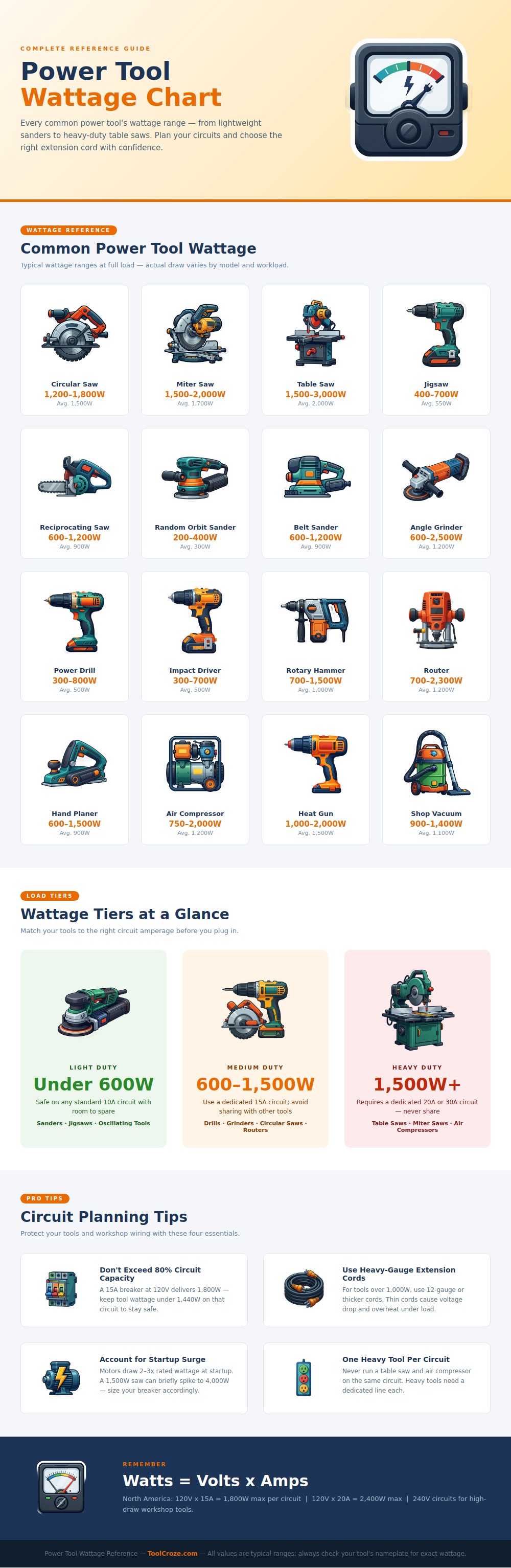
Power tool use electricity to perform work. Different type of power tools require different amounts of electricity to perform there work. Each circuit within an electrical system have a limit to the amount of electricity that it can carry.
The amount of electricity that a tool require can be more than the amount that a circuit can carry. In this case, the circuit breaker within the circuit will trip. When a circuit breaker trips, the electricity within the circuit stop.
Match Power Tools to the Right Circuits
It is important to understand the amount of electricity that a power tool requires because not all power tools requires the same amount of electricity. Power tools can be categorized into three different tier according to the amount of electricity that they require to perform there work. Tools that are considered to be light only requires a small amount of electricity.
Tools that are considered to be medium require a considerable amount of electricity. Tools that are considered to be heavy require a large amount of electricity. Tools that are heavy often require more electricity then a standard 15-amp circuit can provide.
Tools of this category will require circuits that are constructed to handle higher amperages. You can use the provided chart to determine the tier of each of the power tools so that they can be appropriately placed into an electrical outlet. People often make mistakes with power tools because they often believe that each outlet within a workshop will provide the same amount of electricity to each tool.
The electricity provided to a 15-amp line will only provide a certain amount of electricity before the circuit breaker within the line will trip. If the limit of the 15-amp line is exceeded, the circuit breaker will open and the electricity will stop providing power to the tool within the circuit. The chart makes it possible to see the different tiers of power tools so that people can avoid tripping a circuit breaker.
Another issue with power tools is the phenomenon of startup surge. Motors that are within power tools requires more electricity when they are starting up than they require while in operation. Therefore, a power tool that is rated to require a moderate amount of electricity will experience a surge of electricity while the motor start up.
If the electricity within the circuit where the tool is used is already near its limit due to another tool drawing electricity, the startup surge will cause the circuit breaker to trip. You can avoid this problem by providing each high-draw power tool its own circuit. Another problem is the use of extension cord.
Using thin extension cords can create a drop in the voltage of the electricity that is provided to a power tool. To compensate for the dropped voltage, the motor within the power tool have to draw more electricity. This creates heat in the extension cord as well as within the power tool.
This heat will shorten the life of the switches and the windings within the power tool. A thick extension cord must be used for power tools that require heavy amounts of electricity. Using a thick extension cord will prevent the heat that is created by the power tool and extension cord from reaching a temperature that will shorten the life of those tool.
Workshops often change over time. Workshops that are used for heavy use may eventually contain many power tools within the workshop. An outlet may begin as the location where one tool is plugged into.
Over time, the outlet may contain a compressor, saw, and vacuum. Eventually, the amount of electricity that is drawn by these tools may reach the limit of the circuit. The cumulative load of the tools in one outlet can reach a level that cause the circuit breaker to trip.
You can make a map of the power tools in a workshop to each outlet in the shop to ensure that the breaker does not trip. Air compressors create special problem for workshops because the motor within the air compressor will start and stop during its use. Each time the air compressor’s motor starts, the motor creates a surge of electricity.
Therefore, even if the air compressor is a moderate tool, it may appear to behave like a heavy tool. Therefore, an air compressor should be provided its own dedicated circuit within the shop. Dust collection tools such as vacuums and dust extractors will run for long periods of time.
The tools will draw electricity continuously. The cumulative amount of electricity drawn by a saw and a shop vacuum may be too much for the outlet where the shop vacuum is placed. To avoid this problem, a dedicated circuit should be provided for all dust collection tool.
The process of planning the circuits in a workshop is to associate the amount of electricity that a power tool requires to the electrical capacity of the circuits. The numbers on the nameplate of the power tool indicate the amount of electricity that the tool requires. The number on the circuit breaker indicate the amount of electricity that the circuit can provide.
If the amount of electricity that a power tool needs is equal to the electrical capacity of the circuit, the work will proceed without interruption. If the amount of electricity that a power tool needs is not equal to the electrical capacity of the circuit, the circuit breaker will trip. By using the information in the provided chart, you can make the relationship between the power tool and the circuit visible so that the workshop can be planned accordingly.
