⚡ Power Generator Size Calculator
Calculate the exact generator wattage you need — add appliances, set surge factors, and get a recommended generator size instantly.
Add each appliance. Enter running watts and starting watts (motors need 2–3x running watts at startup). Quantity sets how many of each run simultaneously.
| Appliance | Running W | Starting W | Qty | Hours/Day | Action |
|---|
| Appliance | Running Watts | Starting Watts | Surge Factor | Typical Hours/Day |
|---|---|---|---|---|
| Refrigerator (standard) | 150 W | 600 W | 4x | 24 |
| Window AC 5,000 BTU | 500 W | 1,500 W | 3x | 8–12 |
| Window AC 10,000 BTU | 1,200 W | 3,600 W | 3x | 8–12 |
| Central AC 3-ton | 3,500 W | 10,500 W | 3x | 6–10 |
| Furnace Fan (gas heat) | 500 W | 1,000 W | 2x | 4–8 |
| Sump Pump 1/2 HP | 800 W | 2,000 W | 2.5x | 2–6 |
| Well Pump 1 HP | 1,000 W | 3,000 W | 3x | 2–4 |
| LED Lights (per 5) | 50 W | 50 W | 1x | 6–10 |
| Microwave Oven | 1,200 W | 1,200 W | 1x | 0.5–1 |
| Electric Stove (1 burner) | 1,500 W | 1,500 W | 1x | 1–2 |
| TV 55" LED | 120 W | 120 W | 1x | 4–8 |
| Laptop | 65 W | 65 W | 1x | 8–12 |
| Circular Saw 15A | 1,800 W | 5,400 W | 3x | 1–4 |
| Table Saw 3 HP | 2,200 W | 6,600 W | 3x | 1–4 |
| Air Compressor 2 HP | 1,500 W | 4,500 W | 3x | 1–3 |
| Welder 140A | 4,000 W | 4,000 W | 1x | 1–3 |
| Electric Water Heater | 4,500 W | 4,500 W | 1x | 2–4 |
| Chest Freezer | 100 W | 400 W | 4x | 24 |
| Generator Size | Fuel Type | Consumption at 50% Load | Consumption at 100% Load | Tank Size (typical) | Runtime (50% load) |
|---|---|---|---|---|---|
| 2,000 W | Gasoline | 0.10 gal/hr | 0.18 gal/hr | 1.0 gal | ~10 hrs |
| 3,500 W | Gasoline | 0.25 gal/hr | 0.45 gal/hr | 3.5 gal | ~14 hrs |
| 5,000 W | Gasoline | 0.35 gal/hr | 0.65 gal/hr | 6.5 gal | ~18 hrs |
| 5,000 W | Propane | 0.42 lb/hr (0.75 gal/hr) | 0.80 lb/hr | 20 lb tank | ~9 hrs |
| 7,500 W | Gasoline | 0.52 gal/hr | 0.95 gal/hr | 8.0 gal | ~15 hrs |
| 10,000 W | Diesel | 0.35 gal/hr | 0.70 gal/hr | 8.0 gal | ~23 hrs |
| 10,000 W | Propane | 1.15 gal/hr | 2.20 gal/hr | 500 gal tank | ~435 hrs |
| 20,000 W | Diesel | 0.85 gal/hr | 1.65 gal/hr | 50 gal | ~59 hrs |
| Altitude (ft) | Altitude (m) | Power Derating | Available Power (5,000W gen) | Note |
|---|---|---|---|---|
| 0 – 1,000 | 0 – 305 | 0% | 5,000 W | Full rated power |
| 1,000 – 2,000 | 305 – 610 | 3.5% | 4,825 W | Minimal reduction |
| 2,000 – 4,000 | 610 – 1,219 | 7% | 4,650 W | Slight reduction |
| 4,000 – 6,000 | 1,219 – 1,829 | 12% | 4,400 W | Notable reduction |
| 6,000 – 8,000 | 1,829 – 2,438 | 18% | 4,100 W | Consider uprating |
| 8,000 – 10,000 | 2,438 – 3,048 | 24% | 3,800 W | Uprate gen size |
| 10,000+ | 3,048+ | 30%+ | 3,500 W | High-altitude kit needed |
Figuring out the right size of Power Generator depends really on one main thing: knowing what devices you want to use. It is useful to start with a list of all tools and machines that you need to power, and then add their wattages. The bigger the amount of watts, a portable Power Generator can support more devices and tools at the same time.
The total wattage shows the right size of the Power Generator so it matters to understand the power needs of every device.
How to Choose the Right Generator Size
There are two main numbers that one must note. Every device has a starting load and running load. The starting draw usually beats the running draw by a lot, and that usually decides the needed size of the Power Generator.
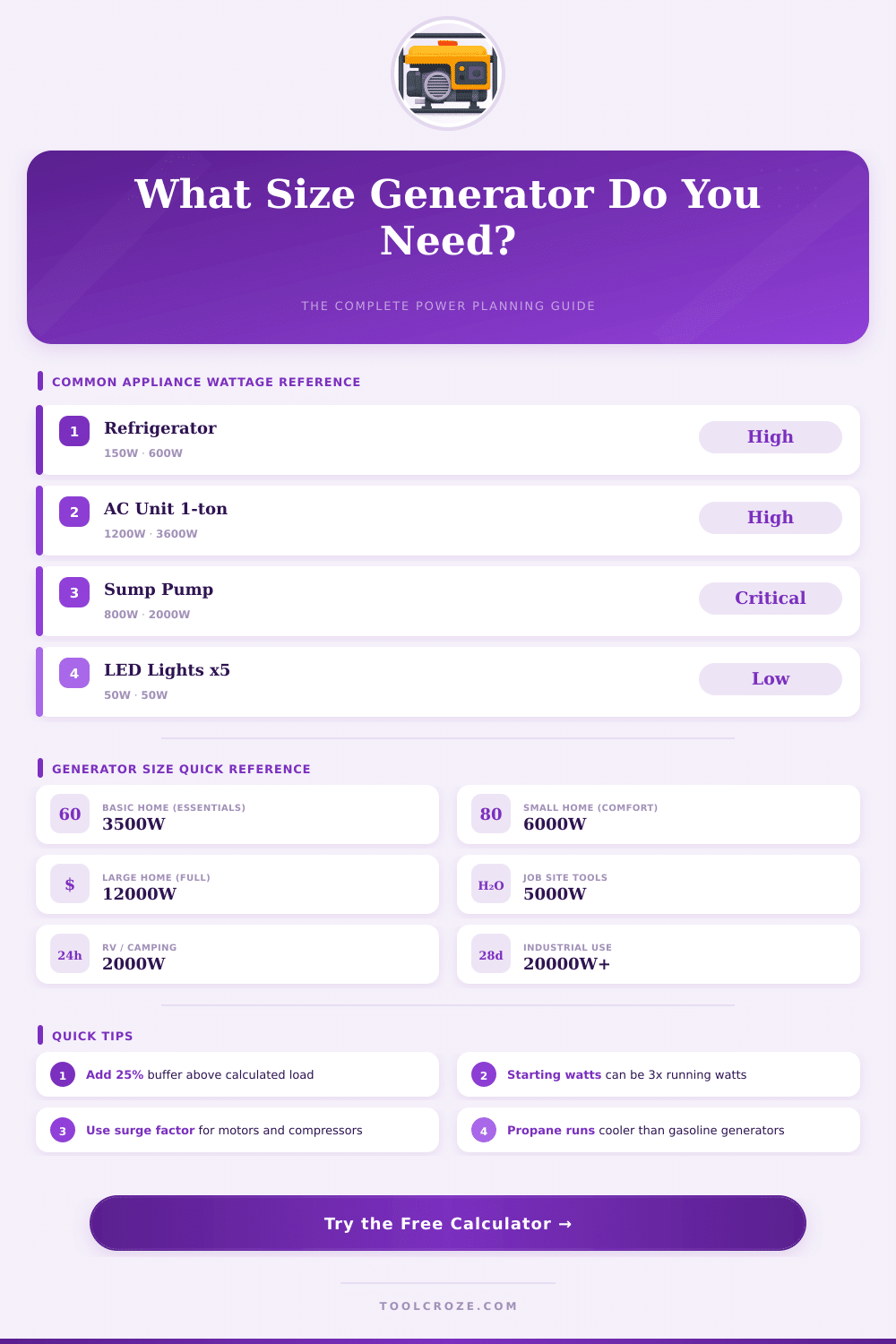
It is good to add around 25 percent for extra space or for sudden extra needs when one measures the loads. Some experts even go at least 50 percent above your need, because one can forget something or want to add extra stuff like a television computer or charger for a phone.
For a typical family, between 5 000 and 8 000 watts of output should be enough to power home devices and systems. Even so that is only a rough rating. A Power Generator of 3 200 watts with double fuel load and backup method can support a fridge and a small window air unit, if one skips the biggest devices.
Rather, standby Power Generators in a range of 15 to 25 kW can automatically power a hole house through a transfer switch.
A Power Generator of 11 000 watts can power a house of 1 700 square feet with a 2.5-ton cooling unit without problems, if the cooler is the only 240-volt circuit in use. Other times, folk with a house of 1 750 square feet used only three circuits from a 3 000-watt portable Power Generator during winter blackouts. Really everything depends on your priorities.
Power Generators are rated in kilowatts or kilovolt-amperes. Global rules give Power Generators a power factor of 0.8, which matters for matching the load with the size of the Power Generator. A Power Generator rated at 100 kVA with 0.8 power factor would be too small for gear that needs the full rated amount.
It is helpful to size your Power Generator so that the highest steady load does not pass 80 percent of therating of the Power Generator.
For heavy tools and small tasks, like drilling or sanding, that work with a 1 kW Power Generator. A Power Generator of 5 000 watts handles up to 20 amps. The monthly power use does not really help for sizing a Power Generator.
What matters is the watts that you need right now, at the same time.