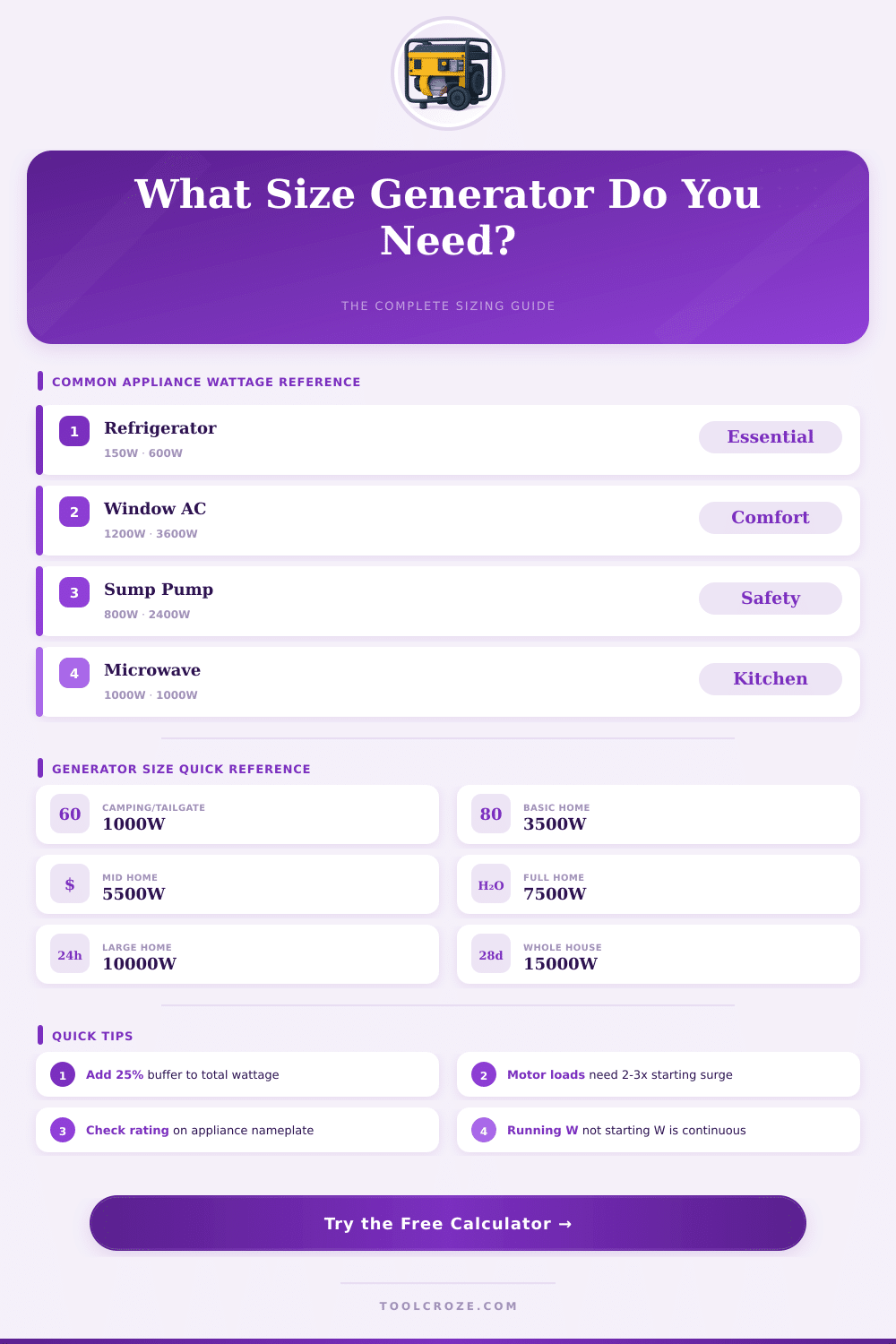
⚡ Portable Generator Size Calculator
Select your appliances, enter quantities, and instantly find the right generator wattage for your needs
| ✔ On | Appliance | Qty | Running Watts | Starting Watts | Notes | Remove |
|---|---|---|---|---|---|---|
| TOTALS | 0 W | 0 W | ||||
| Appliance | Category | Running Watts | Starting Watts | Notes |
|---|---|---|---|---|
| Refrigerator (18 cu ft) | Kitchen | 150 W | 600 W | Motor surge 4x run |
| Chest Freezer (15 cu ft) | Kitchen | 100 W | 400 W | Motor surge 4x run |
| Microwave (1000W) | Kitchen | 1,000 W | 1,000 W | No motor, no surge |
| Electric Stove (1 burner) | Kitchen | 1,500 W | 1,500 W | Heating element |
| Coffee Maker | Kitchen | 800 W | 800 W | No surge |
| Window AC (10,000 BTU) | Comfort | 1,200 W | 3,600 W | Motor surge 3x run |
| Central AC (3 ton) | Comfort | 3,500 W | 10,500 W | Motor surge 3x run |
| Portable AC (12,000 BTU) | Comfort | 1,400 W | 4,200 W | Motor surge 3x run |
| Ceiling Fan | Comfort | 60 W | 70 W | Low surge |
| Box Fan | Comfort | 100 W | 120 W | Low surge |
| Space Heater (1500W) | Heating | 1,500 W | 1,500 W | No surge |
| Electric Furnace (blower) | Heating | 800 W | 2,400 W | Motor surge 3x run |
| Gas Furnace (blower only) | Heating | 600 W | 1,800 W | Motor surge 3x run |
| Sump Pump (1/2 hp) | Safety | 800 W | 2,400 W | Motor surge 3x run |
| Well Pump (1/2 hp) | Safety | 900 W | 2,700 W | Motor surge 3x run |
| LED Lighting (10 bulbs) | Lighting | 100 W | 100 W | No surge |
| Incandescent (10 bulbs) | Lighting | 600 W | 600 W | No surge |
| TV (55" LED) | Electronics | 100 W | 100 W | No surge |
| Laptop / Computer | Electronics | 65 W | 65 W | No surge |
| Phone Charger | Electronics | 20 W | 20 W | No surge |
| Internet Router | Electronics | 20 W | 20 W | No surge |
| Circular Saw (7-1/4") | Tools | 1,400 W | 4,200 W | Motor surge 3x run |
| Drill (1/2") | Tools | 700 W | 2,100 W | Motor surge 3x run |
| Table Saw (10") | Tools | 1,800 W | 5,400 W | Motor surge 3x run |
| Air Compressor (1 hp) | Tools | 1,000 W | 3,000 W | Motor surge 3x run |
| CPAP Machine | Medical | 60 W | 60 W | No surge |
| Oxygen Concentrator | Medical | 300 W | 600 W | Low surge |
| Electric Water Heater | Plumbing | 4,500 W | 4,500 W | No motor |
| Washing Machine | Laundry | 500 W | 1,500 W | Motor surge 3x run |
| Clothes Dryer (electric) | Laundry | 5,000 W | 6,750 W | 240V required |
| Class | Rated Watts | Peak Watts | Typical Fuel (gal/hr) | Best Use Case |
|---|---|---|---|---|
| Inverter Mini | 1,000 W | 1,200 W | 0.1–0.2 | Camping, phone charging |
| Inverter Compact | 2,000 W | 2,200 W | 0.1–0.3 | RV essentials, tailgate |
| Mid-Size Portable | 3,500 W | 4,000 W | 0.3–0.5 | Basic home backup |
| Standard Portable | 5,500 W | 6,500 W | 0.5–0.75 | Mid-size home, job site |
| Large Portable | 7,500 W | 9,000 W | 0.7–1.0 | Full home backup |
| XL Portable | 10,000 W | 12,000 W | 1.0–1.4 | Large home, AC + appliances |
| Heavy Duty | 12,000 W | 15,000 W | 1.2–1.8 | Large home + well pump |
| Semi-Pro | 15,000 W | 18,750 W | 1.5–2.2 | Whole house backup |
| Motor Size | Running Watts | Starting Surge | Surge Multiplier | Typical Appliance |
|---|---|---|---|---|
| 1/6 hp | 275 W | 825 W | 3x | Small pump, fan |
| 1/4 hp | 400 W | 1,200 W | 3x | Sump pump (small) |
| 1/3 hp | 500 W | 1,500 W | 3x | Refrigerator compressor |
| 1/2 hp | 800 W | 2,400 W | 3x | Sump pump, well pump |
| 3/4 hp | 1,100 W | 3,300 W | 3x | AC compressor (small) |
| 1 hp | 1,500 W | 4,500 W | 3x | Air compressor, large pump |
| 1-1/2 hp | 2,200 W | 6,600 W | 3x | Large compressor |
| 2 hp | 2,900 W | 8,700 W | 3x | Central AC (small) |
| 3 hp | 4,300 W | 12,900 W | 3x | Central AC (3 ton) |
| Scenario | Running Watts | Starting Surge | Recommended Generator |
|---|---|---|---|
| Camping Basics (lights + fan + phone) | 280 W | 300 W | 1,000 W inverter |
| Tailgate (TV + grill + cooler) | 600 W | 900 W | 2,000 W inverter |
| RV Essentials (AC + fridge + lights) | 1,700 W | 4,800 W | 3,500 W |
| Job Site (saw + drill + light) | 3,100 W | 9,300 W | 7,500 W portable |
| Basic Home (fridge + lights + fan) | 900 W | 1,800 W | 3,500 W |
| Home + Sump Pump | 1,700 W | 4,200 W | 5,500 W |
| Home + Window AC | 2,100 W | 5,700 W | 7,500 W |
| Full Home (all essentials) | 4,200 W | 11,700 W | 10,000 W+ |
| Home + Central AC (3 ton) | 7,700 W | 18,200 W | 15,000 W |
Picking the right size for a portable generator can seem hard. When one only considers the total amount of watts, one maybe believes that a 5300-watt model will suffice for powering your house. Even so that no always counts.
The best way to exactly estimate how many watts you require is to use a list of watts. List the devices that you want to run, and add their watt values.
Choose the Right Size Portable Generator
Portable generators normally have from 1 000 to 10 000 watts. They are compact, affordable and ideal for giving energy to basic devices during loss of electricity or while camping. In homes commonly one chooses models between 3 000 and 5 000 watts, that can back lights and basic devices.
Generators of around 2,0 to 2,4 kW work well for taks with little load or as a backup in emergencies.
Those little devices handle tasks with low energy needs well, for instance charging a phone during camping or using electrical tools at home. On the other hand, portable generators do not fit powering a whole house or location. Their tiny format makes it easy to move them around and lowers the cost.
To find the write size, consider both the continuous watts and the starting watt needs. For instance, if the devices require fully 4 200 continuous watts and the biggest starting spike is 3 600 watts, then the minimal capacity of the generator should be 4 200 continuous watts plus 7 800 starting watts. One can also simply add all continuous watts and add the biggest starting spike.
Some, that ran a refrigerator, freezer, lights and water pump, used a 5 500-watt generator and found that it works well.
For fun uses usually around 4 000 watts suffice. If one chooses a model of 5 000 watts, one reaches power that is commonly needed at locations, and can at the same time use several tools. A planer under load can draw more amps than one expects, so choosing at least 5 000 watts for heavy tools is a wise decision.
Inverter generators between 1 000 and 4 000 watts are more quiet and safer for sensitive devices, but they cost more when the size grows. Non-inverter portable models spin at 3 600 rpm and are not fully quiet. A unit of 2 000 watts should suffice for a desktop computer, but one must mind the limits.
During use of a generator with limited capacity, avoid running several heavydevices at the same time.
When power outages happen rarely and are short, portable generators can provide energy to some devices, until the service comes back. They operate around 6 to 18 hours depending on the amount of fuel. Having enough fuel available is important, because even the best generator will not run without it.