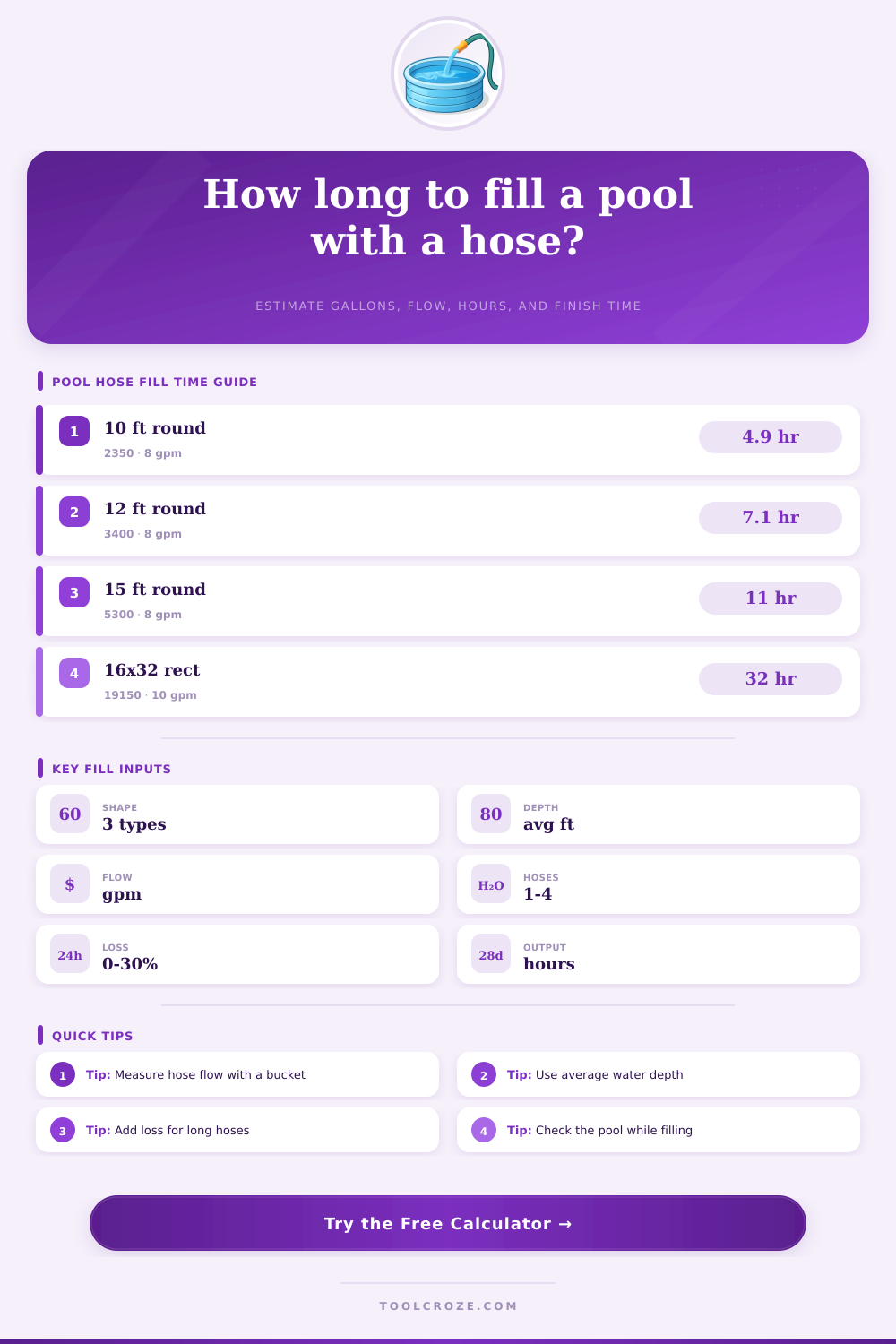
How Long to Fill Pool With Garden Hose Calculator
Estimate pool volume, adjusted hose flow, fill duration, and practical finish timing from pool shape, average depth, hose rate, and pressure loss.
Choose a common pool and hose setup, or enter your own measurements below.
Rectangular volume uses length times width times average depth.
For round pools, enter the inside diameter here.
For round pools this field is ignored by the formula.
Use average filled depth, not the wall height.
Use 100 for full volume, or lower for a normal waterline.
Time how long the hose takes to fill a known bucket.
Each hose is assumed to match the measured flow rate.
This reduces measured flow to a practical sustained rate.
Pool Fill Results
| Hose setup | Typical flow | Best use | Calculation note |
|---|---|---|---|
| 1/2 in hose, 50 ft | 4 to 6 gpm | Small inflatable pools | Higher friction, slower fill |
| 5/8 in hose, 50 ft | 6 to 10 gpm | Most backyard pools | Common default estimate |
| 3/4 in hose, 50 ft | 9 to 14 gpm | Large above ground pools | Better sustained volume |
| Two separate hoses | 12 to 22 gpm | Large in-ground fills | Works best from separate spigots |
| Pool shape | Volume formula | Imperial conversion | Metric conversion |
|---|---|---|---|
| Rectangular | L × W × D | cubic ft × 7.48052 = gal | cubic m × 1000 = L |
| Round | π × radius² × D | diameter / 2 = radius | diameter / 2 = radius |
| Oval | π × L/2 × W/2 × D | good for frame pools | good for frame pools |
| Target fill | full volume × fill % | normal waterline often 85-95% | normal waterline often 85-95% |
| Pool size | Average depth | Water to fill | Time at 8 gpm |
|---|---|---|---|
| 8 ft round | 2.0 ft | about 750 gal | about 1.6 hr |
| 12 ft round | 3.5 ft | about 3,000 gal | about 6.3 hr |
| 15 ft round | 4.0 ft | about 5,300 gal | about 11.0 hr |
| 16 x 32 ft rectangle | 4.5 ft | about 17,600 gal | about 36.7 hr |
| Condition | Loss setting | Example effect | When to use |
|---|---|---|---|
| Short, open hose | 0% to 5% | 8 gpm stays near 8 gpm | Spigot close to pool |
| Typical backyard run | 10% | 8 gpm becomes 7.2 gpm | Default safe estimate |
| Long hose with fittings | 15% to 20% | 8 gpm becomes 6.4-6.8 gpm | Several hose sections |
| Weak pressure | 30% | 8 gpm becomes 5.6 gpm | Low pressure or restrictions |
Filling a pool with a garden hose require a plan. A garden hose often provides a slow flows of water. The slow flow of water will take a long time to fill the pool.
The slow flow of water can be affected by the evaporation of the water due to the sun shining on the pool. A pool volume calculator can help to turn a guess of the amount of time that will be required to fill the pool into an plan. The pool volume calculator will ask for the shape of the pool, the average depths of the pool, and the flow rate of the garden hose.
How to Fill a Pool with a Garden Hose
The shape of the pool will determine the formula for calculating the volume of the pool. If the pool is a rectangular shape, the length of the pool multiplied by the width of the pool and the depth of the pool will calculate the volume of that pool. If the pool is a circular shape, the radius of the pool squared multiplied by the value of pi will calculate the volume of that pool.
If the pool is an oval shape, the calculation will treat the pool as a series of half circles and a rectangle. The shape of the pool is important because a small change in the diameter of the pool will add many gallon of water to the pool that must be pumped in. Adding many gallons of water to the pool will increase the time required to fill that pool.
The average depth of the pool must be measured to calculate the volume of the pool correctly. If the pool has both shallow and deep ends, only using the measurement of the deep end will result in an underestimation of the volume of the pool. To find the average depth, you can measure the depth of the shallow end of the pool and the depth of the deep end measured.
The average depth is the result of dividing the sum of these two depths by two. Using the average depth will ensure the calculated volume of the pool are accurate. The flow rate of the garden hose must be measured instead of relying upon the flow rate that the hose manufacturer provides.
To find the flow rate, you can measure the time that is required to fill a five-gallon bucket with the garden hose. Using this measurement, you can determine the flow rate of the hose. Using this flow rate in the calculator will allow for an adjustment for any loss of pressure in the hose that may result from the friction of the water in the hose.
The effective flow rate of the hose will be more useful than the most optimistic flow rate that can be advertised for the hose. Using multiple garden hoses will increase the flow rate of water that enters the pool. However, using multiple hoses does not always result in a flow rate that is double.
If two hoses are connected to the same spigot on the pool, the pressure of the water will decrease at that spigot. As a result, the flow rate will not be doubled. Instead, using separate spigots will allow hoses to be connected and will allow the flow rate to be entered into the calculator.
The target fill level for the pool should be set to the amount of water that is desired for the pool. Filling the pool to the very top of the wall is not necessary. A target fill level of 85 or 90% of the pool is all that is necessary.
Using these percentages as the target fill level for the pool will leave enough space for the waterline to remain below the top of the pool walls. Filling the pool to an 85 or 90% level will ensure that the pool is deep enough for swimming. These percentages can be entered into the pool volume calculator to determine the amount of time that will be required to fill the pool to the desired level.
There are a number of variables in the process of refilling the pool that the calculator cannot measure. The variables to consider include the amount of evaporation of the pool due to the wind, the number of gallons of water that may evaporate from the pool due to these factors, whether the spigot that the hose is connected to is clog, and whether the pressure of the city water supply is dropping. You should account for these variables by periodically checking the water level in the pool.
Checking the level of the pool will allow for adjustments to the timeline for refilling the pool. Local water restrictions should also be checked. The temperature of the water that comes from the city water lines may factor into how you refill the pool.
Using the hose to deliver cold water to the pool may make it uncomfortably for individuals to use the pool. In this case, the pool may be run with the hose during the nighttime hours when the water has time to warm up before entering the pool. The safety of the individual who is refilling the pool should be considered.
Leaving the hose in an unattended area may result in the pool filling beyond the capacity of the hose. Any mess that is created by the hose overflowing may be avoided by securing the hose to the pool wall with a weight or clip. The pool should also be checked every hour to ensure that the hose did not become detached from the spigot.
Knowing the finish time for refilling the pool is another helpful calculation that you can make by using the pool volume calculator. Knowing the finish time allows for the individual to plan there day around refilling the pool. Other tasks that can be scheduled are those that may require the pool to be filled, such as ordering pool chemicals.
Regardless of the size of the pool that is to be filled, there are certain variables that will always need to be accounted for, such as the depth of the pool, the flow rate of the hose, and the loss of pressure in the hose due to factors like elevation.