🧪 Polyester Resin to Catalyst Ratio Calculator
Size accurate MEKP additions by batch weight, temperature, thickness, filler load, and target gel time for laminating resin, gelcoat, tooling resin, and filled casting mixes.
📌 Presets
⚙ Batch Setup
🎯 Results
📊 Resin Family Comparison Grid
📑 Reference Tables
| Resin family | Density | MEKP range | Base gel | Typical use |
|---|---|---|---|---|
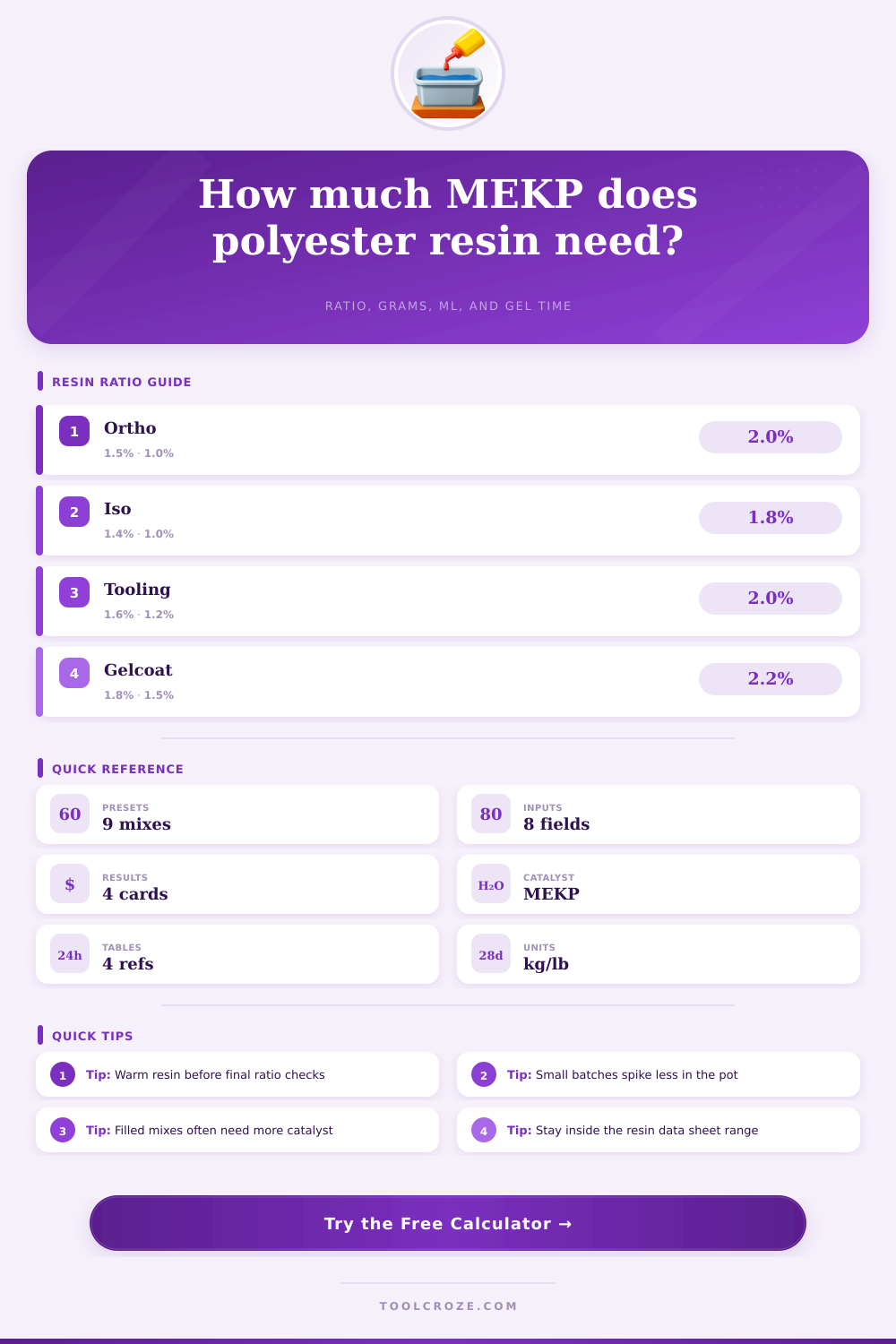
| Orthophthalic laminating | 1.11 g/mL | 1.0% to 2.0% | 18 min | General GRP layup |
| Isophthalic laminating | 1.12 g/mL | 1.0% to 1.8% | 20 min | Marine and tanks |
| Tooling resin | 1.16 g/mL | 1.2% to 2.0% | 16 min | Mold skins and backup |
| Gelcoat | 1.18 g/mL | 1.5% to 2.2% | 14 min | Spray and brush finish |
| Casting polyester | 1.09 g/mL | 0.8% to 1.5% | 28 min | Clear pours and embeds |
| Filled cultured marble | 1.45 g/mL | 1.4% to 2.2% | 17 min | Heavy mineral-filled pours |
| Fire-retardant polyester | 1.23 g/mL | 1.2% to 2.0% | 19 min | Panels and enclosures |
| Chopper gun backup | 1.10 g/mL | 1.2% to 2.0% | 15 min | Spray-up backup laminate |
| Shop temperature | Suggested shift | Why it changes | Practical note |
|---|---|---|---|
| 10°C / 50°F | +0.40% | Slow radical start | Warm resin if possible |
| 16°C / 61°F | +0.20% | Cool shop penalty | Smaller batches help |
| 21°C / 70°F | +0.05% | Near neutral | Standard cup checks |
| 25°C / 77°F | 0.00% | Reference condition | Base data-sheet point |
| 30°C / 86°F | -0.10% | Faster initiation | Watch pot heat |
| 35°C / 95°F | -0.20% | High exotherm risk | Reduce pail depth |
| Resin batch | At 1.0% | At 1.5% | At 2.0% | MEKP mL |
|---|---|---|---|---|
| 250 g | 2.5 g | 3.75 g | 5.0 g | 2.3 to 4.5 |
| 500 g | 5.0 g | 7.5 g | 10.0 g | 4.5 to 9.0 |
| 1.0 kg | 10.0 g | 15.0 g | 20.0 g | 9.0 to 18.0 |
| 2.5 kg | 25.0 g | 37.5 g | 50.0 g | 22.5 to 45.0 |
| 5.0 kg | 50.0 g | 75.0 g | 100.0 g | 45.0 to 90.1 |
| 10.0 kg | 100.0 g | 150.0 g | 200.0 g | 90.1 to 180.2 |
| Scenario | Thickness shift | Filler shift | Batch comment |
|---|---|---|---|
| 0.5 to 1.0 mm skin coat | +0.10% | 0.00% | Low section cools fast |
| 2 to 4 mm hand layup | 0.00% | 0.00% | Baseline laminate |
| 6 to 8 mm wet layup | -0.10% | 0.00% | Moderate exotherm |
| 10 mm plus pour | -0.20% | 0.00% | Lower the ratio first |
| 20% filler load | 0.00% | +0.06% | Slower through-cure |
| 40% filler load | 0.00% | +0.12% | Check cup gel again |
💡 Mixing Notes
This calculator estimates polyester resin MEKP ratios, catalyst grams, milliliters, and gel time from batch weight and shop conditions so you can plan mixes more consistently.
Polyester resins requires a specific amount of MEKP catalyst to allow the resin to undergo the chemical process of polymerizations. Polymerization is the process in which the MEKP catalyst break down to link the styrene molecules within the polyester resin. If there is too little MEKP catalyst within the polyester resin, the polyester resin will not polymerize proper, and the resin will remains tacky.
However, if there is too much MEKP catalyst within the polyester resin, the polymerization will occur too quick for the resin to properly manage the heat created during the polymerization process, or will create bubble within the resin. Because the amount of MEKP catalyst required to initiate polymerization vary, it is essential to find a balance between the cure time and working time of the polyester resin. The ambient temperature of the area in which the polyester resin will be cured is another primary factor that will affect the amount of MEKP catalyst required to initiate the polymerization of the polyester resin.
How Much MEKP to Use in Polyester Resin
If the polyester resin is cured in an environment that is cold, such as a 50-degree shop, the free radical will move more slowly within the resin, thus requiring more MEKP catalyst to initiate polymerization. Conversely, if the ambient temperature of the environment in which the polyester resin will be cured is hot, such as a 95-degree shop, the polymerization will occur more quick, thus requiring less MEKP catalyst to initiate the polymerization process. Thin layers of polyester resin will cool quickly, whereas thick layer of polyester resin will trap the heat created during polymerization, potentially leading to the polyester resin overheating.
The presence of filler within the polyester resin will also affect the amount of MEKP catalyst required to initiate polymerization. Fillers, such as calcium carbonate or ATH, will slow down the cure rate of the polyester resin. Therefore, if you add a large amount of filler to the polyester resin, you will require more MEKP catalyst to initiate polymerization to ensure that the polyester resin can cure through the mass of the amount of filler that was added.
Because fillers, temperature, and thickness can all affect the polyester resin, one ratio of MEKP catalyst will not work for every applications. Use a weight scale to avoid common mistake. Because the density of MEKP catalyst is 1.11 grams per milliliter, using volume measurements can introduce inaccuracies into you mix.
Adding more MEKP catalyst to a batch of polyester resin that has failed to cure will increase the heat of the reaction. The increased heat can ruin the batch of polyester resin. To ensure the resin cures correctly, always perform small test before adding the MEKP catalyst to your polyester resin in large quantities.
Using a small scale of 100 grams of polyester resin in the calculated ratio will allow you to observe the gel time of the resin. The gel time will allow you to observe how your batch of polyester resin and the temperature of your environment affects the curing of the resin. Using this sample of polyester resin, you can adjust the amount of catalyst for your larger project.
To manage your workflow while using polyester resin and MEKP catalyst effective, always add the catalyst to your polyester resin just before you plan to use it. Once you mix the catalyst into the polyester resin, the pot life of your resin begin. Always stir the resin to distribute the catalyst evenly throughout the resin.
However, do not stir the resin too much or you will introduce air bubble into the resin. Finally, always check the data sheet of the polyester resin you are using because different manufacturers makes resins that require different amount of MEKP catalyst to cure.