🔧 Pocket Hole Screw Length Calculator
Choose the right screw length for stock thickness, material, and joint style
| Stock | Length | Thread | Note |
|---|
| Material | Density | Thread | Use |
|---|
| Screw | Stock | Bite | Best fit |
|---|
| Project | Stock | Length | Thread |
|---|
Choosing the right length of pocket hole screws is really important The right size ensures a firm and safe fit, and stops problems as stripping, loosening or poking of the screw through the wood. Pocket hole joinery is a liked method for furniture making, from traditional to modern woodworking.
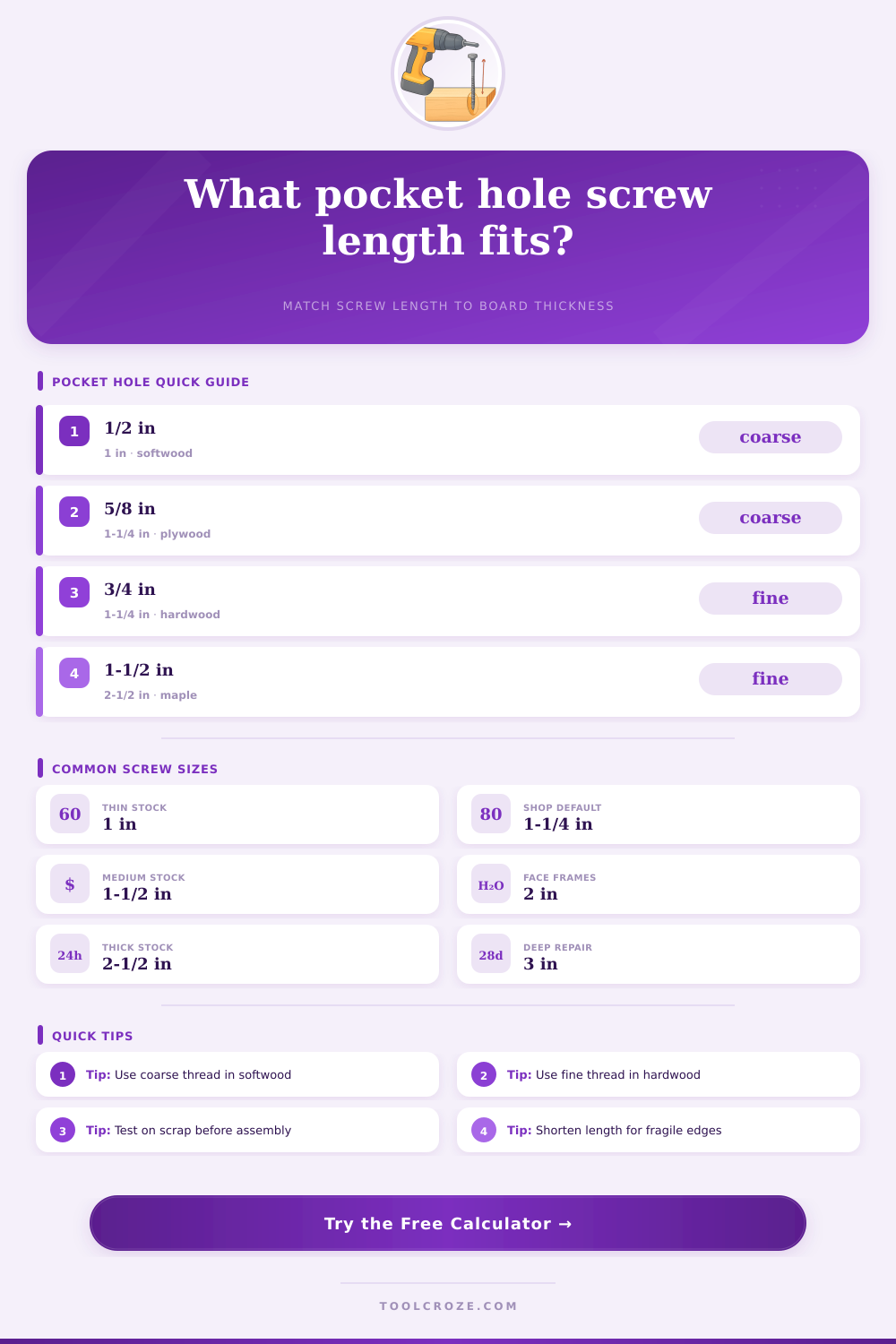
The screw length depends on the setting of the jig and the drill depth, which both relate to the thickness of the joined boards. It goes by the thickness of the materials. For half-inch wood, choose one-inch screws.
How to Choose the Right Pocket Hole Screw Length
For three-quarter-inch, use one-and-a-quarter-inch. For one-and-a-half-inch wood as 2x4s, take two-and-a-half-inch. Kreg gives a chart in the packging of the pocket hole jig, which explains everything.
Here is a bigger chart. Half-inch material uses one-inch screws. Five-eighths material also gets one-inch.
Three-quarter-inch requires one-and-a-quarter-inch. From seven-eighths to one-and-an-eighth material, use one-and-a-half-inch screws. One-and-a-quarter-inch and one-and-three-eighths wood requires two-inch.
And one-and-a-half-inch material gets two-and-a-half-inch screws.
Important thing to mind are the nominal against real board dimensions. The labels on lumber do not show the real size. They are nominal, so bigger than the actual.
Always check the actual thickness before choosing pocket hole screws.
One-and-a-quarter-inch screw works for most work with three-quarter-inch thick wood. Keeping some one-inch screws on hand helps for half-inch material. Pocket hole screws come in many lengths, from one-and-a-quarter-inch until two-and-a-half-inch.
When you build with different thicknesses of materials, count the ideal screw length for maximum strength, but so that it is not too long and does not poke through. The drill depth and screw length must adapt to the thickness of the board, which holds the pointy part of the screw. Test on scrap bits are excellent when you bind different thicknesses.
Also the thread type matters. For hard wood, choose fine threads. For soft wood or MDF, take coarse.
When you set a table apron to a top by means of pocket holes, consider the thickness of the apron and use shorter screws. For exterior use, stainless steel or corrosion-coated screws are the best choice.
The drill has a stop collar, which you must set according to the material thickness. With soft wood or plywood, it is easy to poke through if the screw is overdriven or the hole is drilledtoodeeply.