Pneumatic Cylinder Diameter Calculator
Size a pneumatic cylinder bore from required force, working pressure, load factor, rod-side selection, stroke speed allowance, mounting orientation, safety margin, and available bore sizes.
⚙Cylinder Sizing Presets
Pick a real machine situation, then adjust the pressure, rod diameter, force margin, or available bore series for your cylinder catalog.
📏Bore Diameter Inputs
The calculator converts internally and reports the selected bore in your chosen unit system.
Enter the actual machine force before safety margin and load-factor corrections.
Use regulated pressure after expected valve, hose, and fitting pressure drop.
This multiplier covers guide drag, seal stiction, and mechanism inefficiency.
Retract force is lower because the rod removes usable piston area.
Used for retract-side sizing and rod area loss. Leave small if unknown.
Stroke length sets cylinder air volume and speed-flow requirement.
Fast moves require more valve and line flow than slow clamping moves.
A dynamic allowance helps prevent undersizing when the load must accelerate quickly.
Orientation factor accounts for gravity, side loading risk, and mechanism geometry.
Margin is applied after load, orientation, and speed multipliers.
The calculator rounds up to the next available bore, not just the theoretical diameter.
Edit this list for stocked cylinders. Metric lists should be entered in millimeters when metric units are selected.
Recommended Pneumatic Cylinder Bore
Full Bore Sizing Breakdown
🏭Cylinder Material / Spec Grid
📊Standard Bore Force Reference
| Bore Diameter | Piston Area | Force at 80 PSI | Force at 100 PSI |
|---|---|---|---|
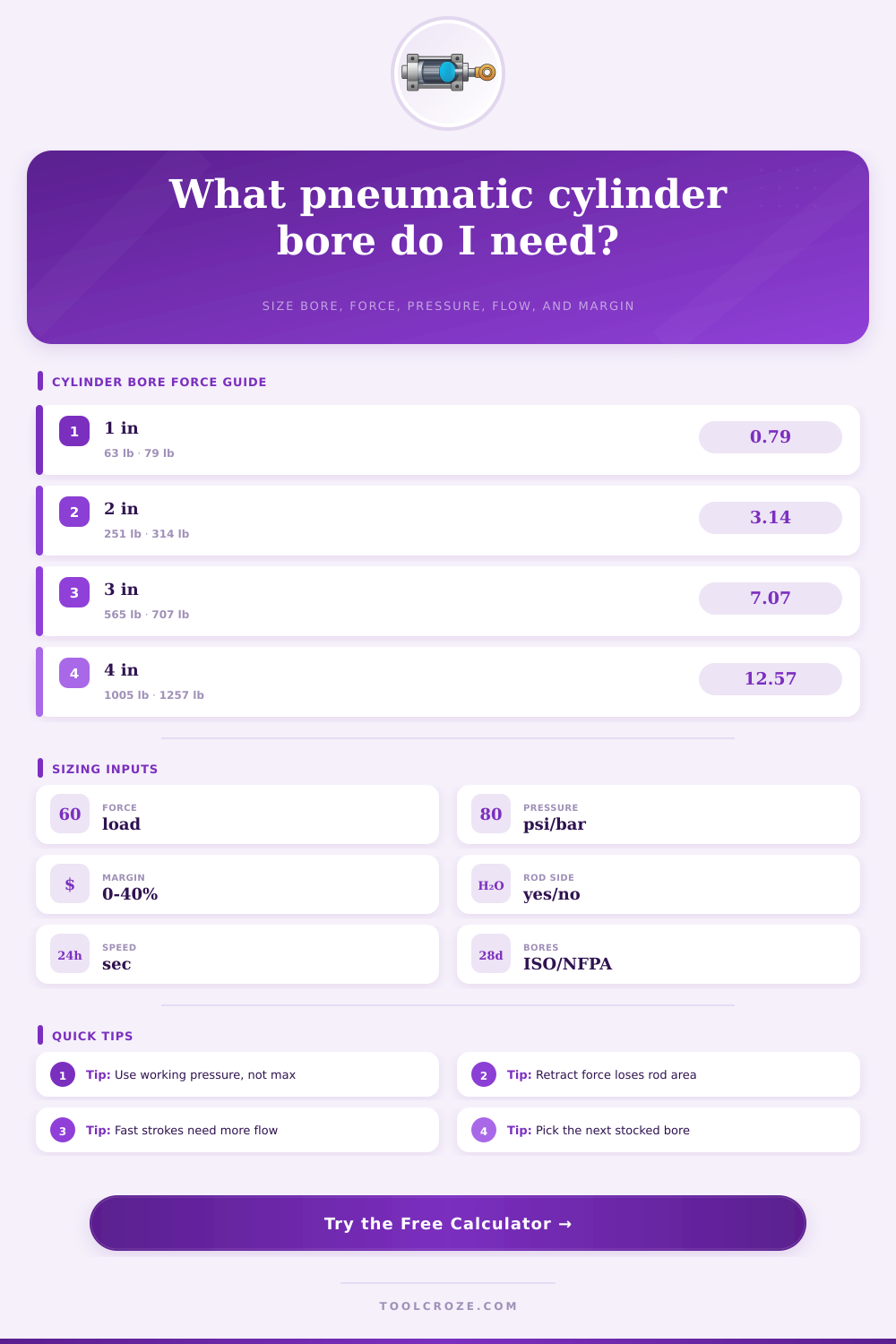
| 1.00 in / 25 mm | 0.79 in² | 63 lbf | 79 lbf |
| 1.50 in / 40 mm | 1.77 in² | 141 lbf | 177 lbf |
| 2.00 in / 50 mm | 3.14 in² | 251 lbf | 314 lbf |
| 2.50 in / 63 mm | 4.91 in² | 393 lbf | 491 lbf |
| 3.25 in / 80 mm | 8.30 in² | 664 lbf | 830 lbf |
| 4.00 in / 100 mm | 12.57 in² | 1005 lbf | 1257 lbf |
⇄Rod-Side Area Loss Reference
| Piston Bore | Rod Diameter | Retract Area Loss | Sizing Meaning |
|---|---|---|---|
| 1.50 in | 0.50 in | 11% | Retract force is close to extend force for light clamps. |
| 2.00 in | 0.75 in | 14% | Check pull loads before assuming the same bore works. |
| 2.50 in | 1.00 in | 16% | Common for guided slides and moderate pull force. |
| 4.00 in | 1.38 in | 12% | Large bores still need rod-area correction on retract. |
⏱Stroke Speed and Air Flow Guide
| Move Type | Typical Stroke Time | Flow Concern | Practical Check |
|---|---|---|---|
| Slow clamp close | 1.5 to 4 sec | Low SCFM, smooth control | Need stable pressure more than peak valve flow. |
| Pick-and-place transfer | 0.5 to 1.2 sec | Moderate valve Cv | Check cushion setting and load acceleration. |
| Ejector or diverter | 0.15 to 0.5 sec | High instantaneous SCFM | Valve, tubing, and exhaust speed controls dominate. |
| Heavy vertical lift | 0.8 to 2.5 sec | Force reserve and control | Add margin and verify safe holding method. |
🧭Mounting Orientation Factor Guide
| Orientation | Factor | When to Use | Design Note |
|---|---|---|---|
| Horizontal guided slide | 1.00 | Rails carry the side load. | Use the friction/load factor for guide drag. |
| Horizontal unguided load | 1.10 | Rod may see minor side force. | Add guides if side load is meaningful. |
| Pivoting link | 1.20 | Link angle changes mechanical advantage. | Size from the worst angle in the stroke. |
| Vertical lift | 1.25 | Cylinder raises the load against gravity. | Use proper load holding beyond air pressure alone. |
📝Practical Bore Sizing Notes
Pneumatic cylinder convert the energy in compressed air into straight-line motion. The bore diameters is the most important dimension of pneumatic cylinders because the bore diameter will determine if the pneumatic cylinder can perform the work that it is required for perform. If the bore diameter is too small for the task that the pneumatic cylinder must perform, then the pneumatic cylinder will stall when it encounters a load.
If the bore diameter is too large for the task, then the pneumatic cylinder will waste some of the compressed air that is supply to the pneumatic cylinder, and the pneumatic cylinder will slow down the machine to which it is attached. The first requirement for calculating the bore diameter is the force that the pneumatic cylinder must generate. The force for a pneumatic cylinder is the work that the pneumatic cylinder must perform.
How to Choose the Right Bore Diameter for a Pneumatic Cylinder
This force can be calculated by measuring the resistance that the mechanism offers. If an estimate of this force are used instead of measuring the actual force, then it is posible that the resulting pneumatic cylinder will have an incorrect bore diameter. The force that is calculated must then be multiplied by a friction and load factor to account for the friction that is create between the pneumatic cylinder’s internal components, and the load that may be placed upon the pneumatic cylinder during operation.
The second requirement for calculating the bore diameter for a pneumatic cylinder is the pressure that must be applied to the piston of the pneumatic cylinder to create the force that is required to perform the work of the pneumatic cylinder. The pressure that must be used in these calculation is the working pressure of the pneumatic cylinder that is supplied to the pneumatic cylinder’s port. It is important to use the working pressure instead of the pressure at which the air compressor will turn off (the cut-out pressure) because the cut-out pressure is always higher than the working pressure of the pneumatic cylinder.
The working pressure is the pressure that regulators, valves, and hose that is attached to the pneumatic cylinder supplies to the pneumatic cylinder. Another factor that must be considered in the calculation of the bore diameter of a pneumatic cylinder is the direction in which the pneumatic cylinder will move. The force that a pneumatic cylinder generates when the piston is extending is not the same than the force that is generated when the piston is retracting.
The force that is generated when the piston is extending is equal to the force that is generated when the pneumatic cylinder is pushing outward against an object. The retracting force is the force that is generated when the pneumatic cylinder is pull inward. The area of the piston that is occupied by the rod will reduce the force that the pneumatic cylinder generates during the retraction stroke.
Therefore, if the application of the pneumatic cylinder requires significant retraction force, then the area of the rod must be accounted for in the calculation of the required bore diameter of the pneumatic cylinder. Pneumatic cylinders also have to be sized according to the speed at which the pneumatic cylinder will move. The speed at which a pneumatic cylinder will move can be determined by the time that it will take for the pneumatic cylinder to travel the length of its stroke.
The stroke time will allow one to calculate the flow of air that will be required by the pneumatic cylinder. The faster that a pneumatic cylinder must move, the larger the air valve and the tubing that will be required to supply the necessary air flow to the pneumatic cylinder. The speed of the pneumatic cylinder will also introduce an allowance for the force that is required to accelerate the pneumatic cylinder to its required speed.
The increased force that is required for acceleration will lead to an increased required bore diameter for the pneumatic cylinder. The mounting orientation of pneumatic cylinder will also have an effect on the load that the pneumatic cylinder must overcome. The force of gravity will assist the movement of the pneumatic cylinder if it is mounted in a horizontal position.
However, the force of gravity will work against the movement of the pneumatic cylinder if the pneumatic cylinder is mounted in a vertical position. Therefore, if the pneumatic cylinder is mounted in a vertical position, the force of gravity will have to be accounted for in the calculations of the required bore diameter for the pneumatic cylinder. Safety margin must be incorporated into the calculations for pneumatic cylinders in order to account for any possibility of increased loads on the pneumatic cylinder or decreased supply pressures of the compressed air that is supplied to the pneumatic cylinder.
A safety margin can be incorporated into the calculations by multiplying the calculated value for the bore diameter of the pneumatic cylinder by a factor that represent the safety margin. A safety margin of 20% is often applied to the calculations. However, a higher safety margin may be required if the load on the pneumatic cylinder is likely to be variable, or if the failure of that pneumatic cylinder would be costly to the company that utilize that pneumatic cylinder.
The safety margin should only be applied to the calculations after the load, working pressure, and other factors have been applied to arrive at the theoretical bore diameter for the pneumatic cylinder. Once the manufacturer of the pneumatic cylinder has calculated the theoretical bore diameter for the pneumatic cylinder, it is still necessary to select a bore diameter for the pneumatic cylinder from those that are available in stock from the manufacturer of the pneumatic cylinder. Often, the theoretical bore diameter will be rounded up to the next available stock size of pneumatic cylinder.
In sizing pneumatic cylinders, many people tend to make mistakes. Often, people may not use the working pressure of the pneumatic cylinder in their calculations, but instead use the maximum rated pressure of the pneumatic cylinder. In addition, many people may not account for the area of the rod that is attached to the pneumatic cylinder’s piston when calculating the required bore diameter.
Another mistake that many people make is in the ignoring the importance of the stroke time of the pneumatic cylinder. Finally, although there are a variety of factors that must be considered in the sizing of pneumatic cylinders, the bore diameter of the pneumatic cylinder is the most important. The bore diameter will ensure that the pneumatic cylinder has enough force to perform the work that is required of it.