Pneumatic Conveying Calculator
Estimate air volume, solids loading ratio, pickup velocity margin, conveying phase fit, and pressure drop for dilute, medium, dense, or vacuum solids conveying lines.
Choose a starting point, then adjust the material, pipe, run, velocity, and phase to match your system.
Material presets set typical density and pickup speed, but density remains editable.
Phase changes velocity expectations and solids pressure loss factors.
0.075 lb/ft3 is standard atmospheric air; adjust for pressure, temperature, or altitude.
Conveying Results
| Material | Typical Bulk Density | Pickup Velocity | Handling Note |
|---|---|---|---|
| Plastic pellets | 32 to 38 lb/ft3 | 4000 to 4500 ft/min | Durable, dilute phase common |
| Wheat flour | 28 to 36 lb/ft3 | 3000 to 3600 ft/min | Dust control and venting matter |
| Portland cement | 80 to 95 lb/ft3 | 3300 to 4200 ft/min | Dense phase often reduces wear |
| Fly ash | 35 to 55 lb/ft3 | 3000 to 3800 ft/min | Can fluidize well when dry |
| Dry sand | 90 to 105 lb/ft3 | 4800 to 5600 ft/min | Abrasive; velocity raises wear |
| Phase Type | Typical Velocity | Solids Loading Ratio | Best Use |
|---|---|---|---|
| Dilute phase | 3500 to 6500 ft/min | 1 to 8 | General pellets, grains, powders |
| Medium phase | 2400 to 4200 ft/min | 8 to 20 | Shorter pressure systems |
| Dense phase | 900 to 2800 ft/min | 20 to 60 | Fragile or abrasive materials |
| Vacuum conveying | 3800 to 6500 ft/min | 1 to 5 | Pickup from bags or bins |
| Pipe ID | 3500 ft/min | 4500 ft/min | 5500 ft/min |
|---|---|---|---|
| 2 in | 76 CFM | 98 CFM | 120 CFM |
| 3 in | 172 CFM | 221 CFM | 270 CFM |
| 4 in | 305 CFM | 393 CFM | 480 CFM |
| 6 in | 687 CFM | 884 CFM | 1080 CFM |
| 8 in | 1222 CFM | 1571 CFM | 1920 CFM |
| Spec Item | Low Risk | Watch Point | Action |
|---|---|---|---|
| Pickup margin | 10 to 35 percent | Below 5 percent | Raise velocity or reduce pipe ID |
| Bend count | 0 to 4 bends | Over 8 bends | Use larger radius and review drop |
| Solids loading | Inside phase range | Outside phase range | Change phase, rate, or airflow |
| Vertical lift | Less than 30 percent of route | Tall risers | Allow extra pressure capacity |
Pneumatic conveying system use air to move bulk solids through pipes instead of using belts or screws to move the solids. Many companies prefers pneumatic conveying systems due to the ability of pneumatic conveying to contain the dust created during the conveying process within the pipes. Additionally, pneumatic conveying systems often have the ability to include multiple pickup points for the bulk solid and multiple discharge points for the bulk solids.
Furthermore, pneumatic conveying systems typically have small equipment footprint due to the ability of the conveying pipe to follow the route of the production facility. However, the air that is used in pneumatic conveying systems to move the bulk solids introduces a variety of different design considerations into the system; the air affect the pressure drop within the system, the velocity of the solids within the system, and the risk of saltation or plugging within the pneumatic conveying system. To understand the pneumatic conveying system, it is important to understand how the different variable relate to each other.
How Pneumatic Conveying Works and What to Check
For instance, the bulk density of the solids will affect the mass of air that is required to move those solids through the system. The rate at which the bulk solids are to be conveyed will impact the size of the blower that is required to provide the necessary air to the system. The diameter of the pipe through which the bulk solids are to be conveyed and the velocity of the bulk solids within that pipe will impact whether or not the solids will reach the minimum pickup speed necessary to convey the bulk solids along the system.
Additionally, the vertical lift that the conveying system must perform and the number of bend along the route of the conveying pipe will impact the resistance of the system against the movement of bulk solids. Finally, the choice of phase (dilute, medium, dense or vacuum) will determine the loading of bulk solids that the system will convey, as well as impact the calculation of the pressure drop along the system. Each of these variables has an impact upon the ability of the pneumatic conveying line to effectively convey the bulk solids through the system; if any of the variables are not accounted for properly, the bulk solids may settle within the pipe.
For example, if the velocity of the bulk solids within the conveying pipe is too low, the solids will not be effectively conveyed along the length of the system. Additionally, if the sizing of the blower is too large for the bulk solids conveying system that is to be created, both the energy that the blower will consume to effectively convey the bulk solids will be wasted, as well as the lifespan of the blower will be shortened due to the over-exertion of the blower motor. The calculator includes the math that is necessary to determine each of these variables after inputting the type of bulk solids that are to be conveyed, the length of the system, the diameter of the pipe that is to be utilized, and the length of the system run.
Pneumatic conveying systems are rarely constructed in manner that are represented by the calculator. For instance, the condition of the pipes changes over time due to the solids that are conveying through the system, as well as due to the wearing of the system over time. Additionally, the density of the air that is conveyed within the system changes due to the altitude at which the system is constructed, the temperature of the air within the system, and the vacuum or pressure of the blower that is utilized within the system.
For example, the blower will behave differently on a hot day than it will on a cold day. Finally, the bulk solids that are to be conveyed can introduce additional variable into the system. For instance, friable pellets will break down to create fines within the conveying system, and hygroscopic solids may tend to cake within the system if the air within the pneumatic conveying system is not conditioned for those solids.
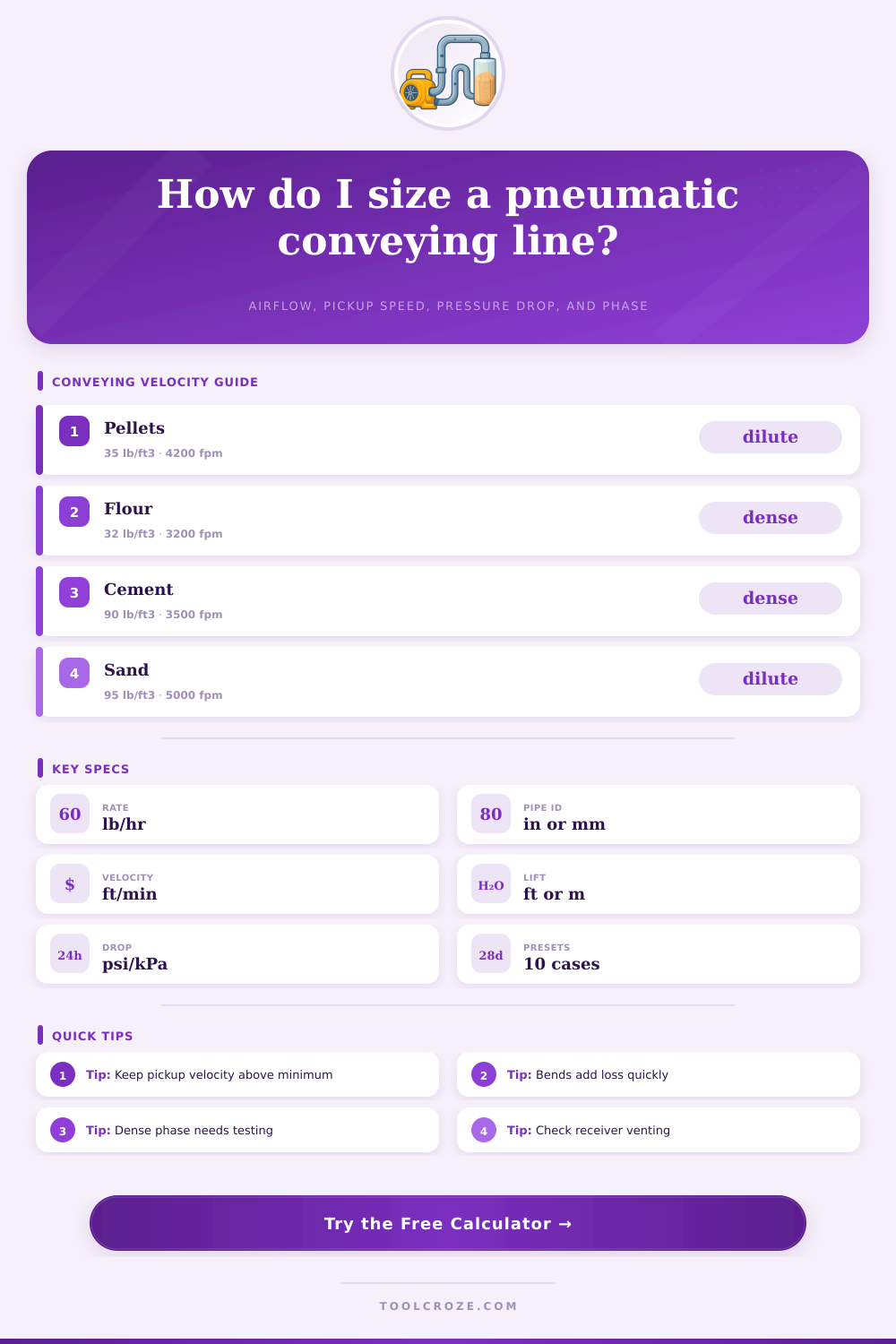
The reference table located on the page is used to provide typical velocities of bulk solids movement within pneumatic conveying systems according to the phase that is selected for the system, as well as the typical loading of bulk solids within those systems. For example, a dense phase cement conveying system will typically allow for higher loading ratio of bulk solids than a dilute phase cement system, but will require more control over the rate at which the bulk solids are fed into the system and vented from the receiver at the end of the conveyance system. The calculator will provide indications of when a proposed conveying system falls outside of the typical parameters for that type of system.
Additionally, the pickup margin is provided as a means of indicating the velocity of the bulk solids within the system. Results of the calculation indicate the margin that is provided for the minimum velocity of the bulk solids within the system; a result close to zero indicates that the system may experience saltation within the system. Similarly, the pressure drop calculation is used to provide an estimation of the pressure drop that will occur along the length of the conveying system.
This calculation also includes a design margin to allow for unknown variable within the system. However, the pressure drop variable is also provided only as an estimation; additional pressure drops may occur along system components such as feeders, diverters, filters, and leaks in the system that only become apparent after the system is constructed. Many mistake are made by those who construct pneumatic conveying systems.
For instance, many individuals will choose the diameter of the pipes for the conveying system first, and then attempt to choose the rate at which the bulk solids will be conveyed and the velocity at which the bulk solids will travel through the system to accommodate for the chosen diameter of the pipe. Such a choice of establishing the diameter of the pipe first may lead to issues with excessive pressure drop within the system, or the velocity of the bulk solids may be too high to allow for abrasion-resistant materials to last along the system. Additionally, many individuals do not recognize that the phase of the pneumatic conveying system is a variable that can be adjusted.
For instance, if the solids loading ratio of the bulk solids that are to be conveyed is outside of the expected range for that system, adjusting the phase of the system from a dilute phase to a medium phase or increasing the diameter of the pipe can solve such a problem more efficient than by purchasing additional blowers of the same size. Another common mistake is underestimating the impact that the bends within the pneumatic conveying system will have upon the pressure drop along that system. Each long-radius elbow within the conveying system will impact the pressure drop along that system; five or six such elbows within a short distance along the system may create a pressure drop that is equal to the drop along the length of the straight pipe sections of that system.
The calculator allows the individuals constructing the system to enter the number of bends within a pneumatic conveying system. It is important to read the safety note that is provided at the bottom of the calculator’s results. As with all systems that convey combustible dust through metal pipes at high speeds, there are safety risk related to the system related to static, overpressure, or explosions.
As a result, it is essential that the system be constructed with components like static control, explosion protection, and proper venting of the receiver into the atmosphere from the system. These components should be incorporated into the system from the beginning of its construction, and should not be constructed afterwards after determining that the pressure drop within the system is acceptable. Finally, it is important to understand that the pneumatic conveying system calculator is a screening device that takes the various measurable system components and outputs consistent results.
Consequently, the calculator allows for the discussion of the system to begin with numbers rather than assumptions about those numbers. The actual construction of the pneumatic conveying system will require additional consideration of the feeder, the filter, and the receiver component of the system. However, once established, the system will tend to convey the bulk solids reliably due to the consideration of each of these system variable before the metal conveying system components were ordered.