Plywood Sheet Weight Calculator
Estimate net plywood sheet weight from actual dimensions, thickness, core density, sheet count, moisture, density override, and rectangular or round cutouts.
▦Plywood Weight Presets
Load a common shop or jobsite panel, then adjust size, thickness, core, moisture, density, quantity, and cutouts.
⚙Sheet Weight Inputs
Calculation breakdown
▣Plywood Core and Spec Grid
📚Plywood Sheet Weight Reference Tables
| Core or species | Density at 12% MC | 4x8 1/2 in | 4x8 3/4 in |
|---|---|---|---|
| Softwood CDX sheathing | 34 lb/ft3 | 45 lb | 68 lb |
| Cabinet veneer core | 40 lb/ft3 | 53 lb | 80 lb |
| Baltic birch multiply | 44 lb/ft3 | 59 lb | 88 lb |
| Marine plywood | 46 lb/ft3 | 61 lb | 92 lb |
| Film faced form ply | 47 lb/ft3 | 63 lb | 94 lb |
| Common sheet | Actual dimensions | Area | Typical use |
|---|---|---|---|
| 4 x 8 ft | 48 x 96 in | 32 sq ft | Cabinets, sheathing, shop fixtures |
| 4 x 10 ft | 48 x 120 in | 40 sq ft | Tall cabinet sides and wall panels |
| 5 x 5 ft | 60 x 60 in | 25 sq ft | Baltic birch and drawer parts |
| 1220 x 2440 mm | 48.03 x 96.06 in | 32.04 sq ft | Metric cabinet and joinery panels |
| 1525 x 3050 mm | 60.04 x 120.08 in | 50.07 sq ft | Large marine, form, and specialty sheets |
| Thickness label | Decimal inches | Metric equivalent | Weight effect |
|---|---|---|---|
| 1/4 in | 0.250 in | 6.35 mm | One third of 3/4 in panel weight |
| 3/8 in | 0.375 in | 9.53 mm | Half of 3/4 in panel weight |
| 1/2 in | 0.500 in | 12.7 mm | Two thirds of 3/4 in panel weight |
| 5/8 in | 0.625 in | 15.9 mm | About 83 percent of 3/4 in weight |
| 3/4 in | 0.750 in | 19.1 mm | Common cabinet and structural baseline |
| Stack weight | Handling class | Practical lift aid | Planning note |
|---|---|---|---|
| Under 50 lb | Single light panel | Hand carry | Awkward size may still need a helper |
| 50 to 120 lb | Heavy single or small stack | Two-person lift | Support long edges to avoid bending |
| 120 to 500 lb | Shop stack | Panel cart or dolly | Secure panels before rolling or loading |
| 500 to 2000 lb | Pallet or bundle | Pallet jack or forklift | Check floor, rack, and vehicle capacity |
| Over 2000 lb | Bulk load | Rated lift equipment | Use qualified material-handling procedures |
💡Weight Estimating Tips
Plywood weight affect how you have to move the plywood with your hands and load it into a truck. A 4×8 sheet of three-quarter inch cabinet plywood weighs approximately eighty pound when the plywood is dry. However, if the plywood sheet become damp, the weight of the plywood increase.
In contrast, if you cut hole into the plywood sheets, the weight of the plywood decrease. You can use the calculator to determine the weight of the plywood sheets. By calculating the plywood weight, you can prepare a lifting plan to move the plywood and create rack to hold the plywood.
Plywood Weight and How to Move It Safely
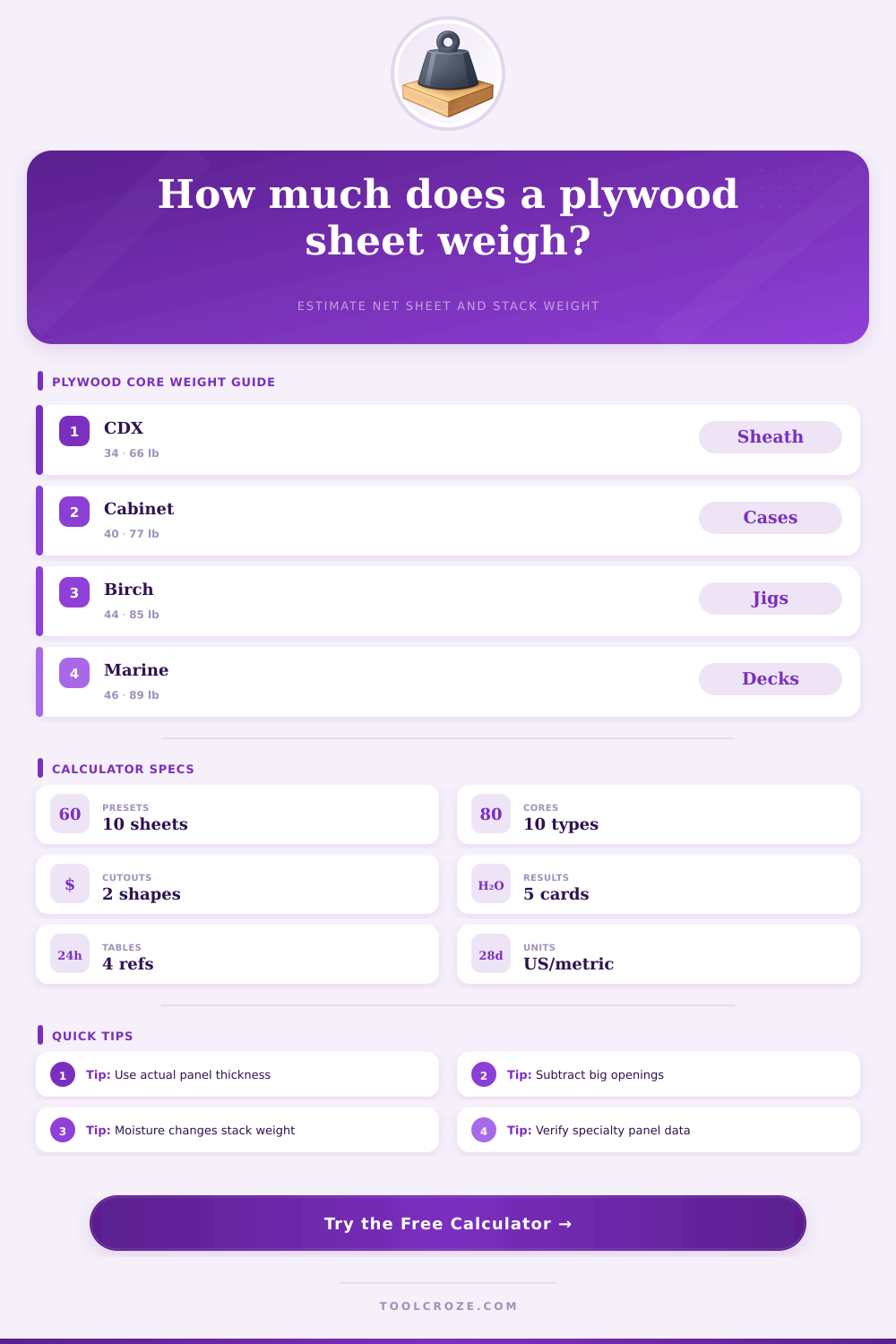
Core density have an impact on the weight of the plywood before moisture content is consider. For instance, softwood CDX sheathing have a density of approximately thirty-four pounds per cubic foot. Marine plywood panel have a density of approximately forty-six pounds per cubic foot.
Consequently, a stack of ten marine plywoods will weigh more than a stack of ten CDX sheathing plywood panels. The weight of the plywood panels vary by over two hundred pounds. The calculator allow the user to change the type of core of the plywood to check how the change in core type changes the weight of the plywood panels.
Moisture content is another factor that can impact the weight of the plywood. For instance, plywood typically have a moisture content of twelve percent when it is sold. However, if the plywood is left in a damp environment, the moisture content of the plywood can increase.
Each percent of moisture content to the plywood increase the weight of the plywood. You can enter the moisture content into the calculator to automatically recalculate the weight of the plywood sheets. By knowing the weight of the plywood with the moisture content can help to determine whether its necesary to allow the plywood to acclimate to the desired moisture level before lifting the plywood panels.
The third factor to consider is the impact that cutouts will have on the weight of the plywood. For instance, if plywood panels have cutouts to create windows, the volume of the plywood will decrease. Consequently, the weight of the plywood will also decrease.
The calculator automatically subtracts the volume of the cutouts from the total volume of the plywood sheet to determine the weight of the plywood with the cutouts. By calculating the weight of the plywood with cutouts, it prevents that you will prepare your lifting plan to handle a plywood sheet that weighs more than the actual weight of the plywood. A fifth factor to consider is the handling class of the plywood.
You can reference a table of weights and their relative handling class to determine the handling class of the plywood. For instance, one person can typically move plywood that weigh under fifty pounds. However, plywood that weigh over five hundred pounds may require the use of mechanical help to move the plywood.
The calculator includes the sheet count and a handling margin that contribute to the determination of the plywood handling class. The sixth factor to consider is the panel stiffness. For instance, it is more difficult to move a thin but dense sheet of plywood than it is to move a thick sheet of plywood that is light in weight.
Consequently, the stiffness of the plywood can impact how difficult it is to move the plywood. Consequently, many will test the stiffness of the plywood by moving a single sheet of plywood prior to moving a stack of plywood. Overall, the purpose of calculating the plywood weight is to change an unknown weight to a known weight.
By knowing the weight of the plywood, it is possible to determine the proper type of cart to use to move the plywood, to clear a path for moving the plywood, and to assign a lift to a team without experiencing any surprises. Furthermore, by knowing the weight of the plywood, the plywood and the individuals moving the plywood will stay safely.