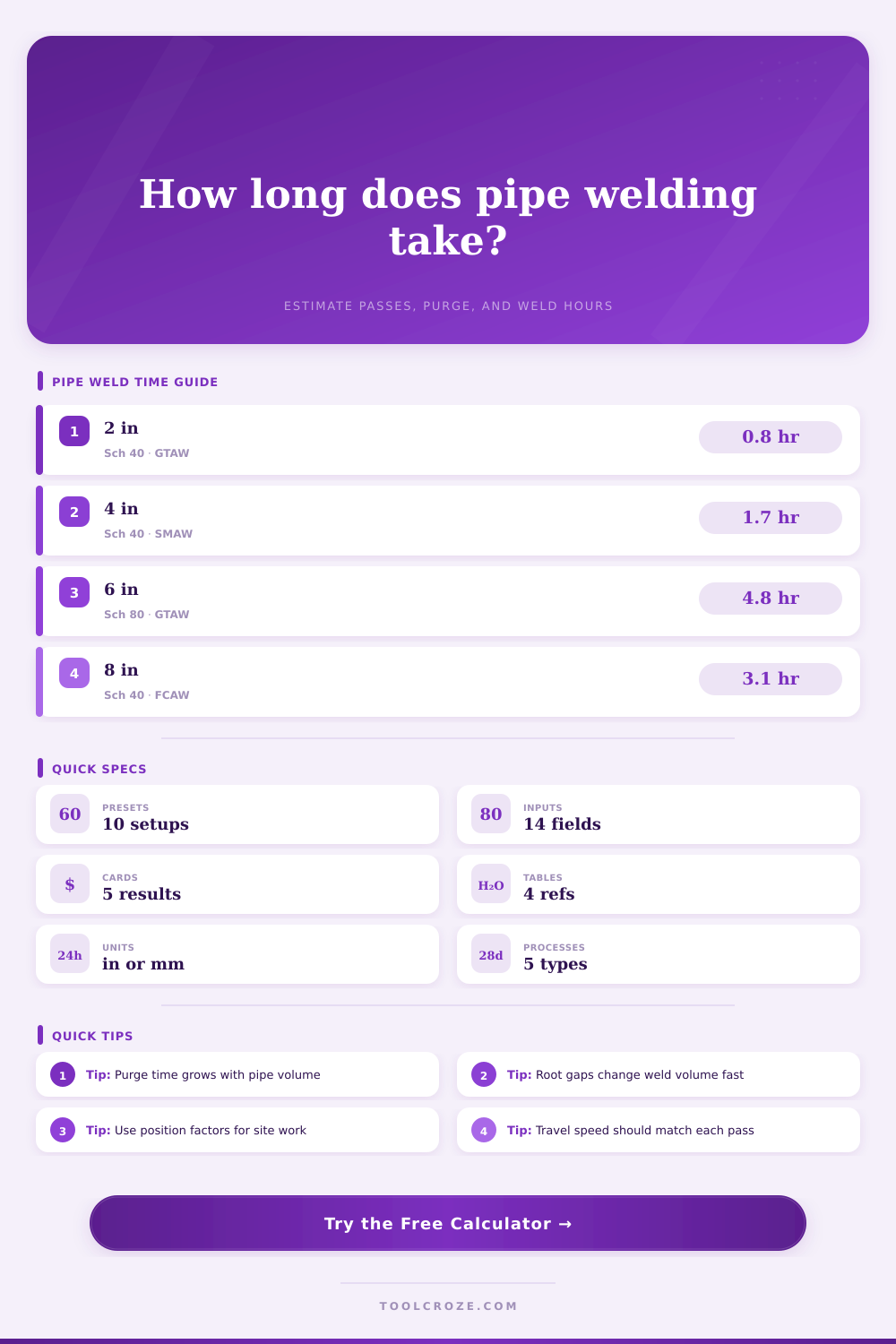
Pipe Welding Time Calculator
Estimate pipe weld circumference, pass count, weld metal, arc time, purge time, tack time, and total weld station hours from practical shop inputs.
Pipe Weld Time Estimate
| Nominal Pipe | Actual OD | Sch 10 Wall | Sch 40 Wall | Sch 80 Wall |
|---|---|---|---|---|
| 1 in | 1.315 in | 0.109 in | 0.133 in | 0.179 in |
| 2 in | 2.375 in | 0.109 in | 0.154 in | 0.218 in |
| 3 in | 3.500 in | 0.120 in | 0.216 in | 0.300 in |
| 4 in | 4.500 in | 0.120 in | 0.237 in | 0.337 in |
| 6 in | 6.625 in | 0.134 in | 0.280 in | 0.432 in |
| 8 in | 8.625 in | 0.148 in | 0.322 in | 0.500 in |
| Process | Typical Travel | Deposition | Arc Efficiency | Best Use |
|---|---|---|---|---|
| GTAW / TIG | 2-6 in/min | 0.5-2 lb/hr | 45-60% | Root, stainless, sanitary |
| SMAW / Stick | 3-7 in/min | 1-4 lb/hr | 55-70% | Field carbon steel |
| GMAW / MIG | 6-16 in/min | 4-12 lb/hr | 75-90% | Shop spools |
| FCAW | 5-12 in/min | 5-14 lb/hr | 70-85% | Heavy wall fill and cap |
| SAW | 10-24 in/min | 10-30 lb/hr | 85-95% | Rotated large pipe |
| Joint Type | Area Estimate | Pass Rule | Fit-up Impact | Notes |
|---|---|---|---|---|
| V groove butt | 1.30t² + gap×t | 2 to 10 passes | High | Most process pipe welds |
| J groove butt | 0.95t² + gap×t | 3 to 12 passes | Medium | Lower fill volume |
| Socket fillet | 0.50 leg² | 1 to 3 passes | Medium | Uses wall as fillet leg |
| Branch weld | 1.65t² + gap×t | 3 to 12 passes | High | Saddle length and access vary |
| Seal weld | 0.35t² | 1 to 2 passes | Low | Thin wall closure welds |
| Condition | Factor | Tack Pattern | Purge Allowance | Use Case |
|---|---|---|---|---|
| Clean shop fit-up | 1.00 | 4 light tacks | 0-4 min/in OD | Rotated spool work |
| Normal shop fit-up | 1.10 | 4-6 tacks | 4-9 min/in OD | Fabrication table |
| Field fit-up | 1.22 | 6-8 tacks | 9-15 min/in OD | Fixed pipe position |
| Restricted access | 1.38 | 8+ tacks | 15 min/in OD | Congested pipe rack |
| Repair tie-in | 1.55 | As needed | 15-22 min/in OD | Cut-out or closure weld |
The problem with most estimates for pipe welding projects is they is based off arc time. If it takes a welder forty minutes to strike an arc, it will take them forty minutes to do the job. They don’t factor in fit-up, purge stabilization or ability to work in tight quarters. Non-welding hours are often measurement of what separates a plan from a guess. Process demands, safety requirements and preparation time is all factors you need to consider that are independent of skill.
Just enter your parameters (joint size and options) into the calculator and let it work out numbers. You no longer have to try to keep track of travel speed and other coefficients in your head. It tells the difference between support activities (like purging and tacking) and productive weld.
Why You Need More Than Just Welding Time
Why is that important? On a high purity line or on stainless steel, support work can consumes the bulk of your schedule. Waiting for oxygen to fall below 10 parts per million can eat up more of your day then actualy laying down the metal. By enabling you to tweak purge times to fit pipe volume, the tool accounts for this lag factor. The bigger the pipe, the greater its volume, which means longer it will take to purge with an inert gas. If you don’t account for this volume penalty, you end up creating a over-optimistic schedule that falls apart on the jobsite.
The remainder of the estimate is driven by joint geometry. A narrow J-groove or a seal weld on thin wall tubing use much less fill metal than a standard V-groove butt weld. How many passes? That depends on cross-sectional area of the weld. On thick wall pipe, it may take as many as ten passes just to fill and cap the weld. Each pass have associated overhead for cooling and inter-pass cleaning. The weld area estimate table in the tool plots these areas out. This explains why using a J-groove can save hours of welding time on heavy wall applications, as there is far less metal to deposit. Fewer passes means fewer opportunities for defects between layers and less slag to remove.
Deposition rates are dramatically different with process selected. If you need precision, then use Gas Tungsten Arc Welding. It will weld slowly. If you want it done quick, choose Flux Cored Arc Welding. That stuff pours on like water but makes a mess you have to clean up later. Select your process and the calculator set the deposition rates and travel speed accordingly. No more setting your stick welding speeds on a TIG root pass. Rushing a stainless steel root pass is asking for trouble, no fusion or worse yet, burn-through. Precision is slow and the tool makes you accept that fact.
Plans often fall apart during the fit-up process. In the shop, everything align perfectly and edges are clean. On the field, there’s wind, dirt, pipes that won’t lie flat, and extra time spent maneuvering tools and adjusting clamps. To compensate for this variability, the calculator include a fit-up factor. Welding a pipe on a crowded pipe rack with restricted access may require double the time of same weld on a clear, open fabrication table. And it isn’t because we’re welding slowly. It’s because we spend more time managing clamps, moving tools around and coping with reduced visibility.
Tack welds is another sneaky expense. Each one requires time to strike, check, and then maybe feather again. It takes ten minutes for four tacks on a small pipe. Half an hour on a big header. You enter the number of tack as well as the time it took so all those little interruptions contribute the right amount of time to the overall project.
It’s about understanding that the arc time is only the tip of the iceberg. You will know that when you add up pass counting and all the delays caused by fitting and purging, the number will no longer lie to you. You’ll begin to see the job not as an easy length equation but as a series of physical constraints which gives you the perspective to turn your rough guess into a dependable schedule. Because it’s not about welding faster, it’s about predicting how long it should of really take to do it right.