
Ever purchase something called two inch but it doesn’t fit in the two inch fitting? It happens all the time with pipes. You’re frustrated out on the job site because the pipe say 2” but the fitting won’t slip over the pipe. It’s closer to two and three quarter inches according to tape. What happened? How do you know what size piping to order? Why was it ordered wrong?
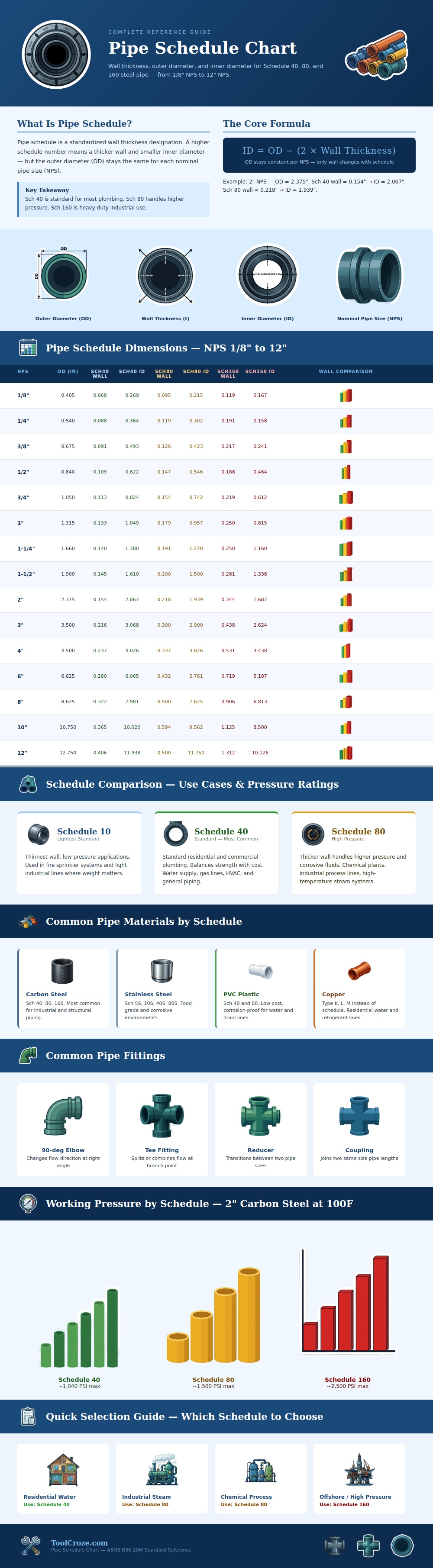
The answer lies in how they is sized…you should of being talking about nominal pipe size and schedule rather than just inner and outer diameter. If you can use those correctly, you’ll save yourself from purchasing the incorrect part and having your system explode under pressure. So what does this have to do with plumbing? These variables relate as follows, as shown in the infographic.
Understanding Pipe Sizes and Schedules
The takeaway is that the outer diameter of steel pipe doesn’t change with schedule. It stay the same no matter what. If it’s a two inch nominal pipe, the tape measure say roughly two and three quarters inch…though its wall thickness will vary. As the schedule number goes up, the wall becomes thicker and thus the inside opening gets narrower.
Why does this matter? Fittings is cut for the consistent outer diameter. For example, if you were to try to fit a Schedule 80 elbow onto Schedule 40 pipe, you’ll find they both look exactly alike since their outsides are the same…but your flow rates would be way off if calculated based off inner diameters. As we can see on the chart above, that’s a tradeoff. Bore shrinks, wall gets heavier, and schedule climbs up from forty to eighty to one hundred sixty. It is common to think of bigger as being more open. However, with a longer schedule, you have stronger walls and less room for fluid to flow through.
Choosing the right schedule: balancing pressure against cost The standard pressure for most household plumbing applications (light industrial) is called “Schedule 40”. These is designed for standard water supply pressures and work fine. This is what you’ll find all over houses.
For something that needs to stand up to higher pressures or corrosive chemicals, they adds more metal with Schedule 80. If you’re working around high-temperature steam lines or chemical plants, you’ll likely see this. Schedule 80 is used in environments where failure isn’t an option.
Schedule 160 is used on really heavy-duty stuff in very extreme industrial situations such as high-pressure hydraulic systems or an offshore platform. Under-specifying these mean bursts and leaks, which can be dangerous. Over-specifying them is wasteful and difficult to install because they have thick walls and are thus heavy.
These specs would be meaningless without understanding what materials they refers to. The graph above is for copper, PVC, stainless steel, and carbon steel. And each material has its own set of specs. For example, carbon steel follows standard ASME B36.10M (the table above). But stainless steel use slightly different numbers with an S after them, such as Schedule 40S or 80S. Since stainless is stronger per inch of thickness, it need less wall thickness.
Also, PVC has schedule 40 and 80, too, but again, because it doesn’t hold up to heat as well than metal, those pipes have lower pressure ratings. As for copper, forget about trying to use steel scheduling logic with that; copper skips the whole schedules thing altogether and instead goes by Type K, L, and M depending on the wall thickness. So while the systems exist in parallel, they’re not quite apples-to-apples.
When it comes to fittings, you have to be exact with the schedule; if you’re relying on a thread or a socket weld for a seal, a Schedule 80 pipe won’t seal well on a Schedule 40 coupling. Because of the difference in thickness, the thread doesn’t get as deep into the fitting and the weld penetrates less deeply. This creates weak spots in your system if you mix them up.
The importance of being exact is also revealed through pressure ratings. A two inch carbon steel pipe rated for Schedule 40 at a hundred degrees fahrenheit can hold more than a thousand PSI. Move it to Schedule 80 and you get a huge jump in ratings. Move it to Schedule 160 and you have twice the ability to hold pressure. Clearly these figures reveal the margin for safety.
Know your pipes… Know the pressure of whatever you’re going to run through them and make sure you have the right size. For a house with cold water, stick with schedule 40. If you’re using acid or steam, use schedule 80. Use heavy duty ones if you really want the added wall thickness.
And here’s where having a chart (above) comes in… You might think you remember these sizes from memory but good luck to ya. Just keep one handy. You won’t remember by heart… ever. One note on this: the only way you’ll be sure is to just measure the outside diameter, and then the wall thickness. Then compare to the chart. That way you get it right the first time. There will be no waste. There will be no leaks. And you will have a long lasting system.
