
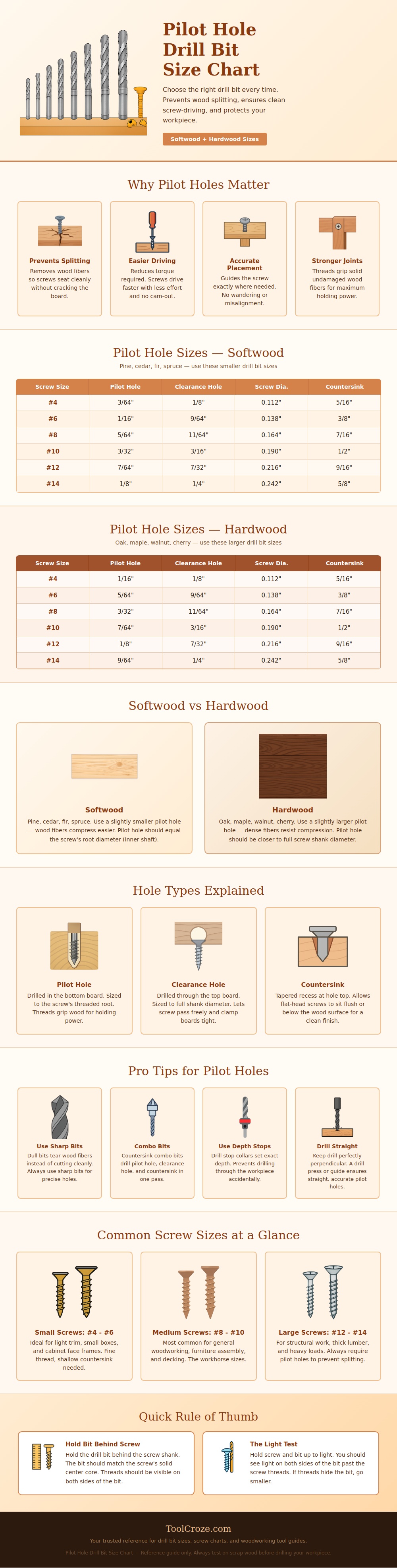
Choosing the right size of pilot hole is very important If you take too big, it can split the wood, break screws or give weak hold. Here are tips about commonly used sizes of drills, so check it before drilling and measure the depth of the pilot hole.
Keeping the drill same size as the shank of the screw is a fast method. It must match with the thickness between the threads. Other way to think: the drill should not be bigger than the small diameter.
Choose the Right Pilot Hole Size
The big diameter includes the threads, while the small is the inside part. Usually the biggest drill that does not show through the screw works well.
Soft wood requires a pilot hole a bit smaller than the diameter of the screw shank, but hard wood requires a bit bigger, because it less compacts under pressure. If you are not sure about the size, start with a drill that is 1/64 inch smaller, that is safe. In soft wood it is possible to skip the pilot hole, when the screw is relatively small and the wood does not crack easily.
Long screws more than two inches long require a deep piltoa hole to lower the torque.
For size 6 no-tapered screws, 3/32 inch drill works for soft wood, while 7/64 inch drill goes for hard wood. Commonly used sizes of pilot holes are 7/64, 3/32, 1/8, 9/64 and 5/32 inches, that match with size 6, 7, 8, 10 and 12 screws.
Using harder materials or soft screws, you must do bigger pilot holes. If screws break, try making the pilot hole larger, even 1/64 inch helps. In metal there is little room, because it does not stretch easily.
The pilot hole should be only a bit bigger than the small diameter. Drilling in metal is diffrent than in wood, where the hole can expand.
For bolt holes, it needs be only a bit bigger than the bolt. Pilot holes should be smaller, with enough material for the screw to bite and hold. When you tie two pieces, the hole through the first should not touch the threads.
The hole in the first panel needs to allow the screw to pass clean, otherwise it may crack.
Hardware stores usually sell gauges to quickly identify drills. It is smart to buy a pack of commonly used sizes, because drilling with a dull drill is no fun. Tapered pilot holes and depth stop countersinks for sizes 6, 8 and 10 are also usefull for common screws.
