🧱 Penny Tile Grout Calculator
Estimate grout quantity in lbs and bags for 3/4" and 1" penny tile projects — bathrooms, showers, backsplashes & more.
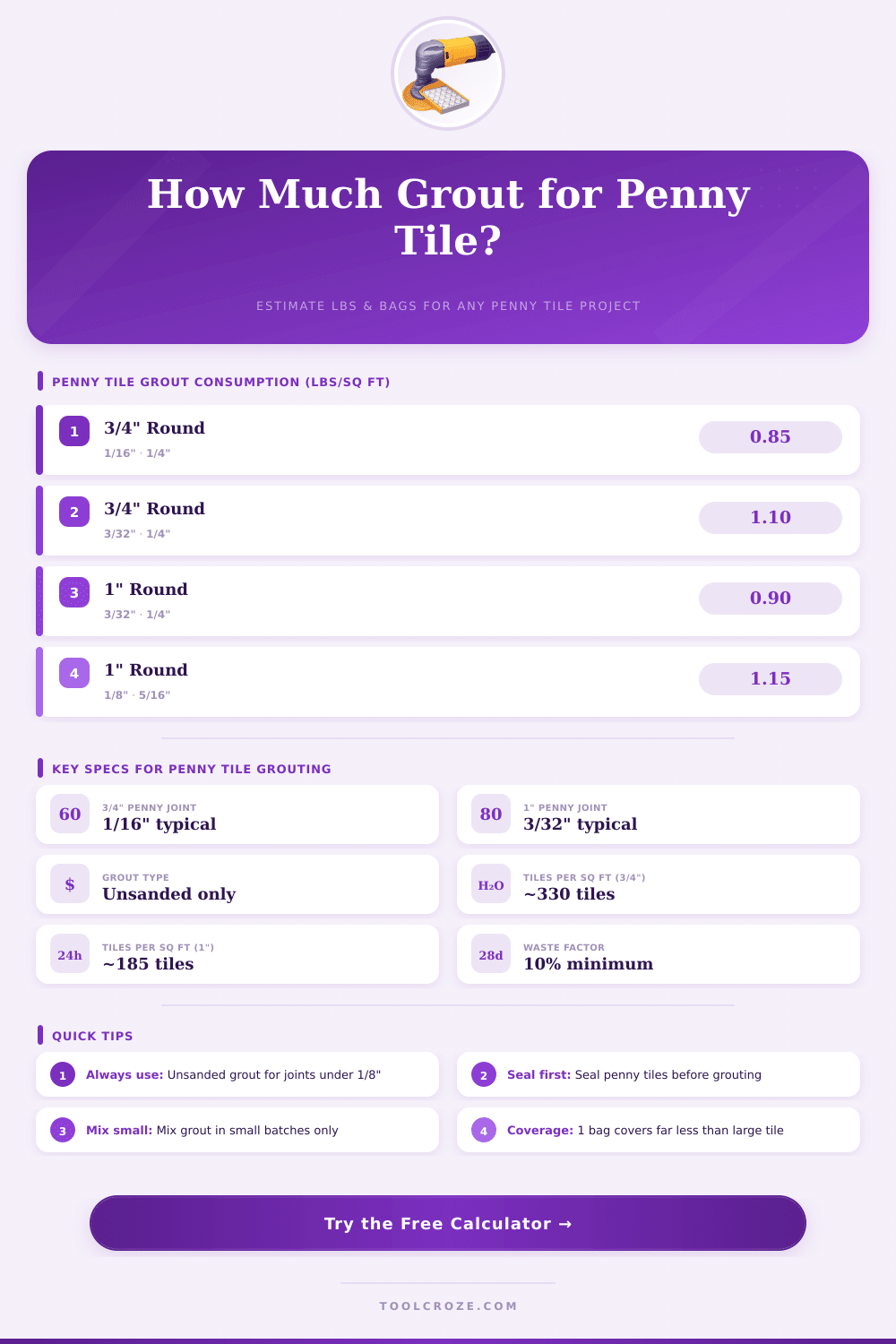
| Tile Size | Shape | Joint Width | Tile Thickness | Lbs / Sq Ft |
|---|---|---|---|---|
| 3/4" (19mm) | Round | 1/16" (0.0625") | 1/4" | 0.85 |
| 3/4" (19mm) | Round | 3/32" (0.094") | 1/4" | 1.15 |
| 7/8" (22mm) | Round | 1/16" (0.0625") | 1/4" | 0.78 |
| 1" (25mm) | Round | 3/32" (0.094") | 1/4" | 0.90 |
| 1" (25mm) | Round | 1/8" (0.125") | 5/16" | 1.18 |
| 3/4" (19mm) | Hex | 1/16" (0.0625") | 1/4" | 0.95 |
| 1" (25mm) | Hex | 3/32" (0.094") | 1/4" | 0.98 |
| Grout Type | Joint Range | Penny Tile Suitable | Notes |
|---|---|---|---|
| Unsanded | Up to 1/8" | ✅ Recommended | Standard for all penny tile joints |
| Sanded | 1/8" – 1/2" | ❌ Not suitable | Sand scratches glazed penny tile |
| Epoxy Unsanded | Up to 1/8" | ✅ Suitable | Higher stain resistance, harder to work |
| Furan / Specialty | Any | ⚠ Specialty only | Industrial/commercial use only |
| Sheet Size | Sq In / Sheet | Sq Ft / Sheet | Sheets per 10 Sq Ft |
|---|---|---|---|
| 12" × 12" | 144 sq in | 1.00 sq ft | 10 sheets |
| 12" × 9" | 108 sq in | 0.75 sq ft | 13.3 sheets |
| 12" × 18" | 216 sq in | 1.50 sq ft | 6.7 sheets |
| 11.75" × 11.75" | 138 sq in | 0.96 sq ft | 10.4 sheets |
The grout for penny tile floors can be hard to choose, but if one understands some basics, the whole work becomes much simpler. Every sheet of 12×12 inches carries around 240 separate tiles. Between these little bits one must fill every crack with grout.
Since one must care about many lines of grout even in a tiny area like a 30-square-foot powder room.
How to Choose Grout for Penny Tile Floors
The color of grout matters more than many folks think. Darker grout works well for bathrooms, because it hides dirt and stains. White or light gray grout better suits walls in kitchens, because it brings out the natural light in the space and gives everything a cleaner and bright look.
When one installs black penny tile floors, light grout will make the sheets more visible, but darker grout hides the net of the sheet. That clear net of sheet commonly appears in homemade setups.
Choosing between sanded and unsanded grout is another step. Sanded grout is usually used for broader spaces, because the sand adds strength. Penny tile floors commonly have very little gaps between them, so unsanded grout is on average the best choice.
But because of the round form of the bits, the most little cracks, where tiles rest togehter evenly, are around 1/16 of inch, while the other spaces are bigger. So in some cases sanded grout actually can be needed.
To apply grout on penny tile floors takes patience. With a grout float one spreads a layer of grout over the surface. At every corner one must work the lines, pushing and pulling the grout forward and backwards, until it well fills around every round tile.
Too much grout that dries can make some bits seem not fully round, which commonly upsets. However the change between tile without grout and with grout is truly striking. Grout also looks much more light when it dries.
Epoxy grout is one option, but it has fewer benefits. After epoxy grout dries, it sets for good and is almost impossible to alter. Regular grout one can soften to clean and shape the lines, but epoxy does knot offer such freedom.
Over time, grout in areas with a lot of traffic can start looking dirty. Light colored grout is especially prone to that. Products to seal grout exist, but putting them in all those little areas on penny tile floors is truly tiring.
Even after finishing, the effect can last only a year before it fades or wears out. It is worth sealing the grout after install, although even sealed grout on shower floors can start to fail over time. Setting sheets offset, like the pattern of bricks, is the secret to makingpenny tile floors look good.