Paver Sand Base Calculator
Estimate compacted paver base aggregate, bedding sand, weight, bags, edge overbuild, slope drop, and ordering allowance for patios, walkways, driveways, and overlays.
⚒Project presets
📏Base and sand inputs
Depths are treated as compacted finished depths. The calculator inflates base volume for shrinkage, then adds the selected waste allowance.
Paver base estimate
Paver area
Base aggregate to order
0 yd³Bedding sand to order
Sand bags estimate
0 50 lb bagsBase weight
Slope drop
0 in🧱Material and spec grid
📋Reference tables
| Application | Compacted base | Bedding sand | Waste range |
|---|---|---|---|
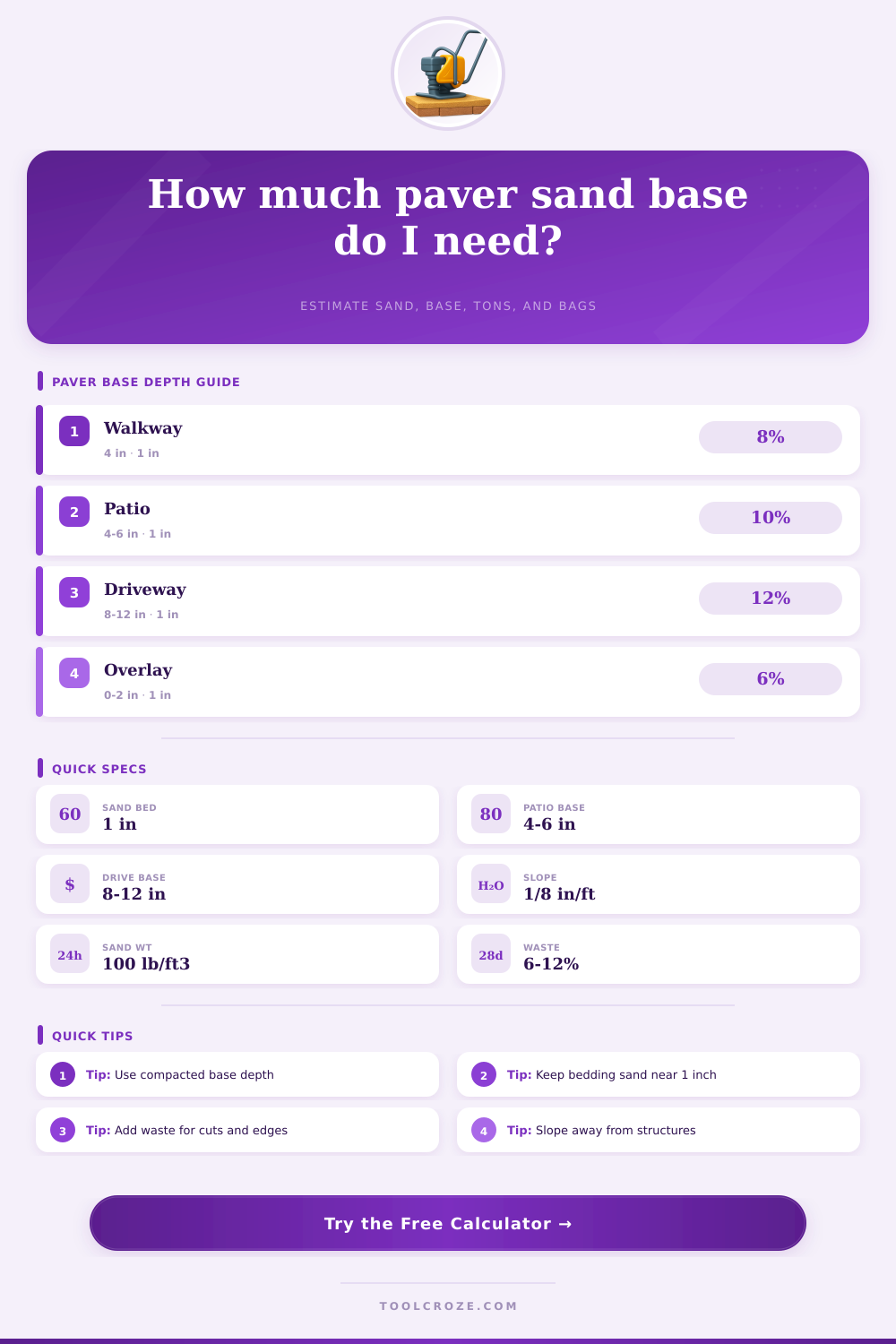
| Pedestrian walkway | 4 in over firm subgrade | 1 in screeded sand | 6% to 10% |
| Patio or sitting area | 4 in to 6 in crushed aggregate | 1 in, not compacted before pavers | 8% to 12% |
| Driveway or vehicle pad | 8 in to 12 in in compacted lifts | 1 in bedding sand | 10% to 15% |
| Concrete overlay | 0 in to 2 in leveling layer | 1/2 in to 1 in sand or setting bed | 5% to 8% |
| Material | Typical density | Calculator use | Notes |
|---|---|---|---|
| Concrete sand | 95 to 105 lb/ft³ | Bedding layer | Sharp, washed, screedable sand |
| Mason sand | 90 to 100 lb/ft³ | Light bedding only | Finer texture, less ideal for heavy loads |
| Dense graded base | 120 to 135 lb/ft³ | Main compacted base | Crushed stone with fines locks tightly |
| Open graded stone | 95 to 115 lb/ft³ | Permeable base | Better drainage, less fine material |
| Bag size | Approx volume | 1 in coverage | Best use |
|---|---|---|---|
| 40 lb sand bag | 0.40 ft³ | 4.8 sq ft | Small repairs and edge fill |
| 50 lb sand bag | 0.50 ft³ | 6.0 sq ft | Walkways and small patios |
| 60 lb sand bag | 0.60 ft³ | 7.2 sq ft | Medium paver layouts |
| 80 lb sand bag | 0.80 ft³ | 9.6 sq ft | Bulk bag planning and large touchups |
| Project size | Area | Base at 6 in | Sand at 1 in |
|---|---|---|---|
| 3 ft x 20 ft walk | 60 sq ft | 1.11 yd³ compacted | 0.19 yd³ bedding |
| 10 ft x 12 ft patio | 120 sq ft | 2.22 yd³ compacted | 0.37 yd³ bedding |
| 12 ft x 16 ft patio | 192 sq ft | 3.56 yd³ compacted | 0.59 yd³ bedding |
| 18 ft x 30 ft drive | 540 sq ft | 10.0 yd³ compacted | 1.67 yd³ bedding |
💡Calculation notes
All the pavers in the world won’t save you from mucking up your yard if you don’t have proper underlying structure. Why? Because what’s underneath, the real stuff, is graded down (below ground), not the pretty surface that you see on top of it, which is made of bedding sand and compacted aggregate that bear weight and controls water. If you get that wrong, the pavers will shifts, sink, or even heave over time. So when choosing materials, it’s less about the color pattern and more about knowing what’s under there.
After you’ve defined your space, the calculator does all the math for you (above). But what do these inputs mean? The shape and size sets the stage for everything. If it’s a simple rectangle, it is easy enough. If not, you must account for an edge overbuild factor. This adds extra base material along perimeter to properly support first row of pavers. You don’t want any crumbling at the edges from frost or traffic pressure without this buffer.
Why a Strong Base Matters for Pavers
Next is the traffic class, which determines how thick this foundation should of be. “A driveway doesn’t have the same structural requirement than a walkway has. Usually a patio only need about four to six inches (of compacted base). For cars, it’s eight to twelve inches. The calculator takes into account those standards so you don’t over- or under-order by guesswork.”
This makes all the difference, and here’s why: Small bases doesn’t hold up to traffic. They’ll fail in as little as two years under load. Sure, you may save a bit initially, but eventually you’re paying a full-on tear-out bill (in two years’ time). That’s the catch most folks overlook if they want to skimp on depth.
The other side is bedding sand. Ideally, spread this to no more than an inch thick (which is usually all it need to be). It’s meant to be a flat surface which the pavers can rest in perfect alignment, each locking into the next. Pile it up thicker then that and the individual units won’t act as single structure. Each will move apart from its neighbors.
Because you acquire and manage these two materials different, the dividing tool makes sense. Sand comes in bags (and you’re unlikely to have any trucked over); aggregate will come by the truckload. Estimate how many bag you’ll need, so you know if you can use a wheelbarrow or if you need bulk delivery.
Many DIYers overlook one other detail: compaction shrinkage. Stone settles and loses some of its volume during compaction. The base calculator makes up for this (generally about 15% for normal crushed aggregates) by increasing amount ordered to match. Otherwise you’ll end up with too little stone just as you’re trying to finish the ground.
It’s also good practice to add extra material for odd edges, cuts, and scraps. Customized shapes and curves creates plenty of unusable scrap stone. Ten to twelve percent additional should cover these waste issues without leaving you high and dry partway into laying down base.
The tool has density figures baked in that correspond to typical industry standards for graded base and concrete sand. While uncommon materials might require a tweak (you know, if you live somewhere weird like me), it’s good to be aware of them because it explain why we care about weight alongside volume. A ton of base looks very different from a ton of sand. Knowing that there’s a connection between tons and cubic yards means you’re going to have a delivery truck that can fit what you ordered.
And then there’s slope. You don’t want water to pool on or beneath a structure, as this will invite frost damage. Even a slight pitch of one-eighth of an inch per foot are huge over time. That’s how much the calculator figures the drop, so you’re sure to grade your base properly before adding stone. Use physics, not just math, to let gravity do the cleaning for you.
Thinking this step by step now avoids headaches later. Make sure you respect the depth requirements. Order things smartly. You should measure twice. A pretty patio becomes a lasting one with a solid base.