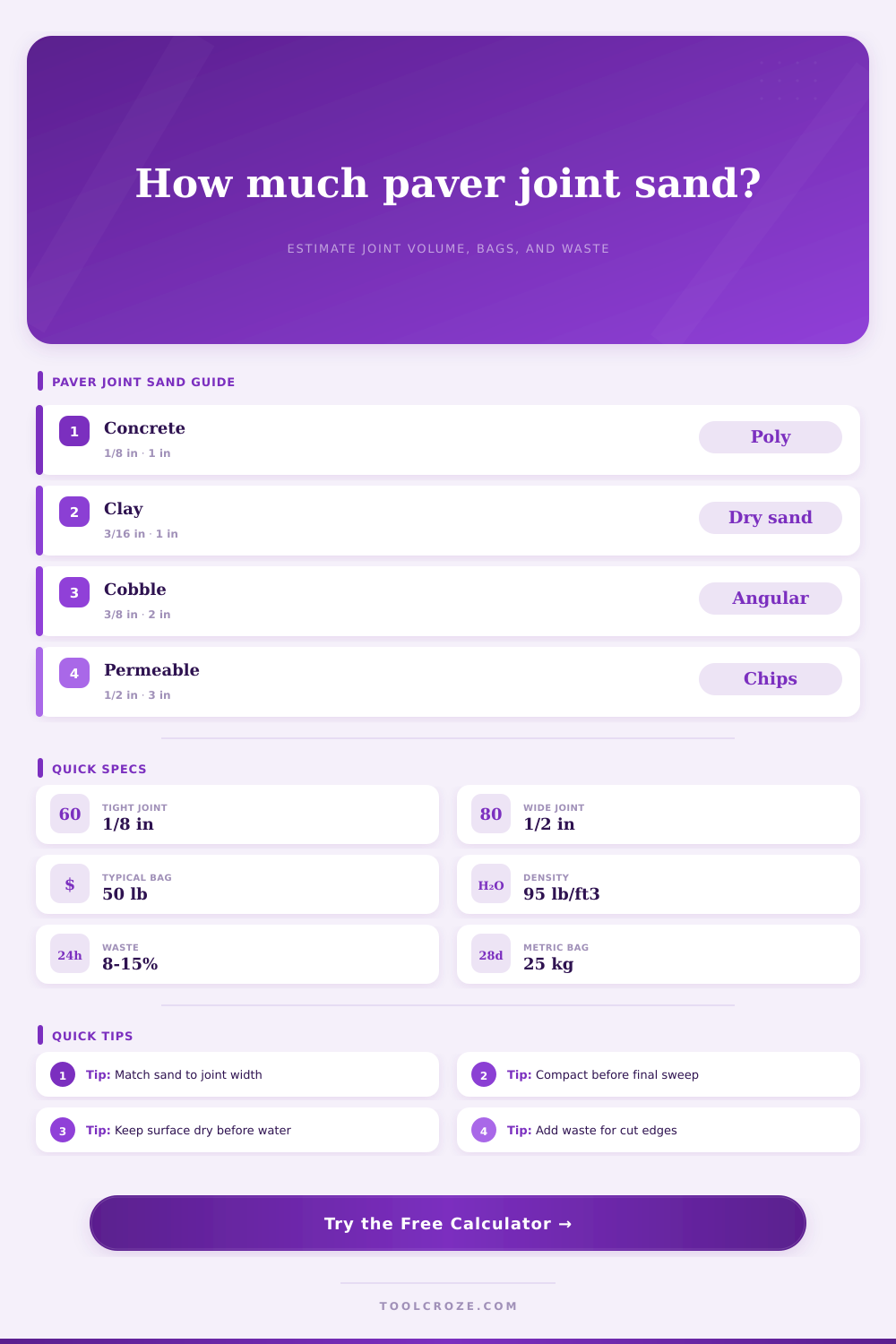
Paver Joint Sand Calculator
Estimate swept joint sand from actual pavement area, paver module, joint width, joint depth, compaction settlement, edge loss, and bag size.
Joint Sand Estimate
Calculation Breakdown
| Paver condition | Typical joint width | Fill depth target | Calculator note |
|---|---|---|---|
| New concrete interlock with chamfered edges | 1/8 to 3/16 in | 1 to 1 1/2 in | Use 90 to 95% fill so sand sits below the chamfer. |
| Clay brick or reclaimed brick path | 3/16 to 1/4 in | 1 to 1 1/4 in | Choose dry sand or kiln dried silica for tight joints. |
| Tumbled cobble, setts, or irregular stone | 1/4 to 5/8 in | 1 1/2 to 2 1/2 in | Increase pattern and waste factors for rounded edges. |
| Permeable pavement with aggregate joints | 3/8 to 3/4 in | 2 to 4 in | Use permeable aggregate density, not polymeric sand density. |
| Joint material | Planning density | Best fit | Avoid using for |
|---|---|---|---|
| Polymeric joint sand | 95 lb/ft³ | Concrete pavers, patios, walkways, dry tight joints | Open permeable joints or constantly wet stone |
| Dry mason joint sand | 100 lb/ft³ | Traditional brick, bedding touch-ups, simple sweep-in repairs | High washout areas without stabilization |
| Kiln dried silica sand | 95 lb/ft³ | Very narrow brick or porcelain paver joints | Wide cobble gaps needing angular lockup |
| Stabilizing joint sand | 98 lb/ft³ | Residential patios that need a firmer non-cement joint | Permeable installations that must drain freely |
| Washed angular joint sand | 105 lb/ft³ | Wide stone joints, cobble aprons, heavy edge detailing | Fine 1/8 in joints that need easy sweeping |
| No. 8 permeable aggregate | 90 lb/ft³ | Open graded permeable pavement joints | Polymeric sand applications or sealed tight joints |
| Laying pattern | Factor | Why it changes sand | Typical use |
|---|---|---|---|
| Running bond or stack bond | 1.00 | Regular rectangular grid with predictable joint length. | Walkways, simple patios, standard driveways |
| Herringbone | 1.08 | More cut edges and rotated joints raise the sweep-in demand. | Driveways, entry courts, high-lock pavement |
| Modular ashlar | 1.12 | Mixed sizes create extra joint turns and shorter segments. | Patios with three-size or four-size bundles |
| Random cobble or fan pattern | 1.22 to 1.28 | Curves, wedge joints, and irregular edges increase voids. | Cobble aprons, medallions, radial borders |
| Large slab grid | 0.82 | Larger modules mean fewer joints per square foot. | Porcelain panels, 24 in square slabs |
| Example paver and joint | Joint depth | 50 lb bag coverage | 25 kg bag coverage |
|---|---|---|---|
| 4 x 8 in paver, 1/8 in joint | 1 in | About 280 to 340 sq ft | About 315 to 380 sq ft |
| 4 x 8 in paver, 1/4 in joint | 1 1/4 in | About 110 to 145 sq ft | About 125 to 160 sq ft |
| 6 x 9 in paver, 3/16 in joint | 1 1/2 in | About 130 to 170 sq ft | About 145 to 190 sq ft |
| 24 x 24 in slab, 3/16 in joint | 1 in | About 700 to 900 sq ft | About 780 to 1000 sq ft |
| Cobble paver, 3/8 in joint | 2 in | About 45 to 70 sq ft | About 50 to 80 sq ft |
There’s one regret you’ll have if you purchase insufficient joint sand: halfway into sweeping the new patio, the broom strikes unadorned pavers and you remember, you’re out of sand. But it’s not just inconvenient to make another store run; it interrupt the compaction schedule and makes you think you forgot something in the plan.
Paver joint sand isn’t complicated math. It’s mostly void space awareness. Yes, the joints themselves is small, but there are many of them covering a big surface area, which adds up fast. Underestimate that volume and you get washed-out seams and weak edges. It is better to overestimate (as long as you don’t have to carry all that extra weight up three flights of stairs).
How to Calculate Joint Sand Needed
After you design your pattern (and define it in the calculator), the calculator does all the hard work. No more guessing about how many times to multiply the pattern or what kind of density conversion to apply.
How do most folks begin? They measure their entire width and length and figure that’s the surface they’ll need sand for. Except it isn’t, because there are things that reduce actual square footage, things like planters, columns and drains that gobble up space. So if you subtract these spaces first, you don’t end up ordering too many bags of sand.
But that’s not where the variable lies. The variable is this: the joint width, plus the paver module. Twenty-four-inch slabs of porcelain has significantly fewer linear feet of joint compared to a basic four- by eight inch brick. This is why so many people miscalculate. If it’s a little patio, then they assume a little less sand are required; without considering that a grid of really teeny tiny bricks results in a huge area of gaps.
The width of the joint plays an enormous role here. Irregular stone (whether tumbled cobble or something else) can have joints a half inch wide or even wider. Chamfered concrete interlocking products may has joints as narrow as an eighth of an inch. The impact of doubling that dimension from an eighth inch to a quarter inch isn’t linear; it’s exponential. It’s not simply twice as much sand. It change the very nature of the joint itself.
For narrow joints (like say chamfered concrete), polymeric sand is ideal. Why? Because it acts like a flowing gel and forms a strong bond after being activated with water. If your joints are wide (on natural stone, in particular), though, using polymeric sand means the sand bridges across the surface instead of filling all the way down. Voids form, which weakens the bond. Angular dry sand, or permeable aggregate, will work better in these situations and physically hold everything together. Again, reference table does a nice job of laying this out. You’ll see it demonstrates how the joint dimension affect material selection.
There’s even another factor: pattern. Long, straight runs in a running bond pattern are easy. Shorter sections and more cuts is found in a herringbone or basket weave pattern. That means more total joint length. More cuts require more edges to be filled. The calculator accounts for this automatically. It does so by applying a multiplier based off the additional demand for sweep-in.
Then there’s compaction settlement to account for. When you run a plate compactor across sand, it compresses. If you don’t account for that loss, the joints will look empty once installed. An allowance of eight to twelve percent should of cover shrinkage. Voilà, full joint.
The last variable is waste. High-waste examples are curved patios with complex borders; low-waste examples are straight driveways. Cleanup takes a toll and cut edges lose sand to the broom. Ten to fifteen percent added for irregular layout covers those losses. It is a small thing, but it matters. When done right, you have enough sand left to top off any low spots and finish the job. You won’t need a second trip.
Once you know what to measure, the math is simple. And finally, how to avoid empty-broombroom dissapears disaster?