Brick Calculator Patio
Estimate patio brick count, border courses, pattern waste, joint spacing, bedding sand, and compacted base material from real patio dimensions.
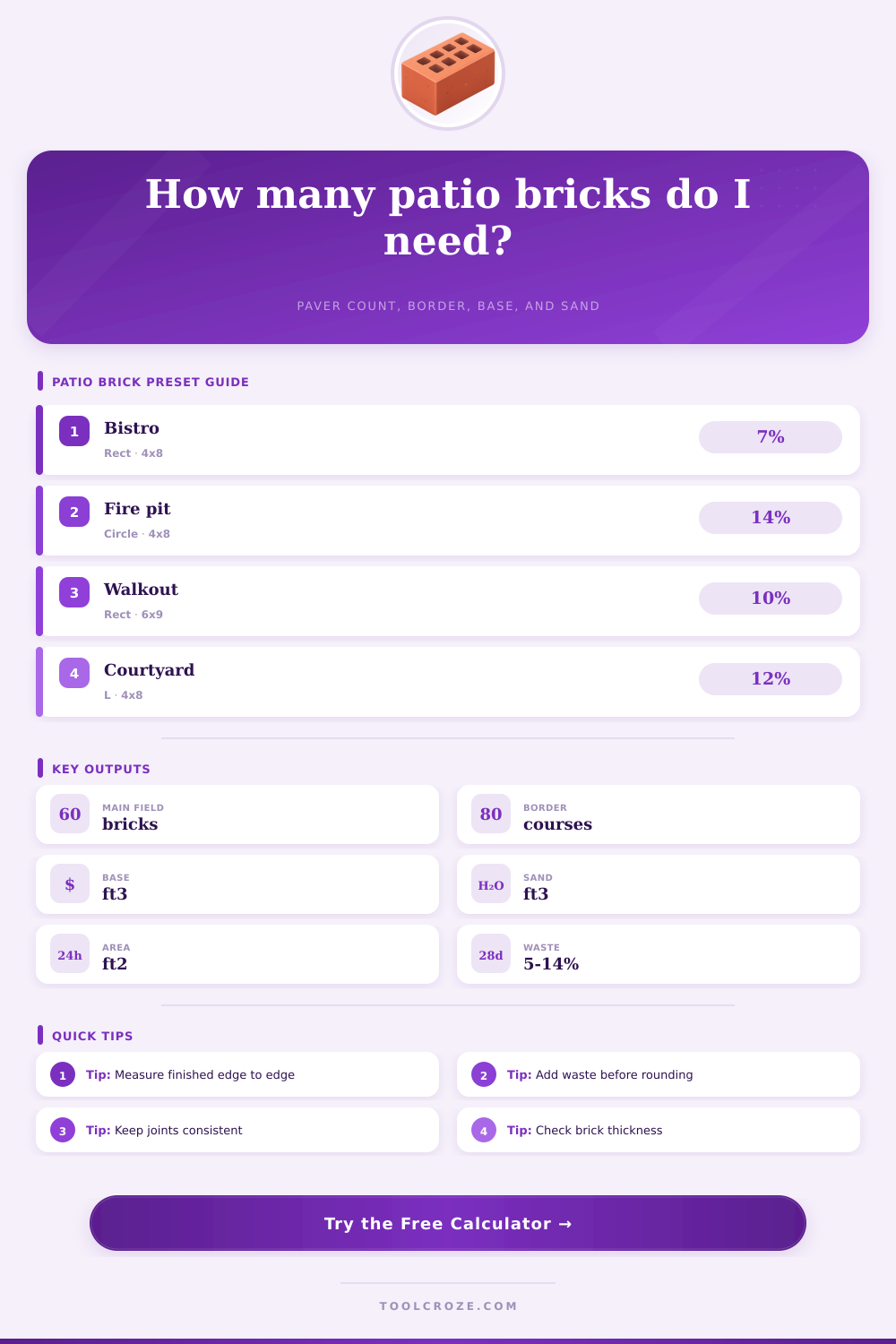
🧱 Real Brick Patio Presets
📐 Patio Layout Inputs
For round patios, use length as the finished diameter. For L-shapes, the calculator adds the main rectangle plus the leg rectangle.
Patio Material Estimate
⚙ Paver Spec Grid
📋 Brick and Paver Size Reference
| Brick or paver | Nominal face | Typical thickness | Best patio use |
|---|---|---|---|
| Clay paving brick | 4 in x 8 in | 2.25 in | Running bond, herringbone, basketweave |
| Concrete Holland paver | 4 in x 8 in | 2.375 in | Driveway-rated patios and walks |
| Large rectangle paver | 6 in x 9 in | 2.375 in | Modern patios with fewer joints |
| Square patio paver | 6 in x 6 in | 2 in | Basketweave accents and compact areas |
🗂 Pattern Waste and Border Reference
| Pattern | Typical waste | Cutting level | Border note |
|---|---|---|---|
| Running bond | 5% | Low | Single soldier border is common |
| Basketweave | 7% | Low to medium | Works well with square corners |
| Herringbone | 10% | Medium | Strong field pattern for patios |
| Diagonal or circle | 12% to 14% | High | Add waste for edge cuts |
💠 Base and Bedding Depth Guide
| Patio condition | Base depth | Sand bed | Calculation note |
|---|---|---|---|
| Pedestrian patio, mild soil | 4 in to 6 in | 1 in | Use compacted depth after tamping |
| Clay soil or freeze area | 6 in to 8 in | 1 in | More base helps drainage and frost movement |
| Permeable paver patio | 8 in to 12 in | 2 in chip stone | Use open-graded aggregate specs |
| Light vehicle edge or apron | 8 in to 10 in | 1 in | Confirm local base requirements |
📏 Common Patio Size Table
| Patio type | Typical size | Common pattern | Planning note |
|---|---|---|---|
| Bistro seating | 8 ft x 10 ft | Running bond | Good for a small table and two chairs |
| Dining patio | 12 ft x 16 ft | Herringbone | Leaves room around a six-seat table |
| Fire pit circle | 14 ft to 18 ft dia | Circle kit or fan | Curved cuts raise waste allowance |
| Courtyard | L-shape | Basketweave | Measure each rectangle separately |
We start here: most people envision red clay or concrete pavers, and we end there: a heap of surplus bricks whose origin they will never know. The distance between their vision and their inventory is often layout issue in disguise, a math equation. Yes, you can measure your yard. But not the way you need to: how much waste? what about borders? what’s under it all that needs to be covered? That’s why this calculator appears on the page. It do the math for you; you do the pattern, without ever having to guess at how many units to purchase.
Second, a patio is more than just surface area. A patio is a sandwich! All the credit goes to the top (the layer everyone sees) while the hard work comes from the bottom layers. Depending on where you live, you may only need 4 inches of base if your soil is sandy and drains well. In my case, I live in a place that has heavy clay and also experiences freeze-thaw cycles, so I’d want at least 6 inches to avoid heaving. This tool changes how much gravel you need by adjusting the thickness of the bedding sand and the depth of the base; most people only calculate the top and end up running out of gravel. This tool avoids that problem by showing you exactly how many cubic feet of sub-base you’ll need before you’ve thought about placing the first brick down.
How to Use the Patio Calculator
And then there’s the pattern. Low waste, forgiving, and easy to work with, a running bond is simple. Looks stunning but requires precise cuts and eats up more material on its edges: the herringbone. To compensate for that, it adds a certain amount (based off your choice) as waste to the overall number. It is not arbitrary. Complex patterns mean cutting bricks into smaller pieces that can’t be used anywhere else. And you gotta pay for those additional units. When you select herringbone in the tool, it auto-bumps the waste allowance to ensure you don’t come up short at the end of installation day and desperately need one more to close a gap.
There is another level: borders. If you plan to use a soldier course border (meaning the bricks in each course will run the length of the edge), it’s neat, but again there are added units beyond the main field grid, so the calculator handles this by adding a specific count for them. Because their layout shifts how they pack in at the border, you must treat them as separate from the field and count them accordingly. This is where the calculator come in… It adds a special count for your border courses depending on what shape your patio is and how long it is. It allows me to keep the main field calculation clear while recognizing that we’ll need to set aside some space for the edges. Keeping things split like this helps you really see where these additional bricks go rather than just dumping it all into some hazy reserve fund.
People don’t realize it, but shape does matter. Rectangles are good. Angles and circles make things less rectangular and create jagged cut-offs. For example, if you have a circular patio around your fire pit, you’re going to produce a lot more waste, as you can’t cover curved edges with straight bricks. The app will adapt to the shape, and determine how many units are needed based on the area. Then it’ll remind you that all that trim costs money. All those cuts cost something. Precision is expensive… You want your circle to appear round.
Don’t skip ahead to the input portion. Measure from finished edge to finished edge. Do not include an edging strip or retaining wall if you plan on using them; only include them in the paved area. Double check your brick size. The nominal size (four by eight) typically refers to the size after it’s installed with joints, NOT the actual face of the brick. This will throw off all calculations that come next. A little mistake quickly adds up when multiplied by hundreds of bricks.
Now that you know how many, treat it as a guide for your budget rather than a lock-down script. There will be variables in real life: uneven ground to level out, or unexpected broken bricks on delivery day. The waste allowance is nice, but doesn’t account for sheer incompetence with handling. Order a bit more then the total just in case, and take your total number as starting point.
There’s a bit of intuition and a lot of math involved in building a patio. It’s one thing to have faith in your intuition; the math assures you that the intuition is sound. Stepping back when it’s all done, you’re happy with the pattern, and also that there was enough to make it solid.