Pallet Rack Weight Capacity Calculator
Estimate beam-pair capacity, pallet load per level, upright frame demand, deflection limits, and rack utilization from real pallet rack dimensions and condition factors.
Configuration adjusts lateral and load-distribution allowance.
Use the posted plaque or manufacturer rating when known.
Include pallet, product, wrap, and any dunnage.
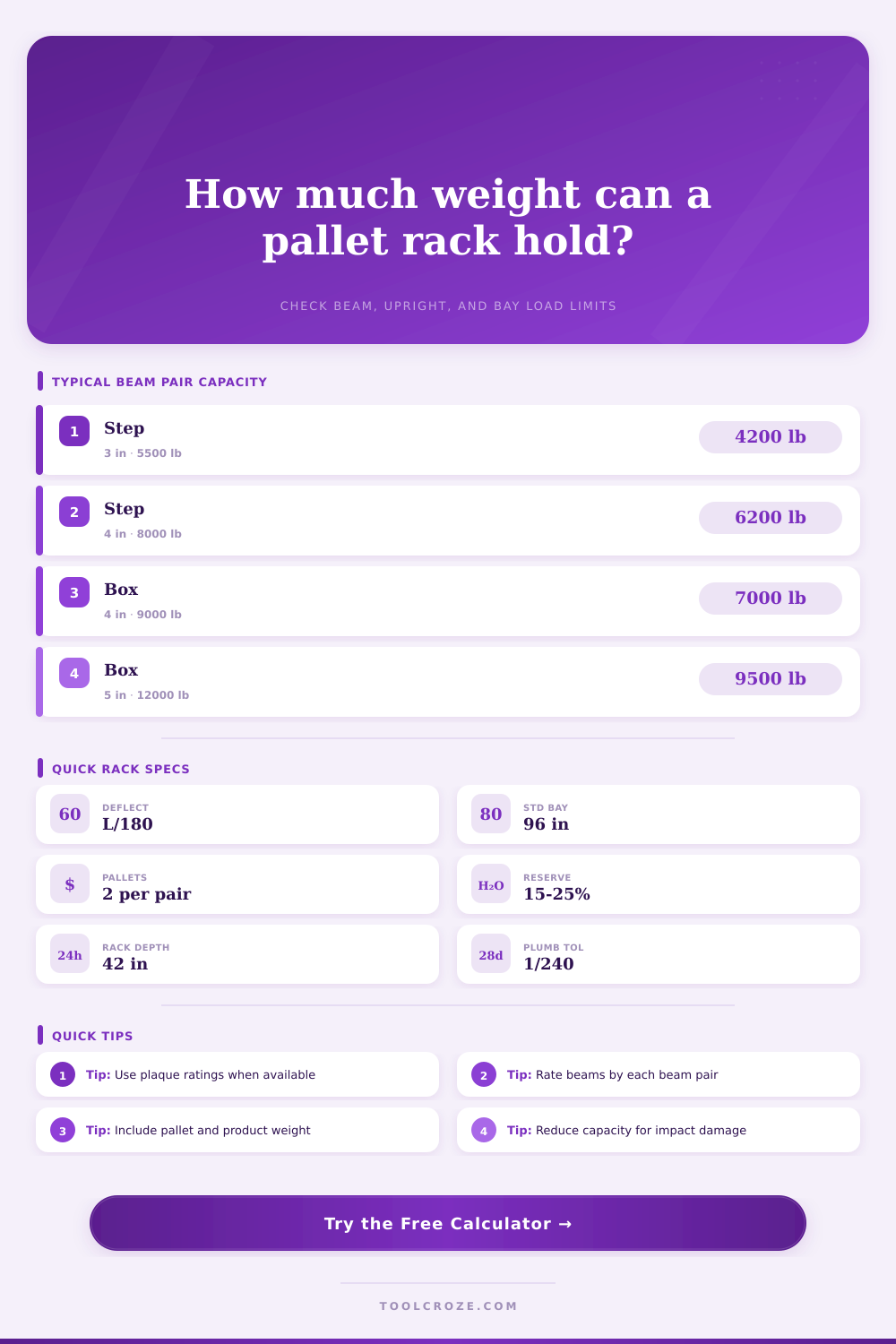
| Beam pair type | 96 in span | 108 in span | 120 in span | Typical use |
|---|---|---|---|---|
| 3 in step beam | 5,500 lb | 4,200 lb | 3,400 lb | Light warehouse pallets |
| 4 in step beam | 8,000 lb | 6,200 lb | 5,000 lb | Standard selective rack |
| 4 in box beam | 9,000 lb | 7,000 lb | 5,700 lb | Dense pallet storage |
| 5 in box beam | 12,000 lb | 9,500 lb | 7,800 lb | Heavy pallet positions |
| Upright class | 12 ft frame | 16 ft frame | 20 ft frame | Notes |
|---|---|---|---|---|
| Light duty | 18,000 lb | 15,000 lb | 12,000 lb | Low beam elevations |
| Standard duty | 30,000 lb | 24,000 lb | 19,000 lb | Typical 42 in deep frame |
| Heavy duty | 42,000 lb | 34,000 lb | 28,000 lb | Dense manufacturing loads |
| Reinforced seismic | 38,000 lb | 31,000 lb | 25,000 lb | Requires engineered anchors |
| Load condition | Capacity factor | Why it matters | Calculator effect |
|---|---|---|---|
| Centered pallets | 1.00 | Load bears evenly on both beams | No reduction |
| Offset pallet | 0.92 | One beam can carry more reaction | Reduces beam capacity |
| Point load | 0.82 | High local bending near contact | Reduces beam capacity |
| Decked mixed cartons | 0.88 | Load may not sit over pallet supports | Reduces beam capacity |
| Check item | Common limit | Good practice | Action if exceeded |
|---|---|---|---|
| Beam deflection | Span / 180 | Keep loaded beams visibly level | Lower pallet weight or shorten span |
| Frame plumb | Height / 240 | Inspect after impact events | Unload and repair before reuse |
| Reserve margin | 10% to 25% | Use higher reserve for unknown loads | Choose heavier beams or fewer pallets |
| Anchor condition | Engineer set | Confirm anchors at aisle and end frames | Replace anchors or re-rate the bay |
Ever see someone loading a forklift with a pallet full of products and carefully easing corner of that load against an upright in their racking? That’s because steel shelving isn’t just storage furnitures; it’s structural engineering. A rack doesn’t give a hoot about your quarterly sales projections or your wish to add another row onto your warehouse floor plan. All it knows and all it cares about is physics: How much weight is coming down on top of me, and will my shape hold up to that? So capacity becomes less of an exercise in optimizing inventory and more of a safety issue.
One thing most warehouse manager do is look at the beam rating alone. They’ll see an eight thousand pound number on a plaque and assume that every single beam are capable of holding such a weight. That’s where folks go wrong. It’s for the pair! Each pair of beams spanning one bay opening work together to support that overall weight for that particular level. The calculator up top breaks down how much demand there is on upright frames vs. The beams, which helps you visualize this dynamic when you put your own specs in.
Why Racking Safety Matters More Than Capacity
You’re not simply verifying whether or not the beam will snap; you’re also checking if entire vertical column can sustain the cumulative weight of all the pallets stacked from floor to ceiling. Everything revolves around the bay. A single piece of equipment will behave very differently depending off the geometry of your bay configuration. What is easily held back within a twelve foot structure might be dangerously overwhelmed in a twenty foot configuration carrying same beam load. This is where upright height and base plate condition become key factors, as taller frames must exerts more force against their anchor points. To account for this, the tool allows you to adjust both the height of your frame and its duty class.
Are you storing dense cases of beverages or heavy machinery parts? The vertical demand increase rapidly. You may have lots of room on beams, but be dangerously close to tipping uprights due to high center of gravity. There are other silent killers in racking systems such as deflection. Just like steel, a beam will bend before breaking and eventually those bends add up over time from all the loading and unloading. Deflection limits based off the span length is often used industry standards. That ensures the beams remain reasonably level so when pallets is put on top they don’t tip or slide around. If you find that beams start to look visibly bent down under weight, then you’re probably using that set-up at its max.
The calculator allows for a margin of reserve, typically between 10% and 25%, depending on the application, which keeps stress levels far below the breaking point. The buffer provides for normal wear and tear of day-to-day operations. It also accounts for slight forklift impacts that may not initially appears to do any harm but weaken the structure over time.
Older facilities have their own quirks. Yes, they may hold a lot, but strength of the structure matters more. Is one bay leaning? Does it have a dent in the upright frame? That appears like a “cosmetic issue” until that becomes part of how weight is carried. With the tool, you can assign a condition factor and lower its effective capacity if there is visible damage or leaning. Derating a little is better than pushing it to theoretical limit with a compromised piece of steel.
You’re not just buying storage; you’re buying peace of mind. Pallet racking is an interdependent system. The beams needs strong uprights. Solid anchors require level flooring. And when balanced properly, you have a quiet, safe storage system working behind the scenes. Ignore it, though, and sooner or later gravity’s going to enter into your way of managing stock. Before loading anything else into the mix, you should of check the weakest link in what you’ve got now.