O Ring Extrusion Gap Calculator
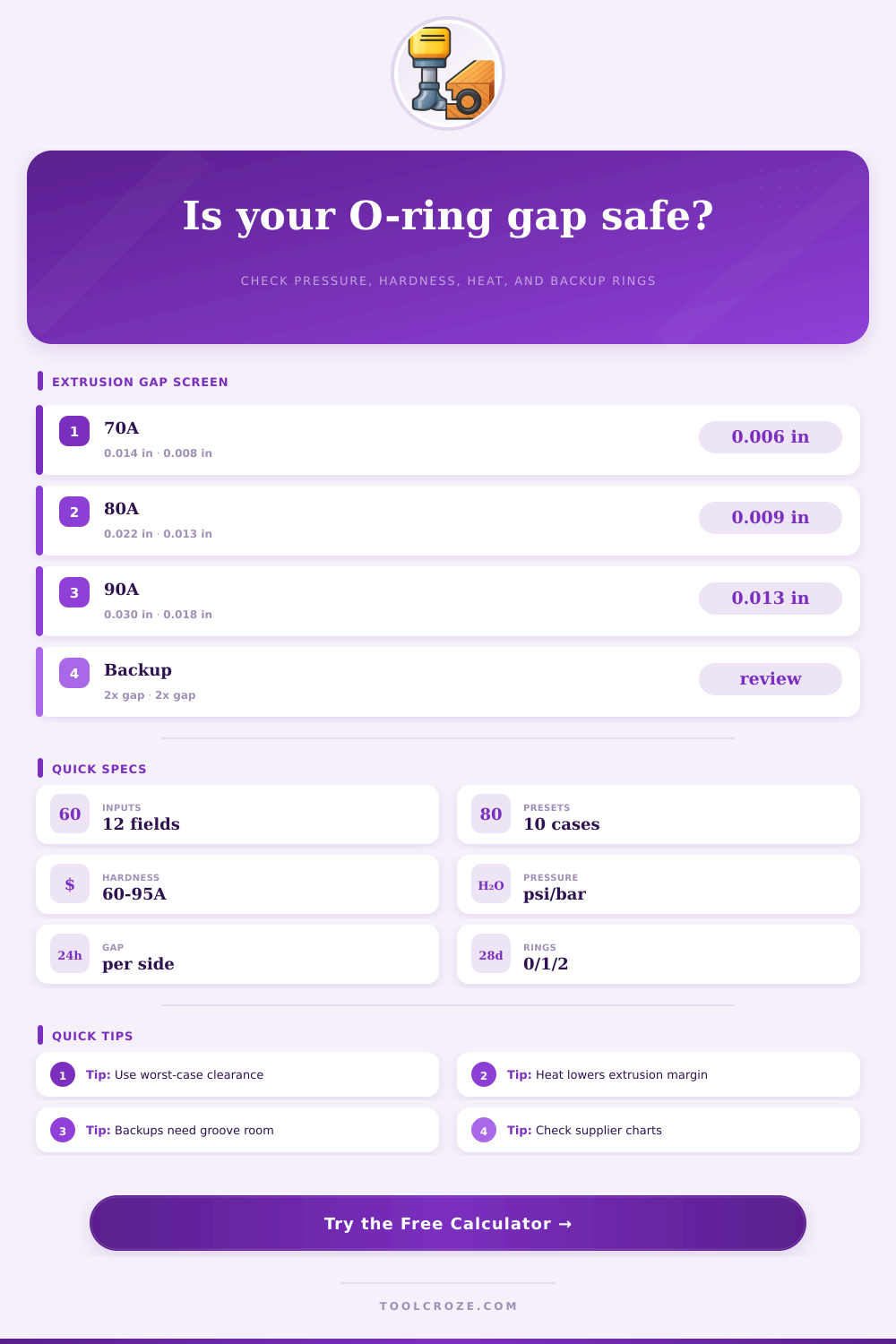
Screen radial clearance against pressure, Shore A hardness, seal material, temperature, gland type, diameter, and backup ring support before cutting or releasing a gland drawing.
1Extrusion Presets
Start from a common seal case, then replace the values with the actual worst-case clearance, pressure, and material data from your design.
2Calculator Inputs
3Material and Gap Grid
Good oil compatibility, normal extrusion resistance, watch heat above about 250°F.
Strong heat and fuel choice with moderate low-temperature flexibility.
Good for water, glycol, and steam; poor for petroleum oil service.
Better abrasion and extrusion resistance than many standard nitrile compounds.
Very high extrusion resistance, often used where O-rings would need support.
Excellent chemical range, but gland design still needs supplier limits.
Chemical protection with low elasticity; closure and groove fit matter more.
Higher hardness improves extrusion resistance but may raise installation force.
4Hardness Gap Reference
| Shore A hardness | Low pressure under 500 psi | Medium pressure 500-1500 psi | High pressure 1500-3000 psi | Design note |
|---|---|---|---|---|
| 60A | Very small gaps only | Usually avoid without backup | Backup ring required | Soft compounds seal easily but extrude quickly. |
| 70A | Common for low pressure | Keep clearance tight | Use backup or harder material | Default hardness for many static glands. |
| 80A | Good margin | Common hydraulic choice | Review gap and cycling | Balanced installation force and extrusion resistance. |
| 90A | Large margin | Good high-pressure screen | Often needs backup at spikes | Harder ring may need careful stretch and squeeze. |
| 95A | Special compound | Supplier data needed | Supplier data needed | Approaches custom seal territory. |
The calculator uses these bands as a screening model. Supplier extrusion charts should set the final release limit.
5Backup Ring Selection Table
| Backup option | Best use | Pressure direction | Gap effect | Gland note |
|---|---|---|---|---|
| No backup | Low pressure or very tight clearance | One or two directions | Base allowance | Needs excellent tolerance control at pressure. |
| Single backup | Known pressure direction | One direction | About 1.9x screen | Place backup on the low-pressure side of the O-ring. |
| Dual backup | Reversing pressure | Two directions | About 2.3x screen | Groove width must include both rings and volume fill. |
| Custom anti-extrusion | Very high pressure or shock | Application-specific | Supplier rated | Use engineered geometry and validation testing. |
6Material Temperature Table
| Material | Common service range | Extrusion behavior | High-temperature caution |
|---|---|---|---|
| NBR nitrile | -40 to 250°F | Normal 70A-90A compounds | Softens and takes set near upper range. |
| FKM | -15 to 400°F | Good heat stability | Low-temperature flexibility can be limited. |
| EPDM | -60 to 300°F | Good water service | Oil exposure can damage the compound. |
| HNBR | -30 to 300°F | Strong abrasion resistance | Good high-pressure oil option. |
| Silicone | -75 to 400°F | Low tear strength | Use conservative gaps and static service. |
| Polyurethane | -40 to 225°F | Excellent extrusion resistance | Temperature and fluid limits are narrower. |
7Gland Spec Grid
| Spec item | Static radial | Dynamic radial | Face seal | Why it matters |
|---|---|---|---|---|
| Radial clearance | Use worst case | Use tighter stack | Closure gap controls | Extrusion starts at the open gap under pressure. |
| Surface finish | Moderate finish | Better finish needed | Flat sealing land | Damage and friction raise local extrusion risk. |
| Squeeze target | 12-25% | 8-16% | 20-30% | Squeeze affects contact stress and heat. |
| Diameter effect | Low direct effect | Friction grows with size | Closure load grows | Large seals see more total pressure force. |
| Backup space | Optional at low pressure | Common at pressure | Special groove needed | Backup rings need gland width and side support. |
8Practical Tips
O-ring extrusion occur when the O-ring is forced into an gap of the gland. O-ring extrusion almost always begin at the gap of the gland. O-rings is soft elastomers.
Because the O-ring is a soft elastomer, the O-ring will flow through the gap if the pressure is high enough. The risk of O-ring extrusion depend upon the size of the gap, the pressure, the temperature, and the material of the O-ring. The gap has to be small enough to ensure that the O-ring does not leave its proper position on the component it is sealing.
What causes O-ring extrusion and how to check the gap
You have to determine the size of the gap based off the pressure, the temperature of the system, and the type of material of the O-ring. The calculator ask for the worst-case clearance of the system, the peak pressure that will be placed upon the O-ring, the hardness of the O-ring, the temperature at which the O-ring will be operating, and the type of gland that will be used with the O-ring. Pressure is one of the primary factors that contribute to O-ring extrusion.
The relationship between pressure and extrusion is not linear in nature. For example, increasing the pressure from 500 psi to 1500 psi does not indicate that the risk of extrusion will also increase by the same factor. A square root factor is used to adjust for this.
Hardness is another of the factors that contributes to extrusion. However, the relationship of hardness to extrusion is in the opposite direction than the relationship of pressure to extrusion. For example, an O-ring with a hardness of 70A is softer than an O-ring with a hardness of 80A or 90A. Because the 70A O-ring is soft, it may deform more easly under high levels of pressure.
An 80A or 90A O-ring will better resist being pushed into the gap created by the gland. However, harder O-rings are more difficult to install and may be difficult to stretch over the piston. The allowable gap for extrusion changes with hardness, all other factors being equal.
The temperature at which the O-ring will be operated also affect the risk of extrusion. For instance, many materials that are used to make O-rings will soften with increasing temperature. For example, Nitrile (NBR) based O-rings may be able to handle 180 F very well.
However, the Nitrile may lose its modulus at a temperature that is well within the upper temperature limit for which the Nitrile O-ring is rated. FFKM compounds maintains their properties over a higher range of temperatures. However, FFKM compounds also have less flexibility at low temperatures.
The factor that is applied to the allowable gap size for O-ring extrusion is based upon the calculated effect of temperature on the O-ring material. However, it is not a guarantee that the O-ring will not extrude under those conditions. The type of gland that is used with the O-ring contributes to the risk of O-ring extrusion.
For instance, static glands has a piston that does not move. A static piston seal will not experience the same amount of pressure on both sides of the O-ring. Rod seals that are used to reciprocating components will experience movement of the rod in relation to the gland.
Additionally, these seals may be exposed to higher levels of pressure. Rotary seals experience friction between the rotary component and the gland. Additionally, the rotary motion of the component can cause a spiral failure in the O-ring.
Dynamic glands have an allowable gap that is less than the static gland because the dynamic gland experiences more extreme conditions. Backup rings are sometimes used in glands. Backup rings increase the safe size of the gap created by the gland.
A single backup ring, placed on the low pressure side of the component, will roughly double the allowable clearance of the gap. Dual backup rings are sometimes used where the pressure can reverse between the high and low pressure sides of the component. Backup rings take up more space within the gland.
Therefore, they must be within the strength of the gland walls. The factor that is applied to the size of the gap indicates the change in allowable gap size with the addition of backup rings. A common mistake is using the nominal clearance of the component rather than the worst-case clearance.
For example, a component may be drawn with a nominal radial gap of 0.008 inches. However, the worst-case radial gap of the component might be 0.012 inches due to manufacturing and installation tolerances. If the nominal gap is placed into the calculator, the O-ring will not account for the actual gap size of the component.
Additionally, you must consider other factors, such as pressure spikes. The pressure calculated for the O-ring may be for the normal or running pressure of the component. However, the O-ring may extrude under high levels of pressure that may only be experienced for short period of time.
The choice of material for the O-ring interacts with a number of the factors discussed above. The calculator only provides an approximation of that interaction. For instance, polyurethane materials exhibit high resistance to O-ring extrusion.
However, polyurethane has a narrower range of temperatures at which it maintain those properties. FFKM compounds exhibit high resistance to both extreme heat and extreme chemical environments. However, FFKM compounds are more expensive than other materials.
The factor that is applied to the allowable gap size is for the average performance of the material. However, the manufacturer’s data will provide a more accurate indication of the performance of the material. For best results, the O-ring extrusion calculator can be used with the most conservative number to estimate the risk of extrusion.
Then, you can compare that estimate with the supplier’s chart that indicates the allowable gap size for the O-ring material. If the supplier’s chart indicates a wider range of allowable gap sizes than those calculated by the calculator, then the supplier’s chart is the limit of the O-rings performance.