📏 O Ring Dimension Calculator
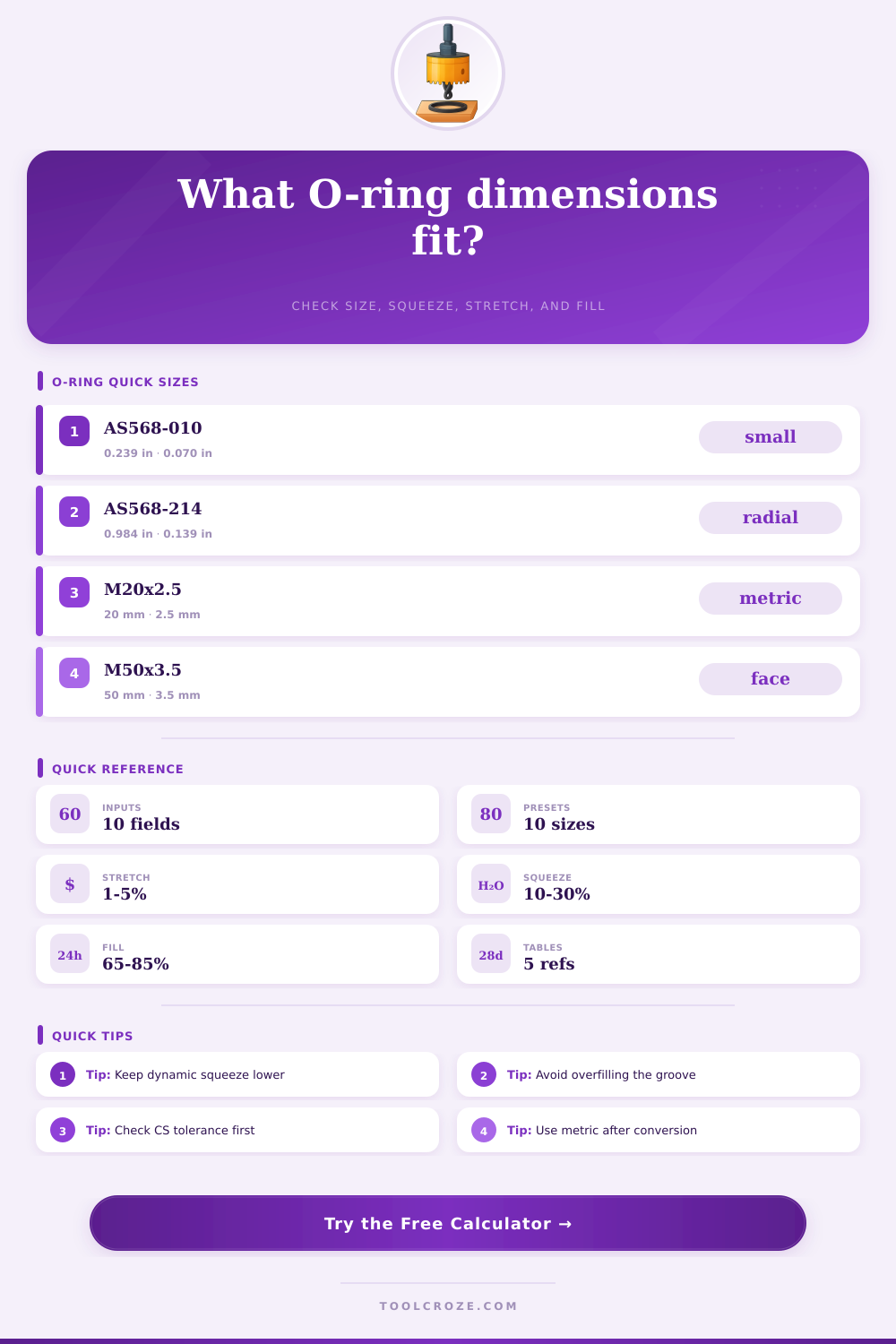
Check AS568 and metric O-ring size, inside diameter, cross-section, gland ID/OD, stretch, squeeze, groove fill, and tolerance allowance.
📌 Presets
⚙ Calculator Setup
🎯 Results
🧮 Full Formulas
- Free OD = free ID + 2 x free cross-section.
- Stretch % = (gland ID - free ID) / free ID x 100.
- Stretch ratio = gland ID / free ID; installed CS = free CS / square root(stretch ratio).
- Nominal squeeze % = (installed CS - gland depth) / installed CS x 100.
- Minimum squeeze % = (installed CS - CS tolerance - gland depth - gland tolerance) / installed CS x 100.
- Maximum squeeze % = (installed CS + CS tolerance - gland depth + gland tolerance) / installed CS x 100.
- O-ring volume = pi x (installed ID + installed CS) x pi x (installed CS / 2)^2.
- Gland volume = pi x mean gland diameter x groove width x gland depth.
- Volume fill % = O-ring volume / gland volume x 100.
- Adjusted risk allowance = selected design allowance applied to squeeze and fill warnings.
📊 Reference Tables
| AS568 size | Free ID | Cross-section | Common use |
|---|---|---|---|
| AS568-010 | 0.239 in | 0.070 in | Small ports and fittings |
| AS568-112 | 0.487 in | 0.103 in | Air couplers and plugs |
| AS568-210 | 0.734 in | 0.139 in | Lids and small bores |
| AS568-214 | 0.984 in | 0.139 in | Hydraulic bores |
| AS568-222 | 1.484 in | 0.139 in | Rod and piston glands |
| AS568-325 | 1.975 in | 0.210 in | Cover and flange seals |
| Metric size | Free ID | Cross-section | Common use |
|---|---|---|---|
| M12 x 2 | 12.0 mm | 2.0 mm | Sensor boss and plugs |
| M20 x 2.5 | 20.0 mm | 2.5 mm | Pump and valve glands |
| M32 x 3 | 32.0 mm | 3.0 mm | Static housings |
| M50 x 3.5 | 50.0 mm | 3.5 mm | Face covers |
| M75 x 4 | 75.0 mm | 4.0 mm | Large flanges |
| M100 x 5 | 100.0 mm | 5.0 mm | Wide static covers |
| Application | Stretch target | Squeeze target | Fill target |
|---|---|---|---|
| Static radial | 1% to 5% | 15% to 30% | 65% to 85% |
| Dynamic radial | 1% to 3% | 8% to 18% | 60% to 75% |
| Face seal | 0% to 2% | 20% to 35% | 65% to 90% |
| Vacuum cover | 0% to 2% | 18% to 32% | 70% to 90% |
| Backup ring | 1% to 3% | 10% to 20% | 55% to 75% |
| Check | Formula | Green band | Watch item |
|---|---|---|---|
| Stretch | (Installed ID - free ID) / free ID | Application target | High stretch thins CS |
| Squeeze | (Installed CS - depth) / installed CS | Target band | Low squeeze leaks |
| Volume fill | Ring volume / groove volume | Below 85% | High fill traps swell |
| Tolerance | CS tolerance plus gland tolerance | Positive squeeze band | Worst case can fail |
🧪 Elastomer / Spec Comparison
| Elastomer | Typical hardness | Compression set trend | Design note |
|---|---|---|---|
| NBR | 70A | Moderate | Good baseline for oil and hydraulic shop work. |
| FKM | 75A | Low to moderate | Often allows stable squeeze in hot service. |
| EPDM | 70A | Moderate | Check fluid compatibility before using in oil. |
| Silicone | 70A | Higher | Use wider tolerance review for long static compression. |
| HNBR | 80A | Low | Useful when pressure and extrusion risk are higher. |
| PTFE encapsulated | Rigid jacket | Low | Needs generous gland geometry and low stretch. |
💡 Tips
This calculator estimates O-ring fit from free size, gland geometry, tolerances, and elastomer choice. Use the stretch, squeeze, fill, and worst-case cards before final drawing review.
To achieve a reliable seal with an O-ring, you need to understand how an O-ring behave when an O-ring is squeezed into a groove. An O-ring doesnt just work according to the size of an O-ring chosen from a chart. An O-ring requires calculation to determine the correct stretch and squeeze of an O-ring to ensure that an O-ring will hold pressure rather than leaks.
An O-ring’s initial dimensions are its free inside diameter and cross-sections. These dimension refer to the O-ring prior to installation. When a person stretches an O-ring over a shaft or into a bore, the volume of the O-ring do not change but its cross-section becomes slightly small due to the stretch.
How to use an O-ring calculator to get a good seal
In order to calculate the dimensions of an O-ring that will fit into a groove, a dimension calculator can be used to account for the thinning of the O-ring due to stretch. If the calculations do not account for the thinning of an O-ring, the squeeze that is performed on the O-ring will be less than that which is calculated. This thinning effect is especially important for smaller O-ring since the same percentage of stretch will remove a greater fraction of the original cord of a smaller O-ring.
The depth of the gland into which an O-ring is installed is another critical dimension since this dimension determines the squeeze that is applied to the O-ring. If the gland is too shallow, the O-ring will not be compress enough to provide a seal. If the gland is too deep, the O-ring can extrude into the clearance gap between the O-ring and the mating component.
You can choose the target squeeze based off the scenarios in which the O-ring is to be used. For static applications, a higher squeeze is required than dynamic applications due to the need for less friction and heat build-up at the seal. The dimension calculator can facilitate these two different scenarios so that the recommended squeeze for static applications is different from those for dynamic applications.
Another critical dimension of a groove into which an O-ring is to be installed is its width. Too narrow a groove will leave the O-ring no place to go when it is squeezed into the groove. This will quickly lead to high percentage of fill.
High percentages of fill can result in trapping of the fluid that the O-ring is to be sealed. In addition, O-rings can swell when the elastomer of the O-ring absorbs the fluid to be sealed; high percentages of fill leave no room for the swelling of the O-ring when it absorbs that fluid. Calculators use a ratio to calculate the volume-fill of the groove; actual groove profiles must still be checked on the component drawings.
Tolerances of the components can also be a common cause of seal failures. The cross-section of the O-ring can have manufacturing tolerances and the gland depth can also have manufacturing tolerances. These manufacturing tolerances can lead to situations in which the squeeze of the O-ring is completely removed from the component; the squeeze calculated for the O-ring may work with the dimensions of the components under normal conditions, yet the actual components that are manufactured may fall into the tolerance band of the O-ring and gland depth that removes all of the squeeze from the O-ring.
A dimension calculator allows for the minimum and maximum squeeze that will result from the O-ring and gland depth with each of the manufacturing tolerances. This information allows for the seal designer to avoid ordering components if the squeeze will fall into the tolerance band that leads to complete removal of the squeeze. Another consideration in the selection of a groove and an O-ring is the material of the O-ring.
Since softer compounds readily deform under pressure, softer compounds allow for a lower squeeze. However, softer elastomers will experience more compression-set over time. Harder compounds maintain their shape under higher squeeze condition but require more force to install the O-ring and may damage lightweight housing.
A dimension calculator may contain an adjustment factor for the different elastomers; the material selection must still be made to ensure that there is adequate compatibility between the elastomer and the fluid that the O-ring is to be sealed. The stretch of an O-ring into its groove can also be adjusted based on the different duties of the O-ring. For static applications, such as static cover seal, more stretch is permitted since static cover seals do not experience any movement that may fatigue the rubber of the O-ring.
For dynamic applications, such as rod seals, less stretch is permitted to prevent the seal from rolling or extruding from its groove. The dimension calculator includes scenarios for static and dynamic applications so that presets account for these stretch differences. It is a habit to calculate O-ring dimensions twice.
Once, with the nominal dimension of the O-ring and component; a second calculation can be made with the worst-case tolerances of those dimension. If the minimum squeeze is above zero and the fill percentage of the O-ring is within safe limits, then the O-ring may work. If either the squeeze or the fill percentage fall outside of the requirements for the O-ring, it is more cost-effective to adjust the depth of the groove in which the O-ring will be installed rather than correcting any leak after the components are manufactured.
A dimension calculator is a useful tool for quickly determining whether or not an O-ring’s basic dimension will work together. However, a calculator cannot be used as a replacement for a full design review. Additionally, a dimension calculator is not a tool that can be used as a replacement for determining the pressure rating of an O-ring seal.
However, a dimension calculator is a fast tool to ensure that the stretch, squeeze and fill percentage of an O-ring are within the correct bands prior to beginning any heavier reviews of the component. By calculating the dimensions of an O-ring prior to cutting any metal component, a designer can ensure that the seal will be inexpensive to create yet the cost of a mistake in creating a groove that is not of the proper size for the O-ring is avoided. To achieve a reliable seal with an O-ring, you need to understand how an O-ring behave when an O-ring is squeezed into a groove.
An O-ring does not just work according to the size of an O-ring chosen from a chart. An O-ring requires calculation to determine the correct stretch and squeeze of an O-ring to ensure that an O-ring will hold pressure rather than leaks. An O-ring’s initial dimensions are its free inside diameter and cross-sections.
These dimension refer to the O-ring prior to installation. When an O-ring is stretched over a shaft or into a bore, the volume of the O-ring do not change but its cross-section becomes slightly small due to the stretch. In order to calculate the dimensions of an O-ring that will fit into a groove, a dimension calculator can be used to account for the thinning of the O-ring due to stretch.
If the calculations do not account for the thinning of an O-ring, the squeeze that is performed on the O-ring will be less than that which is calculated. This thinning effect is especially important for smaller O-ring since the same percentage of stretch will remove a greater fraction of the original cord of a smaller O-ring. The depth of the gland into which an O-ring is installed is another critical dimension since this dimension determines the squeeze that is applied to the O-ring.
If the gland is too shallow, the O-ring will not be compress enough to provide a seal. If the gland is too deep, the O-ring can extrude into the clearance gap between the O-ring and the mating component. You can choose the target squeeze based on the scenarios in which the O-ring is to be used.
For static applications, a higher squeeze is required than dynamic applications due to the need for less friction and heat build-up at the seal. The dimension calculator can facilitate these two different scenarios so that the recommended squeeze for static applications is different from those for dynamic applications. Another critical dimension of a groove into which an O-ring is to be installed is its width.
Too narrow a groove will leave the O-ring no place to go when it is squeezed into the groove. This will quickly lead to high percentage of fill. High percentages of fill can result in trapping of the fluid that the O-ring is to be sealed.
In addition, O-rings can swell when the elastomer of the O-ring absorbs the fluid to be sealed; high percentages of fill leave no room for the swelling of the O-ring when it absorbs that fluid. Calculators use a ratio to calculate the volume-fill of the groove; actual groove profiles must still be checked on the component drawings. Tolerances of the components can also be a common cause of seal failures.
The cross-section of the O-ring can have manufacturing tolerances and the gland depth can also have manufacturing tolerances. These manufacturing tolerances can lead to situations in which the squeeze of the O-ring is completely removed from the component; the squeeze calculated for the O-ring may work with the dimensions of the components under normal conditions, yet the actual components that are manufactured may fall into the tolerance band of the O-ring and gland depth that removes all of the squeeze from the O-ring. A dimension calculator allows for the minimum and maximum squeeze that will result from the O-ring and gland depth with each of the manufacturing tolerances.
This information allows for the seal designer to avoid ordering components if the squeeze will fall into the tolerance band that leads to complete removal of the squeeze. Another consideration in the selection of a groove and an O-ring is the material of the O-ring. Since softer compounds readily deform under pressure, softer compounds allow for a lower squeeze.
However, softer elastomers will experience more compression-set over time. Harder compounds maintain their shape under higher squeeze condition but require more force to install the O-ring and may damage lightweight housing. A dimension calculator may contain an adjustment factor for the different elastomers; the material selection must still be made to ensure that there is adequate compatibility between the elastomer and the fluid that the O-ring is to be sealed.
The stretch of an O-ring into its groove can also be adjusted based on the different duties of the O-ring. For static applications, such as static cover seal, more stretch is permitted since static cover seals do not experience any movement that may fatigue the rubber of the O-ring. For dynamic applications, such as rod seals, less stretch is permitted to prevent the seal from rolling or extruding from its groove.
The dimension calculator includes scenarios for static and dynamic applications so that presets account for these stretch differences. It is a habit to calculate O-ring dimensions twice. Once, with the nominal dimension of the O-ring and component; a second calculation can be made with the worst-case tolerances of those dimension.
If the minimum squeeze is above zero and the fill percentage of the O-ring is within safe limits, then the O-ring may work. If either the squeeze or the fill percentage fall outside of the requirements for the O-ring, it is more cost-effective to adjust the depth of the groove in which the O-ring will be installed rather than correcting any leak after the components are manufactured. A dimension calculator is a useful tool for quickly determining whether or not an O-ring’s basic dimension will work together.
However, a calculator cannot be used as a replacement for a full design review. Additionally, a dimension calculator is not a tool that can be used as a replacement for determining the pressure rating of an O-ring seal. However, a dimension calculator is a fast tool to ensure that the stretch, squeeze and fill percentage of an O-ring are within the correct bands prior to beginning any heavier reviews of the component.
By calculating the dimensions of an O-ring prior to cutting any metal component, a designer can ensure that the seal will be inexpensive to create yet the cost of a mistake in creating a groove that is not of the proper size for the O-ring is avoided. To achieve a reliable seal with an O-ring, you need to understand how an O-ring behave when an O-ring is squeezed into a groove. An O-ring doesnt just work according to the size of an O-ring chosen from a chart.
An O-ring requires calculation to determine the correct stretch and squeeze of an O-ring to ensure that an O-ring will hold pressure rather than leaks. An O-ring’s initial dimensions are its free inside diameter and cross-sections. These dimension refer to the O-ring prior to installation.
When a person stretches an O-ring over a shaft or into a bore, the volume of the O-ring do not change but its cross-section becomes slightly small due to the stretch. In order to calculate the dimensions of an O-ring that will fit into a groove, a dimension calculator can be used to account for the thinning of the O-ring due to stretch. If the calculations do not account for the thinning of an O-ring, the squeeze that is performed on the O-ring will be less than that which is calculated.
This thinning effect is especially important for smaller O-ring since the same percentage of stretch will remove a greater fraction of the original cord of a smaller O-ring. The depth of the gland into which an O-ring is installed is another critical dimension since this dimension determines the squeeze that is applied to the O-ring. If the gland is too shallow, the O-ring will not be compress enough to provide a seal.
If the gland is too deep, the O-ring can extrude into the clearance gap between the O-ring and the mating component. You can choose the target squeeze based off the scenarios in which the O-ring is to be used. For static applications, a higher squeeze is required than dynamic applications due to the need for less friction and heat build-up at the seal.
The dimension calculator can facilitate these two different scenarios so that the recommended squeeze for static applications is different from those for dynamic applications. Another critical dimension of a groove into which an O-ring is to be installed is its width. Too narrow a groove will leave the O-ring no place to go when it is squeezed into the groove.
This will quickly lead to high percentage of fill. High percentages of fill can result in trapping of the fluid that the O-ring is to be sealed. In addition, O-rings can swell when the elastomer of the O-ring absorbs the fluid to be sealed; high percentages of fill leave no room for the swelling of the O-ring when it absorbs that fluid.
Calculators use a ratio to calculate the volume-fill of the groove; actual groove profiles must still be checked on the component drawings. Tolerances of the components can also be a common cause of seal failures. The cross-section of the O-ring can have manufacturing tolerances and the gland depth can also have manufacturing tolerances.
These manufacturing tolerances can lead to situations in which the squeeze of the O-ring is completely removed from the component; the squeeze calculated for the O-ring may work with the dimensions of the components under normal conditions, yet the actual components that are manufactured may fall into the tolerance band of the O-ring and gland depth that removes all of the squeeze from the O-ring. A dimension calculator allows for the minimum and maximum squeeze that will result from the O-ring and gland depth with each of the manufacturing tolerances. This information allows for the seal designer to avoid ordering components if the squeeze will fall into the tolerance band that leads to complete removal of the squeeze.
Another consideration in the selection of a groove and an O-ring is the material of the O-ring. Since softer compounds readily deform under pressure, softer compounds allow for a lower squeeze. However, softer elastomers will experience more compression-set over time.
Harder compounds maintain their shape under higher squeeze condition but require more force to install the O-ring and may damage lightweight housing. A dimension calculator may contain an adjustment factor for the different elastomers; the material selection must still be made to ensure that there is adequate compatibility between the elastomer and the fluid that the O-ring is to be sealed. The stretch of an O-ring into its groove can also be adjusted based on the different duties of the O-ring.
For static applications, such as static cover seal, more stretch is permitted since static cover seals do not experience any movement that may fatigue the rubber of the O-ring. For dynamic applications, such as rod seals, less stretch is permitted to prevent the seal from rolling or extruding from its groove. The dimension calculator includes scenarios for static and dynamic applications so that presets account for these stretch differences.
It is a habit to calculate O-ring dimensions twice. Once, with the nominal dimension of the O-ring and component; a second calculation can be made with the worst-case tolerances of those dimension. If the minimum squeeze is above zero and the fill percentage of the O-ring is within safe limits, then the O-ring may work.
If either the squeeze or the fill percentage fall outside of the requirements for the O-ring, it is more cost-effective to adjust the depth of the groove in which the O-ring will be installed rather than correcting any leak after the components are manufactured. A dimension calculator is a useful tool for quickly determining whether or not an O-ring’s basic dimension will work together. However, a calculator cannot be used as a replacement for a full design review.
Additionally, a dimension calculator is not a tool that can be used as a replacement for determining the pressure rating of an O-ring seal. However, a dimension calculator is a fast tool to ensure that the stretch, squeeze and fill percentage of an O-ring are within the correct bands prior to beginning any heavier reviews of the component. By calculating the dimensions of an O-ring prior to cutting any metal component, a designer can ensure that the seal will be inexpensive to create yet the cost of a mistake in creating a groove that is not of the proper size for the O-ring is avoided.
To achieve a reliable seal with an O-ring, you need to understand how an O-ring behave when an O-ring is squeezed into a groove. An O-ring doesnt just work according to the size of an O-ring chosen from a chart. An O-ring requires calculation to determine the correct stretch and squeeze of an O-ring to ensure that an O-ring will hold pressure rather than leaks.
An O-ring’s initial dimensions are its free inside diameter and cross-sections. These dimension refer to the O-ring prior to installation. When a person stretches an O-ring over a shaft or into a bore, the volume of the O-ring do not change but its cross-section becomes slightly small due to the stretch.
In order to calculate the dimensions of an O-ring that will fit into a groove, a dimension calculator can be used to account for the thinning of the O-ring due to stretch. If the calculations do not account for the thinning of an O-ring, the squeeze that is performed on the O-ring will be less than that which is calculated. This thinning effect is especially important for smaller O-ring since the same percentage of stretch will remove a greater fraction of the original cord of a smaller O-ring.
The depth of the gland into which an O-ring is installed is another critical dimension since this dimension determines the squeeze that is applied to the O-ring. If the gland is too shallow, the O-ring will not be compress enough to provide a seal. If the gland is too deep, the O-ring can extrude into the clearance gap between the O-ring and the mating component.
You can choose the target squeeze based off the scenarios in which the O-ring is to be used. For static applications, a higher squeeze is required than dynamic applications due to the need for less friction and heat build-up at the seal. The dimension calculator can facilitate these two different scenarios so that the recommended squeeze for static applications is different from those for dynamic applications.
Another critical dimension of a groove into which an O-ring is to be installed is its width. Too narrow a groove will leave the O-ring no place to go when it is squeezed into the groove. This will quickly lead to high percentage of fill.
High percentages of fill can result in trapping of the fluid that the O-ring is to be sealed. In addition, O-rings can swell when the elastomer of the O-ring absorbs the fluid to be sealed; high percentages of fill leave no room for the swelling of the O-ring when it absorbs that fluid. Calculators use a ratio to calculate the volume-fill of the groove; actual groove profiles must still be checked on the component drawings.
Tolerances of the components can also be a common cause of seal failures. The cross-section of the O-ring can have manufacturing tolerances and the gland depth can also have manufacturing tolerances. These manufacturing tolerances can lead to situations in which the squeeze of the O-ring is completely removed from the component; the squeeze calculated for the O-ring may work with the dimensions of the components under normal conditions, yet the actual components that are manufactured may fall into the tolerance band of the O-ring and gland depth that removes all of the squeeze from the O-ring.
A dimension calculator allows for the minimum and maximum squeeze that will result from the O-ring and gland depth with each of the manufacturing tolerances. This information allows for the seal designer to avoid ordering components if the squeeze will fall into the tolerance band that leads to complete removal of the squeeze. Another consideration in the selection of a groove and an O-ring is the material of the O-ring.
Since softer compounds readily deform under pressure, softer compounds allow for a lower squeeze. However, softer elastomers will experience more compression-set over time. Harder compounds maintain their shape under higher squeeze condition but require more force to install the O-ring and may damage lightweight housing.
A dimension calculator may contain an adjustment factor for the different elastomers; the material selection must still be made to ensure that there is adequate compatibility between the elastomer and the fluid that the O-ring is to be sealed. The stretch of an O-ring into its groove can also be adjusted based on the different duties of the O-ring. For static applications, such as static cover seal, more stretch is permitted since static cover seals do not experience any movement that may fatigue the rubber of the O-ring.
For dynamic applications, such as rod seals, less stretch is permitted to prevent the seal from rolling or extruding from its groove. The dimension calculator includes scenarios for static and dynamic applications so that presets account for these stretch differences. It is a habit to calculate O-ring dimensions twice.
Once, with the nominal dimension of the O-ring and component; a second calculation can be made with the worst-case tolerances of those dimension. If the minimum squeeze is above zero and the fill percentage of the O-ring is within safe limits, then the O-ring may work. If either the squeeze or the fill percentage fall outside of the requirements for the O-ring, it is more cost-effective to adjust the depth of the groove in which the O-ring will be installed rather than correcting any leak after the components are manufactured.
A dimension calculator is a useful tool for quickly determining whether or not an O-ring’s basic dimension will work together. However, a calculator cannot be used as a replacement for a full design review. Additionally, a dimension calculator is not a tool that can be used as a replacement for determining the pressure rating of an O-ring seal.
However, a dimension calculator is a fast tool to ensure that the stretch, squeeze and fill percentage of an O-ring are within the correct bands prior to beginning any heavier reviews of the component. By calculating the dimensions of an O-ring prior to cutting any metal component, a designer can ensure that the seal will be inexpensive to create yet the cost of a mistake in creating a groove that is not of the proper size for the O-ring is avoided. To achieve a reliable seal with an O-ring, you need to understand how an O-ring behave when an O-ring is squeezed into a groove.
An O-ring doesnt just work according to the size of an O-ring chosen from a chart. An O-ring requires calculation to determine the correct stretch and squeeze of an O-ring to ensure that an O-ring will hold pressure rather than leaks. An O-ring’s initial dimensions are its free inside diameter and cross-sections.
These dimension refer to the O-ring prior to installation. When a person stretches an O-ring over a shaft or into a bore, the volume of the O-ring do not change but its cross-section becomes slightly small due to the stretch. In order to calculate the dimensions of an O-ring that will fit into a groove, a dimension calculator can be used to account for the thinning of the O-ring due to stretch.
If the calculations do not account for the thinning of an O-ring, the squeeze that is performed on the O-ring will be less than that which is calculated. This thinning effect is especially important for smaller O-ring since the same percentage of stretch will remove a greater fraction of the original cord of a smaller O-ring. The depth of the gland into which an O-ring is installed is another critical dimension since this dimension determines the squeeze that is applied to the O-ring.
If the gland is too shallow, the O-ring will not be compress enough to provide a seal. If the gland is too deep, the O-ring can extrude into the clearance gap between the O-ring and the mating component. You can choose the target squeeze based off the scenarios in which the O-ring is to be used.
For static applications, a higher squeeze is required than dynamic applications due to the need for less friction and heat build-up at the seal. The dimension calculator can facilitate these two different scenarios so that the recommended squeeze for static applications is different from those for dynamic applications. Another critical dimension of a groove into which an O-ring is to be installed is its width.
Too narrow a groove will leave the O-ring no place to go when it is squeezed into the groove. This will quickly lead to high percentage of fill. High percentages of fill can result in trapping of the fluid that the O-ring is to be sealed.
In addition, O-rings can swell when the elastomer of the O-ring absorbs the fluid to be sealed; high percentages of fill leave no room for the swelling of the O-ring when it absorbs that fluid. Calculators use a ratio to calculate the volume-fill of the groove; actual groove profiles must still be checked on the component drawings. Tolerances of the components can also be a common cause of seal failures.
The cross-section of the O-ring can have manufacturing tolerances and the gland depth can also have manufacturing tolerances. These manufacturing tolerances can lead to situations in which the squeeze of the O-ring is completely removed from the component; the squeeze calculated for the O-ring may work with the dimensions of the components under normal conditions, yet the actual components that are manufactured may fall into the tolerance band of the O-ring and gland depth that removes all of the squeeze from the O-ring. A dimension calculator allows for the minimum and maximum squeeze that will result from the O-ring and gland depth with each of the manufacturing tolerances.
This information allows for the seal designer to avoid ordering components if the squeeze will fall into the tolerance band that leads to complete removal of the squeeze. Another consideration in the selection of a groove and an O-ring is the material of the O-ring. Since softer compounds readily deform under pressure, softer compounds allow for a lower squeeze.
However, softer elastomers will experience more compression-set over time. Harder compounds maintain their shape under higher squeeze condition but require more force to install the O-ring and may damage lightweight housing. A dimension calculator may contain an adjustment factor for the different elastomers; the material selection must still be made to ensure that there is adequate compatibility between the elastomer and the fluid that the O-ring is to be sealed.
The stretch of an O-ring into its groove can also be adjusted based on the different duties of the O-ring. For static applications, such as static cover seal, more stretch is permitted since static cover seals do not experience any movement that may fatigue the rubber of the O-ring. For dynamic applications, such as rod seals, less stretch is permitted to prevent the seal from rolling or extruding from its groove.
The dimension calculator includes scenarios for static and dynamic applications so that presets account for these stretch differences. It is a habit to calculate O-ring dimensions twice. Once, with the nominal dimension of the O-ring and component; a second calculation can be made with the worst-case tolerances of those dimension.
If the minimum squeeze is above zero and the fill percentage of the O-ring is within safe limits, then the O-ring may work. If either the squeeze or the fill percentage fall outside of the requirements for the O-ring, it is more cost-effective to adjust the depth of the groove in which the O-ring will be installed rather than correcting any leak after the components are manufactured. A dimension calculator is a useful tool for quickly determining whether or not an O-ring’s basic dimension will work together.
However, a calculator cannot be used as a replacement for a full design review. Additionally, a dimension calculator is not a tool that can be used as a replacement for determining the pressure rating of an O-ring seal. However, a dimension calculator is a fast tool to ensure that the stretch, squeeze and fill percentage of an O-ring are within the correct bands prior to beginning any heavier reviews of the component.
By calculating the dimensions of an O-ring prior to cutting any metal component, a designer can ensure that the seal will be inexpensive to create yet the cost of a mistake in creating a groove that is not of the proper size for the O-ring is avoided. To achieve a reliable seal with an O-ring, you need to understand how an O-ring behave when an O-ring is squeezed into a groove. An O-ring doesnt just work according to the size of an O-ring chosen from a chart.
An O-ring requires calculation to determine the correct stretch and squeeze of an O-ring to ensure that an O-ring will hold pressure rather than leaks. An O-ring’s initial dimensions are its free inside diameter and cross-sections. These dimension refer to the O-ring prior to installation.
When a person stretches an O-ring over a shaft or into a bore, the volume of the O-ring do not change but its cross-section becomes slightly small due to the stretch. In order to calculate the dimensions of an O-ring that will fit into a groove, a dimension calculator can be used to account for the thinning of the O-ring due to stretch. If the calculations do not account for the thinning of an O-ring, the squeeze that is performed on the O-ring will be less than that which is calculated.
This thinning effect is especially important for smaller O-ring since the same percentage of stretch will remove a greater fraction of the original cord of a smaller O-ring. The depth of the gland into which an O-ring is installed is another critical dimension since this dimension determines the squeeze that is applied to the O-ring. If the gland is too shallow, the O-ring will not be compress enough to provide a seal.
If the gland is too deep, the O-ring can extrude into the clearance gap between the O-ring and the mating component. You can choose the target squeeze based off the scenarios in which the O-ring is to be used. For static applications, a higher squeeze is required than dynamic applications due to the need for less friction and heat build-up at the seal.
The dimension calculator can facilitate these two different scenarios so that the recommended squeeze for static applications is different from those for dynamic applications. Another critical dimension of a groove into which an O-ring is to be installed is its width. Too narrow a groove will leave the O-ring no place to go when it is squeezed into the groove.
This will quickly lead to high percentage of fill. High percentages of fill can result in trapping of the fluid that the O-ring is to be sealed. In addition, O-rings can swell when the elastomer of the O-ring absorbs the fluid to be sealed; high percentages of fill leave no room for the swelling of the O-ring when it absorbs that fluid.
Calculators use a ratio to calculate the volume-fill of the groove; actual groove profiles must still be checked on the component drawings. Tolerances of the components can also be a common cause of seal failures. The cross-section of the O-ring can have manufacturing tolerances and the gland depth can also have manufacturing tolerances.
These manufacturing tolerances can lead to situations in which the squeeze of the O-ring is completely removed from the component; the squeeze calculated for the O-ring may work with the dimensions of the components under normal conditions, yet the actual components that are manufactured may fall into the tolerance band of the O-ring and gland depth that removes all of the squeeze from the O-ring. A dimension calculator allows for the minimum and maximum squeeze that will result from the O-ring and gland depth with each of the manufacturing tolerances. This information allows for the seal designer to avoid ordering components if the squeeze will fall into the tolerance band that leads to complete removal of the squeeze.
Another consideration in the selection of a groove and an O-ring is the material of the O-ring. Since softer compounds readily deform under pressure, softer compounds allow for a lower squeeze. However, softer elastomers will experience more compression-set over time.
Harder compounds maintain their shape under higher squeeze condition but require more force to install the O-ring and may damage lightweight housing. A dimension calculator may contain an adjustment factor for the different elastomers; the material selection must still be made to ensure that there is adequate compatibility between the elastomer and the fluid that the O-ring is to be sealed. The stretch of an O-ring into its groove can also be adjusted based on the different duties of the O-ring.
For static applications, such as static cover seal, more stretch is permitted since static cover seals do not experience any movement that may fatigue the rubber of the O-ring. For dynamic applications, such as rod seals, less stretch is permitted to prevent the seal from rolling or extruding from its groove. The dimension calculator includes scenarios for static and dynamic applications so that presets account for these stretch differences.
It is a habit to calculate O-ring dimensions twice. Once, with the nominal dimension of the O-ring and component; a second calculation can be made with the worst-case tolerances of those dimension. If the minimum squeeze is above zero and the fill percentage of the O-ring is within safe limits, then the O-ring may work.
If either the squeeze or the fill percentage fall outside of the requirements for the O-ring, it is more cost-effective to adjust the depth of the groove in which the O-ring will be installed rather than correcting any leak after the components are manufactured. A dimension calculator is a useful tool for quickly determining whether or not an O-ring’s basic dimension will work together. However, a calculator cannot be used as a replacement for a full design review.
Additionally, a dimension calculator is not a tool that can be used as a replacement for determining the pressure rating of an O-ring seal. However, a dimension calculator is a fast tool to ensure that the stretch, squeeze and fill percentage of an O-ring are within the correct bands prior to beginning any heavier reviews of the component. By calculating the dimensions of an O-ring prior to cutting any metal component, a designer can ensure that the seal will be inexpensive to create yet the cost of a mistake in creating a groove that is not of the proper size for the O-ring is avoided.
To achieve a reliable seal with an O-ring, you need to understand how an O-ring behave when an O-ring is squeezed into a groove. An O-ring doesnt just work according to the size of an O-ring chosen from a chart. An O-ring requires calculation to determine the correct stretch and squeeze of an O-ring to ensure that an O-ring will hold pressure rather than leaks.
An O-ring’s initial dimensions are its free inside diameter and cross-sections. These dimension refer to the O-ring prior to installation. When a person stretches an O-ring over a shaft or into a bore, the volume of the O-ring do not change but its cross-section becomes slightly small due to the stretch.
In order to calculate the dimensions of an O-ring that will fit into a groove, a dimension calculator can be used to account for the thinning of the O-ring due to stretch. If the calculations do not account for the thinning of an O-ring, the squeeze that is performed on the O-ring will be less than that which is calculated. This thinning effect is especially important for smaller O-ring since the same percentage of stretch will remove a greater fraction of the original cord of a smaller O-ring.
The depth of the gland into which an O-ring is installed is another critical dimension since this dimension determines the squeeze that is applied to the O-ring. If the gland is too shallow, the O-ring will not be compress enough to provide a seal. If the gland is too deep, the O-ring can extrude into the clearance gap between the O-ring and the mating component.
You can choose the target squeeze based off the scenarios in which the O-ring is to be used. For static applications, a higher squeeze is required than dynamic applications due to the need for less friction and heat build-up at the seal. The dimension calculator can facilitate these two different scenarios so that the recommended squeeze for static applications is different from those for dynamic applications.
Another critical dimension of a groove into which an O-ring is to be installed is its width. Too narrow a groove will leave the O-ring no place to go when it is squeezed into the groove. This will quickly lead to high percentage of fill.
High percentages of fill can result in trapping of the fluid that the O-ring is to be sealed. In addition, O-rings can swell when the elastomer of the O-ring absorbs the fluid to be sealed; high percentages of fill leave no room for the swelling of the O-ring when it absorbs that fluid. Calculators use a ratio to calculate the volume-fill of the groove; actual groove profiles must still be checked on the component drawings.
Tolerances of the components can also be a common cause of seal failures. The cross-section of the O-ring can have manufacturing tolerances and the gland depth can also have manufacturing tolerances. These manufacturing tolerances can lead to situations in which the squeeze of the O-ring is completely removed from the component; the squeeze calculated for the O-ring may work with the dimensions of the components under normal conditions, yet the actual components that are manufactured may fall into the tolerance band of the O-ring and gland depth that removes all of the squeeze from the O-ring.
A dimension calculator allows for the minimum and maximum squeeze that will result from the O-ring and gland depth with each of the manufacturing tolerances. This information allows for the seal designer to avoid ordering components if the squeeze will fall into the tolerance band that leads to complete removal of the squeeze. Another consideration in the selection of a groove and an O-ring is the material of the O-ring.
Since softer compounds readily deform under pressure, softer compounds allow for a lower squeeze. However, softer elastomers will experience more compression-set over time. Harder compounds maintain their shape under higher squeeze condition but require more force to install the O-ring and may damage lightweight housing.
A dimension calculator may contain an adjustment factor for the different elastomers; the material selection must still be made to ensure that there is adequate compatibility between the elastomer and the fluid that the O-ring is to be sealed. The stretch of an O-ring into its groove can also be adjusted based on the different duties of the O-ring. For static applications, such as static cover seal, more stretch is permitted since static cover seals do not experience any movement that may fatigue the rubber of the O-ring.
For dynamic applications, such as rod seals, less stretch is permitted to prevent the seal from rolling or extruding from its groove. The dimension calculator includes scenarios for static and dynamic applications so that presets account for these stretch differences. It is a habit to calculate O-ring dimensions twice.
Once, with the nominal dimension of the O-ring and component; a second calculation can be made with the worst-case tolerances of those dimension. If the minimum squeeze is above zero and the fill percentage of the O-ring is within safe limits, then the O-ring may work. If either the squeeze or the fill percentage fall outside of the requirements for the O-ring, it is more cost-effective to adjust the depth of the groove in which the O-ring will be installed rather than correcting any leak after the components are manufactured.
A dimension calculator is a useful tool for quickly determining whether or not an O-ring’s basic dimension will work together. However, a calculator cannot be used as a replacement for a full design review. Additionally, a dimension calculator is not a tool that can be used as a replacement for determining the pressure rating of an O-ring seal.
However, a dimension calculator is a fast tool to ensure that the stretch, squeeze and fill percentage of an O-ring are within the correct bands prior to beginning any heavier reviews of the component. By calculating the dimensions of an O-ring prior to cutting any metal component, a designer can ensure that the seal will be inexpensive to create yet the cost of a mistake in creating a groove that is not of the proper size for the O-ring is avoided. To achieve a reliable seal with an O-ring, you need to understand how an O-ring behave when an O-ring is squeezed into a groove.
An O-ring doesnt just work according to the size of an O-ring chosen from a chart. An O-ring requires calculation to determine the correct stretch and squeeze of an O-ring to ensure that an O-ring will hold pressure rather than leaks. An O-ring’s initial dimensions are its free inside diameter and cross-sections.
These dimension refer to the O-ring prior to installation. When a person stretches an O-ring over a shaft or into a bore, the volume of the O-ring do not change but its cross-section becomes slightly small due to the stretch. In order to calculate the dimensions of an O-ring that will fit into a groove, a dimension calculator can be used to account for the thinning of the O-ring due to stretch.
If the calculations do not account for the thinning of an O-ring, the squeeze that is performed on the O-ring will be less than that which is calculated. This thinning effect is especially important for smaller O-ring since the same percentage of stretch will remove a greater fraction of the original cord of a smaller O-ring. The depth of the gland into which an O-ring is installed is another critical dimension since this dimension determines the squeeze that is applied to the O-ring.
If the gland is too shallow, the O-ring will not be compress enough to provide a seal. If the gland is too deep, the O-ring can extrude into the clearance gap between the O-ring and the mating component. You can choose the target squeeze based off the scenarios in which the O-ring is to be used.
For static applications, a higher squeeze is required than dynamic applications due to the need for less friction and heat build-up at the seal. The dimension calculator can facilitate these two different scenarios so that the recommended squeeze for static applications is different from those for dynamic applications. Another critical dimension of a groove into which an O-ring is to be installed is its width.
Too narrow a groove will leave the O-ring no place to go when it is squeezed into the groove. This will quickly lead to high percentage of fill. High percentages of fill can result in trapping of the fluid that the O-ring is to be sealed.
In addition, O-rings can swell when the elastomer of the O-ring absorbs the fluid to be sealed; high percentages of fill leave no room for the swelling of the O-ring when it absorbs that fluid. Calculators use a ratio to calculate the volume-fill of the groove; actual groove profiles must still be checked on the component drawings. Tolerances of the components can also be a common cause of seal failures.
The cross-section of the O-ring can have manufacturing tolerances and the gland depth can also have manufacturing tolerances. These manufacturing tolerances can lead to situations in which the squeeze of the O-ring is completely removed from the component; the squeeze calculated for the O-ring may work with the dimensions of the components under normal conditions, yet the actual components that are manufactured may fall into the tolerance band of the O-ring and gland depth that removes all of the squeeze from the O-ring. A dimension calculator allows for the minimum and maximum squeeze that will result from the O-ring and gland depth with each of the manufacturing tolerances.
This information allows for the seal designer to avoid ordering components if the squeeze will fall into the tolerance band that leads to complete removal of the squeeze. Another consideration in the selection of a groove and an O-ring is the material of the O-ring. Since softer compounds readily deform under pressure, softer compounds allow for a lower squeeze.
However, softer elastomers will experience more compression-set over time. Harder compounds maintain their shape under higher squeeze condition but require more force to install the O-ring and may damage lightweight housing. A dimension calculator may contain an adjustment factor for the different elastomers; the material selection must still be made to ensure that there is adequate compatibility between the elastomer and the fluid that the O-ring is to be sealed.
The stretch of an O-ring into its groove can also be adjusted based on the different duties of the O-ring. For static applications, such as static cover seal, more stretch is permitted since static cover seals do not experience any movement that may fatigue the rubber of the O-ring. For dynamic applications, such as rod seals, less stretch is permitted to prevent the seal from rolling or extruding from its groove.
The dimension calculator includes scenarios for static and dynamic applications so that presets account for these stretch differences. It is a habit to calculate O-ring dimensions twice. Once, with the nominal dimension of the O-ring and component; a second calculation can be made with the worst-case tolerances of those dimension.
If the minimum squeeze is above zero and the fill percentage of the O-ring is within safe limits, then the O-ring may work. If either the squeeze or the fill percentage fall outside of the requirements for the O-ring, it is more cost-effective to adjust the depth of the groove in which the O-ring will be installed rather than correcting any leak after the components are manufactured. A dimension calculator is a useful tool for quickly determining whether or not an O-ring’s basic dimension will work together.
However, a calculator cannot be used as a replacement for a full design review. Additionally, a dimension calculator is not a tool that can be used as a replacement for determining the pressure rating of an O-ring seal. However, a dimension calculator is a fast tool to ensure that the stretch, squeeze and fill percentage of an O-ring are within the correct bands prior to beginning any heavier reviews of the component.
By calculating the dimensions of an O-ring prior to cutting any metal component, a designer can ensure that the seal will be inexpensive to create yet the cost of a mistake in creating a groove that is not of the proper size for the O-ring is avoided. To achieve a reliable seal with an O-ring, you need to understand how an O-ring behave when an O-ring is squeezed into a groove. An O-ring doesnt just work according to the size of an O-ring chosen from a chart.
An O-ring requires calculation to determine the correct stretch and squeeze of an O-ring to ensure that an O-ring will hold pressure rather than leaks. An O-ring’s initial dimensions are its free inside diameter and cross-sections. These dimension refer to the O-ring prior to installation.
When a person stretches an O-ring over a shaft or into a bore, the volume of the O-ring do not change but its cross-section becomes slightly small due to the stretch. In order to calculate the dimensions of an O-ring that will fit into a groove, a dimension calculator can be used to account for the thinning of the O-ring due to stretch. If the calculations do not account for the thinning of an O-ring, the squeeze that is performed on the O-ring will be less than that which is calculated.
This thinning effect is especially important for smaller O-ring since the same percentage of stretch will remove a greater fraction of the original cord of a smaller O-ring. The depth of the gland into which an O-ring is installed is another critical dimension since this dimension determines the squeeze that is applied to the O-ring. If the gland is too shallow, the O-ring will not be compress enough to provide a seal.
If the gland is too deep, the O-ring can extrude into the clearance gap between the O-ring and the mating component. You can choose the target squeeze based off the scenarios in which the O-ring is to be used. For static applications, a higher squeeze is required than dynamic applications due to the need for less friction and heat build-up at the seal.
The dimension calculator can facilitate these two different scenarios so that the recommended squeeze for static applications is different from those for dynamic applications. Another critical dimension of a groove into which an O-ring is to be installed is its width. Too narrow a groove will leave the O-ring no place to go when it is squeezed into the groove.
This will quickly lead to high percentage of fill. High percentages of fill can result in trapping of the fluid that the O-ring is to be sealed. In addition, O-rings can swell when the elastomer of the O-ring absorbs the fluid to be sealed; high percentages of fill leave no room for the swelling of the O-ring when it absorbs that fluid.
Calculators use a ratio to calculate the volume-fill of the groove; actual groove profiles must still be checked on the component drawings. Tolerances of the components can also be a common cause of seal failures. The cross-section of the O-ring can have manufacturing tolerances and the gland depth can also have manufacturing tolerances.
These manufacturing tolerances can lead to situations in which the squeeze of the O-ring is completely removed from the component; the squeeze calculated for the O-ring may work with the dimensions of the components under normal conditions, yet the actual components that are manufactured may fall into the tolerance band of the O-ring and gland depth that removes all of the squeeze from the O-ring. A dimension calculator allows for the minimum and maximum squeeze that will result from the O-ring and gland depth with each of the manufacturing tolerances. This information allows for the seal designer to avoid ordering components if the squeeze will fall into the tolerance band that leads to complete removal of the squeeze.
Another consideration in the selection of a groove and an O-ring is the material of the O-ring. Since softer compounds readily deform under pressure, softer compounds allow for a lower squeeze. However, softer elastomers will experience more compression-set over time.
Harder compounds maintain their shape under higher squeeze condition but require more force to install the O-ring and may damage lightweight housing. A dimension calculator may contain an adjustment factor for the different elastomers; the material selection must still be made to ensure that there is adequate compatibility between the elastomer and the fluid that the O-ring is to be sealed. The stretch of an O-ring into its groove can also be adjusted based on the different duties of the O-ring.
For static applications, such as static cover seal, more stretch is permitted since static cover seals do not experience any movement that may fatigue the rubber of the O-ring. For dynamic applications, such as rod seals, less stretch is permitted to prevent the seal from rolling or extruding from its groove. The dimension calculator includes scenarios for static and dynamic applications so that presets account for these stretch differences.
It is a habit to calculate O-ring dimensions twice. Once, with the nominal dimension of the O-ring and component; a second calculation can be made with the worst-case tolerances of those dimension. If the minimum squeeze is above zero and the fill percentage of the O-ring is within safe limits, then the O-ring may work.
If either the squeeze or the fill percentage fall outside of the requirements for the O-ring, it is more cost-effective to adjust the depth of the groove in which the O-ring will be installed rather than correcting any leak after the components are manufactured. A dimension calculator is a useful tool for quickly determining whether or not an O-ring’s basic dimension will work together. However, a calculator cannot be used as a replacement for a full design review.
Additionally, a dimension calculator is not a tool that can be used as a replacement for determining the pressure rating of an O-ring seal. However, a dimension calculator is a fast tool to ensure that the stretch, squeeze and fill percentage of an O-ring are within the correct bands prior to beginning any heavier reviews of the component. By calculating the dimensions of an O-ring prior to cutting any metal component, a designer can ensure that the seal will be inexpensive to create yet the cost of a mistake in creating a groove that is not of the proper size for the O-ring is avoided.
To achieve a reliable seal with an O-ring, you need to understand how an O-ring behave when an O-ring is squeezed into a groove. An O-ring doesnt just work according to the size of an O-ring chosen from a chart. An O-ring requires calculation to determine the correct stretch and squeeze of an O-ring to ensure that an O-ring will hold pressure rather than leaks.
An O-ring’s initial dimensions are its free inside diameter and cross-sections. These dimension refer to the O-ring prior to installation. When a person stretches an O-ring over a shaft or into a bore, the volume of the O-ring do not change but its cross-section becomes slightly small due to the stretch.
In order to calculate the dimensions of an O-ring that will fit into a groove, a dimension calculator can be used to account for the thinning of the O-ring due to stretch. If the calculations do not account for the thinning of an O-ring, the squeeze that is performed on the O-ring will be less than that which is calculated. This thinning effect is especially important for smaller O-ring since the same percentage of stretch will remove a greater fraction of the original cord of a smaller O-ring.
The depth of the gland into which an O-ring is installed is another critical dimension since this dimension determines the squeeze that is applied to the O-ring. If the gland is too shallow, the O-ring will not be compress enough to provide a seal. If the gland is too deep, the O-ring can extrude into the clearance gap between the O-ring and the mating component.
You can choose the target squeeze based off the scenarios in which the O-ring is to be used. For static applications, a higher squeeze is required than dynamic applications due to the need for less friction and heat build-up at the seal. The dimension calculator can facilitate these two different scenarios so that the recommended squeeze for static applications is different from those for dynamic applications.
Another critical dimension of a groove into which an O-ring is to be installed is its width. Too narrow a groove will leave the O-ring no place to go when it is squeezed into the groove. This will quickly lead to high percentage of fill.
High percentages of fill can result in trapping of the fluid that the O-ring is to be sealed. In addition, O-rings can swell when the elastomer of the O-ring absorbs the fluid to be sealed; high percentages of fill leave no room for the swelling of the O-ring when it absorbs that fluid. Calculators use a ratio to calculate the volume-fill of the groove; actual groove profiles must still be checked on the component drawings.
Tolerances of the components can also be a common cause of seal failures. The cross-section of the O-ring can have manufacturing tolerances and the gland depth can also have manufacturing tolerances. These manufacturing tolerances can lead to situations in which the squeeze of the O-ring is completely removed from the component; the squeeze calculated for the O-ring may work with the dimensions of the components under normal conditions, yet the actual components that are manufactured may fall into the tolerance band of the O-ring and gland depth that removes all of the squeeze from the O-ring.
A dimension calculator allows for the minimum and maximum squeeze that will result from the O-ring and gland depth with each of the manufacturing tolerances. This information allows for the seal designer to avoid ordering components if the squeeze will fall into the tolerance band that leads to complete removal of the squeeze. Another consideration in the selection of a groove and an O-ring is the material of the O-ring.
Since softer compounds readily deform under pressure, softer compounds allow for a lower squeeze. However, softer elastomers will experience more compression-set over time. Harder compounds maintain their shape under higher squeeze condition but require more force to install the O-ring and may damage lightweight housing.
A dimension calculator may contain an adjustment factor for the different elastomers; the material selection must still be made to ensure that there is adequate compatibility between the elastomer and the fluid that the O-ring is to be sealed. The stretch of an O-ring into its groove can also be adjusted based on the different duties of the O-ring. For static applications, such as static cover seal, more stretch is permitted since static cover seals do not experience any movement that may fatigue the rubber of the O-ring.
For dynamic applications, such as rod seals, less stretch is permitted to prevent the seal from rolling or extruding from its groove. The dimension calculator includes scenarios for static and dynamic applications so that presets account for these stretch differences. It is a habit to calculate O-ring dimensions twice.
Once, with the nominal dimension of the O-ring and component; a second calculation can be made with the worst-case tolerances of those dimension. If the minimum squeeze is above zero and the fill percentage of the O-ring is within safe limits, then the O-ring may work. If either the squeeze or the fill percentage fall outside of the requirements for the O-ring, it is more cost-effective to adjust the depth of the groove in which the O-ring will be installed rather than correcting any leak after the components are manufactured.
A dimension calculator is a useful tool for quickly determining whether or not an O-ring’s basic dimension will work together. However, a calculator cannot be used as a replacement for a full design review. Additionally, a dimension calculator is not a tool that can be used as a replacement for determining the pressure rating of an O-ring seal.
However, a dimension calculator is a fast tool to ensure that the stretch, squeeze and fill percentage of an O-ring are within the correct bands prior to beginning any heavier reviews of the component. By calculating the dimensions of an O-ring prior to cutting any metal component, a designer can ensure that the seal will be inexpensive to create yet the cost of a mistake in creating a groove that is not of the proper size for the O-ring is avoided. To achieve a reliable seal with an O-ring, you need to understand how an O-ring behave when an O-ring is squeezed into a groove.
An O-ring doesnt just work according to the size of an O-ring chosen from a chart. An O-ring requires calculation to determine the correct stretch and squeeze of an O-ring to ensure that an O-ring will hold pressure rather than leaks. An O-ring’s initial dimensions are its free inside diameter and cross-sections.
These dimension refer to the O-ring prior to installation. When a person stretches an O-ring over a shaft or into a bore, the volume of the O-ring do not change but its cross-section becomes slightly small due to the stretch. In order to calculate the dimensions of an O-ring that will fit into a groove, a dimension calculator can be used to account for the thinning of the O-ring due to stretch.
If the calculations do not account for the thinning of an O-ring, the squeeze that is performed on the O-ring will be less than that which is calculated. This thinning effect is especially important for smaller O-ring since the same percentage of stretch will remove a greater fraction of the original cord of a smaller O-ring. The depth of the gland into which an O-ring is installed is another critical dimension since this dimension determines the squeeze that is applied to the O-ring.
If the gland is too shallow, the O-ring will not be compress enough to provide a seal. If the gland is too deep, the O-ring can extrude into the clearance gap between the O-ring and the mating component. You can choose the target squeeze based off the scenarios in which the O-ring is to be used.
For static applications, a higher squeeze is required than dynamic applications due to the need for less friction and heat build-up at the seal. The dimension calculator can facilitate these two different scenarios so that the recommended squeeze for static applications is different from those for dynamic applications. Another critical dimension of a groove into which an O-ring is to be installed is its width.
Too narrow a groove will leave the O-ring no place to go when it is squeezed into the groove. This will quickly lead to high percentage of fill. High percentages of fill can result in trapping of the fluid that the O-ring is to be sealed.
In addition, O-rings can swell when the elastomer of the O-ring absorbs the fluid to be sealed; high percentages of fill leave no room for the swelling of the O-ring when it absorbs that fluid. Calculators use a ratio to calculate the volume-fill of the groove; actual groove profiles must still be checked on the component drawings. Tolerances of the components can also be a common cause of seal failures.
The cross-section of the O-ring can have manufacturing tolerances and the gland depth can also have manufacturing tolerances. These manufacturing tolerances can lead to situations in which the squeeze of the O-ring is completely removed from the component; the squeeze calculated for the O-ring may work with the dimensions of the components under normal conditions, yet the actual components that are manufactured may fall into the tolerance band of the O-ring and gland depth that removes all of the squeeze from the O-ring. A dimension calculator allows for the minimum and maximum squeeze that will result from the O-ring and gland depth with each of the manufacturing tolerances.
This information allows for the seal designer to avoid ordering components if the squeeze will fall into the tolerance band that leads to complete removal of the squeeze. Another consideration in the selection of a groove and an O-ring is the material of the O-ring. Since softer compounds readily deform under pressure, softer compounds allow for a lower squeeze.
However, softer elastomers will experience more compression-set over time. Harder compounds maintain their shape under higher squeeze condition but require more force to install the O-ring and may damage lightweight housing. A dimension calculator may contain an adjustment factor for the different elastomers; the material selection must still be made to ensure that there is adequate compatibility between the elastomer and the fluid that the O-ring is to be sealed.
The stretch of an O-ring into its groove can also be adjusted based on the different duties of the O-ring. For static applications, such as static cover seal, more stretch is permitted since static cover seals do not experience any movement that may fatigue the rubber of the O-ring. For dynamic applications, such as rod seals, less stretch is permitted to prevent the seal from rolling or extruding from its groove.
The dimension calculator includes scenarios for static and dynamic applications so that presets account for these stretch differences. It is a habit to calculate O-ring dimensions twice. Once, with the nominal dimension of the O-ring and component; a second calculation can be made with the worst-case tolerances of those dimension.
If the minimum squeeze is above zero and the fill percentage of the O-ring is within safe limits, then the O-ring may work. If either the squeeze or the fill percentage fall outside of the requirements for the O-ring, it is more cost-effective to adjust the depth of the groove in which the O-ring will be installed rather than correcting any leak after the components are manufactured. A dimension calculator is a useful tool for quickly determining whether or not an O-ring’s basic dimension will work together.
However, a calculator cannot be used as a replacement for a full design review. Additionally, a dimension calculator is not a tool that can be used as a replacement for determining the pressure rating of an O-ring seal. However, a dimension calculator is a fast tool to ensure that the stretch, squeeze and fill percentage of an O-ring are within the correct bands prior to beginning any heavier reviews of the component.
By calculating the dimensions of an O-ring prior to cutting any metal component, a designer can ensure that the seal will be inexpensive to create yet the cost of a mistake in creating a groove that is not of the proper size for the O-ring is avoided. To achieve a reliable seal with an O-ring, you need to understand how an O-ring behave when an O-ring is squeezed into a groove. An O-ring doesnt just work according to the size of an O-ring chosen from a chart.
An O-ring requires calculation to determine the correct stretch and squeeze of an O-ring to ensure that an O-ring will hold pressure rather than leaks. An O-ring’s initial dimensions are its free inside diameter and cross-sections. These dimension refer to the O-ring prior to installation.
When a person stretches an O-ring over a shaft or into a bore, the volume of the O-ring do not change but its cross-section becomes slightly small due to the stretch. In order to calculate the dimensions of an O-ring that will fit into a groove, a dimension calculator can be used to account for the thinning of the O-ring due to stretch. If the calculations do not account for the thinning of an O-ring, the squeeze that is performed on the O-ring will be less than that which is calculated.
This thinning effect is especially important for smaller O-ring since the same percentage of stretch will remove a greater fraction of the original cord of a smaller O-ring. The depth of the gland into which an O-ring is installed is another critical dimension since this dimension determines the squeeze that is applied to the O-ring. If the gland is too shallow, the O-ring will not be compress enough to provide a seal.
If the gland is too deep, the O-ring can extrude into the clearance gap between the O-ring and the mating component. You can choose the target squeeze based off the scenarios in which the O-ring is to be used. For static applications, a higher squeeze is required than dynamic applications due to the need for less friction and heat build-up at the seal.
The dimension calculator can facilitate these two different scenarios so that the recommended squeeze for static applications is different from those for dynamic applications. Another critical dimension of a groove into which an O-ring is to be installed is its width. Too narrow a groove will leave the O-ring no place to go when it is squeezed into the groove.
This will quickly lead to high percentage of fill. High percentages of fill can result in trapping of the fluid that the O-ring is to be sealed. In addition, O-rings can swell when the elastomer of the O-ring absorbs the fluid to be sealed; high percentages of fill leave no room for the swelling of the O-ring when it absorbs that fluid.
Calculators use a ratio to calculate the volume-fill of the groove; actual groove profiles must still be checked on the component drawings. Tolerances of the components can also be a common cause of seal failures. The cross-section of the O-ring can have manufacturing tolerances and the gland depth can also have manufacturing tolerances.
These manufacturing tolerances can lead to situations in which the squeeze of the O-ring is completely removed from the component; the squeeze calculated for the O-ring may work with the dimensions of the components under normal conditions, yet the actual components that are manufactured may fall into the tolerance band of the O-ring and gland depth that removes all of the squeeze from the O-ring. A dimension calculator allows for the minimum and maximum squeeze that will result from the O-ring and gland depth with each of the manufacturing tolerances. This information allows for the seal designer to avoid ordering components if the squeeze will fall into the tolerance band that leads to complete removal of the squeeze.
Another consideration in the selection of a groove and an O-ring is the material of the O-ring. Since softer compounds readily deform under pressure, softer compounds allow for a lower squeeze. However, softer elastomers will experience more compression-set over time.
Harder compounds maintain their shape under higher squeeze condition but require more force to install the O-ring and may damage lightweight housing. A dimension calculator may contain an adjustment factor for the different elastomers; the material selection must still be made to ensure that there is adequate compatibility between the elastomer and the fluid that the O-ring is to be sealed. The stretch of an O-ring into its groove can also be adjusted based on the different duties of the O-ring.
For static applications, such as static cover seal, more stretch is permitted since static cover seals do not experience any movement that may fatigue the rubber of the O-ring. For dynamic applications, such as rod seals, less stretch is permitted to prevent the seal from rolling or extruding from its groove. The dimension calculator includes scenarios for static and dynamic applications so that presets account for these stretch differences.
It is a habit to calculate O-ring dimensions twice. Once, with the nominal dimension of the O-ring and component; a second calculation can be made with the worst-case tolerances of those dimension. If the minimum squeeze is above zero and the fill percentage of the O-ring is within safe limits, then the O-ring may work.
If either the squeeze or the fill percentage fall outside of the requirements for the O-ring, it is more cost-effective to adjust the depth of the groove in which the O-ring will be installed rather than correcting any leak after the components are manufactured. A dimension calculator is a useful tool for quickly determining whether or not an O-ring’s basic dimension will work together. However, a calculator cannot be used as a replacement for a full design review.
Additionally, a dimension calculator is not a tool that can be used as a replacement for determining the pressure rating of an O-ring seal. However, a dimension calculator is a fast tool to ensure that the stretch, squeeze and fill percentage of an O-ring are within the correct bands prior to beginning any heavier reviews of the component. By calculating the dimensions of an O-ring prior to cutting any metal component, a designer can ensure that the seal will be inexpensive to create yet the cost of a mistake in creating a groove that is not of the proper size for the O-ring is avoided.
To achieve a reliable seal with an O-ring, you need to understand how an O-ring behave when an O-ring is squeezed into a groove. An O-ring doesnt just work according to the size of an O-ring chosen from a chart. An O-ring requires calculation to determine the correct stretch and squeeze of an O-ring to ensure that an O-ring will hold pressure rather than leaks.
An O-ring’s initial dimensions are its free inside diameter and cross-sections. These dimension refer to the O-ring prior to installation. When a person stretches an O-ring over a shaft or into a bore, the volume of the O-ring do not change but its cross-section becomes slightly small due to the stretch.
In order to calculate the dimensions of an O-ring that will fit into a groove, a dimension calculator can be used to account for the thinning of the O-ring due to stretch. If the calculations do not account for the thinning of an O-ring, the squeeze that is performed on the O-ring will be less than that which is calculated. This thinning effect is especially important for smaller O-ring since the same percentage of stretch will remove a greater fraction of the original cord of a smaller O-ring.
The depth of the gland into which an O-ring is installed is another critical dimension since this dimension determines the squeeze that is applied to the O-ring. If the gland is too shallow, the O-ring will not be compress enough to provide a seal. If the gland is too deep, the O-ring can extrude into the clearance gap between the O-ring and the mating component.
You can choose the target squeeze based off the scenarios in which the O-ring is to be used. For static applications, a higher squeeze is required than dynamic applications due to the need for less friction and heat build-up at the seal. The dimension calculator can facilitate these two different scenarios so that the recommended squeeze for static applications is different from those for dynamic applications.
Another critical dimension of a groove into which an O-ring is to be installed is its width. Too narrow a groove will leave the O-ring no place to go when it is squeezed into the groove. This will quickly lead to high percentage of fill.
High percentages of fill can result in trapping of the fluid that the O-ring is to be sealed. In addition, O-rings can swell when the elastomer of the O-ring absorbs the fluid to be sealed; high percentages of fill leave no room for the swelling of the O-ring when it absorbs that fluid. Calculators use a ratio to calculate the volume-fill of the groove; actual groove profiles must still be checked on the component drawings.
Tolerances of the components can also be a common cause of seal failures. The cross-section of the O-ring can have manufacturing tolerances and the gland depth can also have manufacturing tolerances. These manufacturing tolerances can lead to situations in which the squeeze of the O-ring is completely removed from the component; the squeeze calculated for the O-ring may work with the dimensions of the components under normal conditions, yet the actual components that are manufactured may fall into the tolerance band of the O-ring and gland depth that removes all of the squeeze from the O-ring.
A dimension calculator allows for the minimum and maximum squeeze that will result from the O-ring and gland depth with each of the manufacturing tolerances. This information allows for the seal designer to avoid ordering components if the squeeze will fall into the tolerance band that leads to complete removal of the squeeze. Another consideration in the selection of a groove and an O-ring is the material of the O-ring.
Since softer compounds readily deform under pressure, softer compounds allow for a lower squeeze. However, softer elastomers will experience more compression-set over time. Harder compounds maintain their shape under higher squeeze condition but require more force to install the O-ring and may damage lightweight housing.
A dimension calculator may contain an adjustment factor for the different elastomers; the material selection must still be made to ensure that there is adequate compatibility between the elastomer and the fluid that the O-ring is to be sealed. The stretch of an O-ring into its groove can also be adjusted based on the different duties of the O-ring. For static applications, such as static cover seal, more stretch is permitted since static cover seals do not experience any movement that may fatigue the rubber of the O-ring.
For dynamic applications, such as rod seals, less stretch is permitted to prevent the seal from rolling or extruding from its groove. The dimension calculator includes scenarios for static and dynamic applications so that presets account for these stretch differences. It is a habit to calculate O-ring dimensions twice.
Once, with the nominal dimension of the O-ring and component; a second calculation can be made with the worst-case tolerances of those dimension. If the minimum squeeze is above zero and the fill percentage of the O-ring is within safe limits, then the O-ring may work. If either the squeeze or the fill percentage fall outside of the requirements for the O-ring, it is more cost-effective to adjust the depth of the groove in which the O-ring will be installed rather than correcting any leak after the components are manufactured.
A dimension calculator is a useful tool for quickly determining whether or not an O-ring’s basic dimension will work together. However, a calculator cannot be used as a replacement for a full design review. Additionally, a dimension calculator is not a tool that can be used as a replacement for determining the pressure rating of an O-ring seal.
However, a dimension calculator is a fast tool to ensure that the stretch, squeeze and fill percentage of an O-ring are within the correct bands prior to beginning any heavier reviews of the component. By calculating the dimensions of an O-ring prior to cutting any metal component, a designer can ensure that the seal will be inexpensive to create yet the cost of a mistake in creating a groove that is not of the proper size for the O-ring is avoided. To achieve a reliable seal with an O-ring, you need to understand how an O-ring behave when an O-ring is squeezed into a groove.
An O-ring doesnt just work according to the size of an O-ring chosen from a chart. An O-ring requires calculation to determine the correct stretch and squeeze of an O-ring to ensure that an O-ring will hold pressure rather than leaks. An O-ring’s initial dimensions are its free inside diameter and cross-sections.
These dimension refer to the O-ring prior to installation. When a person stretches an O-ring over a shaft or into a bore, the volume of the O-ring do not change but its cross-section becomes slightly small due to the stretch. In order to calculate the dimensions of an O-ring that will fit into a groove, a dimension calculator can be used to account for the thinning of the O-ring due to stretch.
If the calculations do not account for the thinning of an O-ring, the squeeze that is performed on the O-ring will be less than that which is calculated. This thinning effect is especially important for smaller O-ring since the same percentage of stretch will remove a greater fraction of the original cord of a smaller O-ring. The depth of the gland into which an O-ring is installed is another critical dimension since this dimension determines the squeeze that is applied to the O-ring.
If the gland is too shallow, the O-ring will not be compress enough to provide a seal. If the gland is too deep, the O-ring can extrude into the clearance gap between the O-ring and the mating component. You can choose the target squeeze based off the scenarios in which the O-ring is to be used.
For static applications, a higher squeeze is required than dynamic applications due to the need for less friction and heat build-up at the seal. The dimension calculator can facilitate these two different scenarios so that the recommended squeeze for static applications is different from those for dynamic applications. Another critical dimension of a groove into which an O-ring is to be installed is its width.
Too narrow a groove will leave the O-ring no place to go when it is squeezed into the groove. This will quickly lead to high percentage of fill. High percentages of fill can result in trapping of the fluid that the O-ring is to be sealed.
In addition, O-rings can swell when the elastomer of the O-ring absorbs the fluid to be sealed; high percentages of fill leave no room for the swelling of the O-ring when it absorbs that fluid. Calculators use a ratio to calculate the volume-fill of the groove; actual groove profiles must still be checked on the component drawings. Tolerances of the components can also be a common cause of seal failures.
The cross-section of the O-ring can have manufacturing tolerances and the gland depth can also have manufacturing tolerances. These manufacturing tolerances can lead to situations in which the squeeze of the O-ring is completely removed from the component; the squeeze calculated for the O-ring may work with the dimensions of the components under normal conditions, yet the actual components that are manufactured may fall into the tolerance band of the O-ring and gland depth that removes all of the squeeze from the O-ring. A dimension calculator allows for the minimum and maximum squeeze that will result from the O-ring and gland depth with each of the manufacturing tolerances.
This information allows for the seal designer to avoid ordering components if the squeeze will fall into the tolerance band that leads to complete removal of the squeeze. Another consideration in the selection of a groove and an O-ring is the material of the O-ring. Since softer compounds readily deform under pressure, softer compounds allow for a lower squeeze.
However, softer elastomers will experience more compression-set over time. Harder compounds maintain their shape under higher squeeze condition but require more force to install the O-ring and may damage lightweight housing. A dimension calculator may contain an adjustment factor for the different elastomers; the material selection must still be made to ensure that there is adequate compatibility between the elastomer and the fluid that the O-ring is to be sealed.
The stretch of an O-ring into its groove can also be adjusted based on the different duties of the O-ring. For static applications, such as static cover seal, more stretch is permitted since static cover seals do not experience any movement that may fatigue the rubber of the O-ring. For dynamic applications, such as rod seals, less stretch is permitted to prevent the seal from rolling or extruding from its groove.
The dimension calculator includes scenarios for static and dynamic applications so that presets account for these stretch differences. It is a habit to calculate O-ring dimensions twice. Once, with the nominal dimension of the O-ring and component; a second calculation can be made with the worst-case tolerances of those dimension.
If the minimum squeeze is above zero and the fill percentage of the O-ring is within safe limits, then the O-ring may work. If either the squeeze or the fill percentage fall outside of the requirements for the O-ring, it is more cost-effective to adjust the depth of the groove in which the O-ring will be installed rather than correcting any leak after the components are manufactured. A dimension calculator is a useful tool for quickly determining whether or not an O-ring’s basic dimension will work together.
However, a calculator cannot be used as a replacement for a full design review. Additionally, a dimension calculator is not a tool that can be used as a replacement for determining the pressure rating of an O-ring seal. However, a dimension calculator is a fast tool to ensure that the stretch, squeeze and fill percentage of an O-ring are within the correct bands prior to beginning any heavier reviews of the component.
By calculating the dimensions of an O-ring prior to cutting any metal component, a designer can ensure that the seal will be inexpensive to create yet the cost of a mistake in creating a groove that is not of the proper size for the O-ring is avoided. To achieve a reliable seal with an O-ring, you need to understand how an O-ring behave when an O-ring is squeezed into a groove. An O-ring doesnt just work according to the size of an O-ring chosen from a chart.
An O-ring requires calculation to determine the correct stretch and squeeze of an O-ring to ensure that an O-ring will hold pressure rather than leaks. An O-ring’s initial dimensions are its free inside diameter and cross-sections. These dimension refer to the O-ring prior to installation.
When a person stretches an O-ring over a shaft or into a bore, the volume of the O-ring do not change but its cross-section becomes slightly small due to the stretch. In order to calculate the dimensions of an O-ring that will fit into a groove, a dimension calculator can be used to account for the thinning of the O-ring due to stretch. If the calculations do not account for the thinning of an O-ring, the squeeze that is performed on the O-ring will be less than that which is calculated.
This thinning effect is especially important for smaller O-ring since the same percentage of stretch will remove a greater fraction of the original cord of a smaller O-ring. The depth of the gland into which an O-ring is installed is another critical dimension since this dimension determines the squeeze that is applied to the O-ring. If the gland is too shallow, the O-ring will not be compress enough to provide a seal.
If the gland is too deep, the O-ring can extrude into the clearance gap between the O-ring and the mating component. You can choose the target squeeze based off the scenarios in which the O-ring is to be used. For static applications, a higher squeeze is required than dynamic applications due to the need for less friction and heat build-up at the seal.
The dimension calculator can facilitate these two different scenarios so that the recommended squeeze for static applications is different from those for dynamic applications. Another critical dimension of a groove into which an O-ring is to be installed is its width. Too narrow a groove will leave the O-ring no place to go when it is squeezed into the groove.
This will quickly lead to high percentage of fill. High percentages of fill can result in trapping of the fluid that the O-ring is to be sealed. In addition, O-rings can swell when the elastomer of the O-ring absorbs the fluid to be sealed; high percentages of fill leave no room for the swelling of the O-ring when it absorbs that fluid.
Calculators use a ratio to calculate the volume-fill of the groove; actual groove profiles must still be checked on the component drawings. Tolerances of the components can also be a common cause of seal failures. The cross-section of the O-ring can have manufacturing tolerances and the gland depth can also have manufacturing tolerances.
These manufacturing tolerances can lead to situations in which the squeeze of the O-ring is completely removed from the component; the squeeze calculated for the O-ring may work with the dimensions of the components under normal conditions, yet the actual components that are manufactured may fall into the tolerance band of the O-ring and gland depth that removes all of the squeeze from the O-ring. A dimension calculator allows for the minimum and maximum squeeze that will result from the O-ring and gland depth with each of the manufacturing tolerances. This information allows for the seal designer to avoid ordering components if the squeeze will fall into the tolerance band that leads to complete removal of the squeeze.
Another consideration in the selection of a groove and an O-ring is the material of the O-ring. Since softer compounds readily deform under pressure, softer compounds allow for a lower squeeze. However, softer elastomers will experience more compression-set over time.
Harder compounds maintain their shape under higher squeeze condition but require more force to install the O-ring and may damage lightweight housing. A dimension calculator may contain an adjustment factor for the different elastomers; the material selection must still be made to ensure that there is adequate compatibility between the elastomer and the fluid that the O-ring is to be sealed. The stretch of an O-ring into its groove can also be adjusted based on the different duties of the O-ring.
For static applications, such as static cover seal, more stretch is permitted since static cover seals do not experience any movement that may fatigue the rubber of the O-ring. For dynamic applications, such as rod seals, less stretch is permitted to prevent the seal from rolling or extruding from its groove. The dimension calculator includes scenarios for static and dynamic applications so that presets account for these stretch differences.
It is a habit to calculate O-ring dimensions twice. Once, with the nominal dimension of the O-ring and component; a second calculation can be made with the worst-case tolerances of those dimension. If the minimum squeeze is above zero and the fill percentage of the O-ring is within safe limits, then the O-ring may work.
If either the squeeze or the fill percentage fall outside of the requirements for the O-ring, it is more cost-effective to adjust the depth of the groove in which the O-ring will be installed rather than correcting any leak after the components are manufactured. A dimension calculator is a useful tool for quickly determining whether or not an O-ring’s basic dimension will work together. However, a calculator cannot be used as a replacement for a full design review.
Additionally, a dimension calculator is not a tool that can be used as a replacement for determining the pressure rating of an O-ring seal. However, a dimension calculator is a fast tool to ensure that the stretch, squeeze and fill percentage of an O-ring are within the correct bands prior to beginning any heavier reviews of the component. By calculating the dimensions of an O-ring prior to cutting any metal component, a designer can ensure that the seal will be inexpensive to create yet the cost of a mistake in creating a groove that is not of the proper size for the O-ring is avoided.
To achieve a reliable seal with an O-ring, you need to understand how an O-ring behave when an O-ring is squeezed into a groove. An O-ring doesnt just work according to the size of an O-ring chosen from a chart. An O-ring requires calculation to determine the correct stretch and squeeze of an O-ring to ensure that an O-ring will hold pressure rather than leaks.
An O-ring’s initial dimensions are its free inside diameter and cross-sections. These dimension refer to the O-ring prior to installation. When a person stretches an O-ring over a shaft or into a bore, the volume of the O-ring do not change but its cross-section becomes slightly small due to the stretch.
In order to calculate the dimensions of an O-ring that will fit into a groove, a dimension calculator can be used to account for the thinning of the O-ring due to stretch. If the calculations do not account for the thinning of an O-ring, the squeeze that is performed on the O-ring will be less than that which is calculated. This thinning effect is especially important for smaller O-ring since the same percentage of stretch will remove a greater fraction of the original cord of a smaller O-ring.
The depth of the gland into which an O-ring is installed is another critical dimension since this dimension determines the squeeze that is applied to the O-ring. If the gland is too shallow, the O-ring will not be compress enough to provide a seal. If the gland is too deep, the O-ring can extrude into the clearance gap between the O-ring and the mating component.
You can choose the target squeeze based off the scenarios in which the O-ring is to be used. For static applications, a higher squeeze is required than dynamic applications due to the need for less friction and heat build-up at the seal. The dimension calculator can facilitate these two different scenarios so that the recommended squeeze for static applications is different from those for dynamic applications.
Another critical dimension of a groove into which an O-ring is to be installed is its width. Too narrow a groove will leave the O-ring no place to go when it is squeezed into the groove. This will quickly lead to high percentage of fill.
High percentages of fill can result in trapping of the fluid that the O-ring is to be sealed. In addition, O-rings can swell when the elastomer of the O-ring absorbs the fluid to be sealed; high percentages of fill leave no room for the swelling of the O-ring when it absorbs that fluid. Calculators use a ratio to calculate the volume-fill of the groove; actual groove profiles must still be checked on the component drawings.
Tolerances of the components can also be a common cause of seal failures. The cross-section of the O-ring can have manufacturing tolerances and the gland depth can also have manufacturing tolerances. These manufacturing tolerances can lead to situations in which the squeeze of the O-ring is completely removed from the component; the squeeze calculated for the O-ring may work with the dimensions of the components under normal conditions, yet the actual components that are manufactured may fall into the tolerance band of the O-ring and gland depth that removes all of the squeeze from the O-ring.
A dimension calculator allows for the minimum and maximum squeeze that will result from the O-ring and gland depth with each of the manufacturing tolerances. This information allows for the seal designer to avoid ordering components if the squeeze will fall into the tolerance band that leads to complete removal of the squeeze. Another consideration in the selection of a groove and an O-ring is the material of the O-ring.
Since softer compounds readily deform under pressure, softer compounds allow for a lower squeeze. However, softer elastomers will experience more compression-set over time. Harder compounds maintain their shape under higher squeeze condition but require more force to install the O-ring and may damage lightweight housing.
A dimension calculator may contain an adjustment factor for the different elastomers; the material selection must still be made to ensure that there is adequate compatibility between the elastomer and the fluid that the O-ring is to be sealed. The stretch of an O-ring into its groove can also be adjusted based on the different duties of the O-ring. For static applications, such as static cover seal, more stretch is permitted since static cover seals do not experience any movement that may fatigue the rubber of the O-ring.
For dynamic applications, such as rod seals, less stretch is permitted to prevent the seal from rolling or extruding from its groove. The dimension calculator includes scenarios for static and dynamic applications so that presets account for these stretch differences. It is a habit to calculate O-ring dimensions twice.
Once, with the nominal dimension of the O-ring and component; a second calculation can be made with the worst-case tolerances of those dimension. If the minimum squeeze is above zero and the fill percentage of the O-ring is within safe limits, then the O-ring may work. If either the squeeze or the fill percentage fall outside of the requirements for the O-ring, it is more cost-effective to adjust the depth of the groove in which the O-ring will be installed rather than correcting any leak after the components are manufactured.
A dimension calculator is a useful tool for quickly determining whether or not an O-ring’s basic dimension will work together. However, a calculator cannot be used as a replacement for a full design review. Additionally, a dimension calculator is not a tool that can be used as a replacement for determining the pressure rating of an O-ring seal.
However, a dimension calculator is a fast tool to ensure that the stretch, squeeze and fill percentage of an O-ring are within the correct bands prior to beginning any heavier reviews of the component. By calculating the dimensions of an O-ring prior to cutting any metal component, a designer can ensure that the seal will be inexpensive to create yet the cost of a mistake in creating a groove that is not of the proper size for the O-ring is avoided. To achieve a reliable seal with an O-ring, you need to understand how an O-ring behave when an O-ring is squeezed into a groove.
An O-ring doesnt just work according to the size of an O-ring chosen from a chart. An O-ring requires calculation to determine the correct stretch and squeeze of an O-ring to ensure that an O-ring will hold pressure rather than leaks. An O-ring’s initial dimensions are its free inside diameter and cross-sections.
These dimension refer to the O-ring prior to installation. When a person stretches an O-ring over a shaft or into a bore, the volume of the O-ring do not change but its cross-section becomes slightly small due to the stretch. In order to calculate the dimensions of an O-ring that will fit into a groove, a dimension calculator can be used to account for the thinning of the O-ring due to stretch.
If the calculations do not account for the thinning of an O-ring, the squeeze that is performed on the O-ring will be less than that which is calculated. This thinning effect is especially important for smaller O-ring since the same percentage of stretch will remove a greater fraction of the original cord of a smaller O-ring. The depth of the gland into which an O-ring is installed is another critical dimension since this dimension determines the squeeze that is applied to the O-ring.
If the gland is too shallow, the O-ring will not be compress enough to provide a seal. If the gland is too deep, the O-ring can extrude into the clearance gap between the O-ring and the mating component. You can choose the target squeeze based off the scenarios in which the O-ring is to be used.
For static applications, a higher squeeze is required than dynamic applications due to the need for less friction and heat build-up at the seal. The dimension calculator can facilitate these two different scenarios so that the recommended squeeze for static applications is different from those for dynamic applications. Another critical dimension of a groove into which an O-ring is to be installed is its width.
Too narrow a groove will leave the O-ring no place to go when it is squeezed into the groove. This will quickly lead to high percentage of fill. High percentages of fill can result in trapping of the fluid that the O-ring is to be sealed.
In addition, O-rings can swell when the elastomer of the O-ring absorbs the fluid to be sealed; high percentages of fill leave no room for the swelling of the O-ring when it absorbs that fluid. Calculators use a ratio to calculate the volume-fill of the groove; actual groove profiles must still be checked on the component drawings. Tolerances of the components can also be a common cause of seal failures.
The cross-section of the O-ring can have manufacturing tolerances and the gland depth can also have manufacturing tolerances. These manufacturing tolerances can lead to situations in which the squeeze of the O-ring is completely removed from the component; the squeeze calculated for the O-ring may work with the dimensions of the components under normal conditions, yet the actual components that are manufactured may fall into the tolerance band of the O-ring and gland depth that removes all of the squeeze from the O-ring. A dimension calculator allows for the minimum and maximum squeeze that will result from the O-ring and gland depth with each of the manufacturing tolerances.
This information allows for the seal designer to avoid ordering components if the squeeze will fall into the tolerance band that leads to complete removal of the squeeze. Another consideration in the selection of a groove and an O-ring is the material of the O-ring. Since softer compounds readily deform under pressure, softer compounds allow for a lower squeeze.
However, softer elastomers will experience more compression-set over time. Harder compounds maintain their shape under higher squeeze condition but require more force to install the O-ring and may damage lightweight housing. A dimension calculator may contain an adjustment factor for the different elastomers; the material selection must still be made to ensure that there is adequate compatibility between the elastomer and the fluid that the O-ring is to be sealed.
The stretch of an O-ring into its groove can also be adjusted based on the different duties of the O-ring. For static applications, such as static cover seal, more stretch is permitted since static cover seals do not experience any movement that may fatigue the rubber of the O-ring. For dynamic applications, such as rod seals, less stretch is permitted to prevent the seal from rolling or extruding from its groove.
The dimension calculator includes scenarios for static and dynamic applications so that presets account for these stretch differences. It is a habit to calculate O-ring dimensions twice. Once, with the nominal dimension of the O-ring and component; a second calculation can be made with the worst-case tolerances of those dimension.
If the minimum squeeze is above zero and the fill percentage of the O-ring is within safe limits, then the O-ring may work. If either the squeeze or the fill percentage fall outside of the requirements for the O-ring, it is more cost-effective to adjust the depth of the groove in which the O-ring will be installed rather than correcting any leak after the components are manufactured. A dimension calculator is a useful tool for quickly determining whether or not an O-ring’s basic dimension will work together.
However, a calculator cannot be used as a replacement for a full design review. Additionally, a dimension calculator is not a tool that can be used as a replacement for determining the pressure rating of an O-ring seal. However, a dimension calculator is a fast tool to ensure that the stretch, squeeze and fill percentage of an O-ring are within the correct bands prior to beginning any heavier reviews of the component.
By calculating the dimensions of an O-ring prior to cutting any metal component, a designer can ensure that the seal will be inexpensive to create yet the cost of a mistake in creating a groove that is not of the proper size for the O-ring is avoided. To achieve a reliable seal with an O-ring, you need to understand how an O-ring behave when an O-ring is squeezed into a groove. An O-ring doesnt just work according to the size of an O-ring chosen from a chart.
An O-ring requires calculation to determine the correct stretch and squeeze of an O-ring to ensure that an O-ring will hold pressure rather than leaks. An O-ring’s initial dimensions are its free inside diameter and cross-sections. These dimension refer to the O-ring prior to installation.
When a person stretches an O-ring over a shaft or into a bore, the volume of the O-ring do not change but its cross-section becomes slightly small due to the stretch. In order to calculate the dimensions of an O-ring that will fit into a groove, a dimension calculator can be used to account for the thinning of the O-ring due to stretch. If the calculations do not account for the thinning of an O-ring, the squeeze that is performed on the O-ring will be less than that which is calculated.
This thinning effect is especially important for smaller O-ring since the same percentage of stretch will remove a greater fraction of the original cord of a smaller O-ring. The depth of the gland into which an O-ring is installed is another critical dimension since this dimension determines the squeeze that is applied to the O-ring. If the gland is too shallow, the O-ring will not be compress enough to provide a seal.
If the gland is too deep, the O-ring can extrude into the clearance gap between the O-ring and the mating component. You can choose the target squeeze based off the scenarios in which the O-ring is to be used. For static applications, a higher squeeze is required than dynamic applications due to the need for less friction and heat build-up at the seal.
The dimension calculator can facilitate these two different scenarios so that the recommended squeeze for static applications is different from those for dynamic applications. Another critical dimension of a groove into which an O-ring is to be installed is its width. Too narrow a groove will leave the O-ring no place to go when it is squeezed into the groove.
This will quickly lead to high percentage of fill. High percentages of fill can result in trapping of the fluid that the O-ring is to be sealed. In addition, O-rings can swell when the elastomer of the O-ring absorbs the fluid to be sealed; high percentages of fill leave no room for the swelling of the O-ring when it absorbs that fluid.
Calculators use a ratio to calculate the volume-fill of the groove; actual groove profiles must still be checked on the component drawings. Tolerances of the components can also be a common cause of seal failures. The cross-section of the O-ring can have manufacturing tolerances and the gland depth can also have manufacturing tolerances.
These manufacturing tolerances can lead to situations in which the squeeze of the O-ring is completely removed from the component; the squeeze calculated for the O-ring may work with the dimensions of the components under normal conditions, yet the actual components that are manufactured may fall into the tolerance band of the O-ring and gland depth that removes all of the squeeze from the O-ring. A dimension calculator allows for the minimum and maximum squeeze that will result from the O-ring and gland depth with each of the manufacturing tolerances. This information allows for the seal designer to avoid ordering components if the squeeze will fall into the tolerance band that leads to complete removal of the squeeze.
Another consideration in the selection of a groove and an O-ring is the material of the O-ring. Since softer compounds readily deform under pressure, softer compounds allow for a lower squeeze. However, softer elastomers will experience more compression-set over time.
Harder compounds maintain their shape under higher squeeze condition but require more force to install the O-ring and may damage lightweight housing. A dimension calculator may contain an adjustment factor for the different elastomers; the material selection must still be made to ensure that there is adequate compatibility between the elastomer and the fluid that the O-ring is to be sealed. The stretch of an O-ring into its groove can also be adjusted based on the different duties of the O-ring.
For static applications, such as static cover seal, more stretch is permitted since static cover seals do not experience any movement that may fatigue the rubber of the O-ring. For dynamic applications, such as rod seals, less stretch is permitted to prevent the seal from rolling or extruding from its groove. The dimension calculator includes scenarios for static and dynamic applications so that presets account for these stretch differences.
It is a habit to calculate O-ring dimensions twice. Once, with the nominal dimension of the O-ring and component; a second calculation can be made with the worst-case tolerances of those dimension. If the minimum squeeze is above zero and the fill percentage of the O-ring is within safe limits, then the O-ring may work.
If either the squeeze or the fill percentage fall outside of the requirements for the O-ring, it is more cost-effective to adjust the depth of the groove in which the O-ring will be installed rather than correcting any leak after the components are manufactured. A dimension calculator is a useful tool for quickly determining whether or not an O-ring’s basic dimension will work together. However, a calculator cannot be used as a replacement for a full design review.
Additionally, a dimension calculator is not a tool that can be used as a replacement for determining the pressure rating of an O-ring seal. However, a dimension calculator is a fast tool to ensure that the stretch, squeeze and fill percentage of an O-ring are within the correct bands prior to beginning any heavier reviews of the component. By calculating the dimensions of an O-ring prior to cutting any metal component, a designer can ensure that the seal will be inexpensive to create yet the cost of a mistake in creating a groove that is not of the proper size for the O-ring is avoided.
To achieve a reliable seal with an O-ring, you need to understand how an O-ring behave when an O-ring is squeezed into a groove. An O-ring doesnt just work according to the size of an O-ring chosen from a chart. An O-ring requires calculation to determine the correct stretch and squeeze of an O-ring to ensure that an O-ring will hold pressure rather than leaks.
An O-ring’s initial dimensions are its free inside diameter and cross-sections. These dimension refer to the O-ring prior to installation. When a person stretches an O-ring over a shaft or into a bore, the volume of the O-ring do not change but its cross-section becomes slightly small due to the stretch.
In order to calculate the dimensions of an O-ring that will fit into a groove, a dimension calculator can be used to account for the thinning of the O-ring due to stretch. If the calculations do not account for the thinning of an O-ring, the squeeze that is performed on the O-ring will be less than that which is calculated. This thinning effect is especially important for smaller O-ring since the same percentage of stretch will remove a greater fraction of the original cord of a smaller O-ring.
The depth of the gland into which an O-ring is installed is another critical dimension since this dimension determines the squeeze that is applied to the O-ring. If the gland is too shallow, the O-ring will not be compress enough to provide a seal. If the gland is too deep, the O-ring can extrude into the clearance gap between the O-ring and the mating component.
You can choose the target squeeze based off the scenarios in which the O-ring is to be used. For static applications, a higher squeeze is required than dynamic applications due to the need for less friction and heat build-up at the seal. The dimension calculator can facilitate these two different scenarios so that the recommended squeeze for static applications is different from those for dynamic applications.
Another critical dimension of a groove into which an O-ring is to be installed is its width. Too narrow a groove will leave the O-ring no place to go when it is squeezed into the groove. This will quickly lead to high percentage of fill.
High percentages of fill can result in trapping of the fluid that the O-ring is to be sealed. In addition, O-rings can swell when the elastomer of the O-ring absorbs the fluid to be sealed; high percentages of fill leave no room for the swelling of the O-ring when it absorbs that fluid. Calculators use a ratio to calculate the volume-fill of the groove; actual groove profiles must still be checked on the component drawings.
Tolerances of the components can also be a common cause of seal failures. The cross-section of the O-ring can have manufacturing tolerances and the gland depth can also have manufacturing tolerances. These manufacturing tolerances can lead to situations in which the squeeze of the O-ring is completely removed from the component; the squeeze calculated for the O-ring may work with the dimensions of the components under normal conditions, yet the actual components that are manufactured may fall into the tolerance band of the O-ring and gland depth that removes all of the squeeze from the O-ring.
A dimension calculator allows for the minimum and maximum squeeze that will result from the O-ring and gland depth with each of the manufacturing tolerances. This information allows for the seal designer to avoid ordering components if the squeeze will fall into the tolerance band that leads to complete removal of the squeeze. Another consideration in the selection of a groove and an O-ring is the material of the O-ring.
Since softer compounds readily deform under pressure, softer compounds allow for a lower squeeze. However, softer elastomers will experience more compression-set over time. Harder compounds maintain their shape under higher squeeze condition but require more force to install the O-ring and may damage lightweight housing.
A dimension calculator may contain an adjustment factor for the different elastomers; the material selection must still be made to ensure that there is adequate compatibility between the elastomer and the fluid that the O-ring is to be sealed. The stretch of an O-ring into its groove can also be adjusted based on the different duties of the O-ring. For static applications, such as static cover seal, more stretch is permitted since static cover seals do not experience any movement that may fatigue the rubber of the O-ring.
For dynamic applications, such as rod seals, less stretch is permitted to prevent the seal from rolling or extruding from its groove. The dimension calculator includes scenarios for static and dynamic applications so that presets account for these stretch differences. It is a habit to calculate O-ring dimensions twice.
Once, with the nominal dimension of the O-ring and component; a second calculation can be made with the worst-case tolerances of those dimension. If the minimum squeeze is above zero and the fill percentage of the O-ring is within safe limits, then the O-ring may work. If either the squeeze or the fill percentage fall outside of the requirements for the O-ring, it is more cost-effective to adjust the depth of the groove in which the O-ring will be installed rather than correcting any leak after the components are manufactured.
A dimension calculator is a useful tool for quickly determining whether or not an O-ring’s basic dimension will work together. However, a calculator cannot be used as a replacement for a full design review. Additionally, a dimension calculator is not a tool that can be used as a replacement for determining the pressure rating of an O-ring seal.
However, a dimension calculator is a fast tool to ensure that the stretch, squeeze and fill percentage of an O-ring are within the correct bands prior to beginning any heavier reviews of the component. By calculating the dimensions of an O-ring prior to cutting any metal component, a designer can ensure that the seal will be inexpensive to create yet the cost of a mistake in creating a groove that is not of the proper size for the O-ring is avoided. To achieve a reliable seal with an O-ring, you need to understand how an O-ring behave when an O-ring is squeezed into a groove.
An O-ring doesnt just work according to the size of an O-ring chosen from a chart. An O-ring requires calculation to determine the correct stretch and squeeze of an O-ring to ensure that an O-ring will hold pressure rather than leaks. An O-ring’s initial dimensions are its free inside diameter and cross-sections.
These dimension refer to the O-ring prior to installation. When a person stretches an O-ring over a shaft or into a bore, the volume of the O-ring do not change but its cross-section becomes slightly small due to the stretch. In order to calculate the dimensions of an O-ring that will fit into a groove, a dimension calculator can be used to account for the thinning of the O-ring due to stretch.
If the calculations do not account for the thinning of an O-ring, the squeeze that is performed on the O-ring will be less than that which is calculated. This thinning effect is especially important for smaller O-ring since the same percentage of stretch will remove a greater fraction of the original cord of a smaller O-ring. The depth of the gland into which an O-ring is installed is another critical dimension since this dimension determines the squeeze that is applied to the O-ring.
If the gland is too shallow, the O-ring will not be compress enough to provide a seal. If the gland is too deep, the O-ring can extrude into the clearance gap between the O-ring and the mating component. You can choose the target squeeze based off the scenarios in which the O-ring is to be used.
For static applications, a higher squeeze is required than dynamic applications due to the need for less friction and heat build-up at the seal. The dimension calculator can facilitate these two different scenarios so that the recommended squeeze for static applications is different from those for dynamic applications. Another critical dimension of a groove into which an O-ring is to be installed is its width.
Too narrow a groove will leave the O-ring no place to go when it is squeezed into the groove. This will quickly lead to high percentage of fill. High percentages of fill can result in trapping of the fluid that the O-ring is to be sealed.
In addition, O-rings can swell when the elastomer of the O-ring absorbs the fluid to be sealed; high percentages of fill leave no room for the swelling of the O-ring when it absorbs that fluid. Calculators use a ratio to calculate the volume-fill of the groove; actual groove profiles must still be checked on the component drawings. Tolerances of the components can also be a common cause of seal failures.
The cross-section of the O-ring can have manufacturing tolerances and the gland depth can also have manufacturing tolerances. These manufacturing tolerances can lead to situations in which the squeeze of the O-ring is completely removed from the component; the squeeze calculated for the O-ring may work with the dimensions of the components under normal conditions, yet the actual components that are manufactured may fall into the tolerance band of the O-ring and gland depth that removes all of the squeeze from the O-ring. A dimension calculator allows for the minimum and maximum squeeze that will result from the O-ring and gland depth with each of the manufacturing tolerances.
This information allows for the seal designer to avoid ordering components if the squeeze will fall into the tolerance band that leads to complete removal of the squeeze. Another consideration in the selection of a groove and an O-ring is the material of the O-ring. Since softer compounds readily deform under pressure, softer compounds allow for a lower squeeze.
However, softer elastomers will experience more compression-set over time. Harder compounds maintain their shape under higher squeeze condition but require more force to install the O-ring and may damage lightweight housing. A dimension calculator may contain an adjustment factor for the different elastomers; the material selection must still be made to ensure that there is adequate compatibility between the elastomer and the fluid that the O-ring is to be sealed.
The stretch of an O-ring into its groove can also be adjusted based on the different duties of the O-ring. For static applications, such as static cover seal, more stretch is permitted since static cover seals do not experience any movement that may fatigue the rubber of the O-ring. For dynamic applications, such as rod seals, less stretch is permitted to prevent the seal from rolling or extruding from its groove.
The dimension calculator includes scenarios for static and dynamic applications so that presets account for these stretch differences. It is a habit to calculate O-ring dimensions twice. Once, with the nominal dimension of the O-ring and component; a second calculation can be made with the worst-case tolerances of those dimension.
If the minimum squeeze is above zero and the fill percentage of the O-ring is within safe limits, then the O-ring may work. If either the squeeze or the fill percentage fall outside of the requirements for the O-ring, it is more cost-effective to adjust the depth of the groove in which the O-ring will be installed rather than correcting any leak after the components are manufactured. A dimension calculator is a useful tool for quickly determining whether or not an O-ring’s basic dimension will work together.
However, a calculator cannot be used as a replacement for a full design review. Additionally, a dimension calculator is not a tool that can be used as a replacement for determining the pressure rating of an O-ring seal. However, a dimension calculator is a fast tool to ensure that the stretch, squeeze and fill percentage of an O-ring are within the correct bands prior to beginning any heavier reviews of the component.
By calculating the dimensions of an O-ring prior to cutting any metal component, a designer can ensure that the seal will be inexpensive to create yet the cost of a mistake in creating a groove that is not of the proper size for the O-ring is avoided. To achieve a reliable seal with an O-ring, you need to understand how an O-ring behave when an O-ring is squeezed into a groove. An O-ring doesnt just work according to the size of an O-ring chosen from a chart.
An O-ring requires calculation to determine the correct stretch and squeeze of an O-ring to ensure that an O-ring will hold pressure rather than leaks. An O-ring’s initial dimensions are its free inside diameter and cross-sections. These dimension refer to the O-ring prior to installation.
When a person stretches an O-ring over a shaft or into a bore, the volume of the O-ring do not change but its cross-section becomes slightly small due to the stretch. In order to calculate the dimensions of an O-ring that will fit into a groove, a dimension calculator can be used to account for the thinning of the O-ring due to stretch. If the calculations do not account for the thinning of an O-ring, the squeeze that is performed on the O-ring will be less than that which is calculated.
This thinning effect is especially important for smaller O-ring since the same percentage of stretch will remove a greater fraction of the original cord of a smaller O-ring. The depth of the gland into which an O-ring is installed is another critical dimension since this dimension determines the squeeze that is applied to the O-ring. If the gland is too shallow, the O-ring will not be compress enough to provide a seal.
If the gland is too deep, the O-ring can extrude into the clearance gap between the O-ring and the mating component. You can choose the target squeeze based off the scenarios in which the O-ring is to be used. For static applications, a higher squeeze is required than dynamic applications due to the need for less friction and heat build-up at the seal.
The dimension calculator can facilitate these two different scenarios so that the recommended squeeze for static applications is different from those for dynamic applications. Another critical dimension of a groove into which an O-ring is to be installed is its width. Too narrow a groove will leave the O-ring no place to go when it is squeezed into the groove.
This will quickly lead to high percentage of fill. High percentages of fill can result in trapping of the fluid that the O-ring is to be sealed. In addition, O-rings can swell when the elastomer of the O-ring absorbs the fluid to be sealed; high percentages of fill leave no room for the swelling of the O-ring when it absorbs that fluid.
Calculators use a ratio to calculate the volume-fill of the groove; actual groove profiles must still be checked on the component drawings. Tolerances of the components can also be a common cause of seal failures. The cross-section of the O-ring can have manufacturing tolerances and the gland depth can also have manufacturing tolerances.
These manufacturing tolerances can lead to situations in which the squeeze of the O-ring is completely removed from the component; the squeeze calculated for the O-ring may work with the dimensions of the components under normal conditions, yet the actual components that are manufactured may fall into the tolerance band of the O-ring and gland depth that removes all of the squeeze from the O-ring. A dimension calculator allows for the minimum and maximum squeeze that will result from the O-ring and gland depth with each of the manufacturing tolerances. This information allows for the seal designer to avoid ordering components if the squeeze will fall into the tolerance band that leads to complete removal of the squeeze.
Another consideration in the selection of a groove and an O-ring is the material of the O-ring. Since softer compounds readily deform under pressure, softer compounds allow for a lower squeeze. However, softer elastomers will experience more compression-set over time.
Harder compounds maintain their shape under higher squeeze condition but require more force to install the O-ring and may damage lightweight housing. A dimension calculator may contain an adjustment factor for the different elastomers; the material selection must still be made to ensure that there is adequate compatibility between the elastomer and the fluid that the O-ring is to be sealed. The stretch of an O-ring into its groove can also be adjusted based on the different duties of the O-ring.
For static applications, such as static cover seal, more stretch is permitted since static cover seals do not experience any movement that may fatigue the rubber of the O-ring. For dynamic applications, such as rod seals, less stretch is permitted to prevent the seal from rolling or extruding from its groove. The dimension calculator includes scenarios for static and dynamic applications so that presets account for these stretch differences.
It is a habit to calculate O-ring dimensions twice. Once, with the nominal dimension of the O-ring and component; a second calculation can be made with the worst-case tolerances of those dimension. If the minimum squeeze is above zero and the fill percentage of the O-ring is within safe limits, then the O-ring may work.
If either the squeeze or the fill percentage fall outside of the requirements for the O-ring, it is more cost-effective to adjust the depth of the groove in which the O-ring will be installed rather than correcting any leak after the components are manufactured. A dimension calculator is a useful tool for quickly determining whether or not an O-ring’s basic dimension will work together. However, a calculator cannot be used as a replacement for a full design review.
Additionally, a dimension calculator is not a tool that can be used as a replacement for determining the pressure rating of an O-ring seal. However, a dimension calculator is a fast tool to ensure that the stretch, squeeze and fill percentage of an O-ring are within the correct bands prior to beginning any heavier reviews of the component. By calculating the dimensions of an O-ring prior to cutting any metal component, a designer can ensure that the seal will be inexpensive to create yet the cost of a mistake in creating a groove that is not of the proper size for the O-ring is avoided.
To achieve a reliable seal with an O-ring, you need to understand how an O-ring behave when an O-ring is squeezed into a groove. An O-ring doesnt just work according to the size of an O-ring chosen from a chart. An O-ring requires calculation to determine the correct stretch and squeeze of an O-ring to ensure that an O-ring will hold pressure rather than leaks.
An O-ring’s initial dimensions are its free inside diameter and cross-sections. These dimension refer to the O-ring prior to installation. When a person stretches an O-ring over a shaft or into a bore, the volume of the O-ring do not change but its cross-section becomes slightly small due to the stretch.
In order to calculate the dimensions of an O-ring that will fit into a groove, a dimension calculator can be used to account for the thinning of the O-ring due to stretch. If the calculations do not account for the thinning of an O-ring, the squeeze that is performed on the O-ring will be less than that which is calculated. This thinning effect is especially important for smaller O-ring since the same percentage of stretch will remove a greater fraction of the original cord of a smaller O-ring.
The depth of the gland into which an O-ring is installed is another critical dimension since this dimension determines the squeeze that is applied to the O-ring. If the gland is too shallow, the O-ring will not be compress enough to provide a seal. If the gland is too deep, the O-ring can extrude into the clearance gap between the O-ring and the mating component.
You can choose the target squeeze based off the scenarios in which the O-ring is to be used. For static applications, a higher squeeze is required than dynamic applications due to the need for less friction and heat build-up at the seal. The dimension calculator can facilitate these two different scenarios so that the recommended squeeze for static applications is different from those for dynamic applications.
Another critical dimension of a groove into which an O-ring is to be installed is its width. Too narrow a groove will leave the O-ring no place to go when it is squeezed into the groove. This will quickly lead to high percentage of fill.
High percentages of fill can result in trapping of the fluid that the O-ring is to be sealed. In addition, O-rings can swell when the elastomer of the O-ring absorbs the fluid to be sealed; high percentages of fill leave no room for the swelling of the O-ring when it absorbs that fluid. Calculators use a ratio to calculate the volume-fill of the groove; actual groove profiles must still be checked on the component drawings.
Tolerances of the components can also be a common cause of seal failures. The cross-section of the O-ring can have manufacturing tolerances and the gland depth can also have manufacturing tolerances. These manufacturing tolerances can lead to situations in which the squeeze of the O-ring is completely removed from the component; the squeeze calculated for the O-ring may work with the dimensions of the components under normal conditions, yet the actual components that are manufactured may fall into the tolerance band of the O-ring and gland depth that removes all of the squeeze from the O-ring.
A dimension calculator allows for the minimum and maximum squeeze that will result from the O-ring and gland depth with each of the manufacturing tolerances. This information allows for the seal designer to avoid ordering components if the squeeze will fall into the tolerance band that leads to complete removal of the squeeze. Another consideration in the selection of a groove and an O-ring is the material of the O-ring.
Since softer compounds readily deform under pressure, softer compounds allow for a lower squeeze. However, softer elastomers will experience more compression-set over time. Harder compounds maintain their shape under higher squeeze condition but require more force to install the O-ring and may damage lightweight housing.
A dimension calculator may contain an adjustment factor for the different elastomers; the material selection must still be made to ensure that there is adequate compatibility between the elastomer and the fluid that the O-ring is to be sealed. The stretch of an O-ring into its groove can also be adjusted based on the different duties of the O-ring. For static applications, such as static cover seal, more stretch is permitted since static cover seals do not experience any movement that may fatigue the rubber of the O-ring.
For dynamic applications, such as rod seals, less stretch is permitted to prevent the seal from rolling or extruding from its groove. The dimension calculator includes scenarios for static and dynamic applications so that presets account for these stretch differences. It is a habit to calculate O-ring dimensions twice.
Once, with the nominal dimension of the O-ring and component; a second calculation can be made with the worst-case tolerances of those dimension. If the minimum squeeze is above zero and the fill percentage of the O-ring is within safe limits, then the O-ring may work. If either the squeeze or the fill percentage fall outside of the requirements for the O-ring, it is more cost-effective to adjust the depth of the groove in which the O-ring will be installed rather than correcting any leak after the components are manufactured.
A dimension calculator is a useful tool for quickly determining whether or not an O-ring’s basic dimension will work together. However, a calculator cannot be used as a replacement for a full design review. Additionally, a dimension calculator is not a tool that can be used as a replacement for determining the pressure rating of an O-ring seal.
However, a dimension calculator is a fast tool to ensure that the stretch, squeeze and fill percentage of an O-ring are within the correct bands prior to beginning any heavier reviews of the component. By calculating the dimensions of an O-ring prior to cutting any metal component, a designer can ensure that the seal will be inexpensive to create yet the cost of a mistake in creating a groove that is not of the proper size for the O-ring is avoided. To achieve a reliable seal with an O-ring, you need to understand how an O-ring behave when an O-ring is squeezed into a groove.
An O-ring doesnt just work according to the size of an O-ring chosen from a chart. An O-ring requires calculation to determine the correct stretch and squeeze of an O-ring to ensure that an O-ring will hold pressure rather than leaks. An O-ring’s initial dimensions are its free inside diameter and cross-sections.
These dimension refer to the O-ring prior to installation. When a person stretches an O-ring over a shaft or into a bore, the volume of the O-ring do not change but its cross-section becomes slightly small due to the stretch. In order to calculate the dimensions of an O-ring that will fit into a groove, a dimension calculator can be used to account for the thinning of the O-ring due to stretch.
If the calculations do not account for the thinning of an O-ring, the squeeze that is performed on the O-ring will be less than that which is calculated. This thinning effect is especially important for smaller O-ring since the same percentage of stretch will remove a greater fraction of the original cord of a smaller O-ring. The depth of the gland into which an O-ring is installed is another critical dimension since this dimension determines the squeeze that is applied to the O-ring.
If the gland is too shallow, the O-ring will not be compress enough to provide a seal. If the gland is too deep, the O-ring can extrude into the clearance gap between the O-ring and the mating component. You can choose the target squeeze based off the scenarios in which the O-ring is to be used.
For static applications, a higher squeeze is required than dynamic applications due to the need for less friction and heat build-up at the seal. The dimension calculator can facilitate these two different scenarios so that the recommended squeeze for static applications is different from those for dynamic applications. Another critical dimension of a groove into which an O-ring is to be installed is its width.
Too narrow a groove will leave the O-ring no place to go when it is squeezed into the groove. This will quickly lead to high percentage of fill. High percentages of fill can result in trapping of the fluid that the O-ring is to be sealed.
In addition, O-rings can swell when the elastomer of the O-ring absorbs the fluid to be sealed; high percentages of fill leave no room for the swelling of the O-ring when it absorbs that fluid. Calculators use a ratio to calculate the volume-fill of the groove; actual groove profiles must still be checked on the component drawings. Tolerances of the components can also be a common cause of seal failures.
The cross-section of the O-ring can have manufacturing tolerances and the gland depth can also have manufacturing tolerances. These manufacturing tolerances can lead to situations in which the squeeze of the O-ring is completely removed from the component; the squeeze calculated for the O-ring may work with the dimensions of the components under normal conditions, yet the actual components that are manufactured may fall into the tolerance band of the O-ring and gland depth that removes all of the squeeze from the O-ring. A dimension calculator allows for the minimum and maximum squeeze that will result from the O-ring and gland depth with each of the manufacturing tolerances.
This information allows for the seal designer to avoid ordering components if the squeeze will fall into the tolerance band that leads to complete removal of the squeeze. Another consideration in the selection of a groove and an O-ring is the material of the O-ring. Since softer compounds readily deform under pressure, softer compounds allow for a lower squeeze.
However, softer elastomers will experience more compression-set over time. Harder compounds maintain their shape under higher squeeze condition but require more force to install the O-ring and may damage lightweight housing. A dimension calculator may contain an adjustment factor for the different elastomers; the material selection must still be made to ensure that there is adequate compatibility between the elastomer and the fluid that the O-ring is to be sealed.
The stretch of an O-ring into its groove can also be adjusted based on the different duties of the O-ring. For static applications, such as static cover seal, more stretch is permitted since static cover seals do not experience any movement that may fatigue the rubber of the O-ring. For dynamic applications, such as rod seals, less stretch is permitted to prevent the seal from rolling or extruding from its groove.
The dimension calculator includes scenarios for static and dynamic applications so that presets account for these stretch differences. It is a habit to calculate O-ring dimensions twice. Once, with the nominal dimension of the O-ring and component; a second calculation can be made with the worst-case tolerances of those dimension.
If the minimum squeeze is above zero and the fill percentage of the O-ring is within safe limits, then the O-ring may work. If either the squeeze or the fill percentage fall outside of the requirements for the O-ring, it is more cost-effective to adjust the depth of the groove in which the O-ring will be installed rather than correcting any leak after the components are manufactured. A dimension calculator is a useful tool for quickly determining whether or not an O-ring’s basic dimension will work together.
However, a calculator cannot be used as a replacement for a full design review. Additionally, a dimension calculator is not a tool that can be used as a replacement for determining the pressure rating of an O-ring seal. However, a dimension calculator is a fast tool to ensure that the stretch, squeeze and fill percentage of an O-ring are within the correct bands prior to beginning any heavier reviews of the component.
By calculating the dimensions of an O-ring prior to cutting any metal component, a designer can ensure that the seal will be inexpensive to create yet the cost of a mistake in creating a groove that is not of the proper size for the O-ring is avoided. To achieve a reliable seal with an O-ring, you need to understand how an O-ring behave when an O-ring is squeezed into a groove. An O-ring doesnt just work according to the size of an O-ring chosen from a chart.
An O-ring requires calculation to determine the correct stretch and squeeze of an O-ring to ensure that an O-ring will hold pressure rather than leaks. An O-ring’s initial dimensions are its free inside diameter and cross-sections. These dimension refer to the O-ring prior to installation.
When a person stretches an O-ring over a shaft or into a bore, the volume of the O-ring do not change but its cross-section becomes slightly small due to the stretch. In order to calculate the dimensions of an O-ring that will fit into a groove, a dimension calculator can be used to account for the thinning of the O-ring due to stretch. If the calculations do not account for the thinning of an O-ring, the squeeze that is performed on the O-ring will be less than that which is calculated.
This thinning effect is especially important for smaller O-ring since the same percentage of stretch will remove a greater fraction of the original cord of a smaller O-ring. The depth of the gland into which an O-ring is installed is another critical dimension since this dimension determines the squeeze that is applied to the O-ring. If the gland is too shallow, the O-ring will not be compress enough to provide a seal.
If the gland is too deep, the O-ring can extrude into the clearance gap between the O-ring and the mating component. You can choose the target squeeze based off the scenarios in which the O-ring is to be used. For static applications, a higher squeeze is required than dynamic applications due to the need for less friction and heat build-up at the seal.
The dimension calculator can facilitate these two different scenarios so that the recommended squeeze for static applications is different from those for dynamic applications. Another critical dimension of a groove into which an O-ring is to be installed is its width. Too narrow a groove will leave the O-ring no place to go when it is squeezed into the groove.
This will quickly lead to high percentage of fill. High percentages of fill can result in trapping of the fluid that the O-ring is to be sealed. In addition, O-rings can swell when the elastomer of the O-ring absorbs the fluid to be sealed; high percentages of fill leave no room for the swelling of the O-ring when it absorbs that fluid.
Calculators use a ratio to calculate the volume-fill of the groove; actual groove profiles must still be checked on the component drawings. Tolerances of the components can also be a common cause of seal failures. The cross-section of the O-ring can have manufacturing tolerances and the gland depth can also have manufacturing tolerances.
These manufacturing tolerances can lead to situations in which the squeeze of the O-ring is completely removed from the component; the squeeze calculated for the O-ring may work with the dimensions of the components under normal conditions, yet the actual components that are manufactured may fall into the tolerance band of the O-ring and gland depth that removes all of the squeeze from the O-ring. A dimension calculator allows for the minimum and maximum squeeze that will result from the O-ring and gland depth with each of the manufacturing tolerances. This information allows for the seal designer to avoid ordering components if the squeeze will fall into the tolerance band that leads to complete removal of the squeeze.
Another consideration in the selection of a groove and an O-ring is the material of the O-ring. Since softer compounds readily deform under pressure, softer compounds allow for a lower squeeze. However, softer elastomers will experience more compression-set over time.
Harder compounds maintain their shape under higher squeeze condition but require more force to install the O-ring and may damage lightweight housing. A dimension calculator may contain an adjustment factor for the different elastomers; the material selection must still be made to ensure that there is adequate compatibility between the elastomer and the fluid that the O-ring is to be sealed. The stretch of an O-ring into its groove can also be adjusted based on the different duties of the O-ring.
For static applications, such as static cover seal, more stretch is permitted since static cover seals do not experience any movement that may fatigue the rubber of the O-ring. For dynamic applications, such as rod seals, less stretch is permitted to prevent the seal from rolling or extruding from its groove. The dimension calculator includes scenarios for static and dynamic applications so that presets account for these stretch differences.
It is a habit to calculate O-ring dimensions twice. Once, with the nominal dimension of the O-ring and component; a second calculation can be made with the worst-case tolerances of those dimension. If the minimum squeeze is above zero and the fill percentage of the O-ring is within safe limits, then the O-ring may work.
If either the squeeze or the fill percentage fall outside of the requirements for the O-ring, it is more cost-effective to adjust the depth of the groove in which the O-ring will be installed rather than correcting any leak after the components are manufactured. A dimension calculator is a useful tool for quickly determining whether or not an O-ring’s basic dimension will work together. However, a calculator cannot be used as a replacement for a full design review.
Additionally, a dimension calculator is not a tool that can be used as a replacement for determining the pressure rating of an O-ring seal. However, a dimension calculator is a fast tool to ensure that the stretch, squeeze and fill percentage of an O-ring are within the correct bands prior to beginning any heavier reviews of the component. By calculating the dimensions of an O-ring prior to cutting any metal component, a designer can ensure that the seal will be inexpensive to create yet the cost of a mistake in creating a groove that is not of the proper size for the O-ring is avoided.
To achieve a reliable seal with an O-ring, you need to understand how an O-ring behave when an O-ring is squeezed into a groove. An O-ring doesnt just work according to the size of an O-ring chosen from a chart. An O-ring requires calculation to determine the correct stretch and squeeze of an O-ring to ensure that an O-ring will hold pressure rather than leaks.
An O-ring’s initial dimensions are its free inside diameter and cross-sections. These dimension refer to the O-ring prior to installation. When a person stretches an O-ring over a shaft or into a bore, the volume of the O-ring do not change but its cross-section becomes slightly small due to the stretch.
In order to calculate the dimensions of an O-ring that will fit into a groove, a dimension calculator can be used to account for the thinning of the O-ring due to stretch. If the calculations do not account for the thinning of an O-ring, the squeeze that is performed on the O-ring will be less than that which is calculated. This thinning effect is especially important for smaller O-ring since the same percentage of stretch will remove a greater fraction of the original cord of a smaller O-ring.
The depth of the gland into which an O-ring is installed is another critical dimension since this dimension determines the squeeze that is applied to the O-ring. If the gland is too shallow, the O-ring will not be compress enough to provide a seal. If the gland is too deep, the O-ring can extrude into the clearance gap between the O-ring and the mating component.
You can choose the target squeeze based off the scenarios in which the O-ring is to be used. For static applications, a higher squeeze is required than dynamic applications due to the need for less friction and heat build-up at the seal. The dimension calculator can facilitate these two different scenarios so that the recommended squeeze for static applications is different from those for dynamic applications.
Another critical dimension of a groove into which an O-ring is to be installed is its width. Too narrow a groove will leave the O-ring no place to go when it is squeezed into the groove. This will quickly lead to high percentage of fill.
High percentages of fill can result in trapping of the fluid that the O-ring is to be sealed. In addition, O-rings can swell when the elastomer of the O-ring absorbs the fluid to be sealed; high percentages of fill leave no room for the swelling of the O-ring when it absorbs that fluid. Calculators use a ratio to calculate the volume-fill of the groove; actual groove profiles must still be checked on the component drawings.
Tolerances of the components can also be a common cause of seal failures. The cross-section of the O-ring can have manufacturing tolerances and the gland depth can also have manufacturing tolerances. These manufacturing tolerances can lead to situations in which the squeeze of the O-ring is completely removed from the component; the squeeze calculated for the O-ring may work with the dimensions of the components under normal conditions, yet the actual components that are manufactured may fall into the tolerance band of the O-ring and gland depth that removes all of the squeeze from the O-ring.
A dimension calculator allows for the minimum and maximum squeeze that will result from the O-ring and gland depth with each of the manufacturing tolerances. This information allows for the seal designer to avoid ordering components if the squeeze will fall into the tolerance band that leads to complete removal of the squeeze. Another consideration in the selection of a groove and an O-ring is the material of the O-ring.
Since softer compounds readily deform under pressure, softer compounds allow for a lower squeeze. However, softer elastomers will experience more compression-set over time. Harder compounds maintain their shape under higher squeeze condition but require more force to install the O-ring and may damage lightweight housing.
A dimension calculator may contain an adjustment factor for the different elastomers; the material selection must still be made to ensure that there is adequate compatibility between the elastomer and the fluid that the O-ring is to be sealed. The stretch of an O-ring into its groove can also be adjusted based on the different duties of the O-ring. For static applications, such as static cover seal, more stretch is permitted since static cover seals do not experience any movement that may fatigue the rubber of the O-ring.
For dynamic applications, such as rod seals, less stretch is permitted to prevent the seal from rolling or extruding from its groove. The dimension calculator includes scenarios for static and dynamic applications so that presets account for these stretch differences. It is a habit to calculate O-ring dimensions twice.
Once, with the nominal dimension of the O-ring and component; a second calculation can be made with the worst-case tolerances of those dimension. If the minimum squeeze is above zero and the fill percentage of the O-ring is within safe limits, then the O-ring may work. If either the squeeze or the fill percentage fall outside of the requirements for the O-ring, it is more cost-effective to adjust the depth of the groove in which the O-ring will be installed rather than correcting any leak after the components are manufactured.
A dimension calculator is a useful tool for quickly determining whether or not an O-ring’s basic dimension will work together. However, a calculator cannot be used as a replacement for a full design review. Additionally, a dimension calculator is not a tool that can be used as a replacement for determining the pressure rating of an O-ring seal.
However, a dimension calculator is a fast tool to ensure that the stretch, squeeze and fill percentage of an O-ring are within the correct bands prior to beginning any heavier reviews of the component. By calculating the dimensions of an O-ring prior to cutting any metal component, a designer can ensure that the seal will be inexpensive to create yet the cost of a mistake in creating a groove that is not of the proper size for the O-ring is avoided. To achieve a reliable seal with an O-ring, you need to understand how an O-ring behave when an O-ring is squeezed into a groove.
An O-ring doesnt just work according to the size of an O-ring chosen from a chart. An O-ring requires calculation to determine the correct stretch and squeeze of an O-ring to ensure that an O-ring will hold pressure rather than leaks. An O-ring’s initial dimensions are its free inside diameter and cross-sections.
These dimension refer to the O-ring prior to installation. When a person stretches an O-ring over a shaft or into a bore, the volume of the O-ring do not change but its cross-section becomes slightly small due to the stretch. In order to calculate the dimensions of an O-ring that will fit into a groove, a dimension calculator can be used to account for the thinning of the O-ring due to stretch.
If the calculations do not account for the thinning of an O-ring, the squeeze that is performed on the O-ring will be less than that which is calculated. This thinning effect is especially important for smaller O-ring since the same percentage of stretch will remove a greater fraction of the original cord of a smaller O-ring. The depth of the gland into which an O-ring is installed is another critical dimension since this dimension determines the squeeze that is applied to the O-ring.
If the gland is too shallow, the O-ring will not be compress enough to provide a seal. If the gland is too deep, the O-ring can extrude into the clearance gap between the O-ring and the mating component. You can choose the target squeeze based off the scenarios in which the O-ring is to be used.
For static applications, a higher squeeze is required than dynamic applications due to the need for less friction and heat build-up at the seal. The dimension calculator can facilitate these two different scenarios so that the recommended squeeze for static applications is different from those for dynamic applications. Another critical dimension of a groove into which an O-ring is to be installed is its width.
Too narrow a groove will leave the O-ring no place to go when it is squeezed into the groove. This will quickly lead to high percentage of fill. High percentages of fill can result in trapping of the fluid that the O-ring is to be sealed.
In addition, O-rings can swell when the elastomer of the O-ring absorbs the fluid to be sealed; high percentages of fill leave no room for the swelling of the O-ring when it absorbs that fluid. Calculators use a ratio to calculate the volume-fill of the groove; actual groove profiles must still be checked on the component drawings. Tolerances of the components can also be a common cause of seal failures.
The cross-section of the O-ring can have manufacturing tolerances and the gland depth can also have manufacturing tolerances. These manufacturing tolerances can lead to situations in which the squeeze of the O-ring is completely removed from the component; the squeeze calculated for the O-ring may work with the dimensions of the components under normal conditions, yet the actual components that are manufactured may fall into the tolerance band of the O-ring and gland depth that removes all of the squeeze from the O-ring. A dimension calculator allows for the minimum and maximum squeeze that will result from the O-ring and gland depth with each of the manufacturing tolerances.
This information allows for the seal designer to avoid ordering components if the squeeze will fall into the tolerance band that leads to complete removal of the squeeze. Another consideration in the selection of a groove and an O-ring is the material of the O-ring. Since softer compounds readily deform under pressure, softer compounds allow for a lower squeeze.
However, softer elastomers will experience more compression-set over time. Harder compounds maintain their shape under higher squeeze condition but require more force to install the O-ring and may damage lightweight housing. A dimension calculator may contain an adjustment factor for the different elastomers; the material selection must still be made to ensure that there is adequate compatibility between the elastomer and the fluid that the O-ring is to be sealed.
The stretch of an O-ring into its groove can also be adjusted based on the different duties of the O-ring. For static applications, such as static cover seal, more stretch is permitted since static cover seals do not experience any movement that may fatigue the rubber of the O-ring. For dynamic applications, such as rod seals, less stretch is permitted to prevent the seal from rolling or extruding from its groove.
The dimension calculator includes scenarios for static and dynamic applications so that presets account for these stretch differences. It is a habit to calculate O-ring dimensions twice. Once, with the nominal dimension of the O-ring and component; a second calculation can be made with the worst-case tolerances of those dimension.
If the minimum squeeze is above zero and the fill percentage of the O-ring is within safe limits, then the O-ring may work. If either the squeeze or the fill percentage fall outside of the requirements for the O-ring, it is more cost-effective to adjust the depth of the groove in which the O-ring will be installed rather than correcting any leak after the components are manufactured. A dimension calculator is a useful tool for quickly determining whether or not an O-ring’s basic dimension will work together.
However, a calculator cannot be used as a replacement for a full design review. Additionally, a dimension calculator is not a tool that can be used as a replacement for determining the pressure rating of an O-ring seal. However, a dimension calculator is a fast tool to ensure that the stretch, squeeze and fill percentage of an O-ring are within the correct bands prior to beginning any heavier reviews of the component.
By calculating the dimensions of an O-ring prior to cutting any metal component, a designer can ensure that the seal will be inexpensive to create yet the cost of a mistake in creating a groove that is not of the proper size for the O-ring is avoided. To achieve a reliable seal with an O-ring, you need to understand how an O-ring behave when an O-ring is squeezed into a groove. An O-ring doesnt just work according to the size of an O-ring chosen from a chart.
An O-ring requires calculation to determine the correct stretch and squeeze of an O-ring to ensure that an O-ring will hold pressure rather than leaks. An O-ring’s initial dimensions are its free inside diameter and cross-sections. These dimension refer to the O-ring prior to installation.
When a person stretches an O-ring over a shaft or into a bore, the volume of the O-ring do not change but its cross-section becomes slightly small due to the stretch. In order to calculate the dimensions of an O-ring that will fit into a groove, a dimension calculator can be used to account for the thinning of the O-ring due to stretch. If the calculations do not account for the thinning of an O-ring, the squeeze that is performed on the O-ring will be less than that which is calculated.
This thinning effect is especially important for smaller O-ring since the same percentage of stretch will remove a greater fraction of the original cord of a smaller O-ring. The depth of the gland into which an O-ring is installed is another critical dimension since this dimension determines the squeeze that is applied to the O-ring. If the gland is too shallow, the O-ring will not be compress enough to provide a seal.
If the gland is too deep, the O-ring can extrude into the clearance gap between the O-ring and the mating component. You can choose the target squeeze based off the scenarios in which the O-ring is to be used. For static applications, a higher squeeze is required than dynamic applications due to the need for less friction and heat build-up at the seal.
The dimension calculator can facilitate these two different scenarios so that the recommended squeeze for static applications is different from those for dynamic applications. Another critical dimension of a groove into which an O-ring is to be installed is its width. Too narrow a groove will leave the O-ring no place to go when it is squeezed into the groove.
This will quickly lead to high percentage of fill. High percentages of fill can result in trapping of the fluid that the O-ring is to be sealed. In addition, O-rings can swell when the elastomer of the O-ring absorbs the fluid to be sealed; high percentages of fill leave no room for the swelling of the O-ring when it absorbs that fluid.
Calculators use a ratio to calculate the volume-fill of the groove; actual groove profiles must still be checked on the component drawings. Tolerances of the components can also be a common cause of seal failures. The cross-section of the O-ring can have manufacturing tolerances and the gland depth can also have manufacturing tolerances.
These manufacturing tolerances can lead to situations in which the squeeze of the O-ring is completely removed from the component; the squeeze calculated for the O-ring may work with the dimensions of the components under normal conditions, yet the actual components that are manufactured may fall into the tolerance band of the O-ring and gland depth that removes all of the squeeze from the O-ring. A dimension calculator allows for the minimum and maximum squeeze that will result from the O-ring and gland depth with each of the manufacturing tolerances. This information allows for the seal designer to avoid ordering components if the squeeze will fall into the tolerance band that leads to complete removal of the squeeze.
Another consideration in the selection of a groove and an O-ring is the material of the O-ring. Since softer compounds readily deform under pressure, softer compounds allow for a lower squeeze. However, softer elastomers will experience more compression-set over time.
Harder compounds maintain their shape under higher squeeze condition but require more force to install the O-ring and may damage lightweight housing. A dimension calculator may contain an adjustment factor for the different elastomers; the material selection must still be made to ensure that there is adequate compatibility between the elastomer and the fluid that the O-ring is to be sealed. The stretch of an O-ring into its groove can also be adjusted based on the different duties of the O-ring.
For static applications, such as static cover seal, more stretch is permitted since static cover seals do not experience any movement that may fatigue the rubber of the O-ring. For dynamic applications, such as rod seals, less stretch is permitted to prevent the seal from rolling or extruding from its groove. The dimension calculator includes scenarios for static and dynamic applications so that presets account for these stretch differences.
It is a habit to calculate O-ring dimensions twice. Once, with the nominal dimension of the O-ring and component; a second calculation can be made with the worst-case tolerances of those dimension. If the minimum squeeze is above zero and the fill percentage of the O-ring is within safe limits, then the O-ring may work.
If either the squeeze or the fill percentage fall outside of the requirements for the O-ring, it is more cost-effective to adjust the depth of the groove in which the O-ring will be installed rather than correcting any leak after the components are manufactured. A dimension calculator is a useful tool for quickly determining whether or not an O-ring’s basic dimension will work together. However, a calculator cannot be used as a replacement for a full design review.
Additionally, a dimension calculator is not a tool that can be used as a replacement for determining the pressure rating of an O-ring seal. However, a dimension calculator is a fast tool to ensure that the stretch, squeeze and fill percentage of an O-ring are within the correct bands prior to beginning any heavier reviews of the component. By calculating the dimensions of an O-ring prior to cutting any metal component, a designer can ensure that the seal will be inexpensive to create yet the cost of a mistake in creating a groove that is not of the proper size for the O-ring is avoided.
To achieve a reliable seal with an O-ring, you need to understand how an O-ring behave when an O-ring is squeezed into a groove. An O-ring doesnt just work according to the size of an O-ring chosen from a chart. An O-ring requires calculation to determine the correct stretch and squeeze of an O-ring to ensure that an O-ring will hold pressure rather than leaks.
An O-ring’s initial dimensions are its free inside diameter and cross-sections. These dimension refer to the O-ring prior to installation. When a person stretches an O-ring over a shaft or into a bore, the volume of the O-ring do not change but its cross-section becomes slightly small due to the stretch.
In order to calculate the dimensions of an O-ring that will fit into a groove, a dimension calculator can be used to account for the thinning of the O-ring due to stretch. If the calculations do not account for the thinning of an O-ring, the squeeze that is performed on the O-ring will be less than that which is calculated. This thinning effect is especially important for smaller O-ring since the same percentage of stretch will remove a greater fraction of the original cord of a smaller O-ring.
The depth of the gland into which an O-ring is installed is another critical dimension since this dimension determines the squeeze that is applied to the O-ring. If the gland is too shallow, the O-ring will not be compress enough to provide a seal. If the gland is too deep, the O-ring can extrude into the clearance gap between the O-ring and the mating component.
You can choose the target squeeze based off the scenarios in which the O-ring is to be used. For static applications, a higher squeeze is required than dynamic applications due to the need for less friction and heat build-up at the seal. The dimension calculator can facilitate these two different scenarios so that the recommended squeeze for static applications is different from those for dynamic applications.
Another critical dimension of a groove into which an O-ring is to be installed is its width. Too narrow a groove will leave the O-ring no place to go when it is squeezed into the groove. This will quickly lead to high percentage of fill.
High percentages of fill can result in trapping of the fluid that the O-ring is to be sealed. In addition, O-rings can swell when the elastomer of the O-ring absorbs the fluid to be sealed; high percentages of fill leave no room for the swelling of the O-ring when it absorbs that fluid. Calculators use a ratio to calculate the volume-fill of the groove; actual groove profiles must still be checked on the component drawings.
Tolerances of the components can also be a common cause of seal failures. The cross-section of the O-ring can have manufacturing tolerances and the gland depth can also have manufacturing tolerances. These manufacturing tolerances can lead to situations in which the squeeze of the O-ring is completely removed from the component; the squeeze calculated for the O-ring may work with the dimensions of the components under normal conditions, yet the actual components that are manufactured may fall into the tolerance band of the O-ring and gland depth that removes all of the squeeze from the O-ring.
A dimension calculator allows for the minimum and maximum squeeze that will result from the O-ring and gland depth with each of the manufacturing tolerances. This information allows for the seal designer to avoid ordering components if the squeeze will fall into the tolerance band that leads to complete removal of the squeeze. Another consideration in the selection of a groove and an O-ring is the material of the O-ring.
Since softer compounds readily deform under pressure, softer compounds allow for a lower squeeze. However, softer elastomers will experience more compression-set over time. Harder compounds maintain their shape under higher squeeze condition but require more force to install the O-ring and may damage lightweight housing.
A dimension calculator may contain an adjustment factor for the different elastomers; the material selection must still be made to ensure that there is adequate compatibility between the elastomer and the fluid that the O-ring is to be sealed. The stretch of an O-ring into its groove can also be adjusted based on the different duties of the O-ring. For static applications, such as static cover seal, more stretch is permitted since static cover seals do not experience any movement that may fatigue the rubber of the O-ring.
For dynamic applications, such as rod seals, less stretch is permitted to prevent the seal from rolling or extruding from its groove. The dimension calculator includes scenarios for static and dynamic applications so that presets account for these stretch differences. It is a habit to calculate O-ring dimensions twice.
Once, with the nominal dimension of the O-ring and component; a second calculation can be made with the worst-case tolerances of those dimension. If the minimum squeeze is above zero and the fill percentage of the O-ring is within safe limits, then the O-ring may work. If either the squeeze or the fill percentage fall outside of the requirements for the O-ring, it is more cost-effective to adjust the depth of the groove in which the O-ring will be installed rather than correcting any leak after the components are manufactured.
A dimension calculator is a useful tool for quickly determining whether or not an O-ring’s basic dimension will work together. However, a calculator cannot be used as a replacement for a full design review. Additionally, a dimension calculator is not a tool that can be used as a replacement for determining the pressure rating of an O-ring seal.
However, a dimension calculator is a fast tool to ensure that the stretch, squeeze and fill percentage of an O-ring are within the correct bands prior to beginning any heavier reviews of the component. By calculating the dimensions of an O-ring prior to cutting any metal component, a designer can ensure that the seal will be inexpensive to create yet the cost of a mistake in creating a groove that is not of the proper size for the O-ring is avoided. To achieve a reliable seal with an O-ring, you need to understand how an O-ring behave when an O-ring is squeezed into a groove.
An O-ring doesnt just work according to the size of an O-ring chosen from a chart. An O-ring requires calculation to determine the correct stretch and squeeze of an O-ring to ensure that an O-ring will hold pressure rather than leaks. An O-ring’s initial dimensions are its free inside diameter and cross-sections.
These dimension refer to the O-ring prior to installation. When a person stretches an O-ring over a shaft or into a bore, the volume of the O-ring do not change but its cross-section becomes slightly small due to the stretch. In order to calculate the dimensions of an O-ring that will fit into a groove, a dimension calculator can be used to account for the thinning of the O-ring due to stretch.
If the calculations do not account for the thinning of an O-ring, the squeeze that is performed on the O-ring will be less than that which is calculated. This thinning effect is especially important for smaller O-ring since the same percentage of stretch will remove a greater fraction of the original cord of a smaller O-ring. The depth of the gland into which an O-ring is installed is another critical dimension since this dimension determines the squeeze that is applied to the O-ring.
If the gland is too shallow, the O-ring will not be compress enough to provide a seal. If the gland is too deep, the O-ring can extrude into the clearance gap between the O-ring and the mating component. You can choose the target squeeze based off the scenarios in which the O-ring is to be used.
For static applications, a higher squeeze is required than dynamic applications due to the need for less friction and heat build-up at the seal. The dimension calculator can facilitate these two different scenarios so that the recommended squeeze for static applications is different from those for dynamic applications. Another critical dimension of a groove into which an O-ring is to be installed is its width.
Too narrow a groove will leave the O-ring no place to go when it is squeezed into the groove. This will quickly lead to high percentage of fill. High percentages of fill can result in trapping of the fluid that the O-ring is to be sealed.
In addition, O-rings can swell when the elastomer of the O-ring absorbs the fluid to be sealed; high percentages of fill leave no room for the swelling of the O-ring when it absorbs that fluid. Calculators use a ratio to calculate the volume-fill of the groove; actual groove profiles must still be checked on the component drawings. Tolerances of the components can also be a common cause of seal failures.
The cross-section of the O-ring can have manufacturing tolerances and the gland depth can also have manufacturing tolerances. These manufacturing tolerances can lead to situations in which the squeeze of the O-ring is completely removed from the component; the squeeze calculated for the O-ring may work with the dimensions of the components under normal conditions, yet the actual components that are manufactured may fall into the tolerance band of the O-ring and gland depth that removes all of the squeeze from the O-ring. A dimension calculator allows for the minimum and maximum squeeze that will result from the O-ring and gland depth with each of the manufacturing tolerances.
This information allows for the seal designer to avoid ordering components if the squeeze will fall into the tolerance band that leads to complete removal of the squeeze. Another consideration in the selection of a groove and an O-ring is the material of the O-ring. Since softer compounds readily deform under pressure, softer compounds allow for a lower squeeze.
However, softer elastomers will experience more compression-set over time. Harder compounds maintain their shape under higher squeeze condition but require more force to install the O-ring and may damage lightweight housing. A dimension calculator may contain an adjustment factor for the different elastomers; the material selection must still be made to ensure that there is adequate compatibility between the elastomer and the fluid that the O-ring is to be sealed.
The stretch of an O-ring into its groove can also be adjusted based on the different duties of the O-ring. For static applications, such as static cover seal, more stretch is permitted since static cover seals do not experience any movement that may fatigue the rubber of the O-ring. For dynamic applications, such as rod seals, less stretch is permitted to prevent the seal from rolling or extruding from its groove.
The dimension calculator includes scenarios for static and dynamic applications so that presets account for these stretch differences. It is a habit to calculate O-ring dimensions twice. Once, with the nominal dimension of the O-ring and component; a second calculation can be made with the worst-case tolerances of those dimension.
If the minimum squeeze is above zero and the fill percentage of the O-ring is within safe limits, then the O-ring may work. If either the squeeze or the fill percentage fall outside of the requirements for the O-ring, it is more cost-effective to adjust the depth of the groove in which the O-ring will be installed rather than correcting any leak after the components are manufactured. A dimension calculator is a useful tool for quickly determining whether or not an O-ring’s basic dimension will work together.
However, a calculator cannot be used as a replacement for a full design review. Additionally, a dimension calculator is not a tool that can be used as a replacement for determining the pressure rating of an O-ring seal. However, a dimension calculator is a fast tool to ensure that the stretch, squeeze and fill percentage of an O-ring are within the correct bands prior to beginning any heavier reviews of the component.
By calculating the dimensions of an O-ring prior to cutting any metal component, a designer can ensure that the seal will be inexpensive to create yet the cost of a mistake in creating a groove that is not of the proper size for the O-ring is avoided. To achieve a reliable seal with an O-ring, you need to understand how an O-ring behave when an O-ring is squeezed into a groove. An O-ring doesnt just work according to the size of an O-ring chosen from a chart.
An O-ring requires calculation to determine the correct stretch and squeeze of an O-ring to ensure that an O-ring will hold pressure rather than leaks. An O-ring’s initial dimensions are its free inside diameter and cross-sections. These dimension refer to the O-ring prior to installation.
When a person stretches an O-ring over a shaft or into a bore, the volume of the O-ring do not change but its cross-section becomes slightly small due to the stretch. In order to calculate the dimensions of an O-ring that will fit into a groove, a dimension calculator can be used to account for the thinning of the O-ring due to stretch. If the calculations do not account for the thinning of an O-ring, the squeeze that is performed on the O-ring will be less than that which is calculated.
This thinning effect is especially important for smaller O-ring since the same percentage of stretch will remove a greater fraction of the original cord of a smaller O-ring. The depth of the gland into which an O-ring is installed is another critical dimension since this dimension determines the squeeze that is applied to the O-ring. If the gland is too shallow, the O-ring will not be compress enough to provide a seal.
If the gland is too deep, the O-ring can extrude into the clearance gap between the O-ring and the mating component. You can choose the target squeeze based off the scenarios in which the O-ring is to be used. For static applications, a higher squeeze is required than dynamic applications due to the need for less friction and heat build-up at the seal.
The dimension calculator can facilitate these two different scenarios so that the recommended squeeze for static applications is different from those for dynamic applications. Another critical dimension of a groove into which an O-ring is to be installed is its width. Too narrow a groove will leave the O-ring no place to go when it is squeezed into the groove.
This will quickly lead to high percentage of fill. High percentages of fill can result in trapping of the fluid that the O-ring is to be sealed. In addition, O-rings can swell when the elastomer of the O-ring absorbs the fluid to be sealed; high percentages of fill leave no room for the swelling of the O-ring when it absorbs that fluid.
Calculators use a ratio to calculate the volume-fill of the groove; actual groove profiles must still be checked on the component drawings. Tolerances of the components can also be a common cause of seal failures. The cross-section of the O-ring can have manufacturing tolerances and the gland depth can also have manufacturing tolerances.
These manufacturing tolerances can lead to situations in which the squeeze of the O-ring is completely removed from the component; the squeeze calculated for the O-ring may work with the dimensions of the components under normal conditions, yet the actual components that are manufactured may fall into the tolerance band of the O-ring and gland depth that removes all of the squeeze from the O-ring. A dimension calculator allows for the minimum and maximum squeeze that will result from the O-ring and gland depth with each of the manufacturing tolerances. This information allows for the seal designer to avoid ordering components if the squeeze will fall into the tolerance band that leads to complete removal of the squeeze.
Another consideration in the selection of a groove and an O-ring is the material of the O-ring. Since softer compounds readily deform under pressure, softer compounds allow for a lower squeeze. However, softer elastomers will experience more compression-set over time.
Harder compounds maintain their shape under higher squeeze condition but require more force to install the O-ring and may damage lightweight housing. A dimension calculator may contain an adjustment factor for the different elastomers; the material selection must still be made to ensure that there is adequate compatibility between the elastomer and the fluid that the O-ring is to be sealed. The stretch of an O-ring into its groove can also be adjusted based on the different duties of the O-ring.
For static applications, such as static cover seal, more stretch is permitted since static cover seals do not experience any movement that may fatigue the rubber of the O-ring. For dynamic applications, such as rod seals, less stretch is permitted to prevent the seal from rolling or extruding from its groove. The dimension calculator includes scenarios for static and dynamic applications so that presets account for these stretch differences.
It is a habit to calculate O-ring dimensions twice. Once, with the nominal dimension of the O-ring and component; a second calculation can be made with the worst-case tolerances of those dimension. If the minimum squeeze is above zero and the fill percentage of the O-ring is within safe limits, then the O-ring may work.
If either the squeeze or the fill percentage fall outside of the requirements for the O-ring, it is more cost-effective to adjust the depth of the groove in which the O-ring will be installed rather than correcting any leak after the components are manufactured. A dimension calculator is a useful tool for quickly determining whether or not an O-ring’s basic dimension will work together. However, a calculator cannot be used as a replacement for a full design review.
Additionally, a dimension calculator is not a tool that can be used as a replacement for determining the pressure rating of an O-ring seal. However, a dimension calculator is a fast tool to ensure that the stretch, squeeze and fill percentage of an O-ring are within the correct bands prior to beginning any heavier reviews of the component. By calculating the dimensions of an O-ring prior to cutting any metal component, a designer can ensure that the seal will be inexpensive to create yet the cost of a mistake in creating a groove that is not of the proper size for the O-ring is avoided.
To achieve a reliable seal with an O-ring, you need to understand how an O-ring behave when an O-ring is squeezed into a groove. An O-ring doesnt just work according to the size of an O-ring chosen from a chart. An O-ring requires calculation to determine the correct stretch and squeeze of an O-ring to ensure that an O-ring will hold pressure rather than leaks.
An O-ring’s initial dimensions are its free inside diameter and cross-sections. These dimension refer to the O-ring prior to installation. When a person stretches an O-ring over a shaft or into a bore, the volume of the O-ring do not change but its cross-section becomes slightly small due to the stretch.
In order to calculate the dimensions of an O-ring that will fit into a groove, a dimension calculator can be used to account for the thinning of the O-ring due to stretch. If the calculations do not account for the thinning of an O-ring, the squeeze that is performed on the O-ring will be less than that which is calculated. This thinning effect is especially important for smaller O-ring since the same percentage of stretch will remove a greater fraction of the original cord of a smaller O-ring.
The depth of the gland into which an O-ring is installed is another critical dimension since this dimension determines the squeeze that is applied to the O-ring. If the gland is too shallow, the O-ring will not be compress enough to provide a seal. If the gland is too deep, the O-ring can extrude into the clearance gap between the O-ring and the mating component.
You can choose the target squeeze based off the scenarios in which the O-ring is to be used. For static applications, a higher squeeze is required than dynamic applications due to the need for less friction and heat build-up at the seal. The dimension calculator can facilitate these two different scenarios so that the recommended squeeze for static applications is different from those for dynamic applications.
Another critical dimension of a groove into which an O-ring is to be installed is its width. Too narrow a groove will leave the O-ring no place to go when it is squeezed into the groove. This will quickly lead to high percentage of fill.
High percentages of fill can result in trapping of the fluid that the O-ring is to be sealed. In addition, O-rings can swell when the elastomer of the O-ring absorbs the fluid to be sealed; high percentages of fill leave no room for the swelling of the O-ring when it absorbs that fluid. Calculators use a ratio to calculate the volume-fill of the groove; actual groove profiles must still be checked on the component drawings.
Tolerances of the components can also be a common cause of seal failures. The cross-section of the O-ring can have manufacturing tolerances and the gland depth can also have manufacturing tolerances. These manufacturing tolerances can lead to situations in which the squeeze of the O-ring is completely removed from the component; the squeeze calculated for the O-ring may work with the dimensions of the components under normal conditions, yet the actual components that are manufactured may fall into the tolerance band of the O-ring and gland depth that removes all of the squeeze from the O-ring.
A dimension calculator allows for the minimum and maximum squeeze that will result from the O-ring and gland depth with each of the manufacturing tolerances. This information allows for the seal designer to avoid ordering components if the squeeze will fall into the tolerance band that leads to complete removal of the squeeze. Another consideration in the selection of a groove and an O-ring is the material of the O-ring.
Since softer compounds readily deform under pressure, softer compounds allow for a lower squeeze. However, softer elastomers will experience more compression-set over time. Harder compounds maintain their shape under higher squeeze condition but require more force to install the O-ring and may damage lightweight housing.
A dimension calculator may contain an adjustment factor for the different elastomers; the material selection must still be made to ensure that there is adequate compatibility between the elastomer and the fluid that the O-ring is to be sealed. The stretch of an O-ring into its groove can also be adjusted based on the different duties of the O-ring. For static applications, such as static cover seal, more stretch is permitted since static cover seals do not experience any movement that may fatigue the rubber of the O-ring.
For dynamic applications, such as rod seals, less stretch is permitted to prevent the seal from rolling or extruding from its groove. The dimension calculator includes scenarios for static and dynamic applications so that presets account for these stretch differences. It is a habit to calculate O-ring dimensions twice.
Once, with the nominal dimension of the O-ring and component; a second calculation can be made with the worst-case tolerances of those dimension. If the minimum squeeze is above zero and the fill percentage of the O-ring is within safe limits, then the O-ring may work. If either the squeeze or the fill percentage fall outside of the requirements for the O-ring, it is more cost-effective to adjust the depth of the groove in which the O-ring will be installed rather than correcting any leak after the components are manufactured.
A dimension calculator is a useful tool for quickly determining whether or not an O-ring’s basic dimension will work together. However, a calculator cannot be used as a replacement for a full design review. Additionally, a dimension calculator is not a tool that can be used as a replacement for determining the pressure rating of an O-ring seal.
However, a dimension calculator is a fast tool to ensure that the stretch, squeeze and fill percentage of an O-ring are within the correct bands prior to beginning any heavier reviews of the component. By calculating the dimensions of an O-ring prior to cutting any metal component, a designer can ensure that the seal will be inexpensive to create yet the cost of a mistake in creating a groove that is not of the proper size for the O-ring is avoided. To achieve a reliable seal with an O-ring, you need to understand how an O-ring behave when an O-ring is squeezed into a groove.
An O-ring doesnt just work according to the size of an O-ring chosen from a chart. An O-ring requires calculation to determine the correct stretch and squeeze of an O-ring to ensure that an O-ring will hold pressure rather than leaks. An O-ring’s initial dimensions are its free inside diameter and cross-sections.
These dimension refer to the O-ring prior to installation. When a person stretches an O-ring over a shaft or into a bore, the volume of the O-ring do not change but its cross-section becomes slightly small due to the stretch. In order to calculate the dimensions of an O-ring that will fit into a groove, a dimension calculator can be used to account for the thinning of the O-ring due to stretch.
If the calculations do not account for the thinning of an O-ring, the squeeze that is performed on the O-ring will be less than that which is calculated. This thinning effect is especially important for smaller O-ring since the same percentage of stretch will remove a greater fraction of the original cord of a smaller O-ring. The depth of the gland into which an O-ring is installed is another critical dimension since this dimension determines the squeeze that is applied to the O-ring.
If the gland is too shallow, the O-ring will not be compress enough to provide a seal. If the gland is too deep, the O-ring can extrude into the clearance gap between the O-ring and the mating component. You can choose the target squeeze based off the scenarios in which the O-ring is to be used.
For static applications, a higher squeeze is required than dynamic applications due to the need for less friction and heat build-up at the seal. The dimension calculator can facilitate these two different scenarios so that the recommended squeeze for static applications is different from those for dynamic applications. Another critical dimension of a groove into which an O-ring is to be installed is its width.
Too narrow a groove will leave the O-ring no place to go when it is squeezed into the groove. This will quickly lead to high percentage of fill. High percentages of fill can result in trapping of the fluid that the O-ring is to be sealed.
In addition, O-rings can swell when the elastomer of the O-ring absorbs the fluid to be sealed; high percentages of fill leave no room for the swelling of the O-ring when it absorbs that fluid. Calculators use a ratio to calculate the volume-fill of the groove; actual groove profiles must still be checked on the component drawings. Tolerances of the components can also be a common cause of seal failures.
The cross-section of the O-ring can have manufacturing tolerances and the gland depth can also have manufacturing tolerances. These manufacturing tolerances can lead to situations in which the squeeze of the O-ring is completely removed from the component; the squeeze calculated for the O-ring may work with the dimensions of the components under normal conditions, yet the actual components that are manufactured may fall into the tolerance band of the O-ring and gland depth that removes all of the squeeze from the O-ring. A dimension calculator allows for the minimum and maximum squeeze that will result from the O-ring and gland depth with each of the manufacturing tolerances.
This information allows for the seal designer to avoid ordering components if the squeeze will fall into the tolerance band that leads to complete removal of the squeeze. Another consideration in the selection of a groove and an O-ring is the material of the O-ring. Since softer compounds readily deform under pressure, softer compounds allow for a lower squeeze.
However, softer elastomers will experience more compression-set over time. Harder compounds maintain their shape under higher squeeze condition but require more force to install the O-ring and may damage lightweight housing. A dimension calculator may contain an adjustment factor for the different elastomers; the material selection must still be made to ensure that there is adequate compatibility between the elastomer and the fluid that the O-ring is to be sealed.
The stretch of an O-ring into its groove can also be adjusted based on the different duties of the O-ring. For static applications, such as static cover seal, more stretch is permitted since static cover seals do not experience any movement that may fatigue the rubber of the O-ring. For dynamic applications, such as rod seals, less stretch is permitted to prevent the seal from rolling or extruding from its groove.
The dimension calculator includes scenarios for static and dynamic applications so that presets account for these stretch differences. It is a habit to calculate O-ring dimensions twice. Once, with the nominal dimension of the O-ring and component; a second calculation can be made with the worst-case tolerances of those dimension.
If the minimum squeeze is above zero and the fill percentage of the O-ring is within safe limits, then the O-ring may work. If either the squeeze or the fill percentage fall outside of the requirements for the O-ring, it is more cost-effective to adjust the depth of the groove in which the O-ring will be installed rather than correcting any leak after the components are manufactured. A dimension calculator is a useful tool for quickly determining whether or not an O-ring’s basic dimension will work together.
However, a calculator cannot be used as a replacement for a full design review. Additionally, a dimension calculator is not a tool that can be used as a replacement for determining the pressure rating of an O-ring seal. However, a dimension calculator is a fast tool to ensure that the stretch, squeeze and fill percentage of an O-ring are within the correct bands prior to beginning any heavier reviews of the component.
By calculating the dimensions of an O-ring prior to cutting any metal component, a designer can ensure that the seal will be inexpensive to create yet the cost of a mistake in creating a groove that is not of the proper size for the O-ring is avoided. To achieve a reliable seal with an O-ring, you need to understand how an O-ring behave when an O-ring is squeezed into a groove. An O-ring doesnt just work according to the size of an O-ring chosen from a chart.
An O-ring requires calculation to determine the correct stretch and squeeze of an O-ring to ensure that an O-ring will hold pressure rather than leaks. An O-ring’s initial dimensions are its free inside diameter and cross-sections. These dimension refer to the O-ring prior to installation.
When a person stretches an O-ring over a shaft or into a bore, the volume of the O-ring do not change but its cross-section becomes slightly small due to the stretch. In order to calculate the dimensions of an O-ring that will fit into a groove, a dimension calculator can be used to account for the thinning of the O-ring due to stretch. If the calculations do not account for the thinning of an O-ring, the squeeze that is performed on the O-ring will be less than that which is calculated.
This thinning effect is especially important for smaller O-ring since the same percentage of stretch will remove a greater fraction of the original cord of a smaller O-ring. The depth of the gland into which an O-ring is installed is another critical dimension since this dimension determines the squeeze that is applied to the O-ring. If the gland is too shallow, the O-ring will not be compress enough to provide a seal.
If the gland is too deep, the O-ring can extrude into the clearance gap between the O-ring and the mating component. You can choose the target squeeze based off the scenarios in which the O-ring is to be used. For static applications, a higher squeeze is required than dynamic applications due to the need for less friction and heat build-up at the seal.
The dimension calculator can facilitate these two different scenarios so that the recommended squeeze for static applications is different from those for dynamic applications. Another critical dimension of a groove into which an O-ring is to be installed is its width. Too narrow a groove will leave the O-ring no place to go when it is squeezed into the groove.
This will quickly lead to high percentage of fill. High percentages of fill can result in trapping of the fluid that the O-ring is to be sealed. In addition, O-rings can swell when the elastomer of the O-ring absorbs the fluid to be sealed; high percentages of fill leave no room for the swelling of the O-ring when it absorbs that fluid.
Calculators use a ratio to calculate the volume-fill of the groove; actual groove profiles must still be checked on the component drawings. Tolerances of the components can also be a common cause of seal failures. The cross-section of the O-ring can have manufacturing tolerances and the gland depth can also have manufacturing tolerances.
These manufacturing tolerances can lead to situations in which the squeeze of the O-ring is completely removed from the component; the squeeze calculated for the O-ring may work with the dimensions of the components under normal conditions, yet the actual components that are manufactured may fall into the tolerance band of the O-ring and gland depth that removes all of the squeeze from the O-ring. A dimension calculator allows for the minimum and maximum squeeze that will result from the O-ring and gland depth with each of the manufacturing tolerances. This information allows for the seal designer to avoid ordering components if the squeeze will fall into the tolerance band that leads to complete removal of the squeeze.
Another consideration in the selection of a groove and an O-ring is the material of the O-ring. Since softer compounds readily deform under pressure, softer compounds allow for a lower squeeze. However, softer elastomers will experience more compression-set over time.
Harder compounds maintain their shape under higher squeeze condition but require more force to install the O-ring and may damage lightweight housing. A dimension calculator may contain an adjustment factor for the different elastomers; the material selection must still be made to ensure that there is adequate compatibility between the elastomer and the fluid that the O-ring is to be sealed. The stretch of an O-ring into its groove can also be adjusted based on the different duties of the O-ring.
For static applications, such as static cover seal, more stretch is permitted since static cover seals do not experience any movement that may fatigue the rubber of the O-ring. For dynamic applications, such as rod seals, less stretch is permitted to prevent the seal from rolling or extruding from its groove. The dimension calculator includes scenarios for static and dynamic applications so that presets account for these stretch differences.
It is a habit to calculate O-ring dimensions twice. Once, with the nominal dimension of the O-ring and component; a second calculation can be made with the worst-case tolerances of those dimension. If the minimum squeeze is above zero and the fill percentage of the O-ring is within safe limits, then the O-ring may work.
If either the squeeze or the fill percentage fall outside of the requirements for the O-ring, it is more cost-effective to adjust the depth of the groove in which the O-ring will be installed rather than correcting any leak after the components are manufactured. A dimension calculator is a useful tool for quickly determining whether or not an O-ring’s basic dimension will work together. However, a calculator cannot be used as a replacement for a full design review.
Additionally, a dimension calculator is not a tool that can be used as a replacement for determining the pressure rating of an O-ring seal. However, a dimension calculator is a fast tool to ensure that the stretch, squeeze and fill percentage of an O-ring are within the correct bands prior to beginning any heavier reviews of the component. By calculating the dimensions of an O-ring prior to cutting any metal component, a designer can ensure that the seal will be inexpensive to create yet the cost of a mistake in creating a groove that is not of the proper size for the O-ring is avoided.
To achieve a reliable seal with an O-ring, you need to understand how an O-ring behave when an O-ring is squeezed into a groove. An O-ring doesnt just work according to the size of an O-ring chosen from a chart. An O-ring requires calculation to determine the correct stretch and squeeze of an O-ring to ensure that an O-ring will hold pressure rather than leaks.
An O-ring’s initial dimensions are its free inside diameter and cross-sections. These dimension refer to the O-ring prior to installation. When a person stretches an O-ring over a shaft or into a bore, the volume of the O-ring do not change but its cross-section becomes slightly small due to the stretch.
In order to calculate the dimensions of an O-ring that will fit into a groove, a dimension calculator can be used to account for the thinning of the O-ring due to stretch. If the calculations do not account for the thinning of an O-ring, the squeeze that is performed on the O-ring will be less than that which is calculated. This thinning effect is especially important for smaller O-ring since the same percentage of stretch will remove a greater fraction of the original cord of a smaller O-ring.
The depth of the gland into which an O-ring is installed is another critical dimension since this dimension determines the squeeze that is applied to the O-ring. If the gland is too shallow, the O-ring will not be compress enough to provide a seal. If the gland is too deep, the O-ring can extrude into the clearance gap between the O-ring and the mating component.
You can choose the target squeeze based off the scenarios in which the O-ring is to be used. For static applications, a higher squeeze is required than dynamic applications due to the need for less friction and heat build-up at the seal. The dimension calculator can facilitate these two different scenarios so that the recommended squeeze for static applications is different from those for dynamic applications.
Another critical dimension of a groove into which an O-ring is to be installed is its width. Too narrow a groove will leave the O-ring no place to go when it is squeezed into the groove. This will quickly lead to high percentage of fill.
High percentages of fill can result in trapping of the fluid that the O-ring is to be sealed. In addition, O-rings can swell when the elastomer of the O-ring absorbs the fluid to be sealed; high percentages of fill leave no room for the swelling of the O-ring when it absorbs that fluid. Calculators use a ratio to calculate the volume-fill of the groove; actual groove profiles must still be checked on the component drawings.
Tolerances of the components can also be a common cause of seal failures. The cross-section of the O-ring can have manufacturing tolerances and the gland depth can also have manufacturing tolerances. These manufacturing tolerances can lead to situations in which the squeeze of the O-ring is completely removed from the component; the squeeze calculated for the O-ring may work with the dimensions of the components under normal conditions, yet the actual components that are manufactured may fall into the tolerance band of the O-ring and gland depth that removes all of the squeeze from the O-ring.
A dimension calculator allows for the minimum and maximum squeeze that will result from the O-ring and gland depth with each of the manufacturing tolerances. This information allows for the seal designer to avoid ordering components if the squeeze will fall into the tolerance band that leads to complete removal of the squeeze. Another consideration in the selection of a groove and an O-ring is the material of the O-ring.
Since softer compounds readily deform under pressure, softer compounds allow for a lower squeeze. However, softer elastomers will experience more compression-set over time. Harder compounds maintain their shape under higher squeeze condition but require more force to install the O-ring and may damage lightweight housing.
A dimension calculator may contain an adjustment factor for the different elastomers; the material selection must still be made to ensure that there is adequate compatibility between the elastomer and the fluid that the O-ring is to be sealed. The stretch of an O-ring into its groove can also be adjusted based on the different duties of the O-ring. For static applications, such as static cover seal, more stretch is permitted since static cover seals do not experience any movement that may fatigue the rubber of the O-ring.
For dynamic applications, such as rod seals, less stretch is permitted to prevent the seal from rolling or extruding from its groove. The dimension calculator includes scenarios for static and dynamic applications so that presets account for these stretch differences. It is a habit to calculate O-ring dimensions twice.
Once, with the nominal dimension of the O-ring and component; a second calculation can be made with the worst-case tolerances of those dimension. If the minimum squeeze is above zero and the fill percentage of the O-ring is within safe limits, then the O-ring may work. If either the squeeze or the fill percentage fall outside of the requirements for the O-ring, it is more cost-effective to adjust the depth of the groove in which the O-ring will be installed rather than correcting any leak after the components are manufactured.
A dimension calculator is a useful tool for quickly determining whether or not an O-ring’s basic dimension will work together. However, a calculator cannot be used as a replacement for a full design review. Additionally, a dimension calculator is not a tool that can be used as a replacement for determining the pressure rating of an O-ring seal.
However, a dimension calculator is a fast tool to ensure that the stretch, squeeze and fill percentage of an O-ring are within the correct bands prior to beginning any heavier reviews of the component. By calculating the dimensions of an O-ring prior to cutting any metal component, a designer can ensure that the seal will be inexpensive to create yet the cost of a mistake in creating a groove that is not of the proper size for the O-ring is avoided. To achieve a reliable seal with an O-ring, you need to understand how an O-ring behave when an O-ring is squeezed into a groove.
An O-ring doesnt just work according to the size of an O-ring chosen from a chart. An O-ring requires calculation to determine the correct stretch and squeeze of an O-ring to ensure that an O-ring will hold pressure rather than leaks. An O-ring’s initial dimensions are its free inside diameter and cross-sections.
These dimension refer to the O-ring prior to installation. When a person stretches an O-ring over a shaft or into a bore, the volume of the O-ring do not change but its cross-section becomes slightly small due to the stretch. In order to calculate the dimensions of an O-ring that will fit into a groove, a dimension calculator can be used to account for the thinning of the O-ring due to stretch.
If the calculations do not account for the thinning of an O-ring, the squeeze that is performed on the O-ring will be less than that which is calculated. This thinning effect is especially important for smaller O-ring since the same percentage of stretch will remove a greater fraction of the original cord of a smaller O-ring. The depth of the gland into which an O-ring is installed is another critical dimension since this dimension determines the squeeze that is applied to the O-ring.
If the gland is too shallow, the O-ring will not be compress enough to provide a seal. If the gland is too deep, the O-ring can extrude into the clearance gap between the O-ring and the mating component. You can choose the target squeeze based off the scenarios in which the O-ring is to be used.
For static applications, a higher squeeze is required than dynamic applications due to the need for less friction and heat build-up at the seal. The dimension calculator can facilitate these two different scenarios so that the recommended squeeze for static applications is different from those for dynamic applications. Another critical dimension of a groove into which an O-ring is to be installed is its width.
Too narrow a groove will leave the O-ring no place to go when it is squeezed into the groove. This will quickly lead to high percentage of fill. High percentages of fill can result in trapping of the fluid that the O-ring is to be sealed.
In addition, O-rings can swell when the elastomer of the O-ring absorbs the fluid to be sealed; high percentages of fill leave no room for the swelling of the O-ring when it absorbs that fluid. Calculators use a ratio to calculate the volume-fill of the groove; actual groove profiles must still be checked on the component drawings. Tolerances of the components can also be a common cause of seal failures.
The cross-section of the O-ring can have manufacturing tolerances and the gland depth can also have manufacturing tolerances. These manufacturing tolerances can lead to situations in which the squeeze of the O-ring is completely removed from the component; the squeeze calculated for the O-ring may work with the dimensions of the components under normal conditions, yet the actual components that are manufactured may fall into the tolerance band of the O-ring and gland depth that removes all of the squeeze from the O-ring. A dimension calculator allows for the minimum and maximum squeeze that will result from the O-ring and gland depth with each of the manufacturing tolerances.
This information allows for the seal designer to avoid ordering components if the squeeze will fall into the tolerance band that leads to complete removal of the squeeze. Another consideration in the selection of a groove and an O-ring is the material of the O-ring. Since softer compounds readily deform under pressure, softer compounds allow for a lower squeeze.
However, softer elastomers will experience more compression-set over time. Harder compounds maintain their shape under higher squeeze condition but require more force to install the O-ring and may damage lightweight housing. A dimension calculator may contain an adjustment factor for the different elastomers; the material selection must still be made to ensure that there is adequate compatibility between the elastomer and the fluid that the O-ring is to be sealed.
The stretch of an O-ring into its groove can also be adjusted based on the different duties of the O-ring. For static applications, such as static cover seal, more stretch is permitted since static cover seals do not experience any movement that may fatigue the rubber of the O-ring. For dynamic applications, such as rod seals, less stretch is permitted to prevent the seal from rolling or extruding from its groove.
The dimension calculator includes scenarios for static and dynamic applications so that presets account for these stretch differences. It is a habit to calculate O-ring dimensions twice. Once, with the nominal dimension of the O-ring and component; a second calculation can be made with the worst-case tolerances of those dimension.
If the minimum squeeze is above zero and the fill percentage of the O-ring is within safe limits, then the O-ring may work. If either the squeeze or the fill percentage fall outside of the requirements for the O-ring, it is more cost-effective to adjust the depth of the groove in which the O-ring will be installed rather than correcting any leak after the components are manufactured. A dimension calculator is a useful tool for quickly determining whether or not an O-ring’s basic dimension will work together.
However, a calculator cannot be used as a replacement for a full design review. Additionally, a dimension calculator is not a tool that can be used as a replacement for determining the pressure rating of an O-ring seal. However, a dimension calculator is a fast tool to ensure that the stretch, squeeze and fill percentage of an O-ring are within the correct bands prior to beginning any heavier reviews of the component.
By calculating the dimensions of an O-ring prior to cutting any metal component, a designer can ensure that the seal will be inexpensive to create yet the cost of a mistake in creating a groove that is not of the proper size for the O-ring is avoided. To achieve a reliable seal with an O-ring, you need to understand how an O-ring behave when an O-ring is squeezed into a groove. An O-ring doesnt just work according to the size of an O-ring chosen from a chart.
An O-ring requires calculation to determine the correct stretch and squeeze of an O-ring to ensure that an O-ring will hold pressure rather than leaks. An O-ring’s initial dimensions are its free inside diameter and cross-sections. These dimension refer to the O-ring prior to installation.
When a person stretches an O-ring over a shaft or into a bore, the volume of the O-ring do not change but its cross-section becomes slightly small due to the stretch. In order to calculate the dimensions of an O-ring that will fit into a groove, a dimension calculator can be used to account for the thinning of the O-ring due to stretch. If the calculations do not account for the thinning of an O-ring, the squeeze that is performed on the O-ring will be less than that which is calculated.
This thinning effect is especially important for smaller O-ring since the same percentage of stretch will remove a greater fraction of the original cord of a smaller O-ring. The depth of the gland into which an O-ring is installed is another critical dimension since this dimension determines the squeeze that is applied to the O-ring. If the gland is too shallow, the O-ring will not be compress enough to provide a seal.
If the gland is too deep, the O-ring can extrude into the clearance gap between the O-ring and the mating component. You can choose the target squeeze based off the scenarios in which the O-ring is to be used. For static applications, a higher squeeze is required than dynamic applications due to the need for less friction and heat build-up at the seal.
The dimension calculator can facilitate these two different scenarios so that the recommended squeeze for static applications is different from those for dynamic applications. Another critical dimension of a groove into which an O-ring is to be installed is its width. Too narrow a groove will leave the O-ring no place to go when it is squeezed into the groove.
This will quickly lead to high percentage of fill. High percentages of fill can result in trapping of the fluid that the O-ring is to be sealed. In addition, O-rings can swell when the elastomer of the O-ring absorbs the fluid to be sealed; high percentages of fill leave no room for the swelling of the O-ring when it absorbs that fluid.
Calculators use a ratio to calculate the volume-fill of the groove; actual groove profiles must still be checked on the component drawings. Tolerances of the components can also be a common cause of seal failures. The cross-section of the O-ring can have manufacturing tolerances and the gland depth can also have manufacturing tolerances.
These manufacturing tolerances can lead to situations in which the squeeze of the O-ring is completely removed from the component; the squeeze calculated for the O-ring may work with the dimensions of the components under normal conditions, yet the actual components that are manufactured may fall into the tolerance band of the O-ring and gland depth that removes all of the squeeze from the O-ring. A dimension calculator allows for the minimum and maximum squeeze that will result from the O-ring and gland depth with each of the manufacturing tolerances. This information allows for the seal designer to avoid ordering components if the squeeze will fall into the tolerance band that leads to complete removal of the squeeze.
Another consideration in the selection of a groove and an O-ring is the material of the O-ring. Since softer compounds readily deform under pressure, softer compounds allow for a lower squeeze. However, softer elastomers will experience more compression-set over time.
Harder compounds maintain their shape under higher squeeze condition but require more force to install the O-ring and may damage lightweight housing. A dimension calculator may contain an adjustment factor for the different elastomers; the material selection must still be made to ensure that there is adequate compatibility between the elastomer and the fluid that the O-ring is to be sealed. The stretch of an O-ring into its groove can also be adjusted based on the different duties of the O-ring.
For static applications, such as static cover seal, more stretch is permitted since static cover seals do not experience any movement that may fatigue the rubber of the O-ring. For dynamic applications, such as rod seals, less stretch is permitted to prevent the seal from rolling or extruding from its groove. The dimension calculator includes scenarios for static and dynamic applications so that presets account for these stretch differences.
It is a habit to calculate O-ring dimensions twice. Once, with the nominal dimension of the O-ring and component; a second calculation can be made with the worst-case tolerances of those dimension. If the minimum squeeze is above zero and the fill percentage of the O-ring is within safe limits, then the O-ring may work.
If either the squeeze or the fill percentage fall outside of the requirements for the O-ring, it is more cost-effective to adjust the depth of the groove in which the O-ring will be installed rather than correcting any leak after the components are manufactured. A dimension calculator is a useful tool for quickly determining whether or not an O-ring’s basic dimension will work together. However, a calculator cannot be used as a replacement for a full design review.
Additionally, a dimension calculator is not a tool that can be used as a replacement for determining the pressure rating of an O-ring seal. However, a dimension calculator is a fast tool to ensure that the stretch, squeeze and fill percentage of an O-ring are within the correct bands prior to beginning any heavier reviews of the component. By calculating the dimensions of an O-ring prior to cutting any metal component, a designer can ensure that the seal will be inexpensive to create yet the cost of a mistake in creating a groove that is not of the proper size for the O-ring is avoided.
To achieve a reliable seal with an O-ring, you need to understand how an O-ring behave when an O-ring is squeezed into a groove. An O-ring doesnt just work according to the size of an O-ring chosen from a chart. An O-ring requires calculation to determine the correct stretch and squeeze of an O-ring to ensure that an O-ring will hold pressure rather than leaks.
An O-ring’s initial dimensions are its free inside diameter and cross-sections. These dimension refer to the O-ring prior to installation. When a person stretches an O-ring over a shaft or into a bore, the volume of the O-ring do not change but its cross-section becomes slightly small due to the stretch.
In order to calculate the dimensions of an O-ring that will fit into a groove, a dimension calculator can be used to account for the thinning of the O-ring due to stretch. If the calculations do not account for the thinning of an O-ring, the squeeze that is performed on the O-ring will be less than that which is calculated. This thinning effect is especially important for smaller O-ring since the same percentage of stretch will remove a greater fraction of the original cord of a smaller O-ring.
The depth of the gland into which an O-ring is installed is another critical dimension since this dimension determines the squeeze that is applied to the O-ring. If the gland is too shallow, the O-ring will not be compress enough to provide a seal. If the gland is too deep, the O-ring can extrude into the clearance gap between the O-ring and the mating component.
You can choose the target squeeze based off the scenarios in which the O-ring is to be used. For static applications, a higher squeeze is required than dynamic applications due to the need for less friction and heat build-up at the seal. The dimension calculator can facilitate these two different scenarios so that the recommended squeeze for static applications is different from those for dynamic applications.
Another critical dimension of a groove into which an O-ring is to be installed is its width. Too narrow a groove will leave the O-ring no place to go when it is squeezed into the groove. This will quickly lead to high percentage of fill.
High percentages of fill can result in trapping of the fluid that the O-ring is to be sealed. In addition, O-rings can swell when the elastomer of the O-ring absorbs the fluid to be sealed; high percentages of fill leave no room for the swelling of the O-ring when it absorbs that fluid. Calculators use a ratio to calculate the volume-fill of the groove; actual groove profiles must still be checked on the component drawings.
Tolerances of the components can also be a common cause of seal failures. The cross-section of the O-ring can have manufacturing tolerances and the gland depth can also have manufacturing tolerances. These manufacturing tolerances can lead to situations in which the squeeze of the O-ring is completely removed from the component; the squeeze calculated for the O-ring may work with the dimensions of the components under normal conditions, yet the actual components that are manufactured may fall into the tolerance band of the O-ring and gland depth that removes all of the squeeze from the O-ring.
A dimension calculator allows for the minimum and maximum squeeze that will result from the O-ring and gland depth with each of the manufacturing tolerances. This information allows for the seal designer to avoid ordering components if the squeeze will fall into the tolerance band that leads to complete removal of the squeeze. Another consideration in the selection of a groove and an O-ring is the material of the O-ring.
Since softer compounds readily deform under pressure, softer compounds allow for a lower squeeze. However, softer elastomers will experience more compression-set over time. Harder compounds maintain their shape under higher squeeze condition but require more force to install the O-ring and may damage lightweight housing.
A dimension calculator may contain an adjustment factor for the different elastomers; the material selection must still be made to ensure that there is adequate compatibility between the elastomer and the fluid that the O-ring is to be sealed. The stretch of an O-ring into its groove can also be adjusted based on the different duties of the O-ring. For static applications, such as static cover seal, more stretch is permitted since static cover seals do not experience any movement that may fatigue the rubber of the O-ring.
For dynamic applications, such as rod seals, less stretch is permitted to prevent the seal from rolling or extruding from its groove. The dimension calculator includes scenarios for static and dynamic applications so that presets account for these stretch differences. It is a habit to calculate O-ring dimensions twice.
Once, with the nominal dimension of the O-ring and component; a second calculation can be made with the worst-case tolerances of those dimension. If the minimum squeeze is above zero and the fill percentage of the O-ring is within safe limits, then the O-ring may work. If either the squeeze or the fill percentage fall outside of the requirements for the O-ring, it is more cost-effective to adjust the depth of the groove in which the O-ring will be installed rather than correcting any leak after the components are manufactured.
A dimension calculator is a useful tool for quickly determining whether or not an O-ring’s basic dimension will work together. However, a calculator cannot be used as a replacement for a full design review. Additionally, a dimension calculator is not a tool that can be used as a replacement for determining the pressure rating of an O-ring seal.
However, a dimension calculator is a fast tool to ensure that the stretch, squeeze and fill percentage of an O-ring are within the correct bands prior to beginning any heavier reviews of the component. By calculating the dimensions of an O-ring prior to cutting any metal component, a designer can ensure that the seal will be inexpensive to create yet the cost of a mistake in creating a groove that is not of the proper size for the O-ring is avoided. To achieve a reliable seal with an O-ring, you need to understand how an O-ring behave when an O-ring is squeezed into a groove.
An O-ring doesnt just work according to the size of an O-ring chosen from a chart. An O-ring requires calculation to determine the correct stretch and squeeze of an O-ring to ensure that an O-ring will hold pressure rather than leaks. An O-ring’s initial dimensions are its free inside diameter and cross-sections.
These dimension refer to the O-ring prior to installation. When a person stretches an O-ring over a shaft or into a bore, the volume of the O-ring do not change but its cross-section becomes slightly small due to the stretch. In order to calculate the dimensions of an O-ring that will fit into a groove, a dimension calculator can be used to account for the thinning of the O-ring due to stretch.
If the calculations do not account for the thinning of an O-ring, the squeeze that is performed on the O-ring will be less than that which is calculated. This thinning effect is especially important for smaller O-ring since the same percentage of stretch will remove a greater fraction of the original cord of a smaller O-ring. The depth of the gland into which an O-ring is installed is another critical dimension since this dimension determines the squeeze that is applied to the O-ring.
If the gland is too shallow, the O-ring will not be compress enough to provide a seal. If the gland is too deep, the O-ring can extrude into the clearance gap between the O-ring and the mating component. You can choose the target squeeze based off the scenarios in which the O-ring is to be used.
For static applications, a higher squeeze is required than dynamic applications due to the need for less friction and heat build-up at the seal. The dimension calculator can facilitate these two different scenarios so that the recommended squeeze for static applications is different from those for dynamic applications. Another critical dimension of a groove into which an O-ring is to be installed is its width.
Too narrow a groove will leave the O-ring no place to go when it is squeezed into the groove. This will quickly lead to high percentage of fill. High percentages of fill can result in trapping of the fluid that the O-ring is to be sealed.
In addition, O-rings can swell when the elastomer of the O-ring absorbs the fluid to be sealed; high percentages of fill leave no room for the swelling of the O-ring when it absorbs that fluid. Calculators use a ratio to calculate the volume-fill of the groove; actual groove profiles must still be checked on the component drawings. Tolerances of the components can also be a common cause of seal failures.
The cross-section of the O-ring can have manufacturing tolerances and the gland depth can also have manufacturing tolerances. These manufacturing tolerances can lead to situations in which the squeeze of the O-ring is completely removed from the component; the squeeze calculated for the O-ring may work with the dimensions of the components under normal conditions, yet the actual components that are manufactured may fall into the tolerance band of the O-ring and gland depth that removes all of the squeeze from the O-ring. A dimension calculator allows for the minimum and maximum squeeze that will result from the O-ring and gland depth with each of the manufacturing tolerances.
This information allows for the seal designer to avoid ordering components if the squeeze will fall into the tolerance band that leads to complete removal of the squeeze. Another consideration in the selection of a groove and an O-ring is the material of the O-ring. Since softer compounds readily deform under pressure, softer compounds allow for a lower squeeze.
However, softer elastomers will experience more compression-set over time. Harder compounds maintain their shape under higher squeeze condition but require more force to install the O-ring and may damage lightweight housing. A dimension calculator may contain an adjustment factor for the different elastomers; the material selection must still be made to ensure that there is adequate compatibility between the elastomer and the fluid that the O-ring is to be sealed.
The stretch of an O-ring into its groove can also be adjusted based on the different duties of the O-ring. For static applications, such as static cover seal, more stretch is permitted since static cover seals do not experience any movement that may fatigue the rubber of the O-ring. For dynamic applications, such as rod seals, less stretch is permitted to prevent the seal from rolling or extruding from its groove.
The dimension calculator includes scenarios for static and dynamic applications so that presets account for these stretch differences. It is a habit to calculate O-ring dimensions twice. Once, with the nominal dimension of the O-ring and component; a second calculation can be made with the worst-case tolerances of those dimension.
If the minimum squeeze is above zero and the fill percentage of the O-ring is within safe limits, then the O-ring may work. If either the squeeze or the fill percentage fall outside of the requirements for the O-ring, it is more cost-effective to adjust the depth of the groove in which the O-ring will be installed rather than correcting any leak after the components are manufactured. A dimension calculator is a useful tool for quickly determining whether or not an O-ring’s basic dimension will work together.
However, a calculator cannot be used as a replacement for a full design review. Additionally, a dimension calculator is not a tool that can be used as a replacement for determining the pressure rating of an O-ring seal. However, a dimension calculator is a fast tool to ensure that the stretch, squeeze and fill percentage of an O-ring are within the correct bands prior to beginning any heavier reviews of the component.
By calculating the dimensions of an O-ring prior to cutting any metal component, a designer can ensure that the seal will be inexpensive to create yet the cost of a mistake in creating a groove that is not of the proper size for the O-ring is avoided. To achieve a reliable seal with an O-ring, you need to understand how an O-ring behave when an O-ring is squeezed into a groove. An O-ring doesnt just work according to the size of an O-ring chosen from a chart.
An O-ring requires calculation to determine the correct stretch and squeeze of an O-ring to ensure that an O-ring will hold pressure rather than leaks. An O-ring’s initial dimensions are its free inside diameter and cross-sections. These dimension refer to the O-ring prior to installation.
When a person stretches an O-ring over a shaft or into a bore, the volume of the O-ring do not change but its cross-section becomes slightly small due to the stretch. In order to calculate the dimensions of an O-ring that will fit into a groove, a dimension calculator can be used to account for the thinning of the O-ring due to stretch. If the calculations do not account for the thinning of an O-ring, the squeeze that is performed on the O-ring will be less than that which is calculated.
This thinning effect is especially important for smaller O-ring since the same percentage of stretch will remove a greater fraction of the original cord of a smaller O-ring. The depth of the gland into which an O-ring is installed is another critical dimension since this dimension determines the squeeze that is applied to the O-ring. If the gland is too shallow, the O-ring will not be compress enough to provide a seal.
If the gland is too deep, the O-ring can extrude into the clearance gap between the O-ring and the mating component. You can choose the target squeeze based off the scenarios in which the O-ring is to be used. For static applications, a higher squeeze is required than dynamic applications due to the need for less friction and heat build-up at the seal.
The dimension calculator can facilitate these two different scenarios so that the recommended squeeze for static applications is different from those for dynamic applications. Another critical dimension of a groove into which an O-ring is to be installed is its width. Too narrow a groove will leave the O-ring no place to go when it is squeezed into the groove.
This will quickly lead to high percentage of fill. High percentages of fill can result in trapping of the fluid that the O-ring is to be sealed. In addition, O-rings can swell when the elastomer of the O-ring absorbs the fluid to be sealed; high percentages of fill leave no room for the swelling of the O-ring when it absorbs that fluid.
Calculators use a ratio to calculate the volume-fill of the groove; actual groove profiles must still be checked on the component drawings. Tolerances of the components can also be a common cause of seal failures. The cross-section of the O-ring can have manufacturing tolerances and the gland depth can also have manufacturing tolerances.
These manufacturing tolerances can lead to situations in which the squeeze of the O-ring is completely removed from the component; the squeeze calculated for the O-ring may work with the dimensions of the components under normal conditions, yet the actual components that are manufactured may fall into the tolerance band of the O-ring and gland depth that removes all of the squeeze from the O-ring. A dimension calculator allows for the minimum and maximum squeeze that will result from the O-ring and gland depth with each of the manufacturing tolerances. This information allows for the seal designer to avoid ordering components if the squeeze will fall into the tolerance band that leads to complete removal of the squeeze.
Another consideration in the selection of a groove and an O-ring is the material of the O-ring. Since softer compounds readily deform under pressure, softer compounds allow for a lower squeeze. However, softer elastomers will experience more compression-set over time.
Harder compounds maintain their shape under higher squeeze condition but require more force to install the O-ring and may damage lightweight housing. A dimension calculator may contain an adjustment factor for the different elastomers; the material selection must still be made to ensure that there is adequate compatibility between the elastomer and the fluid that the O-ring is to be sealed. The stretch of an O-ring into its groove can also be adjusted based on the different duties of the O-ring.
For static applications, such as static cover seal, more stretch is permitted since static cover seals do not experience any movement that may fatigue the rubber of the O-ring. For dynamic applications, such as rod seals, less stretch is permitted to prevent the seal from rolling or extruding from its groove. The dimension calculator includes scenarios for static and dynamic applications so that presets account for these stretch differences.
It is a habit to calculate O-ring dimensions twice. Once, with the nominal dimension of the O-ring and component; a second calculation can be made with the worst-case tolerances of those dimension. If the minimum squeeze is above zero and the fill percentage of the O-ring is within safe limits, then the O-ring may work.
If either the squeeze or the fill percentage fall outside of the requirements for the O-ring, it is more cost-effective to adjust the depth of the groove in which the O-ring will be installed rather than correcting any leak after the components are manufactured. A dimension calculator is a useful tool for quickly determining whether or not an O-ring’s basic dimension will work together. However, a calculator cannot be used as a replacement for a full design review.
Additionally, a dimension calculator is not a tool that can be used as a replacement for determining the pressure rating of an O-ring seal. However, a dimension calculator is a fast tool to ensure that the stretch, squeeze and fill percentage of an O-ring are within the correct bands prior to beginning any heavier reviews of the component. By calculating the dimensions of an O-ring prior to cutting any metal component, a designer can ensure that the seal will be inexpensive to create yet the cost of a mistake in creating a groove that is not of the proper size for the O-ring is avoided.
To achieve a reliable seal with an O-ring, you need to understand how an O-ring behave when an O-ring is squeezed into a groove. An O-ring doesnt just work according to the size of an O-ring chosen from a chart. An O-ring requires calculation to determine the correct stretch and squeeze of an O-ring to ensure that an O-ring will hold pressure rather than leaks.
An O-ring’s initial dimensions are its free inside diameter and cross-sections. These dimension refer to the O-ring prior to installation. When a person stretches an O-ring over a shaft or into a bore, the volume of the O-ring do not change but its cross-section becomes slightly small due to the stretch.
In order to calculate the dimensions of an O-ring that will fit into a groove, a dimension calculator can be used to account for the thinning of the O-ring due to stretch. If the calculations do not account for the thinning of an O-ring, the squeeze that is performed on the O-ring will be less than that which is calculated. This thinning effect is especially important for smaller O-ring since the same percentage of stretch will remove a greater fraction of the original cord of a smaller O-ring.
The depth of the gland into which an O-ring is installed is another critical dimension since this dimension determines the squeeze that is applied to the O-ring. If the gland is too shallow, the O-ring will not be compress enough to provide a seal. If the gland is too deep, the O-ring can extrude into the clearance gap between the O-ring and the mating component.
You can choose the target squeeze based off the scenarios in which the O-ring is to be used. For static applications, a higher squeeze is required than dynamic applications due to the need for less friction and heat build-up at the seal. The dimension calculator can facilitate these two different scenarios so that the recommended squeeze for static applications is different from those for dynamic applications.
Another critical dimension of a groove into which an O-ring is to be installed is its width. Too narrow a groove will leave the O-ring no place to go when it is squeezed into the groove. This will quickly lead to high percentage of fill.
High percentages of fill can result in trapping of the fluid that the O-ring is to be sealed. In addition, O-rings can swell when the elastomer of the O-ring absorbs the fluid to be sealed; high percentages of fill leave no room for the swelling of the O-ring when it absorbs that fluid. Calculators use a ratio to calculate the volume-fill of the groove; actual groove profiles must still be checked on the component drawings.
Tolerances of the components can also be a common cause of seal failures. The cross-section of the O-ring can have manufacturing tolerances and the gland depth can also have manufacturing tolerances. These manufacturing tolerances can lead to situations in which the squeeze of the O-ring is completely removed from the component; the squeeze calculated for the O-ring may work with the dimensions of the components under normal conditions, yet the actual components that are manufactured may fall into the tolerance band of the O-ring and gland depth that removes all of the squeeze from the O-ring.
A dimension calculator allows for the minimum and maximum squeeze that will result from the O-ring and gland depth with each of the manufacturing tolerances. This information allows for the seal designer to avoid ordering components if the squeeze will fall into the tolerance band that leads to complete removal of the squeeze. Another consideration in the selection of a groove and an O-ring is the material of the O-ring.
Since softer compounds readily deform under pressure, softer compounds allow for a lower squeeze. However, softer elastomers will experience more compression-set over time. Harder compounds maintain their shape under higher squeeze condition but require more force to install the O-ring and may damage lightweight housing.
A dimension calculator may contain an adjustment factor for the different elastomers; the material selection must still be made to ensure that there is adequate compatibility between the elastomer and the fluid that the O-ring is to be sealed. The stretch of an O-ring into its groove can also be adjusted based on the different duties of the O-ring. For static applications, such as static cover seal, more stretch is permitted since static cover seals do not experience any movement that may fatigue the rubber of the O-ring.
For dynamic applications, such as rod seals, less stretch is permitted to prevent the seal from rolling or extruding from its groove. The dimension calculator includes scenarios for static and dynamic applications so that presets account for these stretch differences. It is a habit to calculate O-ring dimensions twice.
Once, with the nominal dimension of the O-ring and component; a second calculation can be made with the worst-case tolerances of those dimension. If the minimum squeeze is above zero and the fill percentage of the O-ring is within safe limits, then the O-ring may work. If either the squeeze or the fill percentage fall outside of the requirements for the O-ring, it is more cost-effective to adjust the depth of the groove in which the O-ring will be installed rather than correcting any leak after the components are manufactured.
A dimension calculator is a useful tool for quickly determining whether or not an O-ring’s basic dimension will work together. However, a calculator cannot be used as a replacement for a full design review. Additionally, a dimension calculator is not a tool that can be used as a replacement for determining the pressure rating of an O-ring seal.
However, a dimension calculator is a fast tool to ensure that the stretch, squeeze and fill percentage of an O-ring are within the correct bands prior to beginning any heavier reviews of the component. By calculating the dimensions of an O-ring prior to cutting any metal component, a designer can ensure that the seal will be inexpensive to create yet the cost of a mistake in creating a groove that is not of the proper size for the O-ring is avoided. To achieve a reliable seal with an O-ring, you need to understand how an O-ring behave when an O-ring is squeezed into a groove.
An O-ring doesnt just work according to the size of an O-ring chosen from a chart. An O-ring requires calculation to determine the correct stretch and squeeze of an O-ring to ensure that an O-ring will hold pressure rather than leaks. An O-ring’s initial dimensions are its free inside diameter and cross-sections.
These dimension refer to the O-ring prior to installation. When a person stretches an O-ring over a shaft or into a bore, the volume of the O-ring do not change but its cross-section becomes slightly small due to the stretch. In order to calculate the dimensions of an O-ring that will fit into a groove, a dimension calculator can be used to account for the thinning of the O-ring due to stretch.
If the calculations do not account for the thinning of an O-ring, the squeeze that is performed on the O-ring will be less than that which is calculated. This thinning effect is especially important for smaller O-ring since the same percentage of stretch will remove a greater fraction of the original cord of a smaller O-ring. The depth of the gland into which an O-ring is installed is another critical dimension since this dimension determines the squeeze that is applied to the O-ring.
If the gland is too shallow, the O-ring will not be compress enough to provide a seal. If the gland is too deep, the O-ring can extrude into the clearance gap between the O-ring and the mating component. You can choose the target squeeze based off the scenarios in which the O-ring is to be used.
For static applications, a higher squeeze is required than dynamic applications due to the need for less friction and heat build-up at the seal. The dimension calculator can facilitate these two different scenarios so that the recommended squeeze for static applications is different from those for dynamic applications. Another critical dimension of a groove into which an O-ring is to be installed is its width.
Too narrow a groove will leave the O-ring no place to go when it is squeezed into the groove. This will quickly lead to high percentage of fill. High percentages of fill can result in trapping of the fluid that the O-ring is to be sealed.
In addition, O-rings can swell when the elastomer of the O-ring absorbs the fluid to be sealed; high percentages of fill leave no room for the swelling of the O-ring when it absorbs that fluid. Calculators use a ratio to calculate the volume-fill of the groove; actual groove profiles must still be checked on the component drawings. Tolerances of the components can also be a common cause of seal failures.
The cross-section of the O-ring can have manufacturing tolerances and the gland depth can also have manufacturing tolerances. These manufacturing tolerances can lead to situations in which the squeeze of the O-ring is completely removed from the component; the squeeze calculated for the O-ring may work with the dimensions of the components under normal conditions, yet the actual components that are manufactured may fall into the tolerance band of the O-ring and gland depth that removes all of the squeeze from the O-ring. A dimension calculator allows for the minimum and maximum squeeze that will result from the O-ring and gland depth with each of the manufacturing tolerances.
This information allows for the seal designer to avoid ordering components if the squeeze will fall into the tolerance band that leads to complete removal of the squeeze. Another consideration in the selection of a groove and an O-ring is the material of the O-ring. Since softer compounds readily deform under pressure, softer compounds allow for a lower squeeze.
However, softer elastomers will experience more compression-set over time. Harder compounds maintain their shape under higher squeeze condition but require more force to install the O-ring and may damage lightweight housing. A dimension calculator may contain an adjustment factor for the different elastomers; the material selection must still be made to ensure that there is adequate compatibility between the elastomer and the fluid that the O-ring is to be sealed.
The stretch of an O-ring into its groove can also be adjusted based on the different duties of the O-ring. For static applications, such as static cover seal, more stretch is permitted since static cover seals do not experience any movement that may fatigue the rubber of the O-ring. For dynamic applications, such as rod seals, less stretch is permitted to prevent the seal from rolling or extruding from its groove.
The dimension calculator includes scenarios for static and dynamic applications so that presets account for these stretch differences. It is a habit to calculate O-ring dimensions twice. Once, with the nominal dimension of the O-ring and component; a second calculation can be made with the worst-case tolerances of those dimension.
If the minimum squeeze is above zero and the fill percentage of the O-ring is within safe limits, then the O-ring may work. If either the squeeze or the fill percentage fall outside of the requirements for the O-ring, it is more cost-effective to adjust the depth of the groove in which the O-ring will be installed rather than correcting any leak after the components are manufactured. A dimension calculator is a useful tool for quickly determining whether or not an O-ring’s basic dimension will work together.
However, a calculator cannot be used as a replacement for a full design review. Additionally, a dimension calculator is not a tool that can be used as a replacement for determining the pressure rating of an O-ring seal. However, a dimension calculator is a fast tool to ensure that the stretch, squeeze and fill percentage of an O-ring are within the correct bands prior to beginning any heavier reviews of the component.
By calculating the dimensions of an O-ring prior to cutting any metal component, a designer can ensure that the seal will be inexpensive to create yet the cost of a mistake in creating a groove that is not of the proper size for the O-ring is avoided. To achieve a reliable seal with an O-ring, you need to understand how an O-ring behave when an O-ring is squeezed into a groove. An O-ring doesnt just work according to the size of an O-ring chosen from a chart.
An O-ring requires calculation to determine the correct stretch and squeeze of an O-ring to ensure that an O-ring will hold pressure rather than leaks. An O-ring’s initial dimensions are its free inside diameter and cross-sections. These dimension refer to the O-ring prior to installation.
When a person stretches an O-ring over a shaft or into a bore, the volume of the O-ring do not change but its cross-section becomes slightly small due to the stretch. In order to calculate the dimensions of an O-ring that will fit into a groove, a dimension calculator can be used to account for the thinning of the O-ring due to stretch. If the calculations do not account for the thinning of an O-ring, the squeeze that is performed on the O-ring will be less than that which is calculated.
This thinning effect is especially important for smaller O-ring since the same percentage of stretch will remove a greater fraction of the original cord of a smaller O-ring. The depth of the gland into which an O-ring is installed is another critical dimension since this dimension determines the squeeze that is applied to the O-ring. If the gland is too shallow, the O-ring will not be compress enough to provide a seal.
If the gland is too deep, the O-ring can extrude into the clearance gap between the O-ring and the mating component. You can choose the target squeeze based off the scenarios in which the O-ring is to be used. For static applications, a higher squeeze is required than dynamic applications due to the need for less friction and heat build-up at the seal.
The dimension calculator can facilitate these two different scenarios so that the recommended squeeze for static applications is different from those for dynamic applications. Another critical dimension of a groove into which an O-ring is to be installed is its width. Too narrow a groove will leave the O-ring no place to go when it is squeezed into the groove.
This will quickly lead to high percentage of fill. High percentages of fill can result in trapping of the fluid that the O-ring is to be sealed. In addition, O-rings can swell when the elastomer of the O-ring absorbs the fluid to be sealed; high percentages of fill leave no room for the swelling of the O-ring when it absorbs that fluid.
Calculators use a ratio to calculate the volume-fill of the groove; actual groove profiles must still be checked on the component drawings. Tolerances of the components can also be a common cause of seal failures. The cross-section of the O-ring can have manufacturing tolerances and the gland depth can also have manufacturing tolerances.
These manufacturing tolerances can lead to situations in which the squeeze of the O-ring is completely removed from the component; the squeeze calculated for the O-ring may work with the dimensions of the components under normal conditions, yet the actual components that are manufactured may fall into the tolerance band of the O-ring and gland depth that removes all of the squeeze from the O-ring. A dimension calculator allows for the minimum and maximum squeeze that will result from the O-ring and gland depth with each of the manufacturing tolerances. This information allows for the seal designer to avoid ordering components if the squeeze will fall into the tolerance band that leads to complete removal of the squeeze.
Another consideration in the selection of a groove and an O-ring is the material of the O-ring. Since softer compounds readily deform under pressure, softer compounds allow for a lower squeeze. However, softer elastomers will experience more compression-set over time.
Harder compounds maintain their shape under higher squeeze condition but require more force to install the O-ring and may damage lightweight housing. A dimension calculator may contain an adjustment factor for the different elastomers; the material selection must still be made to ensure that there is adequate compatibility between the elastomer and the fluid that the O-ring is to be sealed. The stretch of an O-ring into its groove can also be adjusted based on the different duties of the O-ring.
For static applications, such as static cover seal, more stretch is permitted since static cover seals do not experience any movement that may fatigue the rubber of the O-ring. For dynamic applications, such as rod seals, less stretch is permitted to prevent the seal from rolling or extruding from its groove. The dimension calculator includes scenarios for static and dynamic applications so that presets account for these stretch differences.
It is a habit to calculate O-ring dimensions twice. Once, with the nominal dimension of the O-ring and component; a second calculation can be made with the worst-case tolerances of those dimension. If the minimum squeeze is above zero and the fill percentage of the O-ring is within safe limits, then the O-ring may work.
If either the squeeze or the fill percentage fall outside of the requirements for the O-ring, it is more cost-effective to adjust the depth of the groove in which the O-ring will be installed rather than correcting any leak after the components are manufactured. A dimension calculator is a useful tool for quickly determining whether or not an O-ring’s basic dimension will work together. However, a calculator cannot be used as a replacement for a full design review.
Additionally, a dimension calculator is not a tool that can be used as a replacement for determining the pressure rating of an O-ring seal. However, a dimension calculator is a fast tool to ensure that the stretch, squeeze and fill percentage of an O-ring are within the correct bands prior to beginning any heavier reviews of the component. By calculating the dimensions of an O-ring prior to cutting any metal component, a designer can ensure that the seal will be inexpensive to create yet the cost of a mistake in creating a groove that is not of the proper size for the O-ring is avoided.
To achieve a reliable seal with an O-ring, you need to understand how an O-ring behave when an O-ring is squeezed into a groove. An O-ring doesnt just work according to the size of an O-ring chosen from a chart. An O-ring requires calculation to determine the correct stretch and squeeze of an O-ring to ensure that an O-ring will hold pressure rather than leaks.
An O-ring’s initial dimensions are its free inside diameter and cross-sections. These dimension refer to the O-ring prior to installation. When a person stretches an O-ring over a shaft or into a bore, the volume of the O-ring do not change but its cross-section becomes slightly small due to the stretch.
In order to calculate the dimensions of an O-ring that will fit into a groove, a dimension calculator can be used to account for the thinning of the O-ring due to stretch. If the calculations do not account for the thinning of an O-ring, the squeeze that is performed on the O-ring will be less than that which is calculated. This thinning effect is especially important for smaller O-ring since the same percentage of stretch will remove a greater fraction of the original cord of a smaller O-ring.
The depth of the gland into which an O-ring is installed is another critical dimension since this dimension determines the squeeze that is applied to the O-ring. If the gland is too shallow, the O-ring will not be compress enough to provide a seal. If the gland is too deep, the O-ring can extrude into the clearance gap between the O-ring and the mating component.
You can choose the target squeeze based off the scenarios in which the O-ring is to be used. For static applications, a higher squeeze is required than dynamic applications due to the need for less friction and heat build-up at the seal. The dimension calculator can facilitate these two different scenarios so that the recommended squeeze for static applications is different from those for dynamic applications.
Another critical dimension of a groove into which an O-ring is to be installed is its width. Too narrow a groove will leave the O-ring no place to go when it is squeezed into the groove. This will quickly lead to high percentage of fill.
High percentages of fill can result in trapping of the fluid that the O-ring is to be sealed. In addition, O-rings can swell when the elastomer of the O-ring absorbs the fluid to be sealed; high percentages of fill leave no room for the swelling of the O-ring when it absorbs that fluid. Calculators use a ratio to calculate the volume-fill of the groove; actual groove profiles must still be checked on the component drawings.
Tolerances of the components can also be a common cause of seal failures. The cross-section of the O-ring can have manufacturing tolerances and the gland depth can also have manufacturing tolerances. These manufacturing tolerances can lead to situations in which the squeeze of the O-ring is completely removed from the component; the squeeze calculated for the O-ring may work with the dimensions of the components under normal conditions, yet the actual components that are manufactured may fall into the tolerance band of the O-ring and gland depth that removes all of the squeeze from the O-ring.
A dimension calculator allows for the minimum and maximum squeeze that will result from the O-ring and gland depth with each of the manufacturing tolerances. This information allows for the seal designer to avoid ordering components if the squeeze will fall into the tolerance band that leads to complete removal of the squeeze. Another consideration in the selection of a groove and an O-ring is the material of the O-ring.
Since softer compounds readily deform under pressure, softer compounds allow for a lower squeeze. However, softer elastomers will experience more compression-set over time. Harder compounds maintain their shape under higher squeeze condition but require more force to install the O-ring and may damage lightweight housing.
A dimension calculator may contain an adjustment factor for the different elastomers; the material selection must still be made to ensure that there is adequate compatibility between the elastomer and the fluid that the O-ring is to be sealed. The stretch of an O-ring into its groove can also be adjusted based on the different duties of the O-ring. For static applications, such as static cover seal, more stretch is permitted since static cover seals do not experience any movement that may fatigue the rubber of the O-ring.
For dynamic applications, such as rod seals, less stretch is permitted to prevent the seal from rolling or extruding from its groove. The dimension calculator includes scenarios for static and dynamic applications so that presets account for these stretch differences. It is a habit to calculate O-ring dimensions twice.
Once, with the nominal dimension of the O-ring and component; a second calculation can be made with the worst-case tolerances of those dimension. If the minimum squeeze is above zero and the fill percentage of the O-ring is within safe limits, then the O-ring may work. If either the squeeze or the fill percentage fall outside of the requirements for the O-ring, it is more cost-effective to adjust the depth of the groove in which the O-ring will be installed rather than correcting any leak after the components are manufactured.
A dimension calculator is a useful tool for quickly determining whether or not an O-ring’s basic dimension will work together. However, a calculator cannot be used as a replacement for a full design review. Additionally, a dimension calculator is not a tool that can be used as a replacement for determining the pressure rating of an O-ring seal.
However, a dimension calculator is a fast tool to ensure that the stretch, squeeze and fill percentage of an O-ring are within the correct bands prior to beginning any heavier reviews of the component. By calculating the dimensions of an O-ring prior to cutting any metal component, a designer can ensure that the seal will be inexpensive to create yet the cost of a mistake in creating a groove that is not of the proper size for the O-ring is avoided. To achieve a reliable seal with an O-ring, you need to understand how an O-ring behave when an O-ring is squeezed into a groove.
An O-ring doesnt just work according to the size of an O-ring chosen from a chart. An O-ring requires calculation to determine the correct stretch and squeeze of an O-ring to ensure that an O-ring will hold pressure rather than leaks. An O-ring’s initial dimensions are its free inside diameter and cross-sections.
These dimension refer to the O-ring prior to installation. When a person stretches an O-ring over a shaft or into a bore, the volume of the O-ring do not change but its cross-section becomes slightly small due to the stretch. In order to calculate the dimensions of an O-ring that will fit into a groove, a dimension calculator can be used to account for the thinning of the O-ring due to stretch.
If the calculations do not account for the thinning of an O-ring, the squeeze that is performed on the O-ring will be less than that which is calculated. This thinning effect is especially important for smaller O-ring since the same percentage of stretch will remove a greater fraction of the original cord of a smaller O-ring. The depth of the gland into which an O-ring is installed is another critical dimension since this dimension determines the squeeze that is applied to the O-ring.
If the gland is too shallow, the O-ring will not be compress enough to provide a seal. If the gland is too deep, the O-ring can extrude into the clearance gap between the O-ring and the mating component. You can choose the target squeeze based off the scenarios in which the O-ring is to be used.
For static applications, a higher squeeze is required than dynamic applications due to the need for less friction and heat build-up at the seal. The dimension calculator can facilitate these two different scenarios so that the recommended squeeze for static applications is different from those for dynamic applications. Another critical dimension of a groove into which an O-ring is to be installed is its width.
Too narrow a groove will leave the O-ring no place to go when it is squeezed into the groove. This will quickly lead to high percentage of fill. High percentages of fill can result in trapping of the fluid that the O-ring is to be sealed.
In addition, O-rings can swell when the elastomer of the O-ring absorbs the fluid to be sealed; high percentages of fill leave no room for the swelling of the O-ring when it absorbs that fluid. Calculators use a ratio to calculate the volume-fill of the groove; actual groove profiles must still be checked on the component drawings. Tolerances of the components can also be a common cause of seal failures.
The cross-section of the O-ring can have manufacturing tolerances and the gland depth can also have manufacturing tolerances. These manufacturing tolerances can lead to situations in which the squeeze of the O-ring is completely removed from the component; the squeeze calculated for the O-ring may work with the dimensions of the components under normal conditions, yet the actual components that are manufactured may fall into the tolerance band of the O-ring and gland depth that removes all of the squeeze from the O-ring. A dimension calculator allows for the minimum and maximum squeeze that will result from the O-ring and gland depth with each of the manufacturing tolerances.
This information allows for the seal designer to avoid ordering components if the squeeze will fall into the tolerance band that leads to complete removal of the squeeze. Another consideration in the selection of a groove and an O-ring is the material of the O-ring. Since softer compounds readily deform under pressure, softer compounds allow for a lower squeeze.
However, softer elastomers will experience more compression-set over time. Harder compounds maintain their shape under higher squeeze condition but require more force to install the O-ring and may damage lightweight housing. A dimension calculator may contain an adjustment factor for the different elastomers; the material selection must still be made to ensure that there is adequate compatibility between the elastomer and the fluid that the O-ring is to be sealed.
The stretch of an O-ring into its groove can also be adjusted based on the different duties of the O-ring. For static applications, such as static cover seal, more stretch is permitted since static cover seals do not experience any movement that may fatigue the rubber of the O-ring. For dynamic applications, such as rod seals, less stretch is permitted to prevent the seal from rolling or extruding from its groove.
The dimension calculator includes scenarios for static and dynamic applications so that presets account for these stretch differences. It is a habit to calculate O-ring dimensions twice. Once, with the nominal dimension of the O-ring and component; a second calculation can be made with the worst-case tolerances of those dimension.
If the minimum squeeze is above zero and the fill percentage of the O-ring is within safe limits, then the O-ring may work. If either the squeeze or the fill percentage fall outside of the requirements for the O-ring, it is more cost-effective to adjust the depth of the groove in which the O-ring will be installed rather than correcting any leak after the components are manufactured. A dimension calculator is a useful tool for quickly determining whether or not an O-ring’s basic dimension will work together.
However, a calculator cannot be used as a replacement for a full design review. Additionally, a dimension calculator is not a tool that can be used as a replacement for determining the pressure rating of an O-ring seal. However, a dimension calculator is a fast tool to ensure that the stretch, squeeze and fill percentage of an O-ring are within the correct bands prior to beginning any heavier reviews of the component.
By calculating the dimensions of an O-ring prior to cutting any metal component, a designer can ensure that the seal will be inexpensive to create yet the cost of a mistake in creating a groove that is not of the proper size for the O-ring is avoided. To achieve a reliable seal with an O-ring, you need to understand how an O-ring behave when an O-ring is squeezed into a groove. An O-ring doesnt just work according to the size of an O-ring chosen from a chart.
An O-ring requires calculation to determine the correct stretch and squeeze of an O-ring to ensure that an O-ring will hold pressure rather than leaks. An O-ring’s initial dimensions are its free inside diameter and cross-sections. These dimension refer to the O-ring prior to installation.
When a person stretches an O-ring over a shaft or into a bore, the volume of the O-ring do not change but its cross-section becomes slightly small due to the stretch. In order to calculate the dimensions of an O-ring that will fit into a groove, a dimension calculator can be used to account for the thinning of the O-ring due to stretch. If the calculations do not account for the thinning of an O-ring, the squeeze that is performed on the O-ring will be less than that which is calculated.
This thinning effect is especially important for smaller O-ring since the same percentage of stretch will remove a greater fraction of the original cord of a smaller O-ring. The depth of the gland into which an O-ring is installed is another critical dimension since this dimension determines the squeeze that is applied to the O-ring. If the gland is too shallow, the O-ring will not be compress enough to provide a seal.
If the gland is too deep, the O-ring can extrude into the clearance gap between the O-ring and the mating component. You can choose the target squeeze based off the scenarios in which the O-ring is to be used. For static applications, a higher squeeze is required than dynamic applications due to the need for less friction and heat build-up at the seal.
The dimension calculator can facilitate these two different scenarios so that the recommended squeeze for static applications is different from those for dynamic applications. Another critical dimension of a groove into which an O-ring is to be installed is its width. Too narrow a groove will leave the O-ring no place to go when it is squeezed into the groove.
This will quickly lead to high percentage of fill. High percentages of fill can result in trapping of the fluid that the O-ring is to be sealed. In addition, O-rings can swell when the elastomer of the O-ring absorbs the fluid to be sealed; high percentages of fill leave no room for the swelling of the O-ring when it absorbs that fluid.
Calculators use a ratio to calculate the volume-fill of the groove; actual groove profiles must still be checked on the component drawings. Tolerances of the components can also be a common cause of seal failures. The cross-section of the O-ring can have manufacturing tolerances and the gland depth can also have manufacturing tolerances.
These manufacturing tolerances can lead to situations in which the squeeze of the O-ring is completely removed from the component; the squeeze calculated for the O-ring may work with the dimensions of the components under normal conditions, yet the actual components that are manufactured may fall into the tolerance band of the O-ring and gland depth that removes all of the squeeze from the O-ring. A dimension calculator allows for the minimum and maximum squeeze that will result from the O-ring and gland depth with each of the manufacturing tolerances. This information allows for the seal designer to avoid ordering components if the squeeze will fall into the tolerance band that leads to complete removal of the squeeze.
Another consideration in the selection of a groove and an O-ring is the material of the O-ring. Since softer compounds readily deform under pressure, softer compounds allow for a lower squeeze. However, softer elastomers will experience more compression-set over time.
Harder compounds maintain their shape under higher squeeze condition but require more force to install the O-ring and may damage lightweight housing. A dimension calculator may contain an adjustment factor for the different elastomers; the material selection must still be made to ensure that there is adequate compatibility between the elastomer and the fluid that the O-ring is to be sealed. The stretch of an O-ring into its groove can also be adjusted based on the different duties of the O-ring.
For static applications, such as static cover seal, more stretch is permitted since static cover seals do not experience any movement that may fatigue the rubber of the O-ring. For dynamic applications, such as rod seals, less stretch is permitted to prevent the seal from rolling or extruding from its groove. The dimension calculator includes scenarios for static and dynamic applications so that presets account for these stretch differences.
It is a habit to calculate O-ring dimensions twice. Once, with the nominal dimension of the O-ring and component; a second calculation can be made with the worst-case tolerances of those dimension. If the minimum squeeze is above zero and the fill percentage of the O-ring is within safe limits, then the O-ring may work.
If either the squeeze or the fill percentage fall outside of the requirements for the O-ring, it is more cost-effective to adjust the depth of the groove in which the O-ring will be installed rather than correcting any leak after the components are manufactured. A dimension calculator is a useful tool for quickly determining whether or not an O-ring’s basic dimension will work together. However, a calculator cannot be used as a replacement for a full design review.
Additionally, a dimension calculator is not a tool that can be used as a replacement for determining the pressure rating of an O-ring seal. However, a dimension calculator is a fast tool to ensure that the stretch, squeeze and fill percentage of an O-ring are within the correct bands prior to beginning any heavier reviews of the component. By calculating the dimensions of an O-ring prior to cutting any metal component, a designer can ensure that the seal will be inexpensive to create yet the cost of a mistake in creating a groove that is not of the proper size for the O-ring is avoided.
To achieve a reliable seal with an O-ring, you need to understand how an O-ring behave when an O-ring is squeezed into a groove. An O-ring doesnt just work according to the size of an O-ring chosen from a chart. An O-ring requires calculation to determine the correct stretch and squeeze of an O-ring to ensure that an O-ring will hold pressure rather than leaks.
An O-ring’s initial dimensions are its free inside diameter and cross-sections. These dimension refer to the O-ring prior to installation. When a person stretches an O-ring over a shaft or into a bore, the volume of the O-ring do not change but its cross-section becomes slightly small due to the stretch.
In order to calculate the dimensions of an O-ring that will fit into a groove, a dimension calculator can be used to account for the thinning of the O-ring due to stretch. If the calculations do not account for the thinning of an O-ring, the squeeze that is performed on the O-ring will be less than that which is calculated. This thinning effect is especially important for smaller O-ring since the same percentage of stretch will remove a greater fraction of the original cord of a smaller O-ring.
The depth of the gland into which an O-ring is installed is another critical dimension since this dimension determines the squeeze that is applied to the O-ring. If the gland is too shallow, the O-ring will not be compress enough to provide a seal. If the gland is too deep, the O-ring can extrude into the clearance gap between the O-ring and the mating component.
You can choose the target squeeze based off the scenarios in which the O-ring is to be used. For static applications, a higher squeeze is required than dynamic applications due to the need for less friction and heat build-up at the seal. The dimension calculator can facilitate these two different scenarios so that the recommended squeeze for static applications is different from those for dynamic applications.
Another critical dimension of a groove into which an O-ring is to be installed is its width. Too narrow a groove will leave the O-ring no place to go when it is squeezed into the groove. This will quickly lead to high percentage of fill.
High percentages of fill can result in trapping of the fluid that the O-ring is to be sealed. In addition, O-rings can swell when the elastomer of the O-ring absorbs the fluid to be sealed; high percentages of fill leave no room for the swelling of the O-ring when it absorbs that fluid. Calculators use a ratio to calculate the volume-fill of the groove; actual groove profiles must still be checked on the component drawings.
Tolerances of the components can also be a common cause of seal failures. The cross-section of the O-ring can have manufacturing tolerances and the gland depth can also have manufacturing tolerances. These manufacturing tolerances can lead to situations in which the squeeze of the O-ring is completely removed from the component; the squeeze calculated for the O-ring may work with the dimensions of the components under normal conditions, yet the actual components that are manufactured may fall into the tolerance band of the O-ring and gland depth that removes all of the squeeze from the O-ring.
A dimension calculator allows for the minimum and maximum squeeze that will result from the O-ring and gland depth with each of the manufacturing tolerances. This information allows for the seal designer to avoid ordering components if the squeeze will fall into the tolerance band that leads to complete removal of the squeeze. Another consideration in the selection of a groove and an O-ring is the material of the O-ring.
Since softer compounds readily deform under pressure, softer compounds allow for a lower squeeze. However, softer elastomers will experience more compression-set over time. Harder compounds maintain their shape under higher squeeze condition but require more force to install the O-ring and may damage lightweight housing.
A dimension calculator may contain an adjustment factor for the different elastomers; the material selection must still be made to ensure that there is adequate compatibility between the elastomer and the fluid that the O-ring is to be sealed. The stretch of an O-ring into its groove can also be adjusted based on the different duties of the O-ring. For static applications, such as static cover seal, more stretch is permitted since static cover seals do not experience any movement that may fatigue the rubber of the O-ring.
For dynamic applications, such as rod seals, less stretch is permitted to prevent the seal from rolling or extruding from its groove. The dimension calculator includes scenarios for static and dynamic applications so that presets account for these stretch differences. It is a habit to calculate O-ring dimensions twice.
Once, with the nominal dimension of the O-ring and component; a second calculation can be made with the worst-case tolerances of those dimension. If the minimum squeeze is above zero and the fill percentage of the O-ring is within safe limits, then the O-ring may work. If either the squeeze or the fill percentage fall outside of the requirements for the O-ring, it is more cost-effective to adjust the depth of the groove in which the O-ring will be installed rather than correcting any leak after the components are manufactured.
A dimension calculator is a useful tool for quickly determining whether or not an O-ring’s basic dimension will work together. However, a calculator cannot be used as a replacement for a full design review. Additionally, a dimension calculator is not a tool that can be used as a replacement for determining the pressure rating of an O-ring seal.
However, a dimension calculator is a fast tool to ensure that the stretch, squeeze and fill percentage of an O-ring are within the correct bands prior to beginning any heavier reviews of the component. By calculating the dimensions of an O-ring prior to cutting any metal component, a designer can ensure that the seal will be inexpensive to create yet the cost of a mistake in creating a groove that is not of the proper size for the O-ring is avoided. To achieve a reliable seal with an O-ring, you need to understand how an O-ring behave when an O-ring is squeezed into a groove.
An O-ring doesnt just work according to the size of an O-ring chosen from a chart. An O-ring requires calculation to determine the correct stretch and squeeze of an O-ring to ensure that an O-ring will hold pressure rather than leaks. An O-ring’s initial dimensions are its free inside diameter and cross-sections.
These dimension refer to the O-ring prior to installation. When a person stretches an O-ring over a shaft or into a bore, the volume of the O-ring do not change but its cross-section becomes slightly small due to the stretch. In order to calculate the dimensions of an O-ring that will fit into a groove, a dimension calculator can be used to account for the thinning of the O-ring due to stretch.
If the calculations do not account for the thinning of an O-ring, the squeeze that is performed on the O-ring will be less than that which is calculated. This thinning effect is especially important for smaller O-ring since the same percentage of stretch will remove a greater fraction of the original cord of a smaller O-ring. The depth of the gland into which an O-ring is installed is another critical dimension since this dimension determines the squeeze that is applied to the O-ring.
If the gland is too shallow, the O-ring will not be compress enough to provide a seal. If the gland is too deep, the O-ring can extrude into the clearance gap between the O-ring and the mating component. You can choose the target squeeze based off the scenarios in which the O-ring is to be used.
For static applications, a higher squeeze is required than dynamic applications due to the need for less friction and heat build-up at the seal. The dimension calculator can facilitate these two different scenarios so that the recommended squeeze for static applications is different from those for dynamic applications. Another critical dimension of a groove into which an O-ring is to be installed is its width.
Too narrow a groove will leave the O-ring no place to go when it is squeezed into the groove. This will quickly lead to high percentage of fill. High percentages of fill can result in trapping of the fluid that the O-ring is to be sealed.
In addition, O-rings can swell when the elastomer of the O-ring absorbs the fluid to be sealed; high percentages of fill leave no room for the swelling of the O-ring when it absorbs that fluid. Calculators use a ratio to calculate the volume-fill of the groove; actual groove profiles must still be checked on the component drawings. Tolerances of the components can also be a common cause of seal failures.
The cross-section of the O-ring can have manufacturing tolerances and the gland depth can also have manufacturing tolerances. These manufacturing tolerances can lead to situations in which the squeeze of the O-ring is completely removed from the component; the squeeze calculated for the O-ring may work with the dimensions of the components under normal conditions, yet the actual components that are manufactured may fall into the tolerance band of the O-ring and gland depth that removes all of the squeeze from the O-ring. A dimension calculator allows for the minimum and maximum squeeze that will result from the O-ring and gland depth with each of the manufacturing tolerances.
This information allows for the seal designer to avoid ordering components if the squeeze will fall into the tolerance band that leads to complete removal of the squeeze. Another consideration in the selection of a groove and an O-ring is the material of the O-ring. Since softer compounds readily deform under pressure, softer compounds allow for a lower squeeze.
However, softer elastomers will experience more compression-set over time. Harder compounds maintain their shape under higher squeeze condition but require more force to install the O-ring and may damage lightweight housing. A dimension calculator may contain an adjustment factor for the different elastomers; the material selection must still be made to ensure that there is adequate compatibility between the elastomer and the fluid that the O-ring is to be sealed.
The stretch of an O-ring into its groove can also be adjusted based on the different duties of the O-ring. For static applications, such as static cover seal, more stretch is permitted since static cover seals do not experience any movement that may fatigue the rubber of the O-ring. For dynamic applications, such as rod seals, less stretch is permitted to prevent the seal from rolling or extruding from its groove.
The dimension calculator includes scenarios for static and dynamic applications so that presets account for these stretch differences. It is a habit to calculate O-ring dimensions twice. Once, with the nominal dimension of the O-ring and component; a second calculation can be made with the worst-case tolerances of those dimension.
If the minimum squeeze is above zero and the fill percentage of the O-ring is within safe limits, then the O-ring may work. If either the squeeze or the fill percentage fall outside of the requirements for the O-ring, it is more cost-effective to adjust the depth of the groove in which the O-ring will be installed rather than correcting any leak after the components are manufactured. A dimension calculator is a useful tool for quickly determining whether or not an O-ring’s basic dimension will work together.
However, a calculator cannot be used as a replacement for a full design review. Additionally, a dimension calculator is not a tool that can be used as a replacement for determining the pressure rating of an O-ring seal. However, a dimension calculator is a fast tool to ensure that the stretch, squeeze and fill percentage of an O-ring are within the correct bands prior to beginning any heavier reviews of the component.
By calculating the dimensions of an O-ring prior to cutting any metal component, a designer can ensure that the seal will be inexpensive to create yet the cost of a mistake in creating a groove that is not of the proper size for the O-ring is avoided. To achieve a reliable seal with an O-ring, you need to understand how an O-ring behave when an O-ring is squeezed into a groove. An O-ring doesnt just work according to the size of an O-ring chosen from a chart.
An O-ring requires calculation to determine the correct stretch and squeeze of an O-ring to ensure that an O-ring will hold pressure rather than leaks. An O-ring’s initial dimensions are its free inside diameter and cross-sections. These dimension refer to the O-ring prior to installation.
When a person stretches an O-ring over a shaft or into a bore, the volume of the O-ring do not change but its cross-section becomes slightly small due to the stretch. In order to calculate the dimensions of an O-ring that will fit into a groove, a dimension calculator can be used to account for the thinning of the O-ring due to stretch. If the calculations do not account for the thinning of an O-ring, the squeeze that is performed on the O-ring will be less than that which is calculated.
This thinning effect is especially important for smaller O-ring since the same percentage of stretch will remove a greater fraction of the original cord of a smaller O-ring. The depth of the gland into which an O-ring is installed is another critical dimension since this dimension determines the squeeze that is applied to the O-ring. If the gland is too shallow, the O-ring will not be compress enough to provide a seal.
If the gland is too deep, the O-ring can extrude into the clearance gap between the O-ring and the mating component. You can choose the target squeeze based off the scenarios in which the O-ring is to be used. For static applications, a higher squeeze is required than dynamic applications due to the need for less friction and heat build-up at the seal.
The dimension calculator can facilitate these two different scenarios so that the recommended squeeze for static applications is different from those for dynamic applications. Another critical dimension of a groove into which an O-ring is to be installed is its width. Too narrow a groove will leave the O-ring no place to go when it is squeezed into the groove.
This will quickly lead to high percentage of fill. High percentages of fill can result in trapping of the fluid that the O-ring is to be sealed. In addition, O-rings can swell when the elastomer of the O-ring absorbs the fluid to be sealed; high percentages of fill leave no room for the swelling of the O-ring when it absorbs that fluid.
Calculators use a ratio to calculate the volume-fill of the groove; actual groove profiles must still be checked on the component drawings. Tolerances of the components can also be a common cause of seal failures. The cross-section of the O-ring can have manufacturing tolerances and the gland depth can also have manufacturing tolerances.
These manufacturing tolerances can lead to situations in which the squeeze of the O-ring is completely removed from the component; the squeeze calculated for the O-ring may work with the dimensions of the components under normal conditions, yet the actual components that are manufactured may fall into the tolerance band of the O-ring and gland depth that removes all of the squeeze from the O-ring. A dimension calculator allows for the minimum and maximum squeeze that will result from the O-ring and gland depth with each of the manufacturing tolerances. This information allows for the seal designer to avoid ordering components if the squeeze will fall into the tolerance band that leads to complete removal of the squeeze.
Another consideration in the selection of a groove and an O-ring is the material of the O-ring. Since softer compounds readily deform under pressure, softer compounds allow for a lower squeeze. However, softer elastomers will experience more compression-set over time.
Harder compounds maintain their shape under higher squeeze condition but require more force to install the O-ring and may damage lightweight housing. A dimension calculator may contain an adjustment factor for the different elastomers; the material selection must still be made to ensure that there is adequate compatibility between the elastomer and the fluid that the O-ring is to be sealed. The stretch of an O-ring into its groove can also be adjusted based on the different duties of the O-ring.
For static applications, such as static cover seal, more stretch is permitted since static cover seals do not experience any movement that may fatigue the rubber of the O-ring. For dynamic applications, such as rod seals, less stretch is permitted to prevent the seal from rolling or extruding from its groove. The dimension calculator includes scenarios for static and dynamic applications so that presets account for these stretch differences.
It is a habit to calculate O-ring dimensions twice. Once, with the nominal dimension of the O-ring and component; a second calculation can be made with the worst-case tolerances of those dimension. If the minimum squeeze is above zero and the fill percentage of the O-ring is within safe limits, then the O-ring may work.
If either the squeeze or the fill percentage fall outside of the requirements for the O-ring, it is more cost-effective to adjust the depth of the groove in which the O-ring will be installed rather than correcting any leak after the components are manufactured. A dimension calculator is a useful tool for quickly determining whether or not an O-ring’s basic dimension will work together. However, a calculator cannot be used as a replacement for a full design review.
Additionally, a dimension calculator is not a tool that can be used as a replacement for determining the pressure rating of an O-ring seal. However, a dimension calculator is a fast tool to ensure that the stretch, squeeze and fill percentage of an O-ring are within the correct bands prior to beginning any heavier reviews of the component. By calculating the dimensions of an O-ring prior to cutting any metal component, a designer can ensure that the seal will be inexpensive to create yet the cost of a mistake in creating a groove that is not of the proper size for the O-ring is avoided.
To achieve a reliable seal with an O-ring, you need to understand how an O-ring behave when an O-ring is squeezed into a groove. An O-ring doesnt just work according to the size of an O-ring chosen from a chart. An O-ring requires calculation to determine the correct stretch and squeeze of an O-ring to ensure that an O-ring will hold pressure rather than leaks.
An O-ring’s initial dimensions are its free inside diameter and cross-sections. These dimension refer to the O-ring prior to installation. When a person stretches an O-ring over a shaft or into a bore, the volume of the O-ring do not change but its cross-section becomes slightly small due to the stretch.
In order to calculate the dimensions of an O-ring that will fit into a groove, a dimension calculator can be used to account for the thinning of the O-ring due to stretch. If the calculations do not account for the thinning of an O-ring, the squeeze that is performed on the O-ring will be less than that which is calculated. This thinning effect is especially important for smaller O-ring since the same percentage of stretch will remove a greater fraction of the original cord of a smaller O-ring.
The depth of the gland into which an O-ring is installed is another critical dimension since this dimension determines the squeeze that is applied to the O-ring. If the gland is too shallow, the O-ring will not be compress enough to provide a seal. If the gland is too deep, the O-ring can extrude into the clearance gap between the O-ring and the mating component.
You can choose the target squeeze based off the scenarios in which the O-ring is to be used. For static applications, a higher squeeze is required than dynamic applications due to the need for less friction and heat build-up at the seal. The dimension calculator can facilitate these two different scenarios so that the recommended squeeze for static applications is different from those for dynamic applications.
Another critical dimension of a groove into which an O-ring is to be installed is its width. Too narrow a groove will leave the O-ring no place to go when it is squeezed into the groove. This will quickly lead to high percentage of fill.
High percentages of fill can result in trapping of the fluid that the O-ring is to be sealed. In addition, O-rings can swell when the elastomer of the O-ring absorbs the fluid to be sealed; high percentages of fill leave no room for the swelling of the O-ring when it absorbs that fluid. Calculators use a ratio to calculate the volume-fill of the groove; actual groove profiles must still be checked on the component drawings.
Tolerances of the components can also be a common cause of seal failures. The cross-section of the O-ring can have manufacturing tolerances and the gland depth can also have manufacturing tolerances. These manufacturing tolerances can lead to situations in which the squeeze of the O-ring is completely removed from the component; the squeeze calculated for the O-ring may work with the dimensions of the components under normal conditions, yet the actual components that are manufactured may fall into the tolerance band of the O-ring and gland depth that removes all of the squeeze from the O-ring.
A dimension calculator allows for the minimum and maximum squeeze that will result from the O-ring and gland depth with each of the manufacturing tolerances. This information allows for the seal designer to avoid ordering components if the squeeze will fall into the tolerance band that leads to complete removal of the squeeze. Another consideration in the selection of a groove and an O-ring is the material of the O-ring.
Since softer compounds readily deform under pressure, softer compounds allow for a lower squeeze. However, softer elastomers will experience more compression-set over time. Harder compounds maintain their shape under higher squeeze condition but require more force to install the O-ring and may damage lightweight housing.
A dimension calculator may contain an adjustment factor for the different elastomers; the material selection must still be made to ensure that there is adequate compatibility between the elastomer and the fluid that the O-ring is to be sealed. The stretch of an O-ring into its groove can also be adjusted based on the different duties of the O-ring. For static applications, such as static cover seal, more stretch is permitted since static cover seals do not experience any movement that may fatigue the rubber of the O-ring.
For dynamic applications, such as rod seals, less stretch is permitted to prevent the seal from rolling or extruding from its groove. The dimension calculator includes scenarios for static and dynamic applications so that presets account for these stretch differences. It is a habit to calculate O-ring dimensions twice.
Once, with the nominal dimension of the O-ring and component; a second calculation can be made with the worst-case tolerances of those dimension. If the minimum squeeze is above zero and the fill percentage of the O-ring is within safe limits, then the O-ring may work. If either the squeeze or the fill percentage fall outside of the requirements for the O-ring, it is more cost-effective to adjust the depth of the groove in which the O-ring will be installed rather than correcting any leak after the components are manufactured.
A dimension calculator is a useful tool for quickly determining whether or not an O-ring’s basic dimension will work together. However, a calculator cannot be used as a replacement for a full design review. Additionally, a dimension calculator is not a tool that can be used as a replacement for determining the pressure rating of an O-ring seal.
However, a dimension calculator is a fast tool to ensure that the stretch, squeeze and fill percentage of an O-ring are within the correct bands prior to beginning any heavier reviews of the component. By calculating the dimensions of an O-ring prior to cutting any metal component, a designer can ensure that the seal will be inexpensive to create yet the cost of a mistake in creating a groove that is not of the proper size for the O-ring is avoided. To achieve a reliable seal with an O-ring, you need to understand how an O-ring behave when an O-ring is squeezed into a groove.
An O-ring doesnt just work according to the size of an O-ring chosen from a chart. An O-ring requires calculation to determine the correct stretch and squeeze of an O-ring to ensure that an O-ring will hold pressure rather than leaks. An O-ring’s initial dimensions are its free inside diameter and cross-sections.
These dimension refer to the O-ring prior to installation. When a person stretches an O-ring over a shaft or into a bore, the volume of the O-ring do not change but its cross-section becomes slightly small due to the stretch. In order to calculate the dimensions of an O-ring that will fit into a groove, a dimension calculator can be used to account for the thinning of the O-ring due to stretch.
If the calculations do not account for the thinning of an O-ring, the squeeze that is performed on the O-ring will be less than that which is calculated. This thinning effect is especially important for smaller O-ring since the same percentage of stretch will remove a greater fraction of the original cord of a smaller O-ring. The depth of the gland into which an O-ring is installed is another critical dimension since this dimension determines the squeeze that is applied to the O-ring.
If the gland is too shallow, the O-ring will not be compress enough to provide a seal. If the gland is too deep, the O-ring can extrude into the clearance gap between the O-ring and the mating component. You can choose the target squeeze based off the scenarios in which the O-ring is to be used.
For static applications, a higher squeeze is required than dynamic applications due to the need for less friction and heat build-up at the seal. The dimension calculator can facilitate these two different scenarios so that the recommended squeeze for static applications is different from those for dynamic applications. Another critical dimension of a groove into which an O-ring is to be installed is its width.
Too narrow a groove will leave the O-ring no place to go when it is squeezed into the groove. This will quickly lead to high percentage of fill. High percentages of fill can result in trapping of the fluid that the O-ring is to be sealed.
In addition, O-rings can swell when the elastomer of the O-ring absorbs the fluid to be sealed; high percentages of fill leave no room for the swelling of the O-ring when it absorbs that fluid. Calculators use a ratio to calculate the volume-fill of the groove; actual groove profiles must still be checked on the component drawings. Tolerances of the components can also be a common cause of seal failures.
The cross-section of the O-ring can have manufacturing tolerances and the gland depth can also have manufacturing tolerances. These manufacturing tolerances can lead to situations in which the squeeze of the O-ring is completely removed from the component; the squeeze calculated for the O-ring may work with the dimensions of the components under normal conditions, yet the actual components that are manufactured may fall into the tolerance band of the O-ring and gland depth that removes all of the squeeze from the O-ring. A dimension calculator allows for the minimum and maximum squeeze that will result from the O-ring and gland depth with each of the manufacturing tolerances.
This information allows for the seal designer to avoid ordering components if the squeeze will fall into the tolerance band that leads to complete removal of the squeeze. Another consideration in the selection of a groove and an O-ring is the material of the O-ring. Since softer compounds readily deform under pressure, softer compounds allow for a lower squeeze.
However, softer elastomers will experience more compression-set over time. Harder compounds maintain their shape under higher squeeze condition but require more force to install the O-ring and may damage lightweight housing. A dimension calculator may contain an adjustment factor for the different elastomers; the material selection must still be made to ensure that there is adequate compatibility between the elastomer and the fluid that the O-ring is to be sealed.
The stretch of an O-ring into its groove can also be adjusted based on the different duties of the O-ring. For static applications, such as static cover seal, more stretch is permitted since static cover seals do not experience any movement that may fatigue the rubber of the O-ring. For dynamic applications, such as rod seals, less stretch is permitted to prevent the seal from rolling or extruding from its groove.
The dimension calculator includes scenarios for static and dynamic applications so that presets account for these stretch differences. It is a habit to calculate O-ring dimensions twice. Once, with the nominal dimension of the O-ring and component; a second calculation can be made with the worst-case tolerances of those dimension.
If the minimum squeeze is above zero and the fill percentage of the O-ring is within safe limits, then the O-ring may work. If either the squeeze or the fill percentage fall outside of the requirements for the O-ring, it is more cost-effective to adjust the depth of the groove in which the O-ring will be installed rather than correcting any leak after the components are manufactured. A dimension calculator is a useful tool for quickly determining whether or not an O-ring’s basic dimension will work together.
However, a calculator cannot be used as a replacement for a full design review. Additionally, a dimension calculator is not a tool that can be used as a replacement for determining the pressure rating of an O-ring seal. However, a dimension calculator is a fast tool to ensure that the stretch, squeeze and fill percentage of an O-ring are within the correct bands prior to beginning any heavier reviews of the component.
By calculating the dimensions of an O-ring prior to cutting any metal component, a designer can ensure that the seal will be inexpensive to create yet the cost of a mistake in creating a groove that is not of the proper size for the O-ring is avoided. To achieve a reliable seal with an O-ring, you need to understand how an O-ring behave when an O-ring is squeezed into a groove. An O-ring doesnt just work according to the size of an O-ring chosen from a chart.
An O-ring requires calculation to determine the correct stretch and squeeze of an O-ring to ensure that an O-ring will hold pressure rather than leaks. An O-ring’s initial dimensions are its free inside diameter and cross-sections. These dimension refer to the O-ring prior to installation.
When a person stretches an O-ring over a shaft or into a bore, the volume of the O-ring do not change but its cross-section becomes slightly small due to the stretch. In order to calculate the dimensions of an O-ring that will fit into a groove, a dimension calculator can be used to account for the thinning of the O-ring due to stretch. If the calculations do not account for the thinning of an O-ring, the squeeze that is performed on the O-ring will be less than that which is calculated.
This thinning effect is especially important for smaller O-ring since the same percentage of stretch will remove a greater fraction of the original cord of a smaller O-ring. The depth of the gland into which an O-ring is installed is another critical dimension since this dimension determines the squeeze that is applied to the O-ring. If the gland is too shallow, the O-ring will not be compress enough to provide a seal.
If the gland is too deep, the O-ring can extrude into the clearance gap between the O-ring and the mating component. You can choose the target squeeze based off the scenarios in which the O-ring is to be used. For static applications, a higher squeeze is required than dynamic applications due to the need for less friction and heat build-up at the seal.
The dimension calculator can facilitate these two different scenarios so that the recommended squeeze for static applications is different from those for dynamic applications. Another critical dimension of a groove into which an O-ring is to be installed is its width. Too narrow a groove will leave the O-ring no place to go when it is squeezed into the groove.
This will quickly lead to high percentage of fill. High percentages of fill can result in trapping of the fluid that the O-ring is to be sealed. In addition, O-rings can swell when the elastomer of the O-ring absorbs the fluid to be sealed; high percentages of fill leave no room for the swelling of the O-ring when it absorbs that fluid.
Calculators use a ratio to calculate the volume-fill of the groove; actual groove profiles must still be checked on the component drawings. Tolerances of the components can also be a common cause of seal failures. The cross-section of the O-ring can have manufacturing tolerances and the gland depth can also have manufacturing tolerances.
These manufacturing tolerances can lead to situations in which the squeeze of the O-ring is completely removed from the component; the squeeze calculated for the O-ring may work with the dimensions of the components under normal conditions, yet the actual components that are manufactured may fall into the tolerance band of the O-ring and gland depth that removes all of the squeeze from the O-ring. A dimension calculator allows for the minimum and maximum squeeze that will result from the O-ring and gland depth with each of the manufacturing tolerances. This information allows for the seal designer to avoid ordering components if the squeeze will fall into the tolerance band that leads to complete removal of the squeeze.
Another consideration in the selection of a groove and an O-ring is the material of the O-ring. Since softer compounds readily deform under pressure, softer compounds allow for a lower squeeze. However, softer elastomers will experience more compression-set over time.
Harder compounds maintain their shape under higher squeeze condition but require more force to install the O-ring and may damage lightweight housing. A dimension calculator may contain an adjustment factor for the different elastomers; the material selection must still be made to ensure that there is adequate compatibility between the elastomer and the fluid that the O-ring is to be sealed. The stretch of an O-ring into its groove can also be adjusted based on the different duties of the O-ring.
For static applications, such as static cover seal, more stretch is permitted since static cover seals do not experience any movement that may fatigue the rubber of the O-ring. For dynamic applications, such as rod seals, less stretch is permitted to prevent the seal from rolling or extruding from its groove. The dimension calculator includes scenarios for static and dynamic applications so that presets account for these stretch differences.
It is a habit to calculate O-ring dimensions twice. Once, with the nominal dimension of the O-ring and component; a second calculation can be made with the worst-case tolerances of those dimension. If the minimum squeeze is above zero and the fill percentage of the O-ring is within safe limits, then the O-ring may work.
If either the squeeze or the fill percentage fall outside of the requirements for the O-ring, it is more cost-effective to adjust the depth of the groove in which the O-ring will be installed rather than correcting any leak after the components are manufactured. A dimension calculator is a useful tool for quickly determining whether or not an O-ring’s basic dimension will work together. However, a calculator cannot be used as a replacement for a full design review.
Additionally, a dimension calculator is not a tool that can be used as a replacement for determining the pressure rating of an O-ring seal. However, a dimension calculator is a fast tool to ensure that the stretch, squeeze and fill percentage of an O-ring are within the correct bands prior to beginning any heavier reviews of the component. By calculating the dimensions of an O-ring prior to cutting any metal component, a designer can ensure that the seal will be inexpensive to create yet the cost of a mistake in creating a groove that is not of the proper size for the O-ring is avoided.
To achieve a reliable seal with an O-ring, you need to understand how an O-ring behave when an O-ring is squeezed into a groove. An O-ring doesnt just work according to the size of an O-ring chosen from a chart. An O-ring requires calculation to determine the correct stretch and squeeze of an O-ring to ensure that an O-ring will hold pressure rather than leaks.
An O-ring’s initial dimensions are its free inside diameter and cross-sections. These dimension refer to the O-ring prior to installation. When a person stretches an O-ring over a shaft or into a bore, the volume of the O-ring do not change but its cross-section becomes slightly small due to the stretch.
In order to calculate the dimensions of an O-ring that will fit into a groove, a dimension calculator can be used to account for the thinning of the O-ring due to stretch. If the calculations do not account for the thinning of an O-ring, the squeeze that is performed on the O-ring will be less than that which is calculated. This thinning effect is especially important for smaller O-ring since the same percentage of stretch will remove a greater fraction of the original cord of a smaller O-ring.
The depth of the gland into which an O-ring is installed is another critical dimension since this dimension determines the squeeze that is applied to the O-ring. If the gland is too shallow, the O-ring will not be compress enough to provide a seal. If the gland is too deep, the O-ring can extrude into the clearance gap between the O-ring and the mating component.
You can choose the target squeeze based off the scenarios in which the O-ring is to be used. For static applications, a higher squeeze is required than dynamic applications due to the need for less friction and heat build-up at the seal. The dimension calculator can facilitate these two different scenarios so that the recommended squeeze for static applications is different from those for dynamic applications.
Another critical dimension of a groove into which an O-ring is to be installed is its width. Too narrow a groove will leave the O-ring no place to go when it is squeezed into the groove. This will quickly lead to high percentage of fill.
High percentages of fill can result in trapping of the fluid that the O-ring is to be sealed. In addition, O-rings can swell when the elastomer of the O-ring absorbs the fluid to be sealed; high percentages of fill leave no room for the swelling of the O-ring when it absorbs that fluid. Calculators use a ratio to calculate the volume-fill of the groove; actual groove profiles must still be checked on the component drawings.
Tolerances of the components can also be a common cause of seal failures. The cross-section of the O-ring can have manufacturing tolerances and the gland depth can also have manufacturing tolerances. These manufacturing tolerances can lead to situations in which the squeeze of the O-ring is completely removed from the component; the squeeze calculated for the O-ring may work with the dimensions of the components under normal conditions, yet the actual components that are manufactured may fall into the tolerance band of the O-ring and gland depth that removes all of the squeeze from the O-ring.
A dimension calculator allows for the minimum and maximum squeeze that will result from the O-ring and gland depth with each of the manufacturing tolerances. This information allows for the seal designer to avoid ordering components if the squeeze will fall into the tolerance band that leads to complete removal of the squeeze. Another consideration in the selection of a groove and an O-ring is the material of the O-ring.
Since softer compounds readily deform under pressure, softer compounds allow for a lower squeeze. These manufacturing tolerances can lead to situations in which the squeeze of the O-ring is completely removed from the component; the squeeze calculated for the O-ring may work with the dimensions of the components under normal conditions, yet the actual components that are manufactured may fall into the tolerance band of the O-ring and gland depth that removes all of the squeeze from the O-ring. A dimension calculator allows for the minimum and maximum squeeze that will result from the O-ring and gland depth with each of the manufacturing tolerances.
This information allows for the seal designer to avoid ordering components if the squeeze will fall into the tolerance band that leads to complete removal of the squeeze. Another consideration in the selection of a groove and an O-ring is the material of the O-ring. Since softer compounds readily deform under pressure, softer compounds allow for a lower squeeze.
However, softer elastomers will experience more compression-set over time. Harder compounds maintain their shape under higher squeeze condition but require more force to install the O-ring and may damage lightweight housing. A dimension calculator may contain an adjustment factor for the different elastomers; the material selection must still be made to ensure that there is adequate compatibility between the elastomer and the fluid that the O-ring is to be sealed.
The stretch of an O-ring into its groove can also be adjusted based on the different duties of the O-ring. For static applications, such as static cover seal, more stretch is permitted since static cover seals do not experience any movement that may fatigue the rubber of the O-ring. For dynamic applications, such as rod seals, less stretch is permitted to prevent the seal from rolling or extruding from its groove.
The dimension calculator includes scenarios for static and dynamic applications so that presets account for these stretch differences. It is a habit to calculate O-ring dimensions twice. Once, with the nominal dimension of the O-ring and component; a second calculation can be made with the worst-case tolerances of those dimension.
If the minimum squeeze is above zero and the fill percentage of the O-ring is within safe limits, then the O-ring may work. If either the squeeze or the fill percentage fall outside of the requirements for the O-ring, it is more cost-effective to adjust the depth of the groove in which the O-ring will be installed rather than correcting any leak after the components are manufactured. A dimension calculator is a useful tool for quickly determining whether or not an O-ring’s basic dimension will work together.
However, a calculator cannot be used as a replacement for a full design review. Additionally, a dimension calculator is not a tool that can be used as a replacement for determining the pressure rating of an O-ring seal. However, a dimension calculator is a fast tool to ensure that the stretch, squeeze and fill percentage of an O-ring are within the correct bands prior to beginning any heavier reviews of the component.
By calculating the dimensions of an O-ring prior to cutting any metal component, a designer can ensure that the seal will be inexpensive to create yet the cost of a mistake in creating a groove that is not of the proper size for the O-ring is avoided. To achieve a reliable seal with an O-ring, you need to understand how an O-ring behave when an O-ring is squeezed into a groove. An O-ring doesnt just work according to the size of an O-ring chosen from a chart.
An O-ring requires calculation to determine the correct stretch and squeeze of an O-ring to ensure that an O-ring will hold pressure rather than leaks. An O-ring’s initial dimensions are its free inside diameter and cross-sections. These dimension refer to the O-ring prior to installation.
When a person stretches an O-ring over a shaft or into a bore, the volume of the O-ring do not change but its cross-section becomes slightly small due to the stretch. In order to calculate the dimensions of an O-ring that will fit into a groove, a dimension calculator can be used to account for the thinning of the O-ring due to stretch. If the calculations do not account for the thinning of an O-ring, the squeeze that is performed on the O-ring will be less than that which is calculated.
This thinning effect is especially important for smaller O-ring since the same percentage of stretch will remove a greater fraction of the original cord of a smaller O-ring. The depth of the gland into which an O-ring is installed is another critical dimension since this dimension determines the squeeze that is applied to the O-ring. If the gland is too shallow, the O-ring will not be compress enough to provide a seal.
If the gland is too deep, the O-ring can extrude into the clearance gap between the O-ring and the mating component. You can choose the target squeeze based off the scenarios in which the O-ring is to be used. For static applications, a higher squeeze is required than dynamic applications due to the need for less friction and heat build-up at the seal.
The dimension calculator can facilitate these two different scenarios so that the recommended squeeze for static applications is different from those for dynamic applications. Another critical dimension of a groove into which an O-ring is to be installed is its width. Too narrow a groove will leave the O-ring no place to go when it is squeezed into the groove.
This will quickly lead to high percentage of fill. High percentages of fill can result in trapping of the fluid that the O-ring is to be sealed. In addition, O-rings can swell when the elastomer of the O-ring absorbs the fluid to be sealed; high percentages of fill leave no room