
If you have ever seen a hydraulic system start leaking right after a fitting was reinstalled, the question about how big your o-ring boss connections are should of be no surprise, you’re probably already aware of its importance. It’s not a gushing leak initially; it’s more of a slow drip that leave a mark on floor and requires an unscheduled shutdown. Typically, replacing the correct size o-ring with the proper combination of groove, thread and O-ring for that specific port take care of the problem, which makes having a good reference point for sizes helpful in doing so.
While a lot of folks are used to seeing tapered pipe threads as a standard these days, O-rings is different, they have a boss port. The straight thread simply secures the fitting and the rubber ring actualy seals the deal. That is what’s contained inside the machined groove in the fitting and it compress against the flat face of receiving port. Since the threading and the seal are not one and the same, you’re able to remove this connection and reassemble it without harming either component.
How O-Ring Boss Connections Work
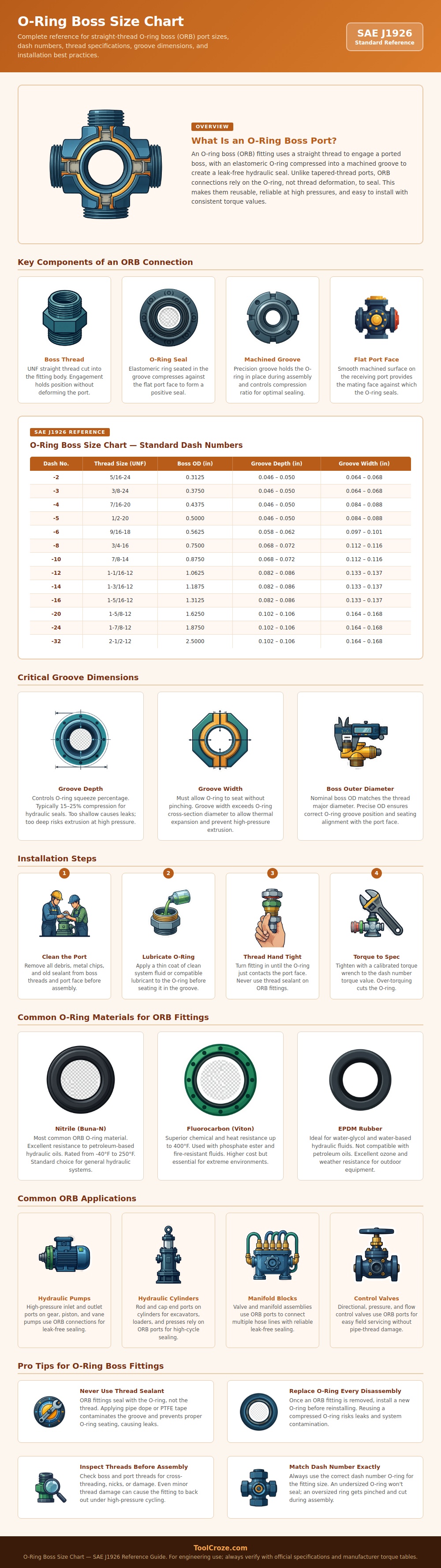
As you can see from chart above, each dash number corresponds to specific groove dimensions, boss diameter, and thread size. A -6 fitting has a 9/16-18 thread, while a -12 have a significantly larger 1-1/16-12 thread. This isn’t just arbitrary. These different threads determines how much room an O-ring has to stretch to seal as the system heats up and how much squeeze it recieve. Too little squeeze means pressure will push fluid past the ring, while too much squeeze mean the ring will get cut during assembly. Before you pick up a wrench, you want to make sure you check both of these conditions; that’s what the dimensions on this chart are for.
The other important consideration besides thread is the groove itself: its width and depth. The width provide the ring room to slide around freely as the fitting is tightened. The depth determines how hard it get squeezed into place. In hydraulic applications, this is typically about 20% compression. Even if you have proper thread engagement, an incorrect width or depth will render the seal inconsistent. Hence the table include both parameters for each size rather than letting us guess at one or the other.
When it’s all installed, what determines longevity? Material selection matter. Nitrile is fine for general purpose hydraulic oil (petroleum based). However, fluorocarbon is preferred for hot weather or if the fluid is phosphate ester based. If you use a water-glycol mix then go with EPDM. All of them are worthless if you have a bad groove cut into your casting, but if the groove fits, they’ll prevent the seal from swelling or getting hard in a couple hundred hours of use.
There are only a handful of common installation errors. One is reaching for thread sealant out of force of habit and wondering why you can’t get the ring to seat. Another is having disassembled it and then deciding to use original ring again, even though it’s no longer round. These two practices turns a re-usable connection into a repeat failure. A better practice: clean the face of the port. Lube a new ring with system fluid. Hand tighten until the ring just barely contacts the port face. Then, tighten with a torque wrench at the appropriate setting for the dash number.
And that’s where the real benefit of the O-ring boss system comes into play. Because it doesn’t rely on crushed threads to create a seal, maintenance is easier. The tech can disconnect the hose, swap out the O-ring, and reconnect the fitting without worrying about leftover sealant residue or damaged threads. Repeatability ensure that hydraulic systems stays in use after each service cycle instead of creating new leaks with each component change. When it is framed this way, the focus shift from matching sizes for one fitting to providing dimensions for a set of matched parts. The chart then doesn’t feel like more work. It just becomes another fast check to keep the slow seep at bay once the machine is rolling again.
