🔧 NPT Taper Angle Calculator
Calculate 1:16 pipe taper geometry, taper per foot, half angle, included angle, thread pitch advance, hand-tight engagement, and wrench allowance.
📌Pipe Size Presets
⚙Taper And Thread Inputs
NPT Taper Results
Calculation Breakdown
🧰Material And Specification Grid
📊NPT Pipe Size Reference
| Nominal Size | Outside Diameter | Threads Per Inch | Common Use |
|---|---|---|---|
| 1/8 NPT | 0.405 in | 27 TPI | Instrument ports and small gauges |
| 1/4 NPT | 0.540 in | 18 TPI | Air lines, valves, and plugs |
| 3/8 NPT | 0.675 in | 18 TPI | Hydraulic adapters and drain ports |
| 1/2 NPT | 0.840 in | 14 TPI | Shop manifolds and utility piping |
| 3/4 NPT | 1.050 in | 14 TPI | Pump drains and water branches |
| 1 NPT | 1.315 in | 11.5 TPI | Sprinkler risers and equipment ports |
| 1-1/4 NPT | 1.660 in | 11.5 TPI | Steam, condensate, and process branches |
| 1-1/2 NPT | 1.900 in | 11.5 TPI | Tank nozzles and larger service lines |
| 2 NPT | 2.375 in | 11.5 TPI | Receiver ports and pipe headers |
| 3 NPT | 3.500 in | 8 TPI | Header cleanouts and heavy fittings |
📐1:16 Taper Geometry Reference
| Geometry Item | Formula | Imperial Value | Metric Equivalent |
|---|---|---|---|
| Diameter taper ratio | D change = L / 16 | 0.0625 in per in | 1.5875 mm per 25.4 mm |
| Taper per foot | 12 in / 16 | 0.750 in per ft | 62.5 mm per m |
| Radius slope | radius change = L / 32 | 0.03125 in per in | 0.03125 mm per mm |
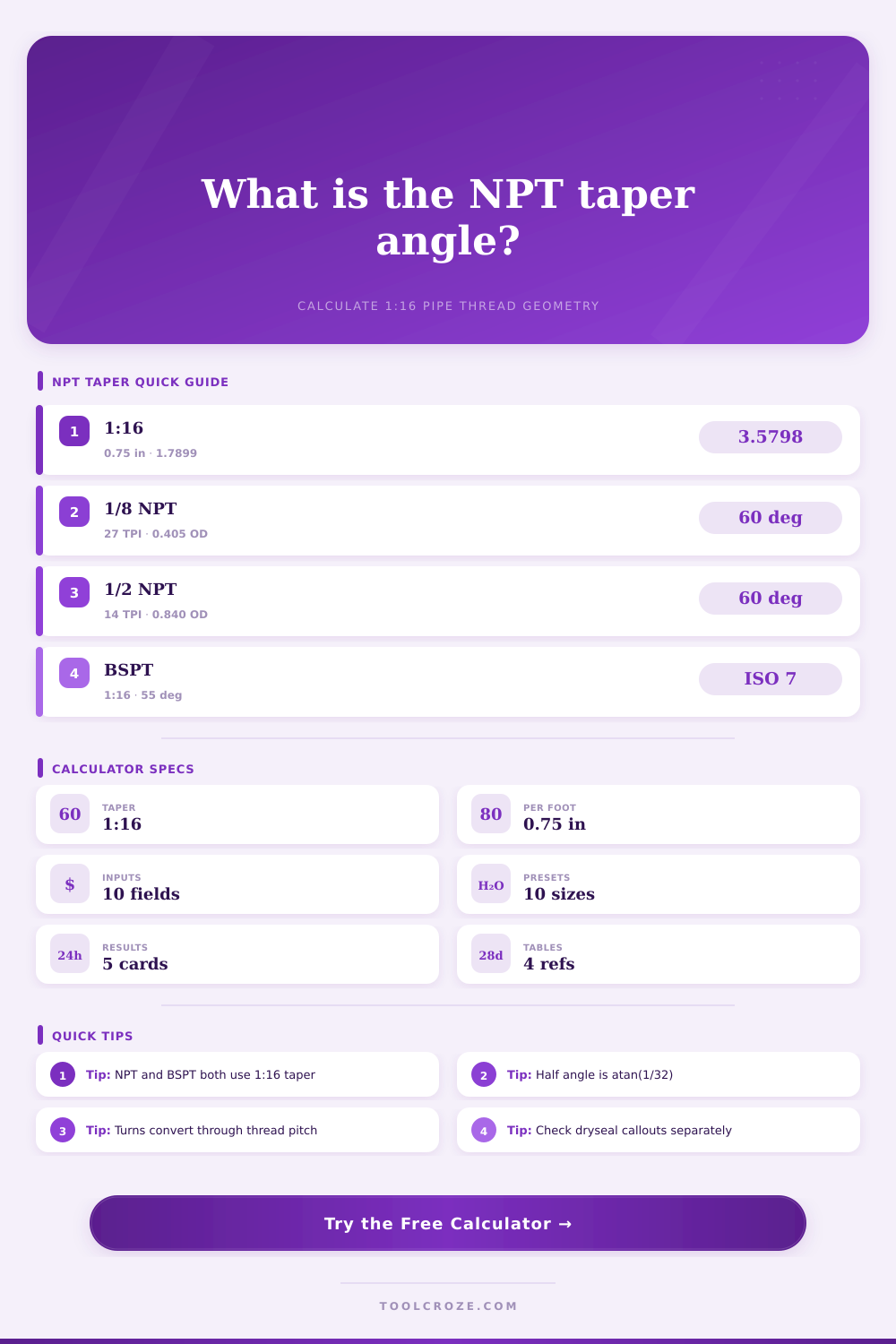
| Half angle | atan(1 / 32) | 1.7899 deg | 31.24 mrad |
| Included angle | 2 x half angle | 3.5798 deg | 62.48 mrad |
⚖NPT, NPTF, And BSPT Comparison
| Thread Type | Taper | Thread Form | Calculator Note |
|---|---|---|---|
| NPT | 1:16 | 60 deg | General tapered pipe thread; sealant commonly used |
| NPTF dryseal | 1:16 | 60 deg | Controls crest and root contact more tightly than NPT |
| BSPT / R | 1:16 | 55 deg | Same taper angle, different thread profile and pitch series |
| BSPP / G | Parallel | 55 deg | Not a taper-thread match for this 1:16 calculator |
🔧Engagement Turn Reference
| Pipe Size Group | Pitch Used | Typical Hand-Tight Turns | Wrench Allowance |
|---|---|---|---|
| 1/8 NPT | 27 TPI | 3.5 to 4.5 turns | 1.5 to 2.5 turns |
| 1/4 to 3/8 NPT | 18 TPI | 4 to 5 turns | 2 to 3 turns |
| 1/2 to 3/4 NPT | 14 TPI | 4 to 5 turns | 2 to 3 turns |
| 1 to 2 NPT | 11.5 TPI | 4.5 to 6 turns | 2 to 3.5 turns |
| 3 NPT and larger | 8 TPI typical | 5 to 7 turns | 2.5 to 4 turns |
📝Shop Measurement Notes
| Check Item | What To Enter | Expected Result | Watch Point |
|---|---|---|---|
| Lathe taper setup | Thread length and large OD | Small end OD and compound angle | Use half angle from the pipe axis |
| Ring or plug gauge span | Measured diameter drop | Percent from 1:16 basic | Burrs can distort small readings |
| Fitting engagement | Hand turns plus wrench turns | Axial advance and diameter change | Sealant changes feel before geometry |
| BSPT comparison | Select BSPT thread type | Same taper angle, 55 deg form | Do not mix thread forms by angle alone |
💡Practical Taper Tips
Have you ever tried to tighten a plumbing joint that was leaking, only to find you could twist the pipe until your arm fell off and it will keep dripping? It is a familiar nightmare for DIYers and plumbers alike. You twist wrench and hear metal whine, but it is no good.
The source of many leaks isn’t necessarily that there wasn’t enough torque. Instead, it’s that the person who tightened the joint didn’t fully understand the geometry involved with what are called “tapered” threads. With parallel threads, you need some sort of sealant or gasket to prevent leakage. But with tapered threads, like National Pipe Taper threads, there is an interference between the threads themselves that creates a mechanical seal. That’s why it’s so forgiving (when done right) but unforgiving (if not). And it’s because you need to know math inside the metal.
Why Tapered Threads Stop Leaks
One of the most important aspects of this system are the one-in-sixteen taper. That’s right; it tapers at one inch per sixteen inches of axial distance. That doesn’t sound like much, but when dealing with a fitting that has only a few inches of engagement, the slope adds up fast. The math is done for you in calculator above. It’ll take that taper ratio and convert it to helpful diameters and angles. While there’s no need to commit all that trig to memory, it does helps to understand what the figures mean.
The approximate half angle off centerline is one point seven nine degrees. If you’re turning a custom repair thread, that’s the angle you’d position your lathe compound to cut at. Double that and you get included angle of about three point five eight degrees. Those figures are exact.
The threads must bite into one another as they progress to create enough radial force to seal. Otherwise, they cross-thread or strip off before creating any kind of radial force. People often mix up the taper angle with the thread angle. Those two angles is very important things and they’re differenter. The thread form angle refers to what each tooth looks like; it’s sixty degrees for NPT. The taper angle refers to the shape of the whole cylinder. It’s a cone. It’s an independent variable, and it has to play well with the other one.
The page’s tool lets you switch between NPT, the more tightly fitting (dry-seal) NPTF standard, and the British Standard Pipe Taper, or BSPT. Even though their tapers is both one in sixteen, BSPT have a fifty-five degree thread form. That shared geometry is where the adapters come into the picture: they’re not directly interchangeable, even though their thread profiles is similar. And mixing them up will result in gaps that nothing but paste can fix.
Theory meets the shop floor in practical use. When you screw the fitting in, you want to know just how far. To do that, the calculator translates engagement turns to both how far it moves and the resulting increase in diameter. A general rule of thumb is that hand-tight means turning the fitting four or five times. Each turn move the threads along the cone, increasing the contact pressure. Adding wrench turns raises that pressure more until, if there are too many turns, the root of the threads gets crushed.
The page has a reference table laying all this out, which gives a range for typical engagement based off pipe size. Keep in mind, however, that age, sealant, or thread damage can change the feel so the reference table is a guide, not a rule. Listen to your fit. Binding too soon? You’re probably already cross-threaded or are trying to fit a damaged nut onto a good one. Freely spinning? You may well of be missing the seal entirely.
Another variable is sealant allowance. You can include a percentage allowance for both paste and/or tape on the tool. It’s not altering the geometry, but it does recognize that no threads is perfect in the real world. Adding a little bit of bulk from a light coat has the effect of changing the engagement point. And that affects prediction. When you’re trying to predict if a gauge passes or fails, it’s a little thing that makes a difference. These tolerances help you make plans for assembly. It is not simply twirling some metal around but making a precise interference fit work.
The taper makes all the difference between a good joint and an annoying drip. The attention to detail that most folks don’t even think about: Half angle vs. Should you use a full cone? Respect the geometry and it stays put in the pipe.