
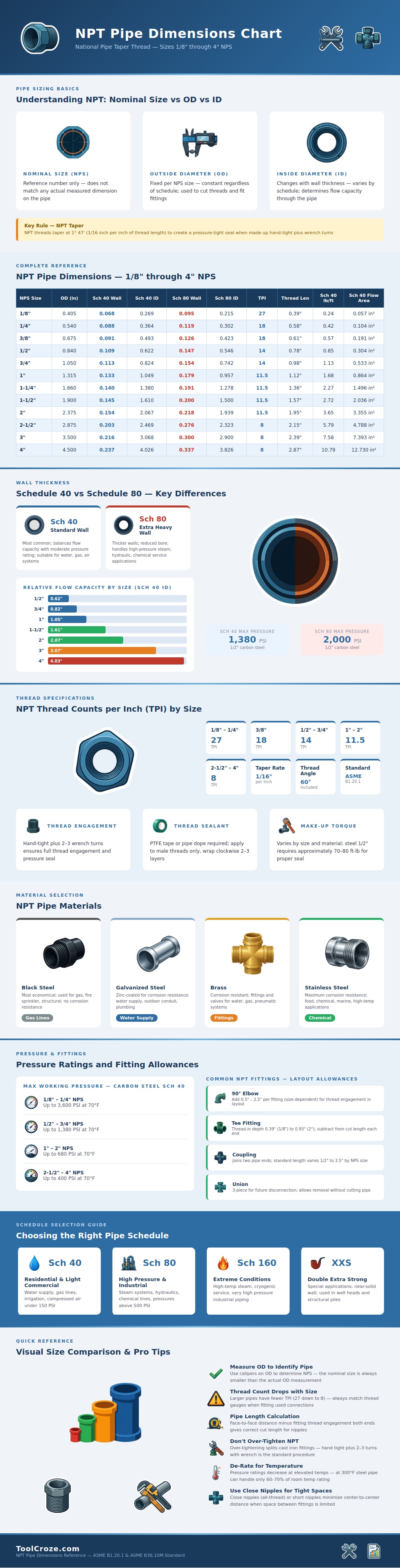
National Pipe Taper thread fitting leaks will drive you nuts if you don’t understand what’s going on here. You’ll swear it’s because of your wrenches or your cheap tape job, but chances are it’s not; it’s because you’ve used them incorrecty. The following chart explains what’s really happening with these fittings and demonstrates that size does matter, more then you might imagine:
An important point to understand is what they mean by “nominal” pipe size. Nominal means it’s a name, not a measurement. So a one-inch pipe is not actualy one inch on either the inside or outside. The name is convenient; however, depending on the wall thickness, the inside diameter decreases and the outside diameter increases. Understanding this will prevent you from making expensive mistakes with seemingly matching fitting sizes that don’t fit together physicaly.
Why Your Pipe Fittings Leak and How to Fix Them
NPT use the taper to create a seal; there is no gasket involved with the seal in NPT. Tapered threads are not straight but angled slightly inward. As you tighten the thread, metal of one piece compresses onto the metal of the other. The two pieces of metal create a barrier through friction by creating an interference fit, which blocks fluid passage. This is why the rule is hand-tight plus a couple of wrench turns. If you go past hand tight, you will distort threads or even split cast iron fitting, defeating purpose completely.
As you might expect, pipe size is also influenced based off materials. Gas lines use black steel which is cheap and durable to modest pressures; however more expensive brass or galvanized steel are required outdoors or when facing corrosives. Note that the infographic shows thicker walled Schedule 80 vs thinner walled Schedule 40. Because the pipe gets stronger as more material is used, the Schedule 80 have a much higher pressure rating, even though it holds less liquid. It’s a give-and-take between strength and capacity.
The number of threads per inch also differs with pipe size and trips up lots of DIY’ers. A 2″ line won’t take a half-inch gauge. For example, the bigger pipe have fewer threads per inch and the smaller one has more. Cross-threading occur when the mismatch causes you to ruin the seal before you even begin the tightening process. Confirm the correct pitch for your size to ensure it engages smoothly.
When planning out your system, be sure to take into account how far the fitting threads into the pipe. For example, a regular coupling takes up a few inches in both directions. This means that unless you subtract this threaded distance from your measurements, your joints won’t line up. You will end up with either forced connections or gaps between them.
But also, as it turns out: temperature does play a bigger role in pressure ratings than you’d think. A thousand-pound-per-square-inch-rated pipe at room temperature may be only 500-pounder if tasked with moving steam. For safety’s sake, you should of take that loss of capacity into account, which means derating your expectations if you’re working at high temperatures.
Plumbing is not about brute force, but very specific geometry. The limits of materials matter; so does the taper. What’s a leaky nightmare becomes a dependable system once you understand those things and show some respect. Measure with intent, and you’ll get everything fitting just right. You won’t have to force anything home.
