
In a plumbing aisle, you stare at pipes that look identical while you read the labels. Half-inch pipe? Okay, so you look down and your tape measure measures about thirteen sixteenths of an inch; you get confused. Why does the size mean one thing (half-inch) when physical dimensions are another (thirteen sixteenth inches)?
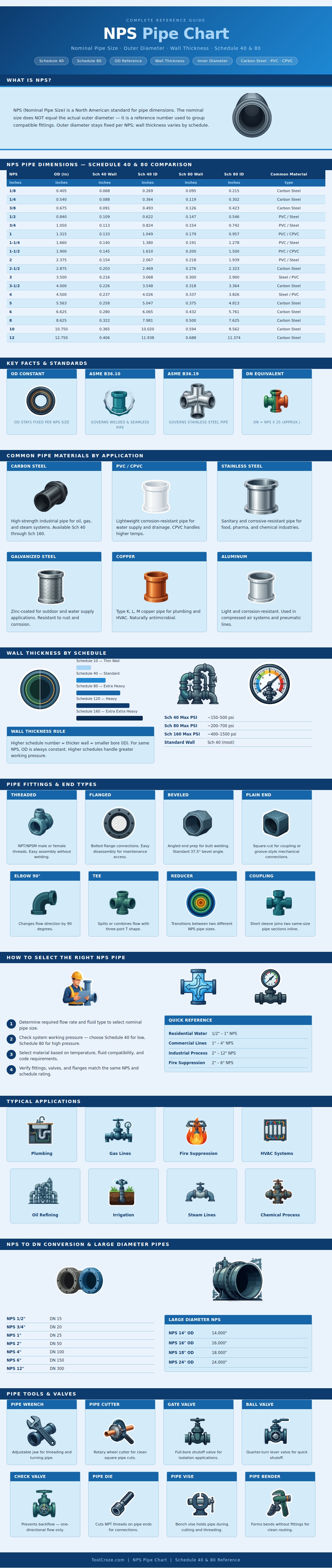
Nominal Pipe Size (NPS) isn’t the actual dimension of the tube. It’s a reference size that lumps similar fittings into one group instead of being a precise description of geometry. For every size, outer diameter never varies; only the wall thickness change depending on what kind of pressure the pipe needs to support. To make this clear, chart above breaks down a side-by-side comparison of the Specs between Schedule 40 and Schedule 80. What you’ll see is that the outer diameter remains the same regardless of the schedule number.
What is Nominal Pipe Size
Meaning, although two pipes with different schedules has different inner flow areas, a Schedule 80 straight section can be joined together with a Schedule 40 elbow. Understanding this point is important because most folks gets confused when shopping around for pipe fittings for plumbing jobs. Nominal size simply refers to matching sizes. The schedule number doesn’t tell you the height of a piece of plumbing; it tells you its thickness and how much pressure it can withstands.
For most home uses, basic Schedule 40 pipe will do just fine because it has walls thick enough to handle moderately high pressures. Use Schedule 80 and the walls is even thicker then that. The thicker wall takes up more interior space, so it slightly shrinks inside diameter. That’s an exchange of durability versus flow capacity. When using corrosive chemicals or handling high-pressure gas lines, you don’t want any possibility of failure, so this become important.
But there’s more: There is also the issue of material choice. In heavy industry area such as oil refineries, carbon steel is used most often thanks to its ability to withstand high pressures and temperatures while maintaining form. For cold water distribution and drain pipes in our houses we see use of PVC and CPVC materials. These are cheaper to install and don’t corrode easy. Hot water distribution in our houses still uses copper thanks to its easy solder-ability and germ-fighting properties.
Each of these materials have its own way of relating to nominal size dimensions. An extra PVC pipe will not just replace a steel pipe; you must account for how differences in wall thickness impact the fit. The first thing you do when choosing the proper pipe is choose for appropriate flow rates. You then can look at pressure ratings. A pipe that is too big causes you to lose velocity control, and a pipe that is too small will sacrifice system volume due to increased friction losses. After you’ve selected the pipe size, you next confirm the working pressure against Schedule 40 or even higher grades.
Finally, you ensure all valves, fittings and flanges are properly matched in both NPS size and schedule rating. Any mismatches becomes weak links that rupture under load. Things change with large diameter piping. For diameters above twelve inches, the nominal size typically equals actual outside diameter. That makes things easier for pipeline engineers transporting crude oil, but confuses plumbers who is accustomed to smaller fractional sizes.
If you have memorized this multiplier, converting from NPS to its metric equivalent, DN, will be easy. Simply take number of inches and multiply it by twenty-five. The result is roughly equivalent to the millimeter size. In other words, a two-inch pipe becomes a DN 50 connection of approximately fifty millimeters under international sizing standards.
Different types of ends call for different tools based off the type of pipe used. For example, if it has threaded ends, you’ll need a die to create exact taper necessary for a good seal and a wrench to tighten it down securely. If flanges are involved, you want a torque wrench to maintain equal tension on all bolts around the gasket surface. To weld bevelled pipes, you need an angle grinder for preparation and to make proper joints. And plain ends typically enter a groove-type mechanical coupling that clamps down snugly with no heat or thread needed. Understanding how each tool matches to each end style helps get you through job site more quickly.
It’s not about numbers; it’s about relationships. You can understand pipes by knowing how they relate to one another. The size of the outer diameter anchors the system, safety margins are adjusted with wall thickness. Longevity comes down to material choice. Reviewing that shelf of tubes later in life, you’ll find that the labels make sense.
It’s all about matching the label to the load, not measuring the metal. You should of checked the specs first.
