
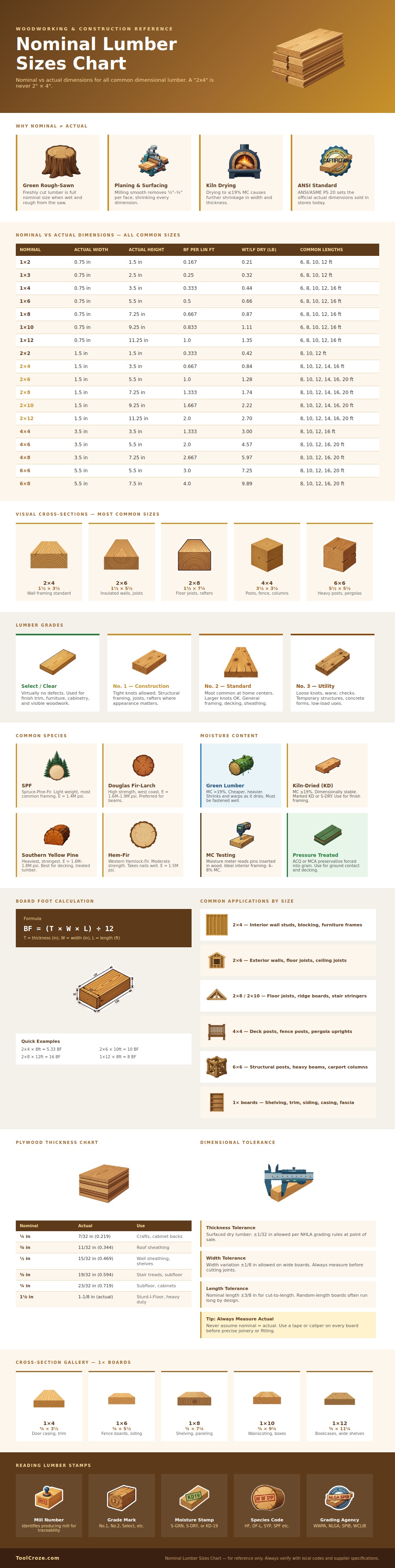
When I buy a two by four, you probably assume it will be two inches by four inches. But when you use that piece of wood, it’s not quite what you expected. In fact, it’s three-and-a-half inches wide by one-and-a-half inches thick. It makes sense if you know how lumber is cut, but it can be confusing at first. The table above explains this in an easy way.
Nominal vs. These are the actual dimensions. Remember: Your tape measure trumps sticker on the pile. Lumber gets modified somewhere along the line. It starts with rough sawn green lumber. At this point, the wood hasn’t lost any of its theoretical size. If I cut down a tree, a 2×4 would be about 2 by 4 inches wide. But since it’s fresh off the tree, the wood is wet, and therefore unstable. Wet wood doesn’t make good house building material; it shrivel up and warps when water evaporates.
Why Lumber Sizes Are Smaller Than The Label
The solution? Planers shave away rough surface and leave behind smooth faces. And then the lumber is sent into a kiln where it dries out, shrinking even more in both thickness and width. By the time you purchase it, it’s standardized in actual sizes, which are what builders count on when they frame a house.
Knowing about shrinkage is important when estimating material needs. For instance, that means gap between your studs in a wall frame would be based off of three-and-a-half-inches (not four), if you build it that way. The infographic explains the typical sizes for everything from heavy posts to small strips. A two-by-six, for instance, isn’t really two-by-six, but one-and-a-half by five-and-a-half. That added thickness is what gives them more structural strength as a floor joist or an exterior wall.
DIYers tend to undervalue the impact of that variance and wind up with thin walls or bouncy floors. Always measure real size of whatever you’re building, and then order your hardware (screws, brackets, etc.) based on the real wood, not its nominal name.
What you buy in the store is also determined by grade. There will be numbers on the end of the board that show what grade it is: Number Two, Number One or Select. Number Two have bigger knots but it’s the normal construction type of lumber. It’s good for framing behind wallboard where the knots won’t show. Select grades has fewer knots, perfect for furniture or other applications where the wood shows. Wasting expensive select lumber for unseen structural members makes no sense, and wasting cheaper wood on a showpiece like a bookshelf just invites heartburn.
Species are also important. Some woods is heavier and stronger than others. Spruce-Pine-Fir is not as strong or heavy as Southern Yellow Pine, so Southern Yellow Pine can support more load. Volume is measured in board feet; not just area or length. The unit confuses many people, but then they recall that a board foot is calculated using length times width times thickness. If you’re ordering rough lumber (sold by the board foot), learning to calculate board feet will allow you to guesstimate prices correctly.
Plywood measurements are like that, too, plywood has a nominal size (what’s on the label) vs. An actual size (it’s usually a hair smaller). For example: what looks like a half inch sheet of plywood is actually more likely a fraction of an inch smaller. That can throw off your joints in cabinets unless you adjust for the difference. Measure twice cut once, as they say.
The bottom line is that just because something is labeled one size does not mean it is that size. Always measure everything first before attempting to fit anything into place or join anything together. It doesn’t matter if you’re building a basic shelving unit or a whole house, taking measurements seriously pays off in time and money.
Turns out that 2×4 isn’t really a two by four at all, but hey; when you work with whatever’s in your hands, it would of held up your wall just fine.
