⚡ Newton Meter to Kilowatt Converter
Convert torque (N·m) + RPM to power in kilowatts, watts, and horsepower instantly
| Torque (N·m) | 1000 RPM | 2000 RPM | 3000 RPM | 4500 RPM | 6000 RPM |
|---|---|---|---|---|---|
| 50 N·m | 4.97 kW | 9.95 kW | 14.92 kW | 22.38 kW | 29.83 kW |
| 100 N·m | 9.95 kW | 19.90 kW | 29.84 kW | 44.76 kW | 59.67 kW |
| 200 N·m | 19.90 kW | 39.79 kW | 59.69 kW | 89.53 kW | 119.3 kW |
| 350 N·m | 34.82 kW | 69.64 kW | 104.5 kW | 156.7 kW | 208.9 kW |
| 500 N·m | 49.74 kW | 99.48 kW | 149.2 kW | 223.8 kW | 298.4 kW |
| 750 N·m | 74.61 kW | 149.2 kW | 223.8 kW | 335.7 kW | 447.6 kW |
| 1000 N·m | 99.48 kW | 198.9 kW | 298.4 kW | 447.6 kW | 596.8 kW |
| 1500 N·m | 149.2 kW | 298.4 kW | 447.6 kW | 671.4 kW | 895.2 kW |
| 2000 N·m | 198.9 kW | 397.8 kW | 596.8 kW | 895.2 kW | 1193 kW |
| From | To N·m | To ft·lb | To in·lb | To kgf·m |
|---|---|---|---|---|
| 1 N·m | 1.000 | 0.7376 | 8.851 | 0.1020 |
| 1 ft·lb | 1.3558 | 1.000 | 12.00 | 0.1383 |
| 1 in·lb | 0.1130 | 0.08333 | 1.000 | 0.01152 |
| 1 kgf·m | 9.8067 | 7.2330 | 86.80 | 1.000 |
| 1 ozf·in | 0.007062 | 0.005208 | 0.0625 | 0.000720 |
| From | Watts (W) | Kilowatts (kW) | Horsepower (hp) | ft·lb/s |
|---|---|---|---|---|
| 1 Watt | 1.000 | 0.001 | 0.001341 | 0.7376 |
| 1 Kilowatt | 1000 | 1.000 | 1.3410 | 737.6 |
| 1 Horsepower | 745.7 | 0.7457 | 1.000 | 550.0 |
| 1 ft·lb/s | 1.3558 | 0.001356 | 0.001818 | 1.000 |
| 1 Megawatt | 1,000,000 | 1000 | 1341.0 | 737,562 |
| Application | Typical Torque | Typical RPM | Power Output | Equiv. HP |
|---|---|---|---|---|
| Electric Bicycle Motor | 40–80 N·m | 200–400 | 0.5–1.5 kW | 0.7–2.0 hp |
| Compact Car (1.2L) | 160–200 N·m | 3500–5000 | 60–85 kW | 80–114 hp |
| Family Car (2.0L) | 200–320 N·m | 3000–5000 | 90–150 kW | 121–201 hp |
| Sports Car (3.0L+) | 350–600 N·m | 4000–7000 | 200–400 kW | 268–536 hp |
| Heavy Diesel Truck | 1000–2500 N·m | 1000–1800 | 200–450 kW | 268–603 hp |
| Electric Car Motor | 300–900 N·m | 0–8000 | 100–450 kW | 134–603 hp |
| Industrial Motor (3-phase) | 500–3000 N·m | 900–1500 | 75–500 kW | 101–670 hp |
| Gas Turbine (aviation) | 5000–50000 N·m | 10000–30000 | 1000–50000 kW | 1341–67050 hp |
Torque is teh measurement of rotational forces and is measured in newton meters. Power is a measurement of how much work are performed over time and is measured in kilowatts. Although torque and power is different measurements, the two are related to one another in that both can be calculated given the other and the speed of an engine (measured in revolutions per minute, or RPM).
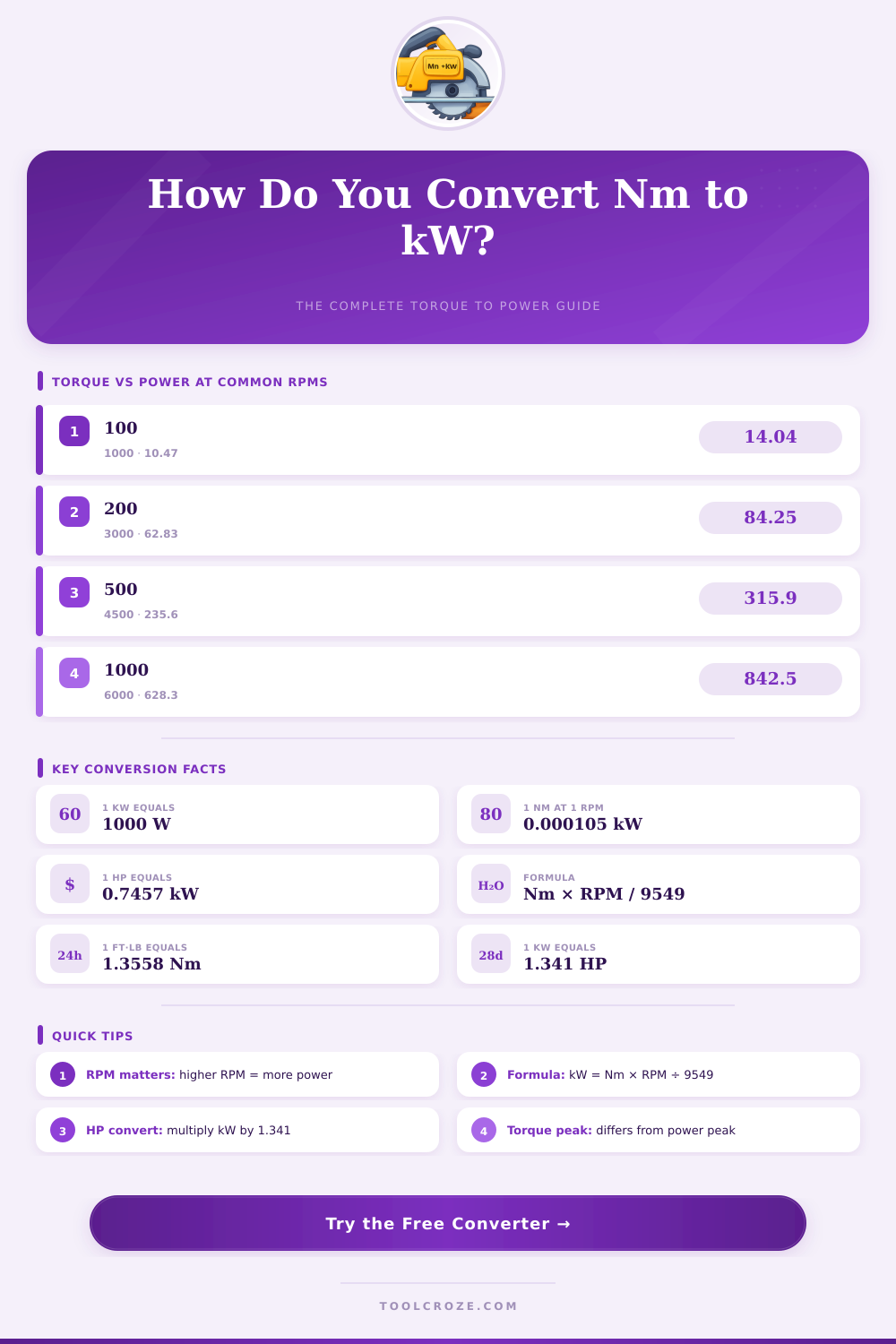
The relationship between the two is important in that while torque is a measurement of the force being apply to an object, power is a measurement of how quickly that force is being applied. The equation used to calculate the power of an engine in the unit of kilowatts given the torque (measured in newton meters) and the RPM of the engine is the following: kW = (Nm × RPM) / 9549. The variable of Nm measure the torque of the engine in newton meters.
How Torque and RPM Make Power
The RPM represent the revolutions per minute of the engine. The constant 9549 is actualy calculate as 30,000 / π. This constant is used in the equation to perform the necessary conversion between the different units of measurement of torque, RPM, and kilowatts.
Finally, the efficiency of the motor must be considered in the calculations. Motors are never 100% efficient in the conversion of energy from one form to another. The efficiency must, therefore, be account for by multiplying the calculated theoretical power by the efficiency of the motor, usualy represented as a decimal (for example, 0.85 efficiency for 85%).
The RPM of an engine can have a direct effect upon the power output of the engine. For example, if an engine is turning at 3000 RPM with 200 Nm of torque, it will output more power then if the same engine were to output the same amount of torque at 1000 RPM. This is due to the fact that power is torque multiplied by the speed (RPM) of the engine.
Thus, as the RPM of the engine increases, so does the power output of that engine. Additionally, the type of engine can also impact the relationship between torque and power. For instance, diesel engines tend to produce more torque at lower RPM than petrol engines.
However, petrol engines has more power at higher RPMs. Electric motors, however, can produce maximum torque at low RPMs. The efficiency of an engine can also have an impact upon it’s power.
Due to the loss of energy to friction and heat, no engine is 100% efficient. Thus, the actual power output will be less than the theoretical power calculated for that engine. For example, if the theoretical power of an engine is 50 kW and the efficiency of the engine is 95%, the actual power output will be 47.5 kW.
Thus, the lower the efficiency, the more power that are lost as waste heat and friction. A higher efficiency will result in an actual power output that is closer to the theoretical power. As such, it is important to account for the efficiency in calculating the power of an engine.
If the units of measurement used are imperial units rather than metric units, it is necessary to convert the measurement of torque from newton meters to foot-pounds. One foot-pound is equal to 1.36 newton meters. Additionally, the power of an engine can also be measured in horsepower units.
One kilowatt is equal to 1.34 horsepower. If you are to use imperial units to calculate the power in horsepower, the formula that should be used is: horsepower = (ft-lb × RPM) / 5252. Each of these unit must be accounted for in any calculations.
Understanding the relationship between torque, power, RPMs, and the efficiency of an engine allow for the selection of the appropriate motor or engine based off the requirements of the technology that is to be used. For example, if high torque is required at lower RPMs, such as in an industrial compressor, a motor with high level of torque and low RPMs is required. In another example, if an engine is to achieve high RPMs, such as in a vehicle, then high power is required.
If the relationship between these different variables is ignored, it is possible that the selected motor will not have enough power to fulfill the requirements for that technology. Thus, by calculating the power in kilowatts of a motor with a given level of torque and RPMs, the manufacturer can ensure that the motor will perform as required before its use.