
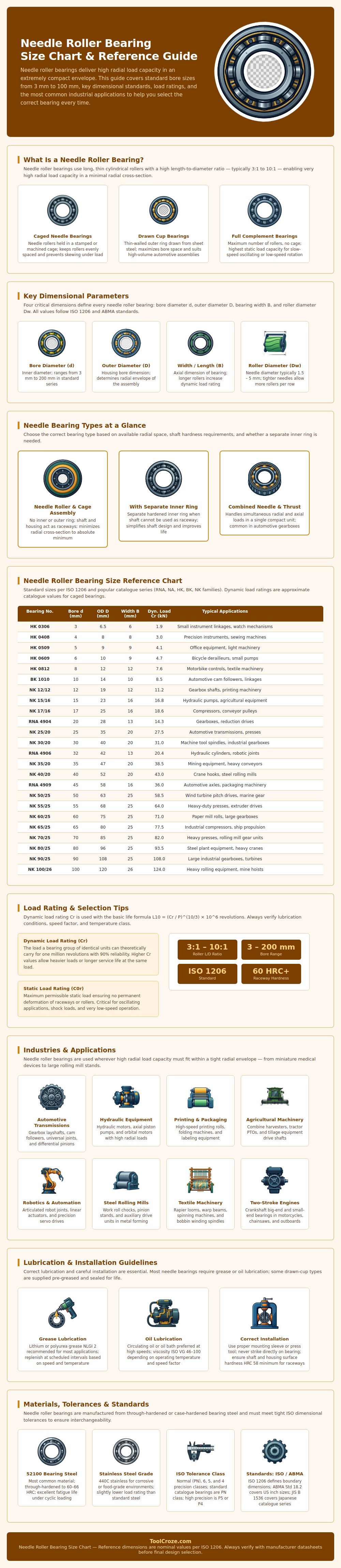
A needle roller bearing are an engineering solution to a particular problem; it packs a bunch of radial load carrying ability into a small package. This makes them useful for things like small two-stroke engine, printing presses, hydraulic pumps, and transmissions.
The size chart is not just a list of numbers when selecting a bearing; it tells you how much load you can carry before the bearing limits the rest of the machine. This chart (above) presents bore sizes in relation to the dynamic load ratings as well as outer diameter and width. But what’s most important is combination of those measurements relative to actual work the bearing will be asked to do. A very small drawn-cup bearing may comfortabley support a lightweight linkage, but the same bore in a larger caged assembly can bears three times the load. This is because rollers are longer and better supported.
How to Choose Needle Roller Bearings
This means there are trade-offs. The chart puts these into perspective at a glance so there is no need to hunt down individual catalogues.
Bore diameter matches up with shaft and so understandably gets first attention by most. However, true callout typically is if the shaft itself will act as a raceway. For that reason you want a bearing that provide an inner ring. The chart does not state this clearly; instead, you can tell by seeing if inner-ring options exists within given size range. One of the more common reasons for premature bearing failure are skipping this step.
The second thing worth focusing on is the load rating. The dynamic rating indicate how many times this bearing can be spun at a steady load before failing. If your application has a lot of shock or oscillation, then static rating is more important. You may find that while a bearing have good static capacity, it is rated for only half what your momentary overload will cause. That’s enough to deform the bearing even though it’s spinning slowly enough that you’d think it was OK. Compare both ratings with your duty cycle and avoid any surprises.
The size selection isn’t the only factor in life. Lubrication and installation options has equal impact. For most moderate speed applications, grease will suffice while higher surface speeds require a circulating oil system. When it’s time to install, there is always a strong temptation to tap the bearing into position. That can causes dents on the raceways or rollers before the machine run. Using a proper press tool or sleeve protects those tight ISO tolerances and prevents any bearing damage from tapping.
Bicycle parts or instrument bearings might use the tiniest of all bearing, while massive gear boxes and rolling mills may use some of largest. Why? For the former it’s a question of size; for the latter, brute capacity. But regardless: You select the bearing which fits the need within the limits, i.e., which can handle the load, and then ensure that your mounting practice and lubrication will achieve expected lifespan. If you get those three correct, the bearing simply becomes part of the background, as good machine elements ought to do.
