
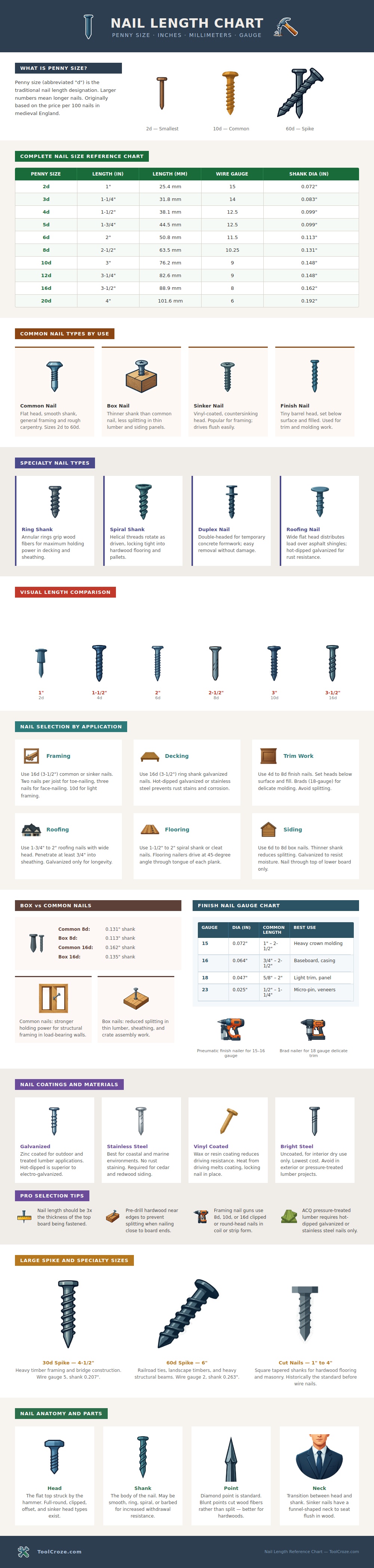
Don’t worry: No economics degree are required to figure out why they’re all so confusing. Here’s the deal: They’re a relic of history. The whole “penny” thing means nothing. Those digits has a little d by their side. That’s because that number once showed how many pounds they cost per hundred nails back in olde England. It was cheaper to use fewer nails, and hence, the name stuck even long after money underwent a change.
That makes sense for an ancient language but it only leads to head-scratching at hardware store today. But if you’re making something that needs to stay put, then it really does matter. Here’s the chart of pennies converted to millimeters and inches. This is handy if you don’t remember where all the rows are, but it will help you avoid mistakes.
Why Nails Have Strange Names
A Two Penny Nail, for instance, is only an inch long. It is not enough for framing your house. They are meant for attaching thin veneers or really delicate trim. Look at the graphic. As the number goes up, the length and thickness also increase. A Sixteen Penny Spike, for instance, is almost Four Inches Long. It have a thick Shank that grips hard into the Lumber. That is what keeps it in place when the wood moves over time.
Choosing the right kind of nail is just as important than choosing the right length. A common nail features a thick shank that can absorbs up in rough framing conditions when the need for holding is greatest. A box nail are thinner and helps to avoid splitting out in lighter lumber. A sinker nail has a counter sinking head that lay flush with the wood surface. They are coated in vinyl to slide in easily, reducing friction as they drive home. The vinyl coating also melts a little under impact heat and grabs the nail into place better than bare steel.
Every tool has its job When installing decking, you need specialty tools, specifically nails with spirals or rings in their shank. As they go through the wood, the ridges on the shaft catch the wood fibers as if they were a screw thread. They offer resistance to being pulled out that smooth shanked nails does not provide. When you’re done building your deck, you don’t want it sliding around in the yard; you want it to stay put while you enjoy using it.
On the trim finish work, you pull out the smaller gauges. Finish nails leaves a very small hole (fifteen gauge) that you can fill and sand until it is invisible. Sometimes the thinner brads don’t even need filling! These are eighteen gauge. The trade-off is holding strength. Thinner nails holds less weight. They are good for decorating but bad for structural loads. It’s a battle between physics and the look here.
The right materials avoids premature failure and rust stains. If you’re using pressure-treated lumber or working outdoors, always use galvanized nails. Treated wood contains chemicals that eat plain steel. Stainless steel is more expensive, but will last longer (especially in coastal areas) if used with cedar siding. For indoor applications where moisture can be controlled, use bright steel nails (no coating). Using the wrong material saves money upfront, but costs more in replacements later. This one gets overlooked by most DIYers until orange streaks dissapears on your fence posts.
Before you swing that hammer, here are some basic rules of thumb for nail length. Generally speaking, nails needs to be long enough to go about halfway into whatever they’re securing. For instance, if you were nailing one two-by-four onto another, use a three-inch nail. That’ll keep it secure but not punch all the way through the other board. When working with hardwood, pre-drilling the hole will prevent splitting, particularly around edges of boards where the grain is exposed. Just 30 seconds of your time and it spares you the headache of destroying a beautiful oak floor. You should of known that.
A small nail is a simple thing. And yet with all that simplicity comes a good bit of wrong guessing. The art of it lies in choosing the right kind, size and material. When you visit the hardware store, don’t just consider the penny sizes. Consider what those sizes mean for real uses and strength. A twopenny nail is still cheap. It might still be cheap. Getting to know your choices won’t cost you a dime.
