Nail Gun Air Consumption Calculator
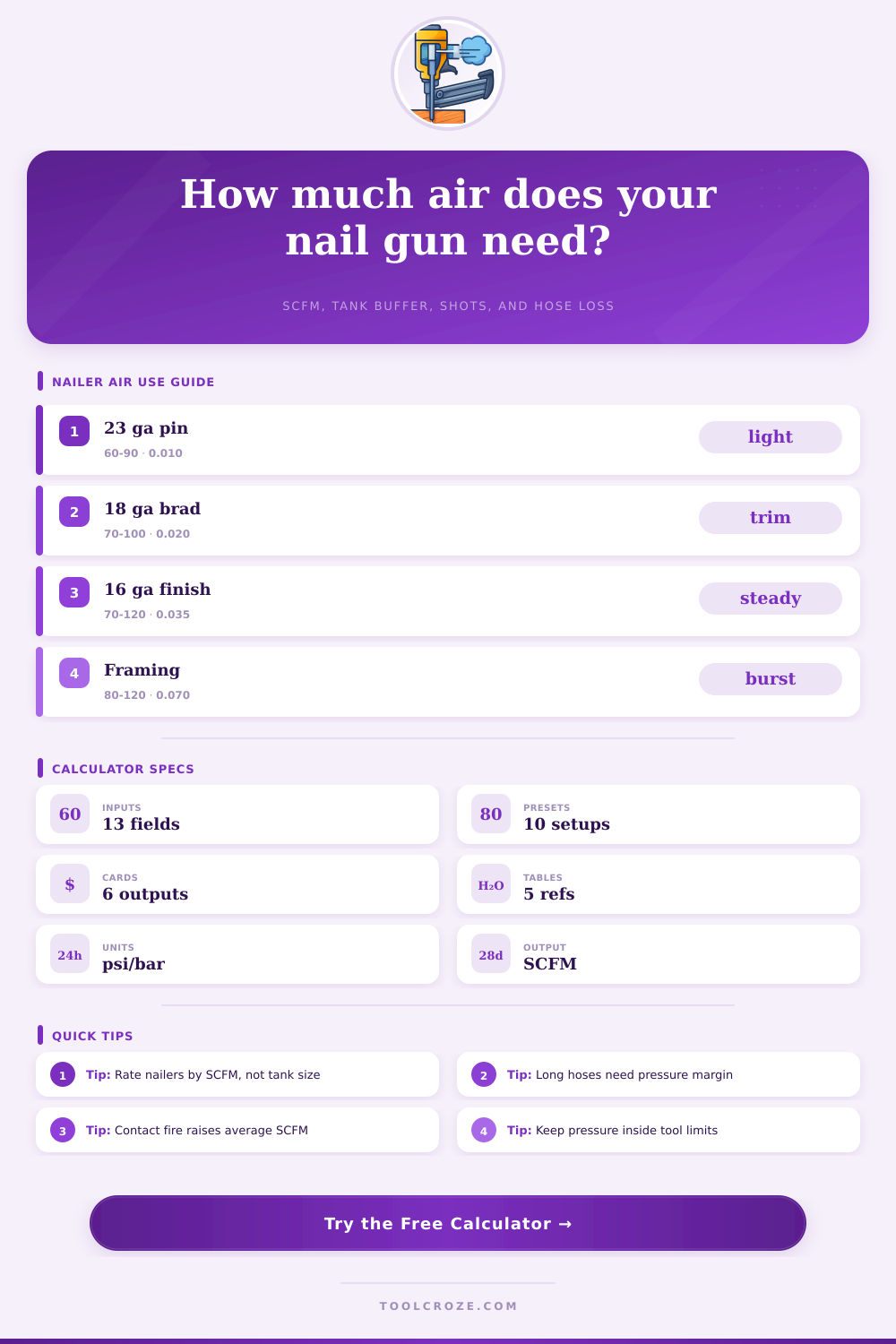
Estimate nailer SCFM, total free air, compressor headroom, tank-only fasteners, and recovery time from the nailer type, firing pace, hose setup, and compressor rating.
Choose a real fastening pattern, then adjust the pressure, fastener count, hose, and compressor to match your setup.
| Nailer class | Typical fastener range | Common pressure | Typical air per shot | Best compressor behavior |
|---|---|---|---|---|
| 23 ga pin nailer | 3/8 to 1-3/8 in pins | 60 to 90 psi | 0.008 to 0.014 SCF | Small tank is usually fine for trim pace |
| 18 ga brad nailer | 5/8 to 2 in brads | 70 to 100 psi | 0.015 to 0.026 SCF | Portable 1.5 to 2.5 SCFM works for most finish work |
| 16 ga finish nailer | 1 to 2-1/2 in finish nails | 70 to 120 psi | 0.026 to 0.045 SCF | Needs more reserve when casing or base is continuous |
| 15 ga angled finish nailer | 1-1/4 to 2-1/2 in DA nails | 80 to 120 psi | 0.035 to 0.055 SCF | Match with 2.5+ SCFM for long molding runs |
| Flooring stapler or cleat nailer | 1-1/2 to 2 in cleats or staples | 70 to 100 psi | 0.040 to 0.065 SCF | Tank volume helps during repeated mallet strikes |
| Roofing coil nailer | 3/4 to 1-3/4 in coil nails | 70 to 120 psi | 0.055 to 0.085 SCF | High firing pace needs 4+ SCFM and short hose runs |
| Siding coil nailer | 1-1/4 to 2-1/2 in siding nails | 70 to 120 psi | 0.050 to 0.080 SCF | Moderate pace still benefits from 3/8 in hose |
| Framing nailer | 2 to 3-1/2 in framing nails | 80 to 120 psi | 0.060 to 0.100 SCF | Use real SCFM reserve for sheathing or contact fire |
| Palm nailer | Connector and framing nails | 80 to 120 psi | 0.050 to 0.085 SCF | Short bursts draw less average air but need stable pressure |
Air-per-shot values are practical estimating ranges for free air at roughly 90 psi; always use the exact manual value when available.
| Nailer type | Light pace | Steady pace | Rapid pace | What to watch |
|---|---|---|---|---|
| 23 ga pin nailer | 0.1 to 0.2 SCFM | 0.3 to 0.5 SCFM | 0.6 to 0.9 SCFM | Very small compressors can recover between pins |
| 18 ga brad nailer | 0.2 to 0.4 SCFM | 0.6 to 1.0 SCFM | 1.2 to 1.8 SCFM | Baseboard runs can outpace tiny inflators |
| 16 ga finish nailer | 0.4 to 0.7 SCFM | 1.0 to 1.6 SCFM | 2.0 to 3.0 SCFM | Pressure sag causes proud nails in hardwood |
| Flooring stapler | 0.5 to 0.9 SCFM | 1.4 to 2.1 SCFM | 2.6 to 3.8 SCFM | Mallet rhythm creates repeated short bursts |
| Roofing coil nailer | 0.8 to 1.3 SCFM | 2.0 to 3.2 SCFM | 4.0 to 6.5 SCFM | Contact fire can exceed small portable ratings |
| Framing nailer | 0.9 to 1.5 SCFM | 2.2 to 3.5 SCFM | 4.5 to 7.0 SCFM | Sheathing pace often needs compressor reserve |
| Air delivery setup | Best nailer range | Allowance used | Pressure behavior | Calculator cue |
|---|---|---|---|---|
| 25 ft 1/4 in hose | Pin, brad, finish | About 6% to 12% | Easy to carry but limited flow | Use light hose only for lower pace |
| 50 ft 3/8 in hose | Most trim and framing | About 8% to 16% | Balanced reach and flow | Good default for jobsite nailers |
| 100 ft 3/8 in hose | Moderate framing | About 14% to 24% | Long runs may sag during bursts | Add reserve margin or raise supply hose size |
| 50 ft 1/2 in hose | Roofing, sheathing, crews | About 5% to 10% | High flow with less pressure drop | Best for rapid-fire nailers |
| Small couplers and filter stack | Any nailer | Add 8% to 12% | Restriction appears at trigger pull | Select restrictive fittings if nails sit proud |
| Compressor style | Typical delivered air | Common tank | Good nailer match | Limit |
|---|---|---|---|---|
| 1 gal trim compressor | 0.5 to 0.8 SCFM | 1 to 2 gal | Pin nailer, slow brad work | Frequent recovery pauses |
| 6 gal pancake compressor | 2.0 to 2.8 SCFM | 6 gal | Brad, finish, light framing | Rapid roofing or sheathing will cycle hard |
| Twin-stack portable | 3.0 to 4.5 SCFM | 4 to 8 gal | Finish crews, framing bursts | Watch duty cycle on long contact fire |
| 20 gal oil-lube portable | 4.5 to 6.5 SCFM | 15 to 30 gal | Framing, siding, roofing pace | Long hoses still need flow fittings |
| Shop belt-drive compressor | 8 to 12+ SCFM | 30 to 80 gal | Multiple nailers or high pace | Regulator and hose become the bottleneck |
| Tank size | 25 psi band | 30 psi band | 40 psi band | Practical use |
|---|---|---|---|---|
| 1 gal | 0.23 SCF | 0.27 SCF | 0.36 SCF | Short pin or brad bursts only |
| 3 gal | 0.68 SCF | 0.82 SCF | 1.09 SCF | Light trim between recovery cycles |
| 6 gal | 1.36 SCF | 1.63 SCF | 2.18 SCF | Common pancake trim reserve |
| 10 gal | 2.27 SCF | 2.73 SCF | 3.64 SCF | Longer finish or framing bursts |
| 20 gal | 4.55 SCF | 5.45 SCF | 7.27 SCF | Roofing and framing recovery cushion |
Approximate buffer uses tank gallons divided by 7.4805, then multiplied by pressure drop divided by 14.7 psi.
Selecting an compressor for a pneumatic nailer requires you to understand the air consumption of the pneumatic nailer, and selecting a compressor for a pneumatic nailer require you to understand in what way the compressor supplies air to the pneumatic nailer. The size of the compressor tanks isnt the same as the air that the compressor can continuously output; rather, you must look at the cubic feet per minute (SCFM) rating of the compressor. While a large compressor tank hold air to supply the pneumatic nailer for a limited number of shots, the motor of the compressor must be able to output air at a fast enough rate to supply the pneumatic nailer.
If the air output of the compressor isnt fast enough to supply the pneumatic nailer, the air pressure will drop and the pneumatic nailer will not function corectly. The calculator allow you to calculate the air requirement of your pneumatic nailer by entering information about the type of pneumatic nailer, the firing pace of the pneumatic nailer, the length of the hose that connect the compressor to the pneumatic nailer, and the rating of the compressor that you are to select. The calculator adjusts the air-per-shot figure according to the air pressures of the pneumatic nailer and the hose, and adds an allowance for waste air (used during test shots) to arrive at the average SCFM rate that the job will require.
How to Choose a Compressor for a Pneumatic Nailer
Additionally, the calculator also output the number of fasteners that the motor of the compressor can supply the pneumatic nailer with before it has to run to refill the tank. The length of the hose that connects the pneumatic nailer to the compressor, as well as the size of the coupler that connect those two tools, may restrict the flow of air that reaches the pneumatic nailer. Long hoses and small couplers will restrict air flow more than short hoses and large couplers.
As a result, if the pneumatic nailer is connected to a long hose with a small diameter, the air pressure at the pneumatic nailer will be less then that measured at the compressor gauge. Such restrictions must be accounted for, since the air pressure at the pneumatic nailer is that which determine if the pneumatic nailer will function correctly. Thus, the calculator also incorporates a factor to account for the restrictions of the coupler.
The firing pace of a pneumatic nailer can change the air requirement of the pneumatic nailer. For example, a person that is performing trim work with a pneumatic nailer may fire it slow, but a person that is installing roofing tiles will fire a pneumatic nailer at a very high rate. Thus, if the firing pace is fast, the compressor will have to have an SCFM rating that can keep up with that fast rate of fire.
The calculator allows the user to enter the number of active minutes per hour to account for such high firing rate. Another consideration for a compressor is its duty cycle. The duty cycle define the amount of time that the compressor motor should be running.
For instance, a duty cycle of 65% means that the compressor motor should only run 65% of the time within some specific timeframe, allowing the motor to cool. If the motor is continually running at rates above the duty cycle, it may fail over time, shortening the life of the motor. The calculator applies this limit to the SCFM figure, as well.
Some of the most common mistake in selecting a compressor for a pneumatic nailer are confusing the size of the compressor tank with the air that the compressor continuously output, and failing to account for the restriction in the pressure of the air that moves through the hose. Both of these mistake can be avoided by referring to the reference tables that are included with the calculator. These tables allow the user to understand how different sizes of hose diameter will impact the flow of air that reaches the pneumatic nailer, as well as how much air each class of pneumatic nailer consume.
Thus, using these reference tables along with the calculator will allow the user to decide if a change in the size of the compressor, the size of the hose, or the length of the hose is needed so that the compressor can supply the pneumatic nailer with enough air to function corectly.