Mulch Calculator Cubic Feet
Estimate landscaping mulch volume from bed shape, length, width, depth, existing mulch credit, bag size, bulk cubic yards, compaction, waste, and coverage.
Mulch Estimate
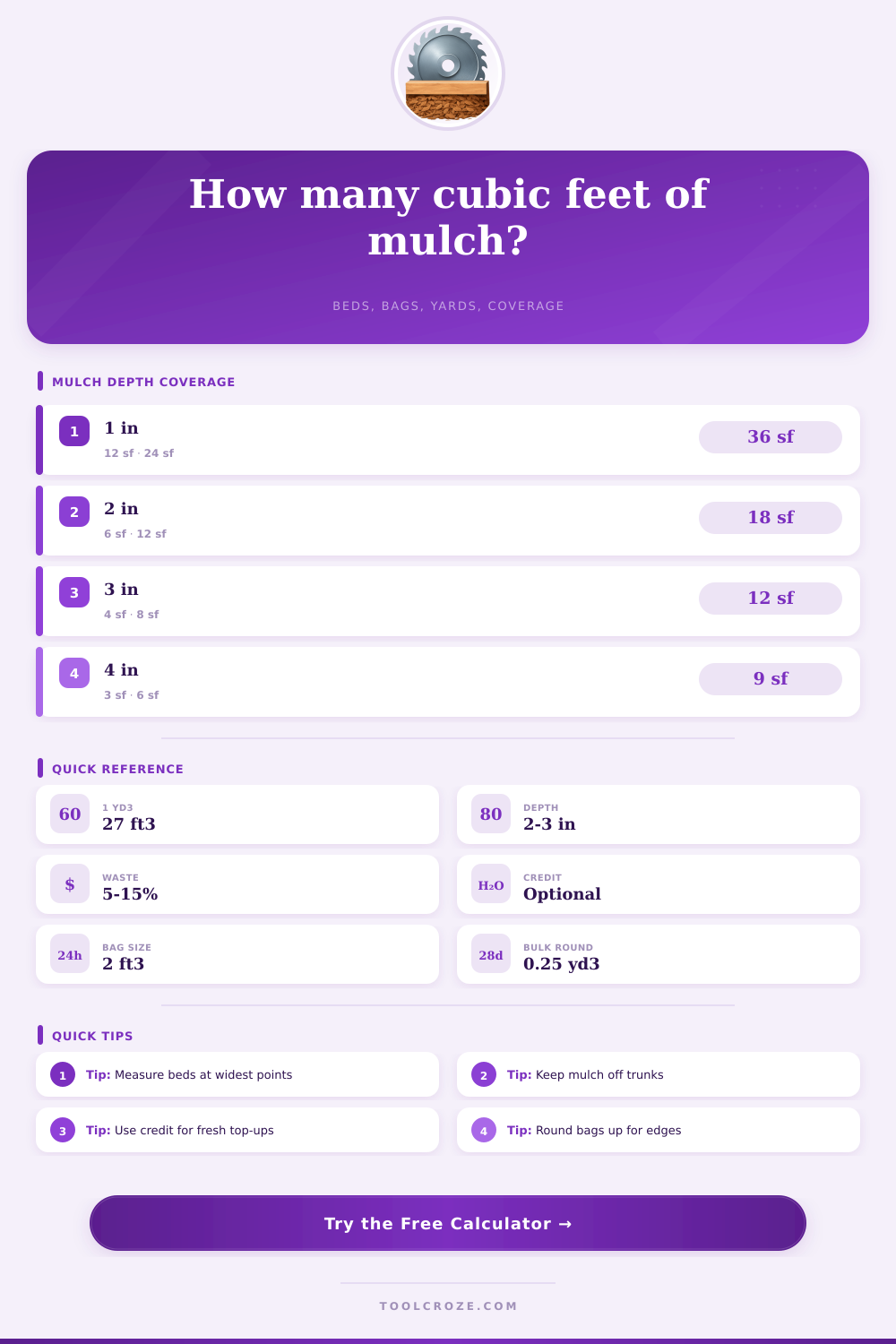
| Depth | 1 cu ft covers | 2 cu ft bag covers | 3 cu ft bag covers | Best use |
|---|---|---|---|---|
| 1 inch | 12 sq ft | 24 sq ft | 36 sq ft | Color refresh |
| 2 inches | 6 sq ft | 12 sq ft | 18 sq ft | Annual top-up |
| 3 inches | 4 sq ft | 8 sq ft | 12 sq ft | New planting bed |
| 4 inches | 3 sq ft | 6 sq ft | 9 sq ft | Weed suppression |
| Mulch preset | Typical depth | Settling allowance | Coverage behavior | Common placement |
|---|---|---|---|---|
| Shredded hardwood | 2 to 3 in | 8% | Interlocks well | Shrub beds |
| Bark nuggets | 3 to 4 in | 5% | Chunky, airy | Large beds |
| Cedar mulch | 2 to 3 in | 7% | Light texture | Foundation beds |
| Pine straw | 3 to 4 in | 12% | Settles quickly | Acid-loving beds |
| Playground chips | 4 to 6 in | 10% | Needs depth | Play zones |
| Project type | Typical shape | Typical size | Suggested depth | Measuring note |
|---|---|---|---|---|
| Foundation bed | Rectangle | 24 x 5 ft | 3 in | Average width at curves |
| Tree ring | Circle | 6 ft diameter | 2 in | Keep ring off trunk |
| Island bed | Oval | 18 x 10 ft | 3 in | Use longest axes |
| Walkway border | Rectangle | 36 x 2.5 ft | 2.5 in | Measure both sides |
| Tapered slope bed | Trapezoid | 30 ft long | 3 in | Use top and bottom widths |
| Volume unit | Cubic feet | At 2 in depth | At 3 in depth | Rounding advice |
|---|---|---|---|---|
| 1 cu ft bag | 1 | 6 sq ft | 4 sq ft | Round up by bag |
| 2 cu ft bag | 2 | 12 sq ft | 8 sq ft | Common bag size |
| 3 cu ft bag | 3 | 18 sq ft | 12 sq ft | Heavier to carry |
| 1 cubic yard | 27 | 162 sq ft | 108 sq ft | Bulk conversion |
| 2 cubic yards | 54 | 324 sq ft | 216 sq ft | Small delivery |
Mulch is like money: Most of us think it’s something we can get all the time. A couple of bag here or there should patch any hole in our landscapes, right? Nope. That mindset typically results in one of two situations: Not enough mulch, and a frustrating weekend spent returning to garden center, or way more than needed, leaving a pile of bark on your driveway.
Knowing the difference between volume and length can make the difference between a messy lawn and a tidy space. But here’s the problem: You’re thinking in flat dimensions. For example, you might think, “I have a 20-foot-long by 5-foot-wide garden bed, so I have a hundred square feet.”
How to Estimate Mulch Needed
But you are buying in three-dimensional blocks, like soil or mulch. And if you factor in depth, things gets wonky pretty quickly. For example, you only need half as much material to make a four-inch deep layer as you would for a two-inch deep layer in the same space. People guess at this part and that’s where budget starts to bleed out.
Plugging in the details. Your bed shape, and your desired depth, into the calculator above does the math for you; it saves you from having to convert cubic feet in your head while shopping in aisle four.
Yes, it’s true: shape do matter. When calculating the mulch needed around a tree, a basic rectangle calculation is going to overestimate what’s really required. After all, part of what it calculates (the area right next to the tree trunk), shouldn’t be filled with bark at all. A tree has a rounded or oval perimeter; using its actual shape (i.e., the ring) ensures you aren’t paying for volume that goes into the gutter. And yes, this tool figures out these geometric variations for you and converts your squiggly, higgledy-piggledy world borders into something that can be understood as a number, not just an educated guess.
Another thing that can trip you up is existing mulch. If you already have two inches of matted-down old bark, you do not want another three on top of that. You simply want to freshen the surface. Take away what you’ve got and you’ll see that you only has this tiny amount to add. The credit system avoids the all-too-common error of smothering plant crowns beneath excess mulch, which suffocates roots (they need air). A little shift in numbers, a big change for plants health.
The second decision is whether to buy bulk or bags. Bulk mulch are sold in cubic yards (a yard contains 27 cubic feet); a single bag is typically just two cubic feet. That’s not so bad, until you realize you might need forty bags for a medium-sized bed. You will have hurtin’ hands and back lugging that many bags, and they also cost more individually packaged than if ordered in bulk. To order by the yard are far less expensive per unit volume…but you’d better have room for a truckload when it arrives.
The page includes reference tables to help you see the tradeoff; how many bags equal one yard at different depths and how much area they will cover.
Waste and settling are the quiet assassins of an estimate. When you wet & spread mulch, it settles and becomes compressed. That fluffy pile appear nice at first but will shrink as time goes on. The waste buffer accounts for uneven application, spills during transport, and natural compaction. If you don’t add some waste cushion, you’ll run out and leave the last corner patchy. It would of been better to have leftover bags than to have to go back in the rain.
The amount of material required is also influenced by type. Pine straw settles different than dense hardwood nuggets or shredded cedar. Heavier materials will holds in place better on slopes; lighter ones may require a bit more for equivalent visual coverage. Knowing that will help you determine if you prefer something that looks good now. Or will still look decent come next spring.
So it’s all about controlling things in the end, whether with mulch or not: creating a weed barrier, keeping water off your roots, and making sure your garden-bed edges knit together as one. The right amount of mulch is also economical because you won’t need as many trip to the nursery. It also shows respect for what’s growing beneath that layer of bark. And if you do the math first and measure twice, you’ll not only save yourself money…but spare your greenery as well.
It is a clean-looking landscape where no one gets left high and dry halfway home.