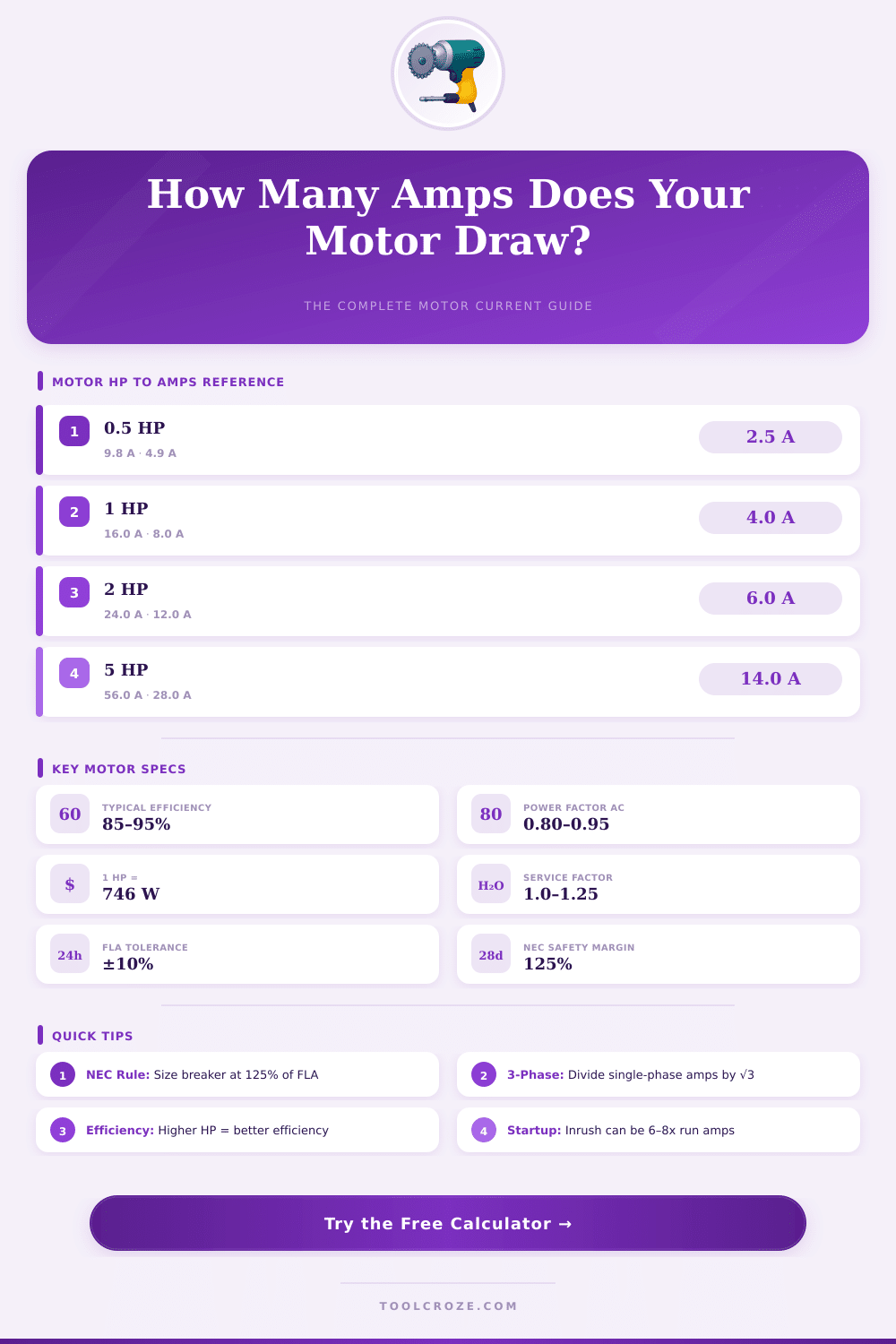
⚡ Motor HP to Amps Calculator
Convert horsepower to amperage for AC single-phase, AC three-phase & DC motors with efficiency and power factor
| HP Rating | kW Equiv. | @ 120V | @ 240V | @ 277V | Breaker Size (240V) |
|---|---|---|---|---|---|
| 0.25 HP | 0.19 kW | 2.0 A | 1.0 A | 0.87 A | 15 A |
| 0.33 HP | 0.25 kW | 2.7 A | 1.4 A | 1.2 A | 15 A |
| 0.5 HP | 0.37 kW | 4.1 A | 2.1 A | 1.8 A | 15 A |
| 0.75 HP | 0.56 kW | 6.1 A | 3.1 A | 2.7 A | 15 A |
| 1 HP | 0.75 kW | 8.1 A | 4.1 A | 3.5 A | 15 A |
| 1.5 HP | 1.12 kW | 12.2 A | 6.1 A | 5.3 A | 15 A |
| 2 HP | 1.49 kW | 16.2 A | 8.1 A | 7.0 A | 15 A |
| 3 HP | 2.24 kW | 24.3 A | 12.2 A | 10.5 A | 20 A |
| 5 HP | 3.73 kW | 40.6 A | 20.3 A | 17.6 A | 30 A |
| 7.5 HP | 5.59 kW | 60.8 A | 30.4 A | 26.4 A | 40 A |
| HP Rating | kW Equiv. | @ 208V 3∅ | @ 240V 3∅ | @ 480V 3∅ | @ 600V 3∅ |
|---|---|---|---|---|---|
| 1 HP | 0.75 kW | 2.7 A | 2.3 A | 1.2 A | 0.9 A |
| 2 HP | 1.49 kW | 5.3 A | 4.6 A | 2.3 A | 1.8 A |
| 5 HP | 3.73 kW | 13.4 A | 11.6 A | 5.8 A | 4.6 A |
| 10 HP | 7.46 kW | 26.7 A | 23.1 A | 11.6 A | 9.2 A |
| 15 HP | 11.19 kW | 40.1 A | 34.7 A | 17.3 A | 13.9 A |
| 20 HP | 14.92 kW | 53.4 A | 46.3 A | 23.1 A | 18.5 A |
| 25 HP | 18.65 kW | 66.8 A | 57.9 A | 28.9 A | 23.2 A |
| 50 HP | 37.30 kW | 133.5 A | 115.7 A | 57.9 A | 46.3 A |
| Motor Type | HP Range | Typical Efficiency | Power Factor | Application |
|---|---|---|---|---|
| AC Induction (1-Ph) | 0.25 – 10 HP | 75 – 88% | 0.80 – 0.92 | Appliances, tools |
| AC Induction (3-Ph) | 1 – 500 HP | 85 – 96% | 0.82 – 0.92 | Industrial machinery |
| NEMA Premium (3-Ph) | 1 – 500 HP | 89 – 96% | 0.84 – 0.93 | Energy-efficient use |
| DC Shunt Motor | 0.5 – 50 HP | 82 – 90% | 1.0 (N/A) | Variable speed drives |
| DC Series Motor | 0.1 – 25 HP | 78 – 86% | 1.0 (N/A) | High-torque start |
| Permanent Magnet DC | 0.1 – 5 HP | 80 – 90% | 1.0 (N/A) | Treadmills, tools |
| Synchronous (3-Ph) | 10 – 1000 HP | 90 – 97% | 0.85 – 1.0 | PF correction, pumps |
| Universal Motor | 0.1 – 2 HP | 60 – 80% | 0.95 – 1.0 | Hand tools, vacuums |
| AWG Size | Max Amps (60°C) | Max Amps (75°C) | Max Amps (90°C) | Typical HP @ 240V |
|---|---|---|---|---|
| 14 AWG | 15 A | 20 A | 25 A | Up to 1.5 HP |
| 12 AWG | 20 A | 25 A | 30 A | Up to 2 HP |
| 10 AWG | 30 A | 35 A | 40 A | Up to 3 HP |
| 8 AWG | 40 A | 50 A | 55 A | Up to 5 HP |
| 6 AWG | 55 A | 65 A | 75 A | Up to 7.5 HP |
| 4 AWG | 70 A | 85 A | 95 A | Up to 10 HP |
| 2 AWG | 95 A | 115 A | 130 A | Up to 15 HP |
| 1/0 AWG | 125 A | 150 A | 170 A | Up to 20 HP |
Understanding the tie between horsepower of a motor and amps helps a lot, especially when one works with electrical motors. One horsepower matches to 746 watts or 0.746 kW. That value one commonly uses to estimate how many amps the motor truly uses.
To estimate horsepowers in ideal conditions, one multiplies the amps by the voltage and divides the result by 746. Like this 15 amps at 120 volts would give around 2.41 horsepowers. In practice even so, losses because of poor efficiency play a role.
How Horsepower and Amps Are Related
The actual values differ according to kinds of motors and setups. Because a motor is not simply a resistive load, the product of voltage and amps does not always match to watts. Part of the electrical watts are lost as haet and never arrive to mechanical work.
Here some rough ratings for the use of amps. Single-phase motor at 115 volts uses around 14 amps each horsepower. Single-phase motor at 230 volts requires around 7 amps each horsepower.
Three-phase motor at 230 volts draws about 2.5 amps each horsepower. And three-phase motor at 460 volts uses around 1.25 amps each horsepower. They count only as guesses.
At 120 volts, a motor uses around 10 amps each horsepower. At 240 volts, it requires around 5 amps each horsepower. Some motors work better, others worse, but those figures give a good idea.
For single-phase motors, if you know the amp use at one horsepower, you can add about 5 amps for every extra horsepower to estimate the total.
Horsepower helps to describe the power of mechanical work. Amps point to the flow at full load or the estimated input flows. Efficiency measures entering watts against exiting horsepowers.
Amps alone have only a little to do with efficiency. A motor with a service factor can sometimes be overloaded, but overload during long time lowers the efficiency of the motor. If the service factor goes past 1, the amps at full load should grow in proportion.
For instance, at service factor 1.15, one must raise the values of amps buy 15 percent.
Motors with low power factor use many amps, while they produce only little horsepower. That is well known. Also, the flow during starting is much higher than the working amps.
A motor of 2.5 horsepowers at 120 volts then uses around 32 to 35 amps at full load. Running it at 70 to 80 percent is more usual for best efficiency and long life of the motor.
Ratings of horsepowers for motors in consumer devices sometimes are exaggerated. There were even court hearings against makers of small cheap compressors, that made silly claims about horsepowers in products for home. The listed amps on thenameplate give a much more reliable measure to estimate the motor.
Always base on the actual values of amps to find the real power.